Key Takeaways
Teen Driver Crash Risk
Teen driver crash risk refers to the statistically elevated probability that drivers aged 16–19 will be involved in a motor vehicle crash compared to older, more experienced drivers. This elevated risk is documented across decades of federal safety research and stems from a combination of inexperience, neurological development, and behavioral factors. It is not simply a matter of bad driving — it reflects measurable gaps in hazard perception, decision-making speed, and risk calibration that improve with experience.
The NHTSA and IIHS measure crash risk using rates per mile driven, which controls for exposure — teen crash rates remain significantly elevated even after accounting for the fact that teens drive fewer total miles than adults.
The Numbers Behind the Risk
The statistics on teen driving aren't particularly subtle. According to the National Highway Traffic Safety Administration (NHTSA), drivers aged 16–19 are nearly three times more likely to be involved in a fatal crash per mile driven than drivers aged 20 and older. The Insurance Institute for Highway Safety (IIHS) reports that in 2022, motor vehicle crashes were the leading cause of death for teenagers in the United States, accounting for roughly a quarter of all teen fatalities.
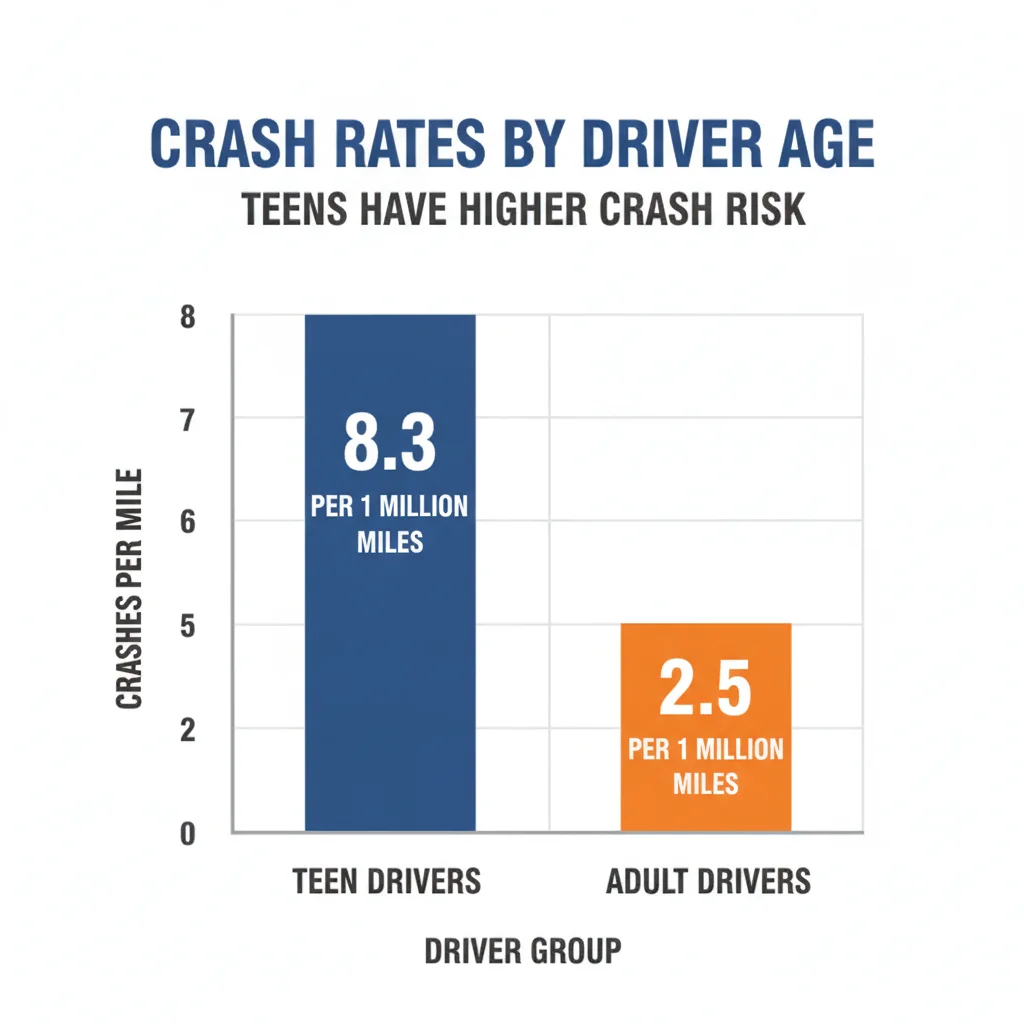
What makes these figures especially striking is that they're measured per mile driven — not total crashes. Because teens drive fewer miles than adults, raw crash totals don't capture the true picture. When you control for exposure, the disparity becomes stark. A 16-year-old behind the wheel for the same number of miles as a 40-year-old is dramatically more likely to crash.
3x
Teen crash rate vs. adults per mile driven
Per NHTSA data, drivers aged 16–19 are nearly three times more likely to be in a fatal crash per mile driven than drivers 20 and older.
~25%
Share of teen deaths caused by car crashes
IIHS data from 2022 shows motor vehicle crashes account for roughly a quarter of all teenage fatalities in the U.S.
50%
Teen fatal crashes occurring at night
According to IIHS, approximately half of all teen driver fatalities happen between 9 p.m. and 6 a.m.
2x+
Crash risk increase with two or more passengers
Research cited by IIHS shows teen crash risk more than doubles when two or more peer passengers are in the vehicle.
26%
Reduction in 16-year-old fatalities under GDL
IIHS estimates that comprehensive Graduated Driver Licensing laws reduced 16-year-old driver fatalities by approximately 26% after widespread adoption.
The risk isn't evenly distributed across the teen years, either. Sixteen-year-olds are at the greatest risk of any age group, and the first six months after licensure are considered the most dangerous driving window in a person's lifetime. As teens accumulate experience, their rates decline rapidly — but the gap with adult drivers persists well into the early 20s.
Understanding why these numbers look the way they do requires looking at the research on hazard perception, cognitive development, and behavioral patterns — not just writing it off as teen recklessness.
The Inexperience Factor: More Than Just Miles
A novice driver of any age is at elevated risk. Research consistently shows that the first 1,000 to 1,500 miles driven independently — regardless of age — carry significantly higher crash probability than subsequent miles. For teens, that novice window coincides with a period of incomplete neurological development, which compounds the problem.
Hazard perception is the clearest example. Experienced drivers scan intersections differently than new drivers — they've built mental models of likely conflict points, unusual vehicle behaviors, and pedestrian patterns. Teens lack these models. Eye-tracking studies cited in NHTSA research show that novice drivers spend more time looking directly ahead and less time checking mirrors, side roads, and peripheral zones where hazards actually emerge.
“Novice teen drivers are not simply experienced drivers who make more mistakes. They are fundamentally different in how they perceive and respond to hazards — and closing that gap requires structured experience, not just time.”
— Dr. Flaura Koplin Winston, Co-scientific director, Center for Injury Research and Prevention, Children's Hospital of Philadelphia
This matters practically. A teen driver approaching a four-way intersection may fixate on the traffic signal while missing a cyclist entering from the right or a pedestrian stepping off a curb. The experienced driver's brain has automated many of these scanning behaviors; the teen's hasn't. Our companion piece on intersection crash patterns covers how these perception failures play out across driver groups.
Extend Practice Beyond GDL Requirements
Most states require 30–50 hours of supervised driving before a teen can get a provisional license. Research supports doing more — and varying the conditions. Make sure your teen has practiced in rain, at night (supervised), on highways, and in unfamiliar areas before they drive those conditions independently. Exposure breadth matters as much as total hours.
Use Driving Agreements Before Handing Over Keys
A written driving agreement — covering phone use, passenger limits, curfew, and consequences — is associated with better teen driving outcomes in behavioral research. Setting expectations in writing before a teen gets licensed creates clarity and gives parents a framework for enforcement that doesn't feel arbitrary after the fact.
The neurological dimension adds another layer. The prefrontal cortex — the brain region responsible for impulse control, risk evaluation, and forward planning — continues developing until roughly age 25. This doesn't mean teens are incapable of good decisions, but it does mean their risk calibration is genuinely less reliable under novel or stressful conditions. Under time pressure, ambiguity, or distraction, teens are more likely than adults to make suboptimal choices.
Behavioral Risk Multipliers: Passengers, Night, and Phones
Beyond baseline inexperience, three behavioral factors consistently appear in crash research as independent multipliers of teen crash risk: peer passengers, nighttime driving, and distraction — particularly phone use.
Peer Passengers
Contrary to what many parents assume, the problem isn't that a passenger will grab the wheel. The issue is social dynamics and divided attention. Studies published in the Journal of Adolescent Health and cited by IIHS show that teen drivers with one peer passenger have a crash risk roughly 44% higher than when driving alone. With two or more passengers, risk more than doubles.
Researchers attribute this partly to distraction and partly to social pressure — teens are more likely to speed, make risky lane changes, or ignore hazards when peers are present. This is why liability exposure for families with teen drivers is substantially higher than many parents initially anticipate.

Nighttime Driving
IIHS data consistently shows that fatal crash rates for teenagers peak in the late evening and overnight hours. Roughly half of teen crash fatalities occur between 9 p.m. and 6 a.m. — a period that includes reduced visibility, higher likelihood of encountering impaired drivers, and increased driver fatigue. For a teen whose hazard perception is already limited, nighttime conditions strip away additional safety margin.
Phone Use and Distraction
Teens report higher rates of phone use while driving than any other age group, according to AAA Foundation for Traffic Safety surveys. Glancing at a phone for just two seconds at 55 mph means traveling more than 160 feet — roughly half a football field — without eyes on the road. For a driver who already processes hazards more slowly than an experienced adult, that gap is far more dangerous.
GDL Enforcement Varies Significantly by State
While all states have GDL programs, the specifics differ considerably. Some states require six months with a learner's permit; others require only three. Passenger and nighttime restrictions vary as well. Parents should look up their state's specific GDL requirements — and consider treating the legal minimums as a floor, not a target.
Telematics Programs Can Monitor Real Driving Behavior
Many major insurers offer telematics or usage-based insurance programs that track real driving behaviors — speed, braking, phone use, and nighttime mileage. For families with teen drivers, these programs serve a dual purpose: they can reduce premiums for safe driving, and they give parents visibility into actual behind-the-wheel behavior they wouldn't otherwise have.
What Graduated Driver Licensing Does — and Doesn't Do
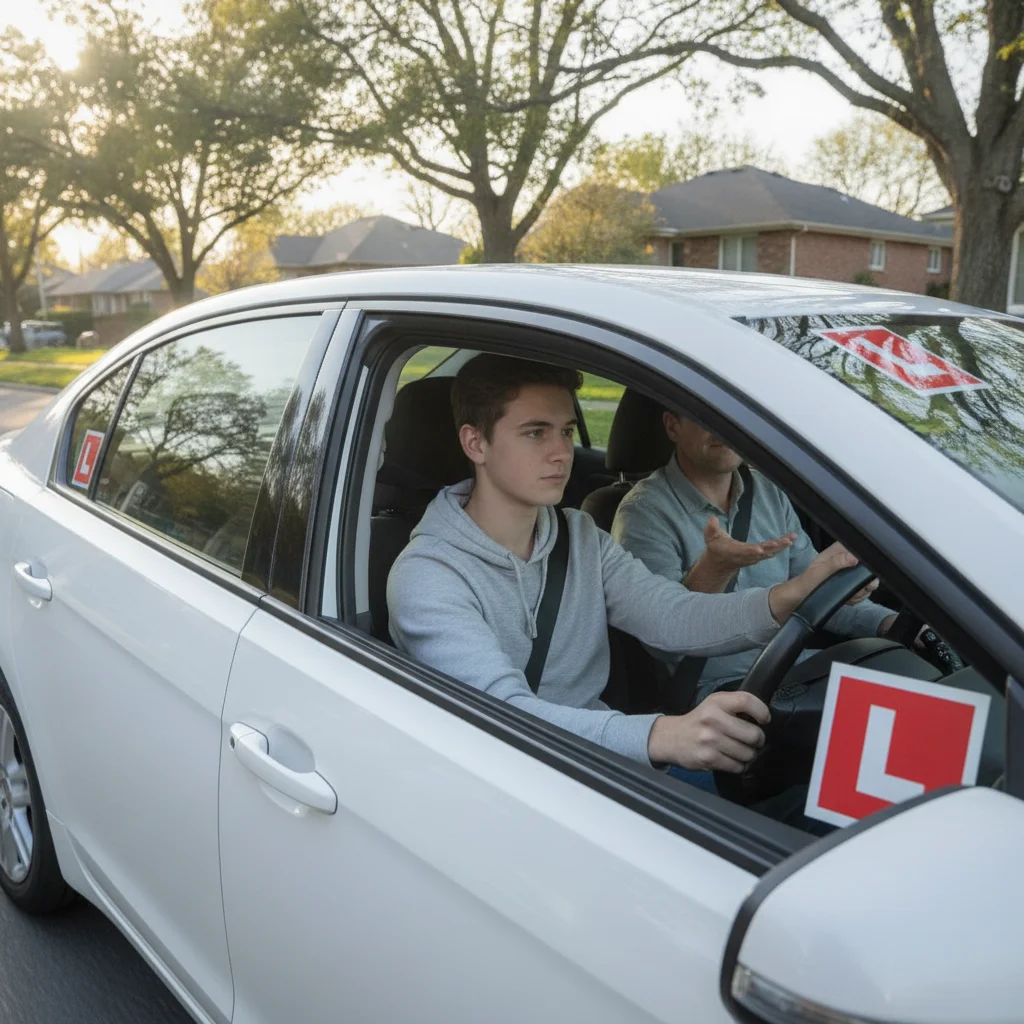
All 50 states and the District of Columbia have some form of Graduated Driver Licensing (GDL) program, but the strength of those programs varies considerably. The core idea behind GDL is to introduce driving privileges in stages, allowing teens to build experience under lower-risk conditions before gaining full licensure.
A typical three-stage GDL structure includes a supervised learner permit period, a provisional license with restrictions (nighttime driving limits, passenger caps), and full licensure after a set period of crash-free driving. The research on well-designed GDL programs is strongly positive. IIHS estimates that comprehensive GDL laws reduced 16-year-old driver fatalities by approximately 26% in the years following their implementation in the late 1990s and early 2000s.
But GDL isn't a complete solution. Enforcement is inconsistent. Many teens drive with passengers or after curfew during their provisional period without consequence. And GDL does nothing to address distraction from phones, which became ubiquitous after most GDL frameworks were designed. Researchers at the Children's Hospital of Philadelphia found that crashes still spike in the months immediately after full licensure, suggesting that the transition off GDL restrictions itself carries risk.
Parents who treat GDL restrictions as a bureaucratic hurdle rather than a genuine safety scaffold are missing the point. The restrictions exist because the data shows they reduce crashes — treating them as optional undermines their protective value.
Extend Practice Beyond GDL Requirements
Most states require 30–50 hours of supervised driving before a teen can get a provisional license. Research supports doing more — and varying the conditions. Make sure your teen has practiced in rain, at night (supervised), on highways, and in unfamiliar areas before they drive those conditions independently. Exposure breadth matters as much as total hours.
Use Driving Agreements Before Handing Over Keys
A written driving agreement — covering phone use, passenger limits, curfew, and consequences — is associated with better teen driving outcomes in behavioral research. Setting expectations in writing before a teen gets licensed creates clarity and gives parents a framework for enforcement that doesn't feel arbitrary after the fact.
How Crash Risk Translates to Insurance Costs
Insurance premiums for teen drivers aren't arbitrary — they're a direct expression of actuarial data. Insurers have decades of claims history showing that 16- and 17-year-old drivers generate significantly more frequent and more expensive claims than drivers in their 30s and 40s. That cost gets built into the premium.
Adding a 16-year-old to a household policy can raise premiums by 50% to over 100% depending on the insurer, coverage levels, and vehicle. How a teen driver affects your entire household rate — not just the teen's specific coverage line — is often a surprise to parents who assume the cost will be contained.
The good news is that a subset of discounts specifically targets teen drivers and can meaningfully offset costs. Good student discounts, telematics programs (which monitor actual driving behavior), and driver training discounts can reduce the premium hit for families with safe teens. Our guide on which discounts actually move the needle for young drivers evaluates the options in detail.
GDL Enforcement Varies Significantly by State
While all states have GDL programs, the specifics differ considerably. Some states require six months with a learner's permit; others require only three. Passenger and nighttime restrictions vary as well. Parents should look up their state's specific GDL requirements — and consider treating the legal minimums as a floor, not a target.
Telematics Programs Can Monitor Real Driving Behavior
Many major insurers offer telematics or usage-based insurance programs that track real driving behaviors — speed, braking, phone use, and nighttime mileage. For families with teen drivers, these programs serve a dual purpose: they can reduce premiums for safe driving, and they give parents visibility into actual behind-the-wheel behavior they wouldn't otherwise have.
Understanding the rate factors that shape premiums more broadly can help families make more informed decisions about where to absorb cost and where to maintain coverage depth.
What Parents Can Actually Control
The research literature on teen crash prevention converges on a handful of parent-driven interventions that demonstrably work. These go beyond reminding a teen to "be careful" and focus on structured exposure and enforced limits.
Supervised Practice Hours — and Quality
Most GDL programs require 30–50 hours of supervised driving. Research suggests that more hours are better, but the diversity of those hours matters as much as the count. Teens who practice only in familiar neighborhoods in good weather have less developed hazard perception than those who practice in rain, at night, on highways, and in high-density traffic — under supervision where errors carry no real consequence.
Enforced Restrictions Beyond GDL Minimums
Parents who enforce nighttime and passenger restrictions beyond the GDL minimum — and who communicate those restrictions clearly before licensure — have teens with lower crash rates in the post-licensure period. Driving agreements, which spell out expectations and consequences, are associated with better outcomes in behavioral research.

Modeling and Communication
Teens whose parents regularly use phones while driving, speed, or express road aggression are more likely to do the same. The research on driving behavior modeling is consistent: teens absorb habits from the adults who taught them to drive. Parents who want safe teen drivers need to examine their own habits with the same scrutiny they apply to their kids.
The crash statistics for teen drivers are sobering — but they're not fate. Every factor that drives them is identifiable, measurable, and to some degree addressable. The families who treat those statistics as a roadmap rather than a headline tend to produce better outcomes.

All claims are backed by peer-reviewed research. Sources on request.