
Key Takeaways
Why Young Drivers Start at a Disadvantage — and What You Can Do About It
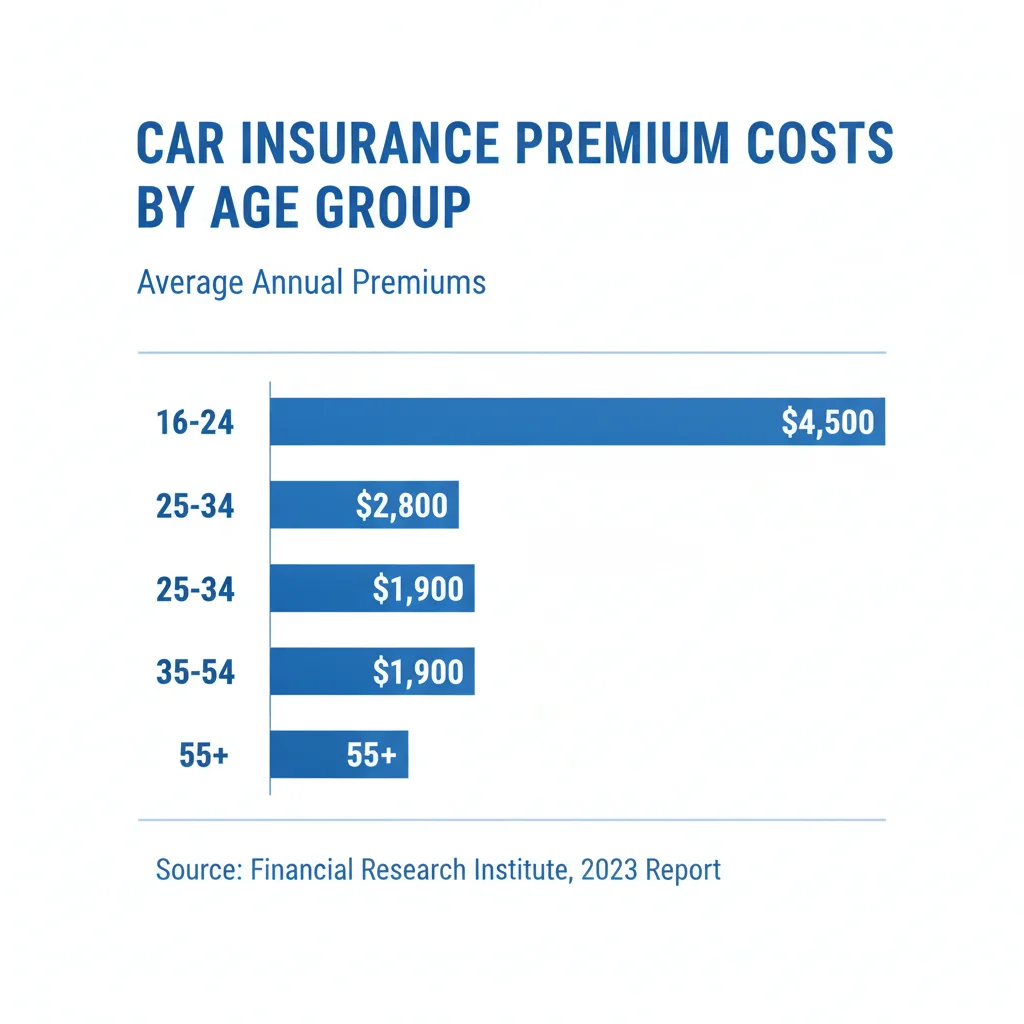
If you're under 25 and you've priced out your own car insurance policy, the sticker shock is real. According to industry data, drivers aged 16–24 pay more per year than any other age group — often 50% to 150% more than a 35-year-old with an identical driving record. Insurers aren't being arbitrary. Young drivers statistically have higher crash rates, shorter reaction histories, and less documented experience behind the wheel. The risk is real, and carriers price accordingly.
But here's what a lot of young drivers don't realize: the insurance industry has also built an entire architecture of discounts specifically aimed at this demographic, precisely because insurers want to retain customers who will — if treated right — become decades-long policyholders. The catch is that most of these discounts are not automatically applied. You have to know what exists and ask for it.
This isn't about gaming the system. It's about understanding how insurers actually calculate your premium and then making sure every legitimate credit you qualify for is actually reflected in your rate. The discounts below are real, widely available, and in several cases can move the needle by hundreds of dollars per year. Here's how to approach each one strategically.
Discount Availability Varies by State
Not every discount listed in this article is available in every state. State insurance regulators approve which discount programs insurers can offer, and some states restrict or require specific credits. California, for example, prohibits the use of education and occupation as rating factors. Always verify with your insurer which discounts are available under your state's regulations.
The Age Surcharge Phases Out Gradually
Most insurers begin meaningfully reducing age-based surcharges as drivers move through their mid-20s, with premiums typically stabilizing around ages 25–26 for drivers with clean records. Building a claim-free history now directly shapes what your base rate looks like at that transition point. See our <a href="/car-insurance/rates-and-savings/rate-factors/why-two-drivers-with-clean-records-pay-completely-different-premiums">breakdown of what insurers weigh beyond driving history</a> to understand all the factors in play.
Discounts That Actually Make a Measurable Difference for Young Drivers
The list below is ordered roughly by financial impact — though your actual savings will depend on your insurer, your state, and your specific situation. Some of these discounts stack on top of each other; others are mutually exclusive. Work through each one to identify which apply to you, and then have a direct conversation with your agent or insurer's customer service line to confirm they're on your policy. See our guide to asking the right questions for exactly how to approach that conversation.
Stay on a parent's policy as long as legally possible
This is the single biggest lever most young drivers have access to, and it's not even close. Adding a young driver to an existing household policy is dramatically cheaper than buying a standalone policy for the same person. The reason is simple: insurers spread risk across the entire household, and the parents' clean driving history buffers the young driver's actuarial profile.
In practical terms, adding a 19-year-old to a parent's policy might add $800–$1,500 per year to the household premium. Buying a separate policy for that same driver could easily cost $2,500–$4,000 per year on its own. That differential — sometimes over $1,500 annually — is the largest single discount available to young drivers, even though it's not formally listed as a "discount" anywhere.
The rules vary by state and insurer, but generally you can remain on a parent's policy if you share the same household address. Some insurers extend this to full-time college students even if they live away from home, as long as the family home remains their primary residence. If you're a college student with a car on campus, ask your parents' insurer explicitly whether you still qualify — many do, and the savings are substantial.
One thing to flag: once you move out permanently and establish your own address, most insurers will require you to get your own policy. Plan for that transition cost well in advance. See the key rate factors that will shape your first standalone premium so you're not caught off guard.
Adding a young driver to a parent's policy can save over $1,500 annually compared to a standalone policy.
Enroll in a telematics or usage-based program
Telematics programs — where your insurer monitors your actual driving behavior via a smartphone app or plug-in device — are arguably the most powerful discount available specifically to young drivers who drive carefully. Programs like Progressive Snapshot, State Farm Drive Safe & Save, and Allstate Drivewise track metrics such as hard braking, acceleration, cornering, speed, and nighttime driving. Drive well during the monitoring period and you can earn meaningful discounts — often 10–30% — based on demonstrated behavior rather than actuarial age assumptions.
This matters especially for young drivers because traditional rating factors are brutal for anyone under 25 regardless of how safely they actually drive. Telematics gives you a way to prove your actual risk level rather than being penalized for your demographic. If you genuinely are a cautious, low-mileage driver, these programs can meaningfully offset the age surcharge baked into your base rate.
[in_content_images:1]The flip side is real: if the program reveals risky behavior — frequent hard braking, late-night driving, high speeds — it can actually increase your premium at some carriers. Read the program terms carefully before enrolling. At most major insurers, however, the enrollment itself earns an upfront discount of 5–10% regardless of your score, so there's usually a floor benefit just for participating.
For a deeper look at how these programs actually work across major carriers, see our safe driver program comparison.
Telematics lets cautious young drivers prove their actual risk level rather than paying for their demographic.
Claim the good student discount if your GPA qualifies
Most major insurers offer a good student discount for full-time students — typically in high school or college — who maintain a minimum GPA, usually 3.0 or a B average. The logic insurers use: academic performance correlates with responsibility and attention to detail, traits that also predict safer driving behavior. Whether you agree with that theory or not, the discount is real and widely available.
The financial impact is meaningful: good student discounts typically range from 8–25% depending on the carrier, and they apply until the student turns 25 or graduates, whichever comes first. At some insurers, a student in the top 20% of their class or on the Dean's List may qualify for an enhanced credit.
To claim it, you'll usually need to submit a current transcript or a signed statement from a school official confirming your GPA. Some insurers ask for verification annually. It's a low-friction process for a discount that could easily save $200–$500 per year on a typical young driver's premium.
If you're a student who doesn't have a car at school and only drives occasionally when home, also ask about the student away at school discount — a separate credit available at many carriers for students who live more than a certain distance from home (often 100 miles) without a car. That one can be even larger because it reflects reduced exposure.
Good student discounts of 8–25% are widely available and require nothing more than a transcript submission.
Complete an approved defensive driving course
An approved defensive driving or driver's education course earns you a rate reduction at most major carriers — and for young drivers, the discount is often larger than for older drivers because the baseline risk is higher. Many states mandate that insurers offer this credit, and the reduction is typically 5–15% on applicable coverages, applied for a defined period (often 3 years).
The key word is "approved." Not every online course or YouTube tutorial qualifies. Each state has a list of approved programs, and insurers may have additional requirements. Look for courses approved by your state's DMV or department of insurance. Organizations like the National Safety Council and AAA offer programs that are widely accepted. Some insurers have direct partnerships with specific programs and will point you toward qualifying options if you ask.
The total cost of a qualifying course typically runs $25–$75. If it earns you even a 5% discount on a $2,500 annual premium, that's $125 in year one alone — a strong return on a few hours of coursework. The discount usually applies automatically upon submitting your completion certificate to the insurer.
Our defensive driving course guide covers what to look for in a qualifying program and which carriers tend to offer the most generous credits.
A $50 approved defensive driving course can return $100+ per year in premium savings for three years running.
Drive a vehicle with strong safety ratings and driver-assist tech
The car you drive affects your premium in multiple ways, but one that young drivers often overlook is the safety technology discount. Vehicles equipped with advanced driver-assistance systems (ADAS) — including automatic emergency braking, lane departure warning, forward collision warning, and blind-spot monitoring — qualify for safety feature credits at many insurers.
These discounts vary by carrier and by how the vehicle is rated by IIHS (Insurance Institute for Highway Safety) or NHTSA. A vehicle with a Top Safety Pick+ designation and multiple ADAS features might qualify for 5–15% in combined safety discounts, depending on the insurer. For a young driver already paying a steep age surcharge, choosing a vehicle with strong safety credentials serves double duty: it lowers the probability of a claim, and it actively earns a lower rate.
[in_content_images:2]One practical note: sometimes newer vehicles with more safety tech have higher comprehensive and collision premiums because replacement parts are expensive. The net effect on your total premium depends on the coverage types you're carrying and the specific vehicle. Our article on how vehicle age and safety ratings shape discount eligibility walks through this tradeoff in detail. Also see how ADAS features unlock discounts for insurer-specific details.
A vehicle with ADAS features can earn 5–15% in safety discounts — and reduce the likelihood of a claim in the first place.
Pay your premium in full upfront
Monthly installment billing is convenient but expensive. Most insurers charge installment fees ranging from $3 to $15 per payment, which adds up to $36–$180 per year on a semi-annual or annual policy. Beyond the per-payment fee, many carriers offer an explicit "paid-in-full" discount of 5–10% when you pay your entire six-month or annual premium upfront rather than in installments.
For a young driver paying $2,000+ per year, paying in full could save $100–$200 or more between the eliminated fees and the pay-in-full discount. If cash flow is the constraint, consider this: put the semi-annual premium in a savings account six months in advance. The discipline of saving toward a lump premium payment also tends to prompt young drivers to shop and compare rates more actively at renewal — another money-saving behavior.
Pairing this with a paperless billing and auto-pay setup can stack additional small credits. Most carriers offer $5–$15 off just for going paperless, and auto-pay enrollment sometimes carries its own credit. These feel trivial individually, but they stack without any real effort. See our breakdown of paperless and auto-pay savings to understand what's realistic at major carriers.
Paying your premium upfront instead of monthly can save $100–$200 a year through eliminated fees and pay-in-full discounts.
Bundle your renters or other insurance with your auto policy
If you're a young driver who has moved into your own apartment, you likely need renters insurance — and bundling it with your auto policy typically earns a multi-policy discount of 5–15% on your auto premium. Even if your landlord doesn't require renters insurance, it's a sensible protection that costs $15–$30 per month on its own and can shave a meaningful chunk off your car insurance at the same time.
The bundling discount is one of the most consistently available credits across carriers, and unlike some discounts that require ongoing proof (like a good student credit), it typically stays in place as long as both policies are active. When you eventually add a homeowners policy down the road, the same logic applies — bundling tends to produce the most straightforward, lowest-friction discounts in the industry.
One important caveat: bundling doesn't always produce the best total price. Some carriers offer generous auto rates but mediocre renters rates, or vice versa. Always price the bundled total against buying each policy separately from different carriers before assuming the bundle is the better deal. The discount percentage sounds good, but it only matters if the base rates are competitive in the first place.
Bundling renters and auto insurance earns a 5–15% multi-policy discount with almost zero additional effort.
Ask about occupational and alumni discounts you may already qualify for
This is the discount category most young drivers have never thought about — and it can be surprisingly generous at certain carriers. Many insurers offer rate reductions for membership in specific organizations, alumni associations, professional groups, or even certain employers. If you work for a large company, your employer may have a group insurance arrangement with a preferred carrier that includes a rate credit for employees.
Similarly, if you're a college student or recent graduate, your alumni association may have a group auto insurance deal you're not aware of. These aren't always prominently advertised — they're often buried in the "member benefits" section of alumni portals or employee handbooks. Major carriers including Liberty Mutual, Farmers, and MetLife have long-standing group relationships with educational institutions, professional associations, and employers.
The discount amounts vary widely — from a token 3% to a more substantial 10–15% at carriers with deep group relationships. It takes about five minutes to check whether your employer, school, or any organization you're part of has a qualifying arrangement. For a broader look at this discount category, see membership and professional discounts.
Alumni and employer group discounts can reach 15% — and most young drivers have never thought to check.
Document Your Discounts at Each Renewal
Every time your policy renews, request an itemized list of all discounts currently applied to your account. Circumstances change — your GPA might have improved, you may have completed a defensive driving course, or your insurer may have added a new program you now qualify for. Spending 10 minutes on this at each renewal is the easiest way to make sure no savings slip through the cracks.
Shopping Around Matters More Than You Think
Discount structures vary significantly between insurers, and a carrier that's expensive for one young driver profile may be competitive for another. Get quotes from at least three carriers before your next renewal and compare the fully discounted price, not just the base rate. <a href="/car-insurance/rates-and-savings/discounts-and-deals/loyalty-discounts-vs-switching-bonuses-which-saves-you-more">Switching bonuses</a> at some carriers can also offset any loyalty benefit you'd lose by leaving.
Putting It All Together: How to Stack These Discounts
The real power here isn't any single discount — it's the combination. A young driver who stays on a parent's policy, maintains a B average, enrolls in a telematics program, pays in full, and goes paperless might realistically shave 25–40% off what the base rate would otherwise be. That's not hypothetical; that's the practical math of stacking legitimate credits.
The most important step is to not assume your insurer is already applying everything you qualify for. Insurers have no legal obligation to volunteer every discount you're eligible for. Common myths about insurance savings lead many drivers to assume their rate is already optimized when it isn't. Run through this list, document what applies to you, and ask explicitly.
Also worth doing: shop at least two or three competing insurers before your next renewal. Discount structures vary significantly between carriers, and a company that offers a generous telematics program may be stingier on good student credits. The only way to know is to compare. For a broader look at everything you might qualify for beyond what's covered here, see our complete auto insurance discount guide.


All claims are backed by peer-reviewed research. Sources on request.