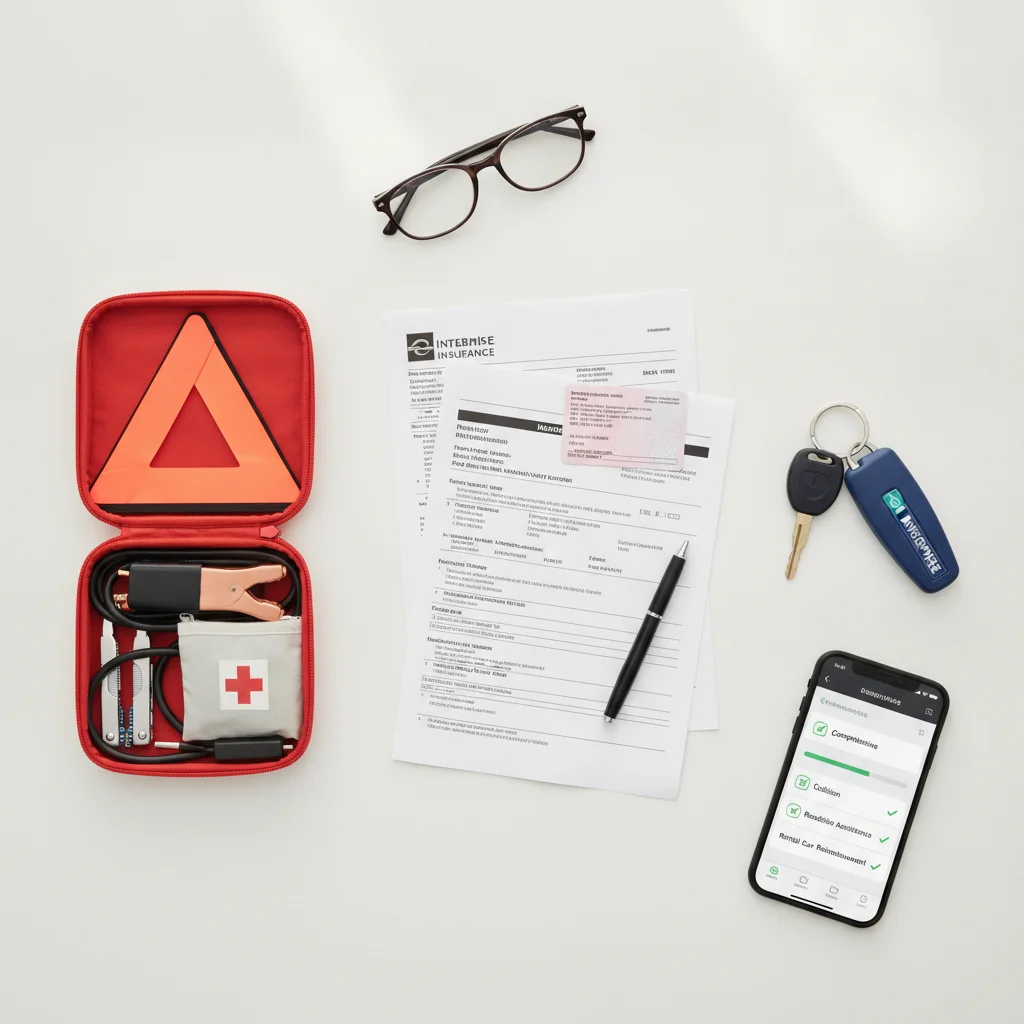
Key Takeaways
Why Optional Coverages Hit Differently With a Teen on Your Policy
The moment you add a teen driver to your household policy, your insurer reprices risk across the entire account. Adding a 16-year-old can double certain coverage costs, and that's before you've touched your optional add-ons. What most parents don't realize is that this repricing also changes the math on which optional coverages are worth carrying.
With an experienced adult driver, skipping accident forgiveness or roadside assistance might be a reasonable bet. With a 17-year-old behind the wheel three days a week, that calculus shifts dramatically. Inexperienced drivers are involved in crashes at nearly three times the rate of drivers aged 20 and older, according to federal traffic safety data. That statistical reality is exactly why some optional coverages that were borderline before become clear priorities now.
The goal of this article isn't to scare you into buying every add-on your insurer pitches. It's to give you a clear-eyed look at which optional coverages deliver real protection for households with teen or new drivers — and which ones are mostly margin-builders for the insurer. The full landscape of optional add-ons is broad; this guide narrows it to what actually matters when inexperience is your primary risk factor.
The Add-Ons Worth Considering for Teen and New Drivers
Accident Forgiveness
This is the add-on I'd push hardest for households with new drivers. Here's why: a single at-fault accident — even a minor one — can trigger a rate increase of 20% to 40% that persists for three to five years. For a policy that's already elevated because of a teen driver, that compounding effect is brutal.
Accident forgiveness prevents your first at-fault claim from increasing your premium. The specifics vary by insurer — some offer it as a paid add-on, others as an earned perk after years of clean driving, and a few restrict it to one per household regardless of driver. Before you buy it, confirm that it applies to all listed drivers, including your teen, not just the primary policyholder.
The cost is typically modest — often $50 to $100 per year — but the protection against rate escalation after a teen-caused incident can be worth hundreds annually over a multi-year period. Do the math: if your current six-month premium is $1,800 and a claim would bump it by 30% for three years, you're looking at $1,620 in additional premiums over that window. Accident forgiveness at $75 a year pays for itself roughly ten times over in that scenario.
One teen-caused at-fault claim can raise your premium by 30% for three to five years — accident forgiveness stops that cascade.
Uninsured and Underinsured Motorist Coverage (UM/UIM)
Many parents focus exclusively on protecting against their teen causing an accident. What they underestimate is the exposure from other drivers hitting their teen. Liability coverage explains what happens when your teen is at fault, but UM/UIM coverage handles the opposite scenario — when someone else hits your teen and either has no insurance or not enough to cover the damages.
Roughly one in eight U.S. drivers is uninsured, and that number skews higher in certain states. Teens, who often drive during high-risk hours and in areas with dense traffic, face meaningful exposure here. If an uninsured driver rear-ends your teen and your teen sustains injuries, your own UM/UIM coverage is what pays for their medical bills, lost wages, and pain-and-suffering damages when the other driver can't.
UM/UIM is required in some states and optional in others. Even where it's optional, I'd treat it as essential when a teen is on the policy. Stack your UM/UIM limits to match your liability limits — this ensures symmetrical protection on both sides of a collision scenario.
One in eight drivers on the road has no insurance — UM/UIM coverage is your teen's financial safety net when they can't control who hits them.
New Car Replacement or Gap Coverage
Gap coverage is highly specific in when it matters — but when it does, it matters enormously. If your teen is assigned to a vehicle that's financed or leased and less than three to four years old, gap coverage is worth serious consideration. Here's the mechanic: vehicles depreciate faster than most loan balances shrink, particularly in the first two years. If the car is totaled, your insurer pays actual cash value (ACV) — not what you owe. Gap coverage bridges the difference.
New car replacement goes a step further: instead of paying ACV, it pays to replace the vehicle with a comparable new model. This is typically available only for vehicles in their first year or two and costs more than standard gap coverage, but for a brand-new vehicle assigned to a teen driver, the exposure is real.
The math is straightforward. If your teen is driving a three-year-old financed vehicle worth $18,000 with $22,000 remaining on the loan and it's totaled, your insurer pays $18,000. You still owe $4,000. Gap coverage eliminates that shortfall. For households where the teen's vehicle is older or fully paid off, skip it — the depreciation gap doesn't exist anymore.
If your teen's vehicle is totaled while still financed, gap coverage eliminates the shortfall between what you owe and what insurance pays.
Roadside Assistance
This one is less about catastrophic financial loss and more about practical reality: teen drivers are more likely to lock their keys in the car, run out of gas, or get a flat tire and not know what to do. Many new drivers haven't yet built the situational awareness or mechanical know-how to handle minor roadside emergencies independently.
Adding roadside assistance through your auto insurer is typically cheap — $5 to $15 per month — and covers towing, lockout service, flat tire changes, fuel delivery, and jump-starts. Some insurers limit the number of claims per year, so check the fine print before assuming unlimited use.
One caveat: if you already have roadside assistance through a credit card, a vehicle warranty, or a membership like AAA, you may be doubling up. Audit what you already carry before adding it to your policy. For families that don't have an existing roadside plan, however, adding it when a teen joins the policy is a smart, low-cost move.
Teen drivers are more likely to face minor roadside emergencies — and less equipped to handle them alone without roadside assistance coverage.
Rental Reimbursement Coverage
After an accident, your vehicle may be in the shop for days or weeks. If your teen is driving the family's only second vehicle, losing it to repairs creates a real logistical problem. Rental reimbursement coverage pays for a rental car while your vehicle is being repaired after a covered claim.
The cost is minimal — typically $3 to $10 per month — and the daily limits usually range from $30 to $50 per day for up to 30 days. Make sure the daily limit is realistic for your area; rental rates in many markets now run $50 to $80 per day for a basic sedan, so a $30 daily cap may leave you paying out of pocket for the difference.
This coverage only pays when the damage stems from a covered claim — it doesn't activate for mechanical breakdowns or routine maintenance. And it pairs logically with accident forgiveness: if your teen has a fender-bender, you want both the rental covered and the rate protected.
Rental reimbursement eliminates the logistics headache of being without a vehicle while your teen's damaged car is being repaired.
Telematics and Usage-Based Insurance Programs
Technically a rating program rather than a traditional add-on, telematics-based monitoring has become one of the most consequential optional features for households with teen drivers. The insurer installs an app or device that tracks driving behavior — hard braking, rapid acceleration, late-night driving, phone use — and adjusts your premium based on observed risk.
For a teen who drives conservatively, this is a legitimate discount vehicle. Many insurers offer an immediate enrollment discount of 5% to 10% just for signing up, plus additional savings of 10% to 30% if the driving data looks clean after the first policy period. On an already-elevated teen premium, that's real money.
The trade-off is data sharing. The insurer is collecting granular information about when, where, and how your teen drives. For some families, that's a privacy concern; for others, the monitoring itself serves as a behavioral incentive for the teen. Make sure your teen is aware the data is being collected and understands that poor scores — aggressive driving, phone use, late-night trips — can actually increase the premium, not just fail to reduce it.
Rate factors like age and driving history already put teens at the top of the risk chart. A clean telematics record is one of the few levers that can push their premium back down faster than simply waiting for time to pass.
A teen with clean telematics data can earn discounts of up to 30% — one of the few ways to actively lower a premium that's already elevated by age.
Medical Payments Coverage (MedPay) or Personal Injury Protection (PIP)
MedPay and PIP both cover medical expenses for you and your passengers after an accident, regardless of fault. The distinction matters: MedPay is simpler and narrower, covering medical and funeral expenses only. PIP is broader, adding lost wages and rehabilitation in states that offer or require it. In no-fault states, PIP is mandatory; elsewhere, it's optional.
For households with a teen driver, the case for carrying MedPay or PIP is this: health insurance often has deductibles, co-pays, and coverage gaps that kick in after an accident. MedPay steps in immediately, paying medical bills without requiring you to first exhaust your health insurance. It also covers passengers in your teen's vehicle — friends, siblings — not just family members listed on the policy.
Premiums are low — $5 to $20 per month for $5,000 to $10,000 in coverage — and if your health insurance has a high deductible or limited emergency coverage, the math in favor of MedPay is straightforward. If you have comprehensive health coverage with low out-of-pocket costs, it's more discretionary.
MedPay kicks in immediately after a crash to cover medical bills for your teen and their passengers — regardless of who caused the accident.
Bundle Strategically, Not Reflexively
Insurers sometimes offer discounts when you add multiple optional coverages at once, but that's not a reason to add everything. Start with accident forgiveness and UM/UIM as your foundation, then layer in gap coverage only if the vehicle is financed. Roadside and rental reimbursement are inexpensive enough to add without much deliberation, but telematics enrollment deserves a separate conversation with your teen first.
Review Add-Ons at Every Renewal
Coverage needs change faster with teen drivers than with experienced adults. A teen who hits the 12-month mark with a clean record may qualify for good student discounts or telematics savings that offset some add-on costs. Revisit your optional coverage stack at each six-month renewal — what made sense at age 16 may be redundant or overpriced by age 19.
Accident Forgiveness Has Limits
Most accident forgiveness programs protect against one at-fault accident per policy period, not one per driver. If you and your teen both have incidents in the same policy term, only the first may be forgiven. Confirm the exact terms with your insurer before assuming the coverage will apply to every driver listed on the account.
Telematics Data Can Hurt, Not Just Help
Telematics programs are not purely beneficial for all drivers. If your teen drives aggressively, frequently uses their phone while driving, or takes late-night trips regularly, the monitoring data can trigger a premium increase rather than a discount. Enrollment typically locks you in for the policy period, so have an honest conversation about your teen's driving habits before opting in.
Making the Decision: Prioritization Over Perfection
You don't have to add every coverage on this list to be well-protected. The right combination depends on three things: the vehicle your teen drives, whether that vehicle is financed, and your household's financial cushion for absorbing a loss. A family with a $1,000 emergency fund handles a fender-bender very differently than one with six months of expenses saved.
If budget is a constraint — and it usually is once you've absorbed the base premium increase — prioritizing optional coverages per dollar of protection is the smartest framework. Start with the coverages that protect against catastrophic, unrecoverable losses: uninsured motorist, accident forgiveness, and gap coverage if applicable. Layer in the convenience-oriented ones — roadside, rental reimbursement — only if the budget allows.
Also check whether your insurer offers a telematics or young driver monitoring program before you finalize your add-ons. If your teen is willing to participate and drives responsibly, the discount from that program can offset the cost of one or two other add-ons entirely. Discounts that drivers overlook are often more valuable than people expect — especially for households where premium creep has already hit hard.

Finally, revisit these decisions annually. A teen who has driven incident-free for 18 months represents a meaningfully different risk profile than a brand-new licensee. Some coverages — like accident forgiveness — may become less critical once your teen has built a clean record and your policy has survived without a claim. Stay flexible, and treat your coverage stack as a living decision rather than a set-it-and-forget-it box to check.

All claims are backed by peer-reviewed research. Sources on request.