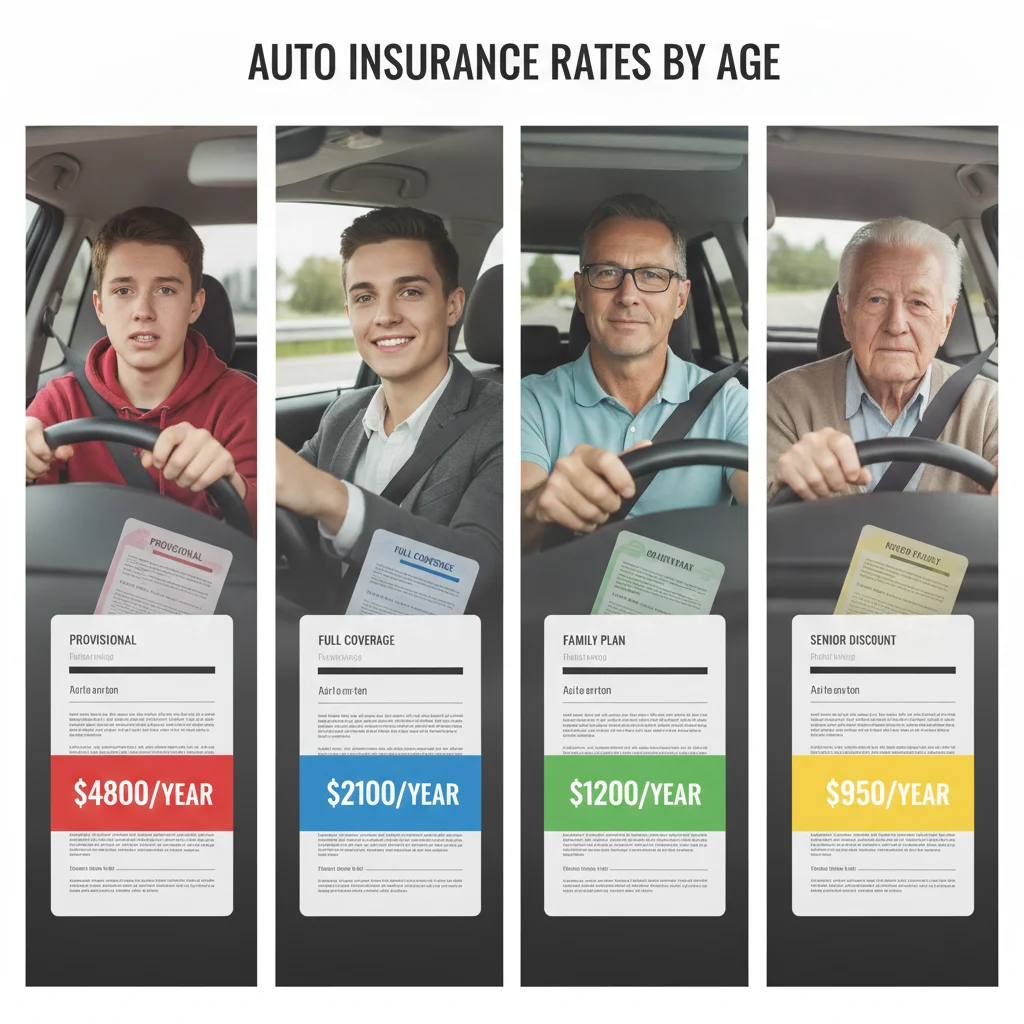
Key Takeaways
Teen Driver Rate Impact
When a licensed teenage driver is added to a household auto insurance policy, insurers recalculate the risk profile for the entire policy — not just for the teen. This typically results in a premium increase that affects all vehicles and coverage types on the account, not just the car the teen is expected to drive. The increase reflects the statistically higher accident rate associated with drivers aged 16–19.
Insurers use actuarial tables that assign each licensed household member a risk tier. A teen driver's tier is among the highest in personal lines underwriting, and many carriers apply a "household rating" model that distributes that risk across the full policy.
Why Insurers Don't Just Price the Teen — They Price the Household
Most parents expect a rate increase when they add a 16-year-old to their auto policy. What catches many off guard is just how broad that increase can be. It's not simply a line item added for the new driver. In most states and with most major carriers, the teen's presence triggers a full re-underwriting of the household's risk profile.
This is because of how personal auto insurance rating works. Insurers don't evaluate a single driver behind a single steering wheel in a vacuum. They look at every licensed driver in the household who has access to the insured vehicles. If that household now includes a teenage driver — statistically the highest-risk group on American roads — the entire policy is re-scored.

The underlying logic is straightforward: if a 16-year-old lives in your home, they can theoretically get behind the wheel of any car in the driveway. Even if you designate them as the primary driver of your oldest, cheapest vehicle, insurers build in the possibility they could drive the others. That probabilistic exposure is baked into your total premium.
Age is one of the most powerful pricing variables in auto insurance, and no age bracket produces higher baseline loss ratios than the 16–19 group. According to the Insurance Institute for Highway Safety, teen drivers are involved in fatal crashes at nearly three times the rate of drivers aged 20 and older per mile driven. Actuaries price that reality directly into your bill.
Household Rating Varies by Carrier and State
Not every insurer uses the same rating model, and state insurance regulations can limit how broadly carriers apply teen risk across a household policy. In some states, insurers are restricted from rating vehicles that a teen is explicitly excluded from driving. Ask your carrier directly which model they use — driver assignment or household rating — so you understand exactly how the teen's risk is being distributed across your policy.
Separate Policies Carry a Coverage Trade-Off
While a separate policy for the teen may sometimes reduce contamination of the parents' rate, it typically comes with lower coverage limits and higher standalone premiums. More importantly, if the teen causes a serious accident and their standalone policy limits are exhausted, the injured party may pursue the parents' assets through other legal avenues. Consult an insurance professional before separating policies based on cost alone.
The Mechanics: How Carriers Allocate Teen Risk Across Your Policy
Understanding how insurers actually spread teen risk requires a brief look at the two dominant rating models used in personal auto underwriting.
Driver Assignment Model
Some carriers use a driver assignment approach, where each driver in the household is matched to a specific vehicle. The teen is typically assigned to the vehicle they use most — or, strategically, to the lowest-value car on the policy. Under this model, that specific vehicle's premium increases substantially, but the other vehicles may see a more modest uptick.
Household Rating Model
More common among major national carriers is a household rating approach. Here, the insurer looks at the combined risk of all drivers and all vehicles together. The teen's elevated risk score doesn't stay confined to one car — it bleeds into the rate calculation for every vehicle on the policy. This is why families with multiple cars often see increases across the board, not just on the car their teen drives.
~89%
Premium increase for adding a 16-year-old male
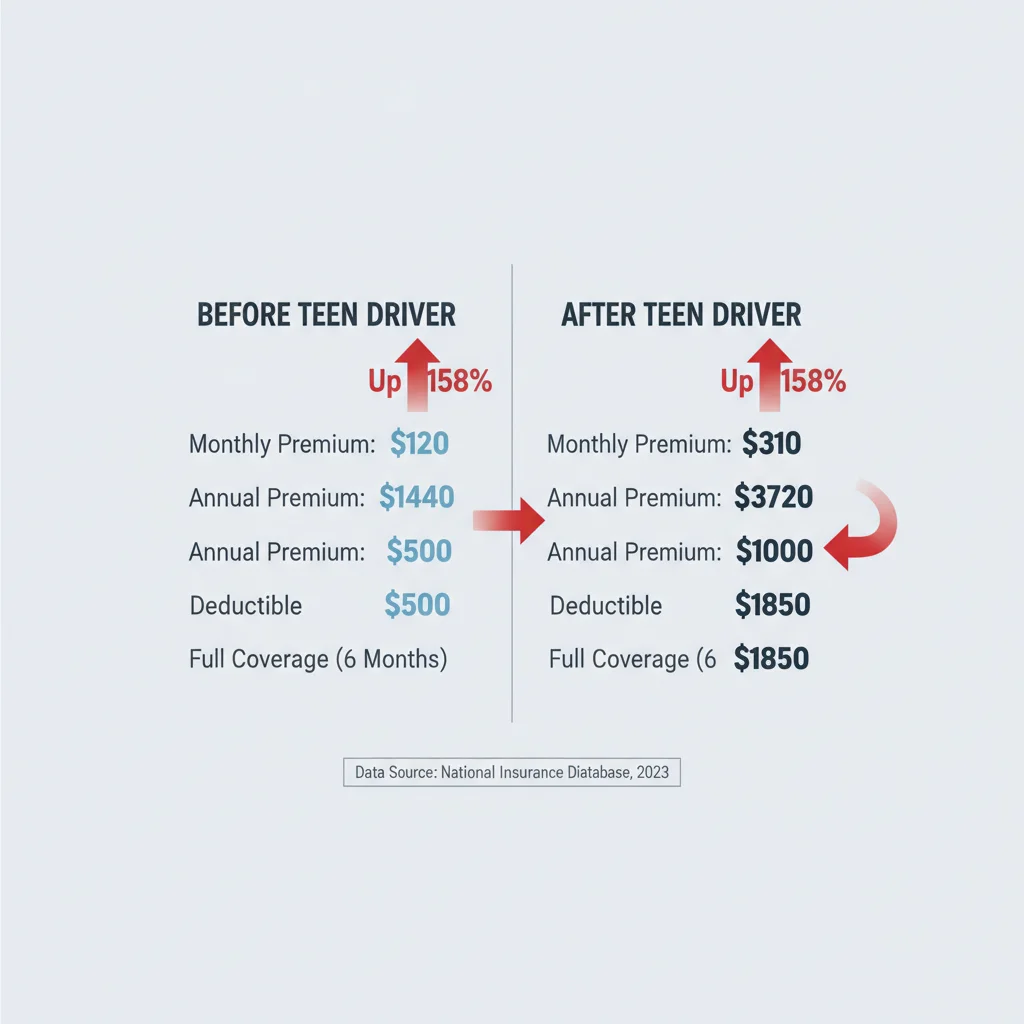
According to Bankrate analysis of major insurer quotes, adding a 16-year-old male driver to a parent's policy raises the household premium by an average of roughly 89%.
3x
Teen crash rate vs. drivers 20+
The Insurance Institute for Highway Safety reports that teen drivers are involved in fatal crashes at nearly three times the rate of drivers aged 20 and older per mile driven.
$2,000+
Average annual teen surcharge on household policy
NerdWallet's insurance rate analysis found that the average annual cost added to a parent's policy by a teen driver exceeds $2,000, though this varies significantly by state, gender, and carrier.
Up to 25%
Potential good student discount on teen premium
Most major carriers offer good student discounts ranging from 5% to 25% for full-time students maintaining a B average or higher, with documentation submitted at renewal.
10–30%
Telematics discount range for safe teen drivers
Usage-based insurance programs that monitor driving behavior can deliver discounts of 10% to 30% or more for teen drivers who consistently demonstrate safe habits.
Beyond these two models, there's a third factor that catches many families off guard: coverage-level amplification. Teen risk doesn't inflate your premium uniformly across all coverage types. Liability and collision tend to absorb the sharpest increases, because those are the lines most directly tied to at-fault accident frequency. If you're already carrying high liability limits — which is advisable — the dollar increase can be substantial even if the percentage increase seems manageable.
Liability coverage for teen drivers deserves its own careful review, because the legal exposure a teenage driver creates for the household is significant and often underestimated by parents focused only on the premium number.
What the Numbers Actually Look Like
Industry data gives us a realistic range for what households should expect when a teen enters the picture.
“Teen drivers are the single largest rating factor in personal auto insurance. When one enters the household, everything changes — the risk calculation, the coverage needs, and the conversation families should be having with their agent.”
— J. Robert Hunter, Former Director of Insurance, Consumer Federation of America
The average annual premium for a married couple with two cars runs roughly $2,200 to $2,800 per year depending on location, vehicle type, and coverage levels, based on data from the National Association of Insurance Commissioners. Add a 16-year-old male driver — statistically the highest-risk segment — and that figure can climb to $4,200 or more, an increase of 50% to 100% or higher.
Teen female drivers typically produce a smaller but still significant increase, reflecting their lower accident and violation rates compared to male peers. That gender gap has narrowed in recent years as more states restrict gender-based pricing, but it remains a factor in markets where it's still permitted.
Geography matters enormously here. Urban households in states like Michigan, Louisiana, or Florida — where baseline rates are already high — can see teen additions produce some of the steepest absolute dollar increases in the country. Rural households in states like Maine or Iowa start from a lower base, so the percentage increase may be similar but the dollar impact more manageable.
The vehicle assigned to the teen is another lever. A newer SUV with a high replacement cost will carry a larger collision premium than an older sedan worth $8,000. If you have the option of assigning the teen to a lower-value, lower-horsepower vehicle, the savings can be meaningful — though this approach works better under driver assignment models than household rating models.
Assign Your Teen to the Right Vehicle
If your carrier uses a driver assignment model, strategically assigning your teen to the lowest-value, lowest-horsepower vehicle on your policy can reduce the premium impact. A paid-off older sedan with a lower replacement cost generates a smaller collision premium than a newer SUV. Confirm with your agent which model your carrier uses before making this decision.
Start the Telematics Program Early
Enroll your teen in a telematics or usage-based insurance program as soon as they're added to the policy — not mid-term. Most carriers require a full monitoring period before applying a discount, so starting at policy inception maximizes the time available to earn the rate reduction. Some programs also offer a small discount just for enrollment, regardless of scores.
Discounts and Programs That Actually Move the Needle
The good news is that the insurance industry has built in several mechanisms specifically designed to soften the blow of teen pricing. Not all of them are well-publicized, and not all deliver equal value — but used in combination, they can trim a meaningful portion of the increase.
Good Student Discount
Most major carriers offer a discount — typically ranging from 5% to 25% — for full-time students who maintain a B average or better. The correlation between academic performance and driving behavior is well-established in actuarial research; students who demonstrate discipline in one domain tend to exhibit it in others. Documentation is usually a report card or school transcript submitted at renewal.
Driver Education and Training
Completing a state-approved driver education course can qualify your teen for a discount at many carriers. Some insurers go further, offering larger discounts for completion of advanced defensive driving programs beyond the standard license-requirement course.
Telematics and Usage-Based Programs
Perhaps the most impactful option for motivated families is a telematics program, where a mobile app or plug-in device monitors driving behavior — speed, braking, late-night driving, phone use — in real time. Safe driving scores can generate discounts of 10% to 30% or more. For a teen who actually drives carefully, this can be a significant offset. It also creates a built-in accountability mechanism that many parents find valuable independently of the savings.
Some optional add-ons are especially worth considering for teen drivers, including accident forgiveness programs that prevent a first at-fault claim from triggering a permanent rate increase. Given the statistical likelihood of a minor incident in the early years of driving, that protection can pay for itself quickly.
The Policy Structure Question: One Policy or Two?
Before accepting your renewal quote after adding a teen, it's worth evaluating whether keeping the teen on your policy is actually the best financial structure — or just the default assumption.
The comparison between adding a teen to your policy versus getting them a separate one is more nuanced than most families realize. A separate policy for the teen will almost always carry a higher base premium — young drivers without a household policy to anchor them to are rated as higher risk as standalone customers. But in some cases, particularly where the teen has their own car, separating the policies can reduce the contamination of the parents' rate.
The liability exposure question cuts the other way. If the teen is on your policy and causes a serious accident, your policy limits are what ultimately shield the household from lawsuit exposure. A teen on a minimum-limit standalone policy creates a gap that plaintiffs' attorneys know how to exploit.
Household Rating Varies by Carrier and State
Not every insurer uses the same rating model, and state insurance regulations can limit how broadly carriers apply teen risk across a household policy. In some states, insurers are restricted from rating vehicles that a teen is explicitly excluded from driving. Ask your carrier directly which model they use — driver assignment or household rating — so you understand exactly how the teen's risk is being distributed across your policy.
Separate Policies Carry a Coverage Trade-Off
While a separate policy for the teen may sometimes reduce contamination of the parents' rate, it typically comes with lower coverage limits and higher standalone premiums. More importantly, if the teen causes a serious accident and their standalone policy limits are exhausted, the injured party may pursue the parents' assets through other legal avenues. Consult an insurance professional before separating policies based on cost alone.
There's also a longer-term consideration. Teens who remain on a parent's policy into early adulthood are building a shared claims history rather than establishing their own. That can complicate things when they eventually need to transition to their own coverage — particularly if there have been any at-fault incidents. Understanding the long-term trajectory of the policy relationship matters as much as the near-term premium math.
How to Prepare Before the Rate Increase Arrives
The most effective time to manage the financial impact of adding a teen driver is before the renewal quote lands in your inbox — ideally several months before the teen gets their license. That window gives you time to shop, adjust coverage strategically, and implement discount programs before the first policy period with the teen on it.
Shop the Market Proactively
Your current carrier may not be competitive for households with teen drivers. Some insurers specialize in this segment and price it more favorably; others apply steep loads to teen risk across the board. Getting quotes from at least three to five carriers with the teen's information included is essential. The spread between the cheapest and most expensive quote for the same household can easily exceed $1,000 annually.
Review Your Coverage Levels
Adding a teen driver is a natural occasion to audit your overall policy. Are your liability limits appropriate for the increased legal exposure? Is your collision deductible set correctly for the vehicle the teen will drive? Optional coverage add-ons like roadside assistance and rental reimbursement also deserve a second look — a teen driver who has a breakdown or fender bender miles from home creates a different logistical reality than an experienced adult driver.
Establish Baseline Documentation
If you're pursuing a good student discount or planning to submit driver education records, gather that documentation now. Insurers require verification, and having it ready at policy inception rather than chasing it mid-term saves both time and potential delays in discount application.
Assign Your Teen to the Right Vehicle
If your carrier uses a driver assignment model, strategically assigning your teen to the lowest-value, lowest-horsepower vehicle on your policy can reduce the premium impact. A paid-off older sedan with a lower replacement cost generates a smaller collision premium than a newer SUV. Confirm with your agent which model your carrier uses before making this decision.
Start the Telematics Program Early
Enroll your teen in a telematics or usage-based insurance program as soon as they're added to the policy — not mid-term. Most carriers require a full monitoring period before applying a discount, so starting at policy inception maximizes the time available to earn the rate reduction. Some programs also offer a small discount just for enrollment, regardless of scores.

Finally, have an explicit conversation with your teen about what the rate increase represents and what behaviors can mitigate it. Telematics programs only work as intended when the driver understands what's being tracked. Making the teen a partner in managing the household's insurance cost — rather than a passive participant — has practical and behavioral benefits that extend well beyond the premium number.

All claims are backed by peer-reviewed research. Sources on request.