Key Takeaways
Why EV Tax Credit Timing Is a Moving Target
The federal EV tax credit has never been a static benefit. Since the Inflation Reduction Act took effect in 2023, the rules governing which vehicles qualify, which buyers are eligible, and how the credit can be claimed have shifted repeatedly — sometimes with very little advance warning. For a buyer expecting up to $7,500 off a new EV or $4,000 off a qualifying used one, a missed deadline or a policy change that took effect the month before your purchase can wipe out thousands of dollars in expected savings.
Understanding why these rules change — and when changes typically occur — is the foundation of smart timing. The IRA tied credit eligibility to a complex web of battery sourcing requirements, domestic assembly rules, income limits, and vehicle price caps. Each of those levers gets adjusted independently. The IRS issues new guidance. The Treasury Department updates the list of qualifying battery suppliers. Congress debates extensions or modifications. Any of these can reset the playing field.
See our timeline of EV tax credit changes since the IRA for a full chronological breakdown of what has changed and when. This article focuses on what to do with that knowledge — specifically, how to watch for changes and structure your purchase window to protect your credit eligibility.
Know the Rules Before You Set a Purchase Date
Timing only works if you understand what you're timing around. Before you set a target purchase date, you need to confirm three things: the vehicle you want currently qualifies, you currently qualify as a buyer, and the credit structure you're planning on won't change before you close the deal.
Vehicle-Level Eligibility
Not every EV on the market qualifies for the full $7,500 credit — or any credit at all. Under the IRA, new EVs must be assembled in North America, and the battery must meet progressively tightening sourcing thresholds for critical minerals and components. These thresholds increase annually, meaning a vehicle that qualified in 2023 may not qualify in 2024 or 2025 if its battery supply chain doesn't meet the new bar.
The Department of Energy and IRS maintain a jointly updated list of eligible vehicles at fueleconomy.gov. Check it each time you're about to make a purchase decision — not just once at the beginning of your research. Manufacturers periodically update their sourcing declarations, which can add or remove models mid-year. Our deep dive on EV battery sourcing requirements under the IRA explains exactly how those thresholds work and why the same model can qualify for different credit amounts depending on when you buy.
Buyer-Level Eligibility
The income caps are hard limits — there is no partial credit for being slightly over the threshold. For new EVs purchased in 2024–2025, the modified adjusted gross income (MAGI) limits are $150,000 for single filers, $225,000 for heads of household, and $300,000 for joint filers. For used EVs, those limits drop to $75,000, $112,500, and $150,000 respectively.
Critically, the IRS lets you use your MAGI from either the year of purchase or the prior year — whichever is lower. That creates a legitimate planning opportunity: if your income fluctuated significantly between years, the timing of your purchase relative to when you file can determine whether you qualify at all. For the full eligibility picture, see our federal EV tax credit explainer.
Prior-Year MAGI Can Unlock Eligibility
The IRS allows buyers to qualify using their MAGI from either the year of purchase or the preceding tax year — whichever is lower. This means buyers whose income dropped significantly from one year to the next may qualify even if their current-year income is above the cap. Consult a tax professional if your income is close to the threshold across two years, as the documentation requirements for using prior-year MAGI must be handled correctly at filing.
Leased EVs Follow Different Rules
When you lease an EV, the credit goes to the leasing company (the legal vehicle owner), not to you as the lessee. Manufacturers and dealers sometimes pass a portion of the credit through as a lower monthly payment or reduced cap cost — but this is at their discretion. Leased vehicles are also exempt from the North American assembly and battery sourcing requirements that apply to purchased vehicles, which is why some foreign-assembled EVs are available with lease incentives but not purchase credits.
Watch for Mid-Year Guidance Changes
Most significant IRS guidance takes effect at the start of a calendar year, but mid-year updates do occur — particularly when Treasury finalizes rules that were initially issued in proposed form. In 2023, updates to the battery component requirements took effect in April, catching some buyers off guard. There is no automatic notification system for these changes; proactive monitoring is the buyer's responsibility.
MSRP Caps Are Non-Negotiable
New EVs must have an MSRP at or below $80,000 for SUVs, vans, and trucks, and $55,000 for sedans and other passenger cars. These caps apply to the manufacturer's suggested retail price — not your negotiated transaction price. If a dealer adds market-adjustment markups that push the sticker above the cap, the vehicle doesn't qualify regardless of what you actually pay. Always verify the MSRP before finalizing your deal.

Best Practices for Tracking Rule Changes
The biggest mistake EV buyers make is researching the credit once and assuming those rules will hold until they're ready to buy. Rule changes can come from multiple directions simultaneously: congressional legislation, Treasury Department guidance updates, IRS notices, and manufacturer-level sourcing changes that affect which vehicles appear on the eligible list. Here's how to stay ahead of the curve.
Bookmark and check the IRS and DOE eligible vehicle list within 30 days of your planned purchase date.
Vehicle eligibility changes when manufacturers update their sourcing certifications or when new IRS guidance takes effect. A model that qualified when you started your research may have lost eligibility — or a new model may have been added. Checking close to purchase eliminates the gap between research and reality.
Set up IRS and Treasury Department news alerts using Google Alerts or an RSS reader.
The IRS and Treasury don't send buyers direct notifications when guidance changes. Proactive monitoring is the only way to catch updates in real time rather than discovering them after the fact. Policy changes often come with a prospective effective date, giving attentive buyers a narrow window to act.
Confirm your MAGI eligibility using both your current-year estimate and your prior-year tax return.
The IRS allows buyers to use the lower of two years' MAGI to qualify, which creates planning flexibility but also requires knowing both numbers. Buyers who rely on a single year's income estimate risk either disqualifying themselves unnecessarily or assuming they qualify when they don't.
Verify dealer enrollment in the IRS point-of-sale transfer program before committing to a dealership.
Only IRS-registered dealers can process the point-of-sale credit transfer. Choosing a non-enrolled dealer forces you to claim the credit on your tax return, which reintroduces the tax liability constraint and delays your benefit by up to 12–18 months. This is a dealer-selection criterion, not just a paperwork detail.
Research your state's EV incentive programs and check current funding availability before finalizing your purchase timeline.
State incentives can stack significantly with the federal credit, but they operate on independent funding cycles. Programs that are fully funded in January can be depleted by spring. Buyers who treat state credits as reliable without checking current status risk losing thousands of dollars in expected savings.
Document your purchase date and qualifying vehicle configuration in writing at time of sale.
If the IRS ever questions your credit claim, the purchase date and vehicle configuration at time of sale are the determining factors. Dealers sometimes modify vehicle configurations after contract signing, and any change that affects MSRP or sourcing compliance could affect eligibility. Written documentation protects your position.
The Point-of-Sale Transfer: Your Most Powerful Timing Tool
Starting in 2024, buyers gained the ability to transfer the EV tax credit directly to a participating dealer at the point of sale. Instead of waiting until you file your taxes to see the credit applied against your tax liability, you can take it as an immediate reduction in purchase price — a direct discount at signing.
This is significant for two reasons. First, it removes the tax liability constraint. Previously, if you owed less in federal taxes than the credit amount, you lost the difference. The point-of-sale transfer converts the credit into cash value that the dealer receives from the IRS regardless of your tax situation. Second, it changes how you think about timing risk. If you claim the credit at the dealer and a rule change occurs after your purchase date, your credit is already locked in.
Lock In With the Point-of-Sale Transfer
If you use the dealer point-of-sale transfer to claim your credit, the qualifying purchase date is the day you sign the purchase agreement — not when you file taxes. This means your eligibility is determined by the rules in effect on that date, insulating you from any subsequent rule changes. Confirming your deal on a specific date is therefore more protective than waiting, especially when policy uncertainty is high.
Ask About Reservation Programs
Some states let buyers reserve a spot in a rebate program before completing their purchase, locking in eligibility even if the program's funding gets depleted before your deal closes. If your state offers this, submit your reservation as early as possible — before you've even finalized a vehicle or dealer — to protect your position in the queue.
Not every dealer participates in the transfer program — it requires registration with the IRS. Before you commit to a dealership, confirm they're enrolled. If they're not, you either need to find another dealer or plan to claim the credit on your tax return, which reintroduces the tax liability constraint and delays your savings by months.
For buyers weighing new versus used EVs, the credit structures are meaningfully different. Used EVs are capped at $4,000 or 30% of the sale price (whichever is less) and carry stricter income limits. The comparison of new vs. used EV tax credits walks through both programs in detail so you can confirm which applies to your situation before you time a purchase.
$7,500
Maximum federal new EV tax credit
Under the Inflation Reduction Act, qualifying new EV buyers can claim up to $7,500 — subject to vehicle, income, and MSRP eligibility requirements.
$4,000
Maximum federal used EV tax credit
The used clean vehicle credit is capped at $4,000 or 30% of the vehicle sale price, whichever is lower, with stricter income limits than the new vehicle credit.
2024
Year point-of-sale credit transfer launched
Starting January 1, 2024, buyers can transfer the federal EV credit to an enrolled dealer, receiving an immediate price reduction rather than waiting for tax filing.
Annual
Frequency of battery sourcing threshold increases
The IRA's battery mineral and component sourcing requirements step up every year through at least 2026, progressively tightening which vehicles can claim the full credit.
Stacking State Incentives Without Letting Them Expire
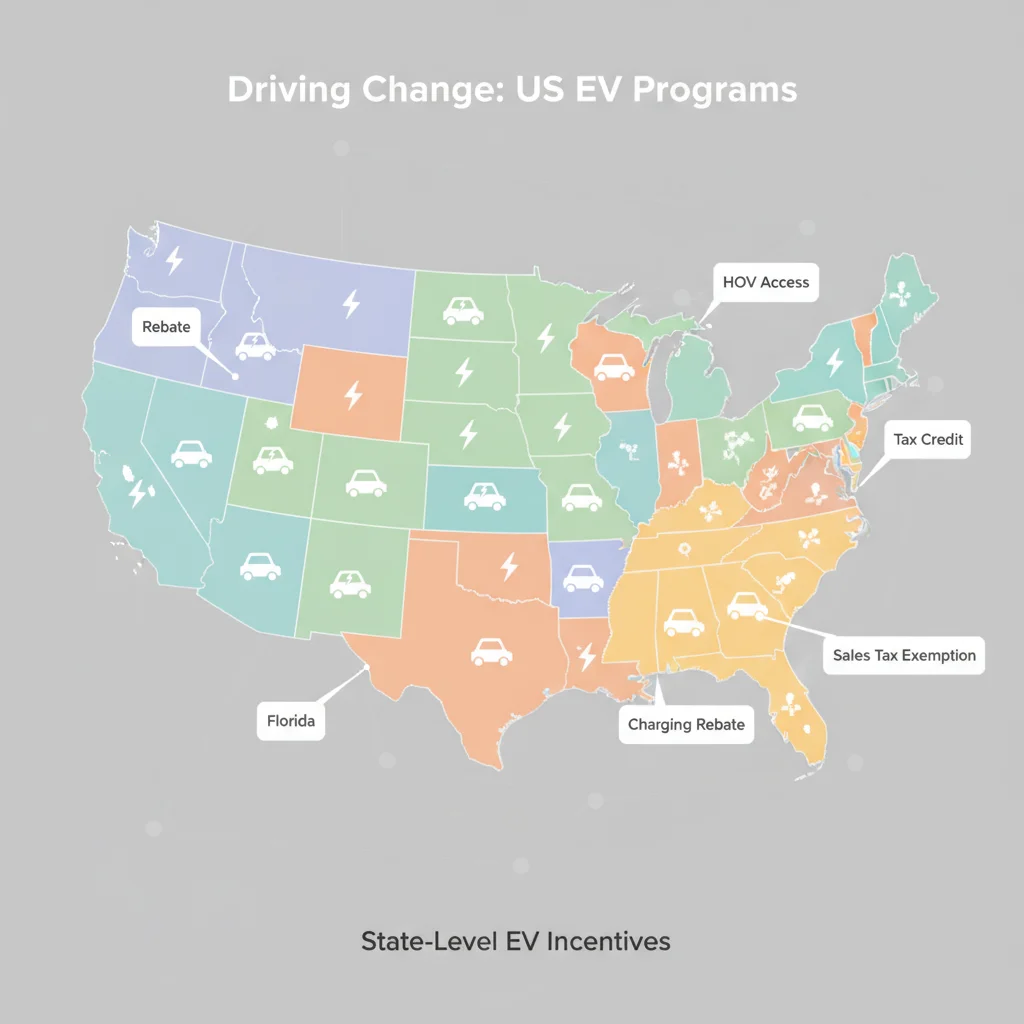
Federal credits get most of the attention, but state incentives can add thousands more — and they operate on completely independent timelines. Several states offer rebates, tax credits, or reduced registration fees for EV buyers, and many of these programs have annual funding caps that can be exhausted mid-year.
California's Clean Vehicle Rebate Project, for example, ran out of funding ahead of schedule in 2023 before being succeeded by the Clean Cars 4 All program with different eligibility requirements. Colorado, New York, and several other states have their own programs with different income limits, vehicle caps, and reservation systems. Some require a pre-purchase registration; others are first-come, first-served after purchase.
The key insight: state program funding is finite and unpredictable. If a state program you're counting on gets depleted, you can't retroactively claim the benefit after the fact. Research what's available in your state early in your process, confirm current funding status shortly before purchase, and if a program is known to be nearing its cap, that's a legitimate reason to accelerate your timeline.
“Incentive programs are designed to change behavior, and they're most effective when buyers engage with them actively. Waiting passively for the 'right' moment usually means missing it. The buyers who capture the most value are the ones tracking the rules, not just the vehicles.”
— Ingrid Malmqvist, Senior EV policy analyst, clean transportation advocacy organization
Timing also intersects with the broader car-buying calendar. End-of-year purchases often coincide with manufacturer incentives and dealer-level discounts as inventory gets cleared. But year-end is also when IRS guidance for the upcoming year is typically released, meaning a purchase in late December might qualify under different rules than one in early January. Our guide on timing your purchase for maximum discounts covers the broader seasonal patterns worth layering into your planning.
Quick Wins: What You Can Do Right Now
Tracking policy changes and understanding eligibility criteria is important groundwork, but there are concrete actions you can take today to lock in your position before the next round of rule changes hits.
What to Watch in the Year Ahead
Battery sourcing thresholds under the IRA are scheduled to increase through 2026 and beyond. Each annual step-up means more vehicles could lose their full credit eligibility — or gain it, if manufacturers accelerate their domestic sourcing. Congressional debate around extending, modifying, or eliminating the credit entirely is ongoing, and any legislative action could change the landscape rapidly.
Policy uncertainty is a legitimate reason to buy sooner rather than later if you're on the fence. Credits that exist today aren't guaranteed to exist in their current form next year. At the same time, manufacturers are actively responding to sourcing requirements by retooling supply chains, so some vehicles that don't qualify today may qualify in the future. Predicting which way a specific model will move requires monitoring manufacturer announcements alongside policy updates.
For deadline-driven planning specifically, our companion article on how EV incentive deadlines should shape your buying timeline provides a framework for anchoring your purchase window around known phase-out dates and funding cliffs. Use it alongside the sourcing timeline and the eligible vehicle list to build a complete picture of your purchase window.
The bottom line is straightforward: EV tax credits reward buyers who do their homework and stay engaged with the policy environment. Set a purchase window, monitor the rules within that window, confirm eligibility close to signing, and use the point-of-sale transfer to lock in your savings on the day you buy. That's the complete approach.


All claims are backed by peer-reviewed research. Sources on request.