Key Takeaways
Brake Fluid Hygroscopicity
Brake fluid is hygroscopic, meaning it naturally absorbs moisture from the surrounding air over time. As water accumulates in the fluid, its boiling point drops significantly — which can cause brake fade or failure under hard braking. This happens regardless of how often your friction brakes are actually used, making it just as relevant for electric vehicles as for gas-powered cars.
Most vehicles use DOT 3, DOT 4, or DOT 5.1 glycol-based brake fluids, all of which are hygroscopic. DOT 5 (silicone-based) is non-hygroscopic but is rarely specified by OEMs. The Federal Motor Vehicle Safety Standard (FMVSS No. 116) sets minimum dry and wet boiling point requirements for each DOT rating.
The Misconception: Fewer Brake Uses Means No Brake Service
One of the most appealing selling points of electric vehicles is reduced maintenance. No oil changes, no spark plugs, no transmission fluid — the list of skipped service items is genuinely impressive. And once owners discover that regenerative braking handles the majority of everyday stopping, it's easy to conclude that brake-related maintenance is effectively off the table.
That conclusion is wrong, and it's costing some EV owners real money and real safety.
The friction brake system on an EV — calipers, rotors, pads, and hydraulic lines — does sit relatively idle compared to a gas car. But the brake fluid circulating through that system doesn't care how often the brakes activate. It's sitting in an enclosed reservoir, in contact with rubber seals and metal components, slowly absorbing moisture from the atmosphere every single day. That process is purely chemical and entirely time-driven.
EVs skip oil changes, but they're not maintenance-free — and brake fluid is one of the clearest examples of a service item that survives the transition from combustion to electric. Understanding why requires a short look at what brake fluid actually does and why moisture is the enemy.
Why Brake Fluid Degrades Even When Brakes Aren't Used
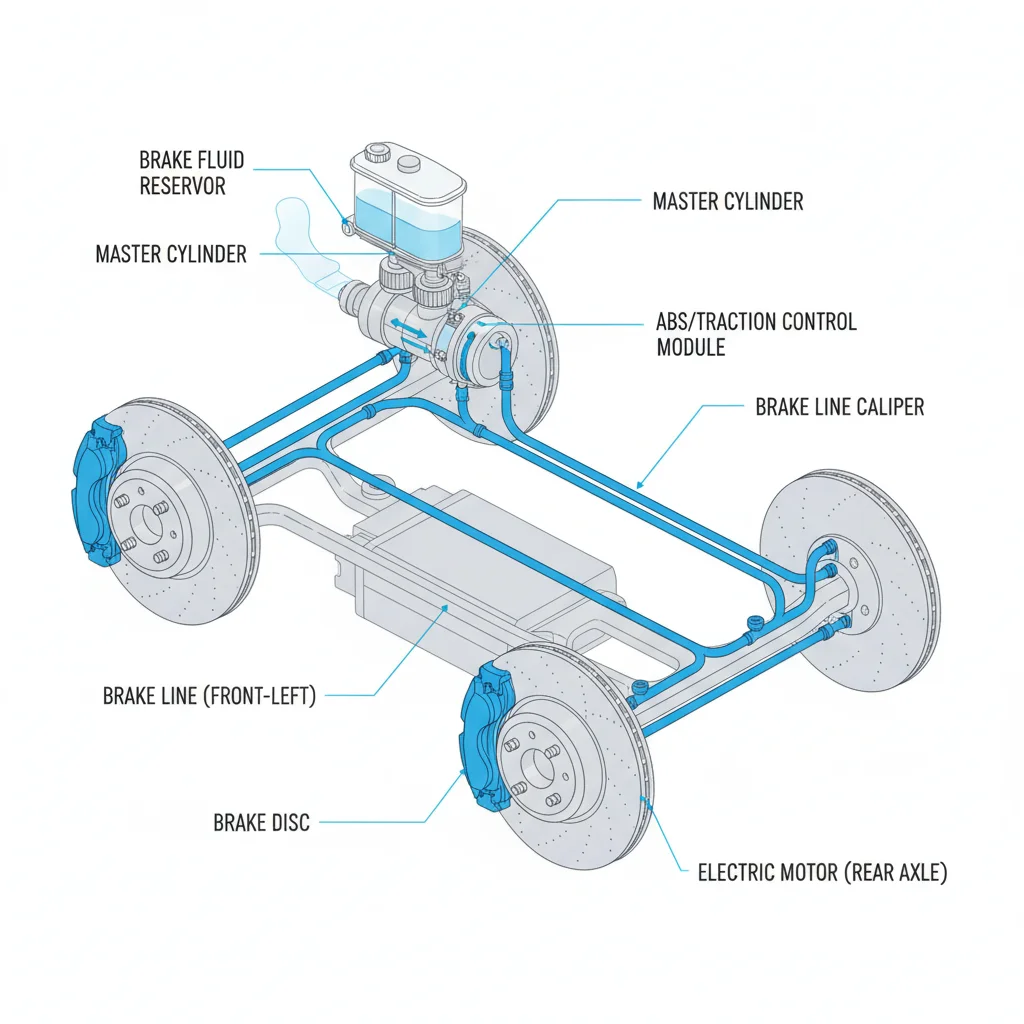
Brake fluid is the hydraulic medium that transmits force from your brake pedal to the calipers at each wheel. It needs to withstand extreme temperatures — especially the heat generated during hard braking — without boiling. When brake fluid boils, it creates vapor bubbles in the lines, and vapor, unlike liquid, is compressible. That's what causes the terrifying sensation of a pedal going straight to the floor with little stopping effect. It's called vapor lock, and it's a brake failure scenario.
The challenge is that all glycol-based brake fluids (DOT 3, DOT 4, and DOT 5.1 — the types specified by nearly every passenger vehicle manufacturer) are hygroscopic: they actively attract and absorb water molecules from the surrounding air. This happens through microscopic permeation in rubber hoses, through the reservoir cap vent, and through any other point of atmospheric contact.
~3%
Moisture content threshold for brake fluid replacement
Industry standard guidance from brake fluid manufacturers and automotive engineers; most recommend replacement when water content reaches approximately 3% by volume.
155°F drop
Boiling point reduction with contaminated DOT 4 fluid
Fresh DOT 4 fluid can withstand approximately 446°F dry; at 3% moisture content, that wet boiling point can fall to around 311°F — a reduction that materially increases vapor lock risk.
2 years
Typical EV brake fluid inspection interval
Tesla, Hyundai, and other major EV manufacturers recommend checking brake fluid for moisture contamination every two years regardless of mileage.
$80–$150
Average brake fluid flush cost at independent shop
Based on typical U.S. independent shop labor rates and brake fluid material costs as of 2024; dealer pricing is generally higher.
Over time, the accumulated water content drops the fluid's wet boiling point significantly. A fresh bottle of DOT 4 fluid has a dry boiling point around 446°F (230°C). Once moisture content reaches roughly 3% — which can happen in as little as two years in humid climates — that boiling point can fall below 311°F (155°C). That's still adequate under normal driving, but if you need to make repeated hard stops — during a descent, an emergency, or a track day — the margin shrinks fast.
For EV owners, there's an additional wrinkle: because regenerative braking handles most routine deceleration, the friction brakes may go weeks without significant activation. This means the fluid sits static in the calipers and lines for extended periods, potentially accelerating localized moisture accumulation and corrosion in components that aren't being cycled regularly. Here's how regenerative braking actually interacts with your traditional brake components.
Humidity Accelerates Moisture Absorption
EV owners in high-humidity climates — coastal areas, the Southeast, the Pacific Northwest — may find their brake fluid reaches the replacement threshold closer to 18–24 months rather than the full two to three years. Owners in arid regions like the Southwest may get closer to three years before contamination becomes a concern. Geography matters; don't assume the longest interval applies to your situation.
EV Brake Bleeding May Need Specialized Software
Many modern EVs use electronic brake actuators and fully integrated regenerative/friction brake management systems. Fully bleeding the old fluid from all chambers in these systems sometimes requires a manufacturer scan tool to cycle the actuator electronically. If you're using an independent shop, confirm they have the appropriate tools for your specific EV model before scheduling the service.
What the Manufacturer Data Actually Says
EV manufacturers aren't ignoring this issue. Their service schedules reflect the time-based nature of brake fluid degradation directly.
Tesla's maintenance documentation recommends inspecting brake fluid for contamination every two years and replacing it if moisture content is too high. Chevrolet's guidance for the Bolt EV references the standard GM brake fluid inspection intervals tied to time, not mileage. Hyundai and Kia, whose Ioniq and EV6 lineups have grown rapidly, both include brake fluid replacement in their scheduled maintenance tied to annual or biennial intervals.
This isn't manufacturers being overly cautious or padding a service revenue stream. It's a straightforward acknowledgment that fluid chemistry doesn't pause between brake activations.
“Brake fluid is one of the most neglected fluids in any vehicle — gas or electric. People confuse the brake system working well with the fluid being healthy. Those are two completely different things. By the time you feel a problem in the pedal, you've already been driving on compromised fluid for months.”
— Craig Van Batenburg, EV and hybrid automotive trainer, Automotive Career Development Center (ACDC)
The practical implication for owners: if you've been driving your EV for two years and the brake fluid has never been checked or changed, you're overdue — regardless of how low your brake wear looks. A complete EV maintenance schedule that includes brake fluid checks and other time-based services can help you track all of these intervals in one place.
How to Check Whether Your EV's Brake Fluid Actually Needs Changing
You don't have to guess, and you don't necessarily have to pay a dealer to tell you. There are two practical methods for assessing brake fluid condition at home or at an independent shop.
Test Strips
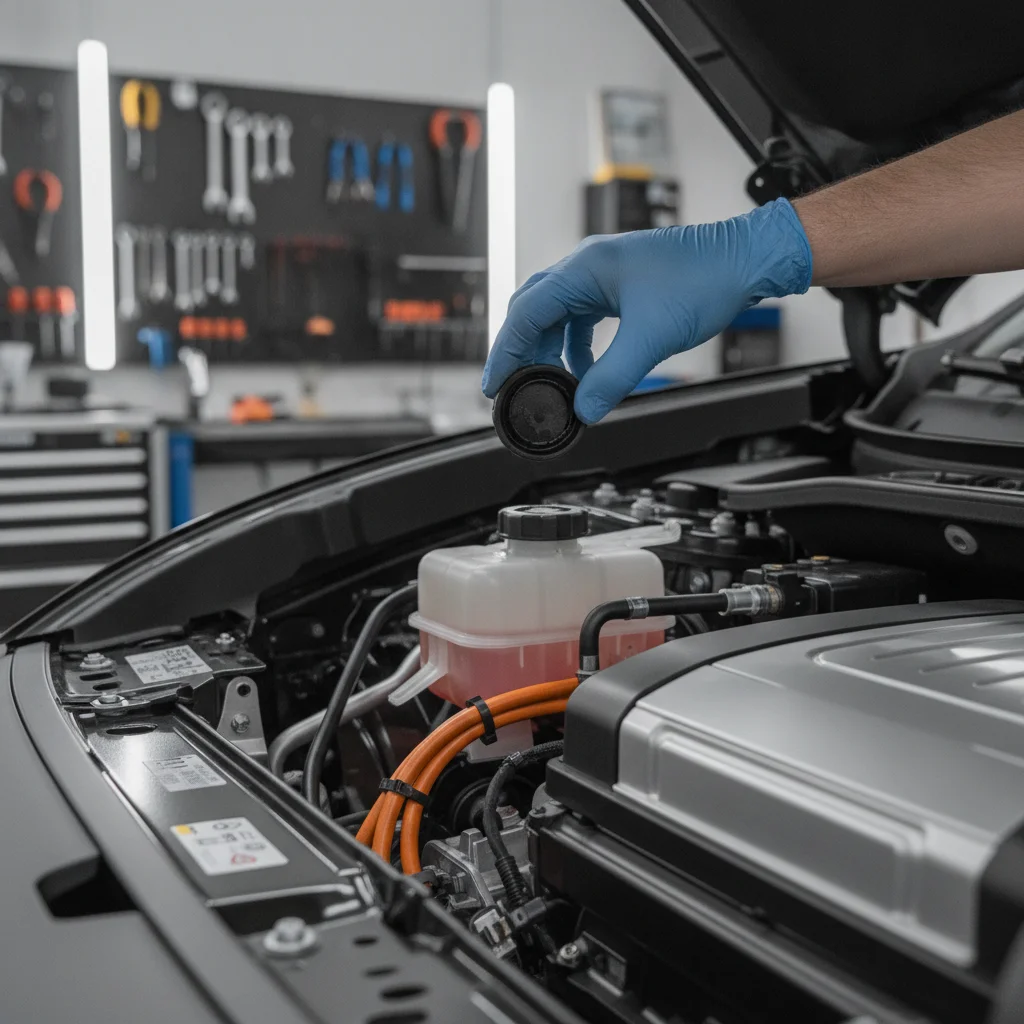
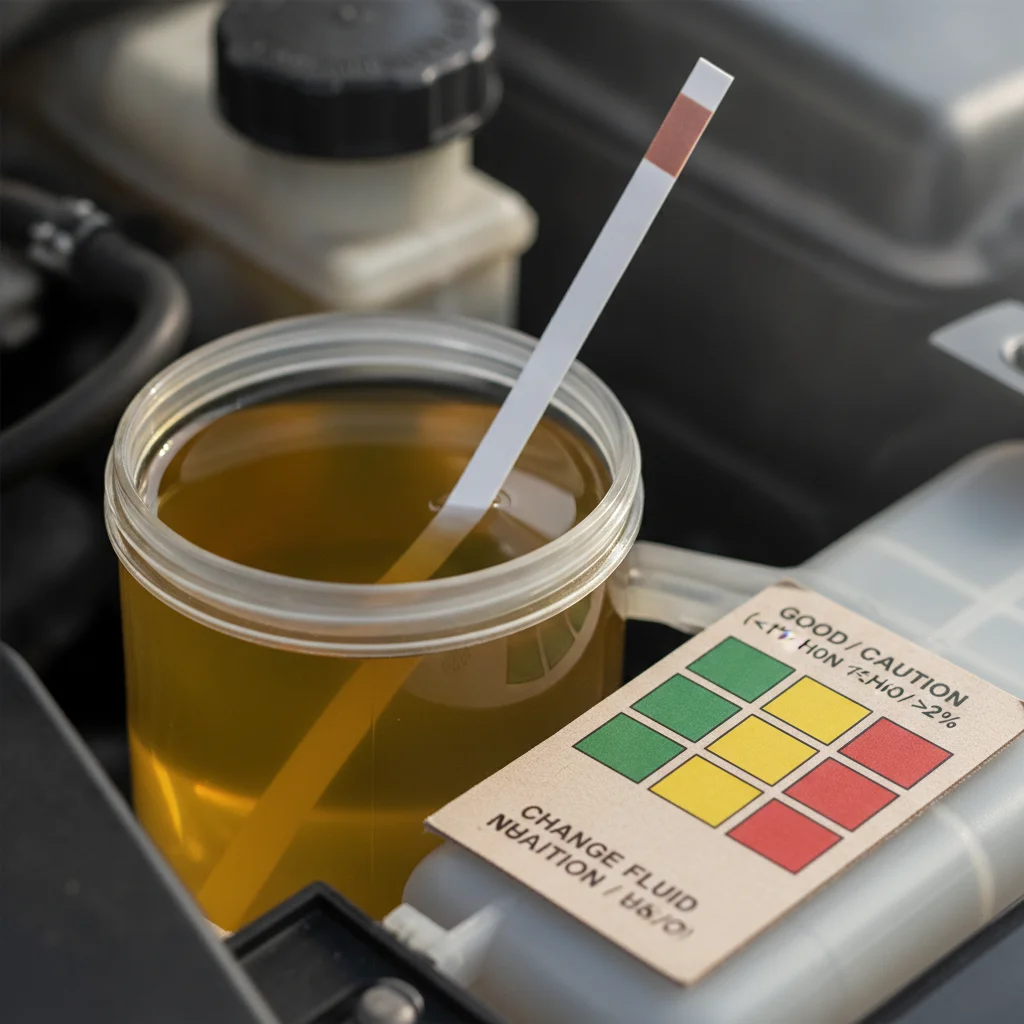
Inexpensive copper-based test strips (available for a few dollars from auto parts stores) measure the concentration of copper ions in the fluid — a proxy for moisture contamination and oxidative degradation. You dip the strip into the reservoir, wait the specified time, and compare the color change to a reference chart. It's not laboratory-precise, but it gives you a reliable go/no-go signal and is the same method many dealers use for a quick check.
Refractometer
A fluid refractometer measures the refractive index of the brake fluid, which correlates to its moisture content percentage. This is more precise than test strips and gives you an actual water percentage reading. A reading above approximately 3% water content by volume is generally accepted as the threshold for replacement.
Test Before You Guess
Before booking a flush, buy a pack of brake fluid test strips online or at an auto parts store — they typically cost under $10 for a pack of five. Dip one in your brake fluid reservoir and compare the result to the included chart. If the strip says your fluid is within acceptable range, you may have another season before a full replacement is needed. If it flags contamination, you have solid evidence to act on rather than a vague maintenance reminder.
If either method flags your fluid as contaminated, don't delay the service. Brake fluid replacement is not an expensive job — typically $80 to $150 at an independent shop — and it's one of the higher-value-per-dollar safety services on any vehicle.
It's also worth understanding how this fits into the broader brake service picture. Fluid condition is just one variable alongside pad thickness and rotor condition. Brake service timelines for pads, rotors, and fluid explained together gives you a complete view of when each element needs attention and how they interact.
The Longer Brake Life Paradox: Why Infrequent Use Creates New Risks
Here's the counterintuitive part of EV brake ownership: the same regenerative braking system that extends the life of your pads and rotors dramatically can also create conditions that accelerate brake fluid and caliper degradation in other ways.
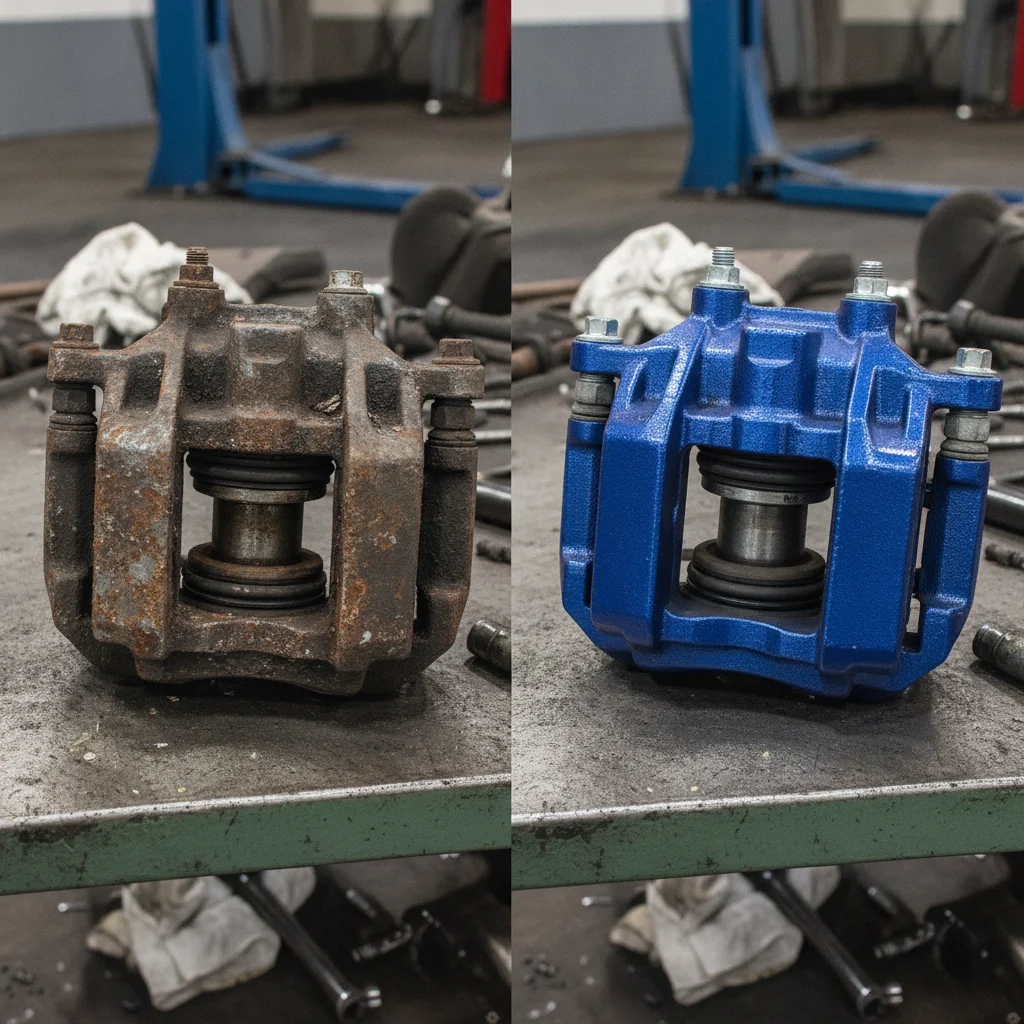
When friction brakes sit unused for extended periods, a few things happen. Rotors can develop surface rust (cosmetic in most cases, but occasionally problematic). Caliper pistons and sliders that aren't being cycled regularly can seize or corrode over time. And brake fluid that isn't being heated and circulated through normal braking cycles has no mechanism to redistribute or off-gas accumulated moisture.
The science behind why EV brakes last so much longer than gas car brakes is genuinely impressive — but longer intervals between friction brake activations also mean less opportunity for the system to self-exercise. Some EV software addresses this by periodically activating the friction brakes at low speed to keep calipers functional, but this doesn't address fluid chemistry.
The practical upshot: EV owners should think of brake fluid service as a time-based task rather than a usage-based one. Set a calendar reminder at the two-year mark from your last service (or your purchase date if it's never been done) and get the fluid tested. Don't wait for a symptom — by the time you notice a spongy pedal, the fluid has already been degraded for some time.
What to Expect at the Service Appointment
Brake fluid replacement — sometimes called a brake flush — is a straightforward service that most independent shops and dealerships can perform in under an hour. The technician evacuates the old fluid from the system and replaces it with fresh fluid to the manufacturer's specification, bleeding each caliper to remove air bubbles in the process.
For EVs with integrated regenerative braking systems and electronic brake actuators (like those found on many newer models), there's an important nuance: the bleeding procedure may require manufacturer-specific software to cycle the electronic actuator and fully purge old fluid from all system chambers. This is one reason why some owners prefer to have this service done at a brand-authorized dealer or a shop with the appropriate OEM scan tool, at least for the first time.
Humidity Accelerates Moisture Absorption
EV owners in high-humidity climates — coastal areas, the Southeast, the Pacific Northwest — may find their brake fluid reaches the replacement threshold closer to 18–24 months rather than the full two to three years. Owners in arid regions like the Southwest may get closer to three years before contamination becomes a concern. Geography matters; don't assume the longest interval applies to your situation.
EV Brake Bleeding May Need Specialized Software
Many modern EVs use electronic brake actuators and fully integrated regenerative/friction brake management systems. Fully bleeding the old fluid from all chambers in these systems sometimes requires a manufacturer scan tool to cycle the actuator electronically. If you're using an independent shop, confirm they have the appropriate tools for your specific EV model before scheduling the service.
When budgeting, expect to pay roughly $80–$150 at an independent shop, or $150–$250 at a dealership depending on the model and local labor rates. The fluid itself costs relatively little; you're mostly paying for labor and the bleeding process. Some EV-specialized independent shops have invested in the necessary software tools and can perform the service at competitive rates — worth researching before defaulting to the dealer.
Ask specifically that the technician document the fluid specification used (DOT 4, DOT 4 LV, DOT 5.1, etc.) and confirm it matches your owner's manual requirement. Using the wrong specification — particularly mixing DOT ratings — can compromise seal materials and reduce braking performance.

All claims are backed by peer-reviewed research. Sources on request.