Key Takeaways
Totaled Car (Total Loss)
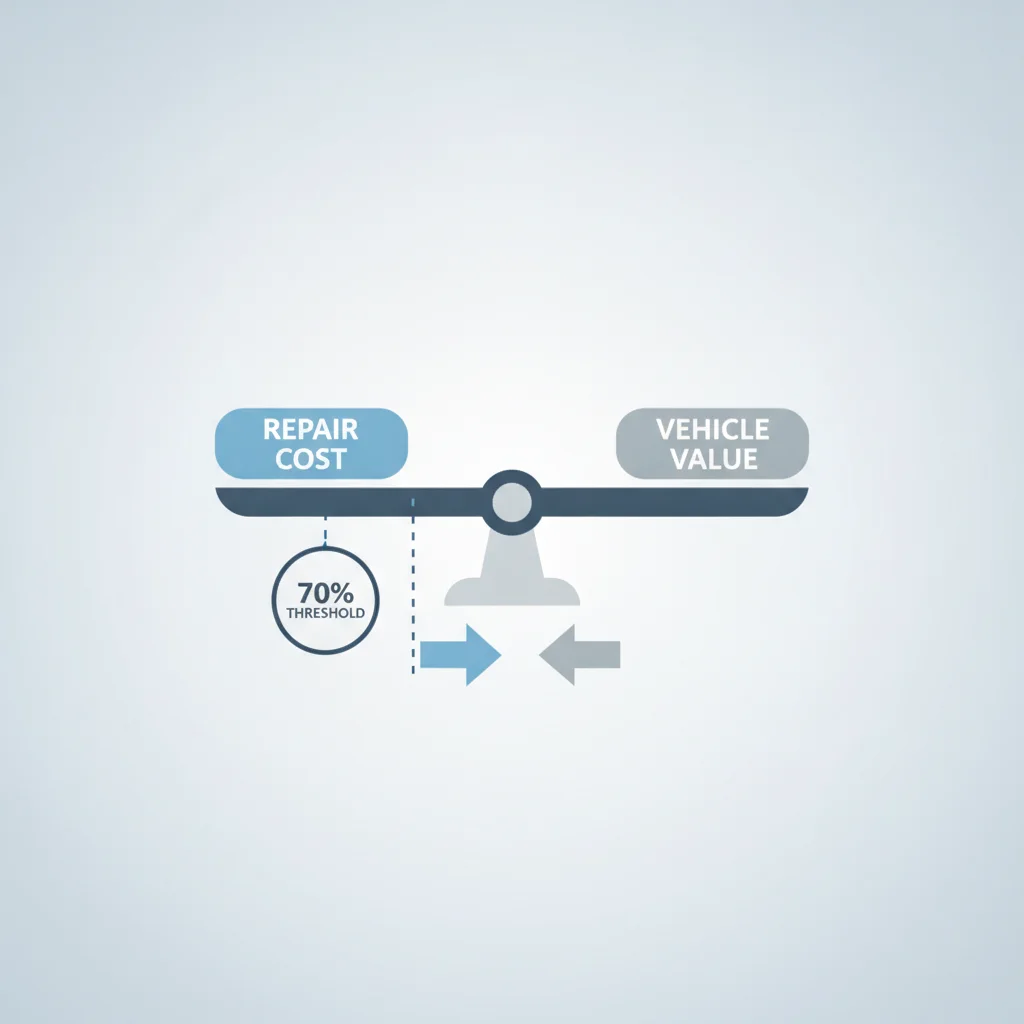
A car is considered "totaled" — or declared a total loss — when the cost to repair it equals or exceeds a certain percentage of its pre-accident market value. At that point, your insurer typically pays you what the vehicle was worth rather than covering repair costs. This threshold varies by state and by insurer, but it's generally somewhere between 70% and 100% of the car's actual cash value.
The specific percentage that triggers a total loss declaration is called the Total Loss Threshold (TLT) or Total Loss Formula (TLF), and it differs by state law. Some states use a fixed percentage threshold; others use a formula that also factors in the vehicle's salvage value.
What "Totaled" Actually Means
The word "totaled" gets thrown around a lot after accidents, but there's a precise meaning behind it. Your car is declared a total loss when repairing it would cost more than a set percentage of what the car was worth before the accident happened. That threshold — determined by your state's laws or your insurer's internal formula — is the key number driving the entire decision.
Here's why this matters to you: once a car is totaled, the claim process shifts completely. Instead of your insurer paying a repair shop, they're now paying you the vehicle's pre-accident market value — technically called its actual cash value (ACV). And that figure almost always reflects depreciation, meaning it's likely less than what you paid for the car.
Understanding that distinction upfront can save you a lot of frustration. You're not being shortchanged because of some fine print — the system is designed around market value, not purchase price. Once that clicks, the rest of the process becomes much easier to navigate.
How Insurers Calculate the Total Loss Threshold
Every state sets its own rules for when a vehicle must be declared a total loss. There are two main frameworks insurers use:
- Total Loss Threshold (TLT): A fixed percentage. If repair costs equal or exceed that percentage of the vehicle's ACV, it's totaled. Common thresholds range from 70% to 100% — so a car worth $15,000 with $11,000 in repair costs would be totaled in a state with a 75% threshold.
- Total Loss Formula (TLF): Used in some states, this formula adds the repair cost to the salvage value, then compares that sum to the vehicle's ACV. If (Repair Cost + Salvage Value) ≥ ACV, the car is totaled.
The practical difference: the TLF makes it easier for a car to be declared a total loss because it counts the salvage value against the equation. A vehicle with high salvage value (like a newer SUV) may be totaled even if repair costs alone don't hit the threshold.
70–100%
Typical total loss threshold range by state
State laws set the percentage of ACV at which a vehicle must be declared a total loss; thresholds vary widely across the U.S.
$4,700
Average total loss claim payout
Industry data from CCC Intelligent Solutions reflects average ACV payouts for passenger vehicles declared total losses in recent claim years.
20%+
Share of collision claims resulting in total loss
According to CCC's annual Crash Course report, more than one in five collision claims now results in a total loss, up significantly from a decade ago.
1–3 weeks
Typical total loss settlement timeline
Most standard total loss claims resolve within this window, assuming no valuation disputes or title complications arise.
Insurers also conduct their own inspection — usually through a staff adjuster or a third-party appraiser — to estimate repair costs. That estimate, combined with the state's formula, determines the outcome. To understand what adjusters look for during this process, see our article on how insurance adjusters evaluate your claim.
State Thresholds Vary Significantly
Some states — like California and Texas — use a relatively low threshold (around 75%), making it easier for a damaged car to be totaled. Others use formulas rather than flat percentages. If you're curious about your state's specific rule, your insurer's claims department or your state's Department of Insurance website can confirm the applicable standard.
Appraisal Clauses Exist for a Reason
Most standard auto insurance policies include an appraisal clause — a built-in dispute mechanism that lets each side hire an independent appraiser when they can't agree on value. The two appraisers then select a neutral umpire whose majority decision is binding. It's not common, but it's a legitimate option when a gap in valuation is significant.
Agreed Value Policies for Specialty Vehicles
Standard auto policies use ACV, but specialty and collector car policies often offer agreed value coverage, where you and the insurer lock in the car's value at policy inception. If the vehicle is totaled, you receive that agreed amount — no depreciation, no negotiation. If you own a classic, collector, or high-value vehicle, this coverage type is worth exploring.
How Your Payout Is Calculated
Once your car is declared a total loss, the insurer owes you its actual cash value — what the vehicle was worth on the open market the day before the accident. This is where a lot of policyholders feel the sting, because ACV is almost never equal to what you originally paid.
Insurers use several tools to determine ACV:
- Third-party valuation services (like CCC, Mitchell, or J.D. Power)
- Local comparable vehicle listings (cars of the same make, model, year, mileage, and condition)
- Book values as a secondary reference
Your car's condition, trim level, mileage, and any documented upgrades all affect the final number. This is why keeping good maintenance records pays off — a well-documented service history can support a higher valuation.
“Insurers aren't trying to lowball you — they're using data tools that sometimes miss local market conditions. Your job as the policyholder is to give them better data, not just push back harder.”
— Amy Bach, Executive Director, United Policyholders — a nonprofit insurance consumer advocacy organization
For a deeper look at how depreciation affects settlement amounts, our guide on actual cash value vs. replacement cost walks through exactly why these numbers diverge and what you can do about it.
Gather Comps Before Accepting an Offer
Before you accept any settlement, spend 20 minutes searching local listings for vehicles that match yours in year, make, model, trim, and mileage. If you find multiple listings priced higher than the insurer's offer, that's leverage. Send those listings to your adjuster with a written note requesting a valuation review.
Think Twice Before Keeping a Salvage Vehicle
Retaining a totaled car can seem like a good deal, but a salvage title follows that vehicle forever. Most mainstream insurers will only offer liability coverage on a salvage-titled vehicle — not comprehensive or collision — until it passes a rebuilt title inspection. That leaves you exposed if the car is damaged again before repairs are complete.
Confirm Rental Coverage End Dates Early
Rental car coverage under your policy typically stops a set number of days after the total loss is declared — not when your settlement check arrives. Call your insurer on day one to find out exactly when your rental benefit expires, so you're not stuck paying out of pocket while waiting for paperwork to clear.
When You Still Owe Money on the Car
This is the scenario that trips up a lot of drivers, especially those with newer vehicles. If you're still making loan payments when your car is totaled, the insurance payout goes to your lender first — not to you. And if your loan balance is higher than your car's ACV (a situation called being "upside down" or "underwater"), you're on the hook for the difference.

That's where gap insurance becomes critical. Gap insurance is specifically designed to cover the difference between what your insurer pays and what you still owe. Without it, a $3,000 gap between your loan balance and your ACV comes straight out of your pocket — even though your car is sitting in a salvage yard.
If you're deciding whether gap insurance or new car replacement coverage makes more sense for your situation, our comparison article — new car replacement vs. gap insurance — breaks down how each one works and which fits different ownership scenarios.
Can You Dispute the Settlement Offer?
Yes — and if the insurer's offer feels low, you should at least look into it. Valuation tools aren't perfect, and insurers sometimes undervalue vehicles, particularly when comparable sales in your area skew higher than national data suggests.
Here's how to build your case:
- Pull your own comps. Search local listings for vehicles identical or near-identical to yours — same year, make, model, trim, mileage, and condition. Screenshot them. Print them out.
- Document condition improvements. Recent new tires, a brake job, or a detailed service history can support a higher valuation.
- List aftermarket upgrades. Factory-installed options matter more than aftermarket ones, but any documented upgrade has some value.
- Request the insurer's valuation report. You're entitled to see the methodology they used. Sometimes errors in mileage, trim level, or condition rating are correctable.
Many insurers will revise their offer with solid documentation. If you reach a genuine impasse, some states allow a formal appraisal process where each party hires an independent appraiser, and a neutral umpire resolves the disagreement.
State Thresholds Vary Significantly
Some states — like California and Texas — use a relatively low threshold (around 75%), making it easier for a damaged car to be totaled. Others use formulas rather than flat percentages. If you're curious about your state's specific rule, your insurer's claims department or your state's Department of Insurance website can confirm the applicable standard.
Appraisal Clauses Exist for a Reason
Most standard auto insurance policies include an appraisal clause — a built-in dispute mechanism that lets each side hire an independent appraiser when they can't agree on value. The two appraisers then select a neutral umpire whose majority decision is binding. It's not common, but it's a legitimate option when a gap in valuation is significant.
Agreed Value Policies for Specialty Vehicles
Standard auto policies use ACV, but specialty and collector car policies often offer agreed value coverage, where you and the insurer lock in the car's value at policy inception. If the vehicle is totaled, you receive that agreed amount — no depreciation, no negotiation. If you own a classic, collector, or high-value vehicle, this coverage type is worth exploring.
Keep in mind that disputes extend your timeline. If you need a replacement vehicle quickly, weigh the potential gain against the delay — and factor in whether your insurer is covering a rental car in the meantime.
Keeping the Car After a Total Loss
You may not want to hand over your keys. Maybe the damage is cosmetic and the car still runs fine. Maybe you want to repair it yourself. In most states, you have the right to retain your totaled vehicle — but you need to understand what you're agreeing to.
When you keep a totaled car:
- The insurer deducts the vehicle's salvage value from your payout. So if the car is worth $12,000 and salvage value is $2,500, you receive $9,500 instead of $12,000.
- The vehicle is reissued with a salvage title, which significantly lowers resale value and can make it difficult to get conventional financing or full insurance coverage.
- Before you can legally drive it again in most states, the car must pass a rebuilt/reconstructed title inspection after repairs are completed.
Gather Comps Before Accepting an Offer
Before you accept any settlement, spend 20 minutes searching local listings for vehicles that match yours in year, make, model, trim, and mileage. If you find multiple listings priced higher than the insurer's offer, that's leverage. Send those listings to your adjuster with a written note requesting a valuation review.
Think Twice Before Keeping a Salvage Vehicle
Retaining a totaled car can seem like a good deal, but a salvage title follows that vehicle forever. Most mainstream insurers will only offer liability coverage on a salvage-titled vehicle — not comprehensive or collision — until it passes a rebuilt title inspection. That leaves you exposed if the car is damaged again before repairs are complete.
Confirm Rental Coverage End Dates Early
Rental car coverage under your policy typically stops a set number of days after the total loss is declared — not when your settlement check arrives. Call your insurer on day one to find out exactly when your rental benefit expires, so you're not stuck paying out of pocket while waiting for paperwork to clear.
This path can make sense if you have a mechanic you trust and repair costs are genuinely lower than the insurer estimated. But go in with eyes open — a salvage title is a permanent mark on that vehicle's record.
Special Cases: EVs and High-Value Vehicles
Total loss rules work the same way for electric vehicles, but the financial stakes can be dramatically different. EV batteries are extraordinarily expensive to replace, which means even a low-speed collision can produce repair estimates that total an otherwise structurally sound car.

The complexity goes beyond cost. Many insurers aren't yet equipped to accurately assess battery damage, and the salvage market for EV components is still maturing. If you drive an EV, our article on what happens when an EV battery is totaled explains the unique challenges these claims present and what EV owners should watch for.
For high-value or classic vehicles, agreed value policies offer a cleaner alternative to ACV settlements. Under an agreed value policy, you and the insurer lock in the vehicle's value upfront — so there's no depreciation fight if the car is totaled.
State Thresholds Vary Significantly
Some states — like California and Texas — use a relatively low threshold (around 75%), making it easier for a damaged car to be totaled. Others use formulas rather than flat percentages. If you're curious about your state's specific rule, your insurer's claims department or your state's Department of Insurance website can confirm the applicable standard.
Appraisal Clauses Exist for a Reason
Most standard auto insurance policies include an appraisal clause — a built-in dispute mechanism that lets each side hire an independent appraiser when they can't agree on value. The two appraisers then select a neutral umpire whose majority decision is binding. It's not common, but it's a legitimate option when a gap in valuation is significant.
Agreed Value Policies for Specialty Vehicles
Standard auto policies use ACV, but specialty and collector car policies often offer agreed value coverage, where you and the insurer lock in the car's value at policy inception. If the vehicle is totaled, you receive that agreed amount — no depreciation, no negotiation. If you own a classic, collector, or high-value vehicle, this coverage type is worth exploring.
Finally, if your car is repaired rather than totaled — even after a serious accident — it may still lose resale value. That's a different kind of claim altogether. Our guide on diminished value claims explains when you might qualify to recover that loss.
Steps to Take Right After a Total Loss Declaration
Getting organized quickly after a total loss declaration will protect your payout and speed up your settlement. Here's a practical checklist:
- Remove all personal belongings from the vehicle before it's towed or moved to a salvage yard. Once it leaves your possession, access isn't guaranteed.
- Ask for the insurer's valuation report in writing. Review it carefully for errors in mileage, trim level, or condition rating.
- Gather documentation: maintenance records, receipts for recent repairs, and photos of the vehicle in good condition (before the accident).
- Contact your lender if you have an outstanding loan. They'll need to be involved in the title transfer and payout process.
- Verify your rental coverage. Most policies cover a rental car during the claim, but that coverage often ends shortly after the total loss declaration — not when you've received your check.
- Don't sign anything you don't understand. Once you accept a settlement, the claim is typically closed. Make sure the number is right before you sign.
Gather Comps Before Accepting an Offer
Before you accept any settlement, spend 20 minutes searching local listings for vehicles that match yours in year, make, model, trim, and mileage. If you find multiple listings priced higher than the insurer's offer, that's leverage. Send those listings to your adjuster with a written note requesting a valuation review.
Think Twice Before Keeping a Salvage Vehicle
Retaining a totaled car can seem like a good deal, but a salvage title follows that vehicle forever. Most mainstream insurers will only offer liability coverage on a salvage-titled vehicle — not comprehensive or collision — until it passes a rebuilt title inspection. That leaves you exposed if the car is damaged again before repairs are complete.
Confirm Rental Coverage End Dates Early
Rental car coverage under your policy typically stops a set number of days after the total loss is declared — not when your settlement check arrives. Call your insurer on day one to find out exactly when your rental benefit expires, so you're not stuck paying out of pocket while waiting for paperwork to clear.
The total loss process feels overwhelming at first, but it follows a predictable sequence. Give yourself a day to absorb the news, then work through these steps one at a time. Most claims resolve within a few weeks — and knowing what's coming makes each step easier to handle.

All claims are backed by peer-reviewed research. Sources on request.