Key Takeaways
Instant Torque
Instant torque refers to an electric motor's ability to deliver its maximum rotational force the moment power is applied — with no delay, no rev-up period, and no gear changes required. Unlike a gasoline engine, which must build power as engine speed climbs, an electric motor produces peak torque at zero RPM. The result is immediate, linear acceleration from a standstill.
In engineering terms, an AC induction or permanent magnet synchronous motor achieves maximum torque at stall conditions because torque is a direct function of current, which can be supplied instantly by the battery and inverter system.
The Moment You Press the Pedal
Drive an electric vehicle for the first time and something feels different almost immediately. You pull out of a parking lot, press the accelerator, and the car simply goes — no hesitation, no engine noise climbing before movement follows. If you're used to gasoline cars, your brain is expecting a brief mechanical pause. It never comes.
That sensation isn't a gimmick or a marketing trick. It's a direct consequence of how electric motors work at a fundamental level, and understanding it will help you evaluate EV performance claims with much clearer eyes than relying on headline 0–60 numbers alone.
To understand why EVs feel this way, you need to understand two concepts: torque, and when an engine or motor actually produces it. Everything else follows from there.
Torque vs. Horsepower: Getting the Terms Straight
These two words get used interchangeably in car commercials, but they measure different things. Torque is rotational force — the twisting effort that actually turns the wheels and moves the car from a stop. Horsepower is a measure of how fast that work is done over time. A simple way to think about it: torque gets you off the line, horsepower determines your top speed.
For everyday driving — merging onto a highway, pulling into traffic, climbing a steep driveway — torque is what you feel and what you care about. Horsepower becomes more relevant once you're already moving at speed.
0 RPM
RPM at which an EV motor delivers peak torque
Unlike gasoline engines that must rev to 2,000–5,000 RPM to reach peak torque, electric motors are at maximum torque the instant they begin spinning.
1.99 sec
Tesla Model S Plaid 0–60 mph time
Tesla's flagship sedan demonstrates how instant torque and dual-motor AWD can produce supercar-rivaling acceleration at a fraction of exotic car prices.
~20%
Faster tire wear rate on EVs vs. comparable gas cars
Studies by tire manufacturers including Bridgestone and Continental have estimated EVs wear tires significantly faster due to instant torque delivery and higher vehicle weight.
1 gear
Number of drive ratios in most EVs
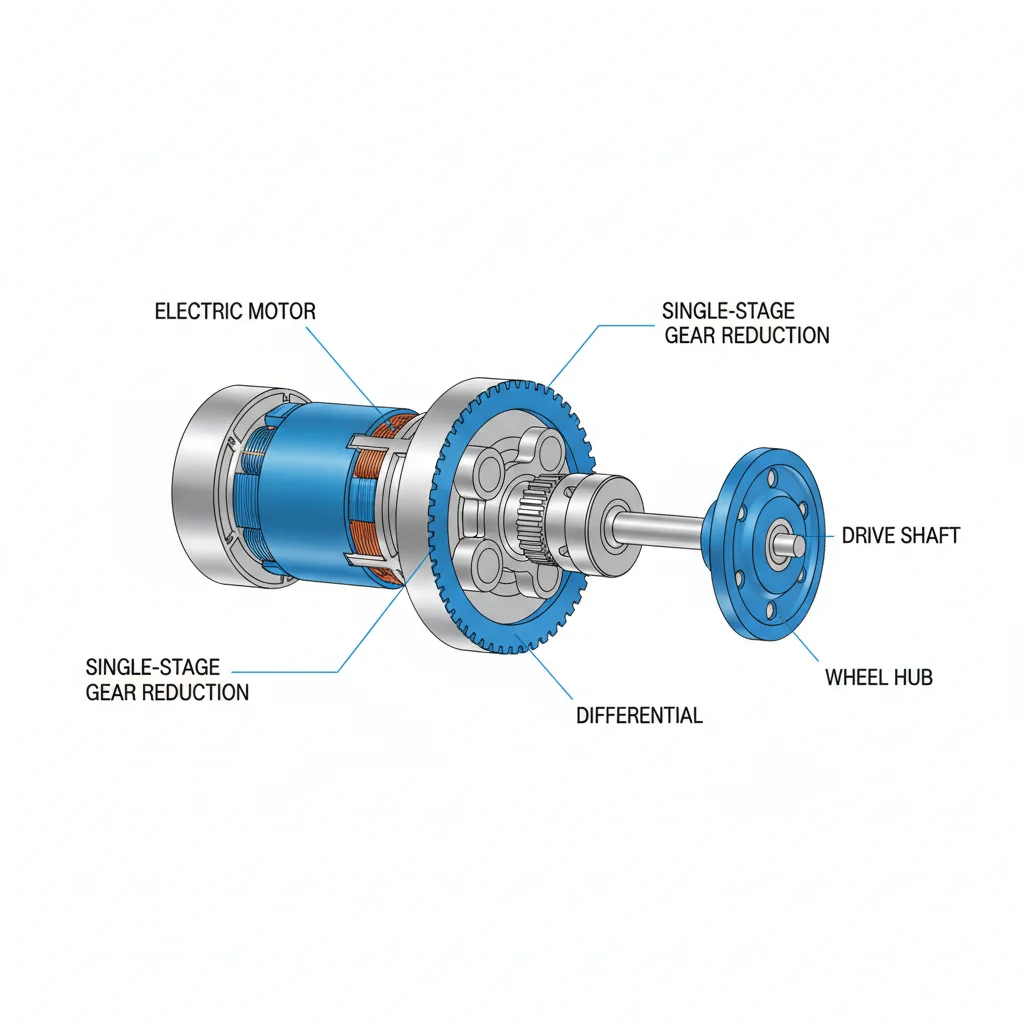
The vast majority of battery electric vehicles use a single fixed reduction gear, eliminating shift interruptions that momentarily break power delivery in gas vehicles.
Now here's the critical piece: a gasoline engine doesn't produce peak torque the moment you hit the gas. It produces peak torque somewhere in the middle of its RPM range — often between 2,000 and 5,000 RPM, depending on the engine. From a standstill at idle (roughly 700–900 RPM), you have to rev the engine up through its power band to get there. That takes time. That's the delay.
An electric motor works completely differently. It produces its maximum torque at zero RPM — meaning the instant the motor starts turning, it's already at peak pulling power. There's no power band to rev through. There's no delay.
“The electric motor is, in many ways, the ideal vehicle propulsion machine. It produces maximum torque at zero speed, its power-to-weight ratio is excellent, and it operates efficiently across an enormous speed range.”
— Mehrdad Ehsani, Professor of Electrical Engineering, Texas A&M University, and co-author of 'Modern Electric, Hybrid Electric, and Fuel Cell Vehicles'
Why Electric Motors Work This Way
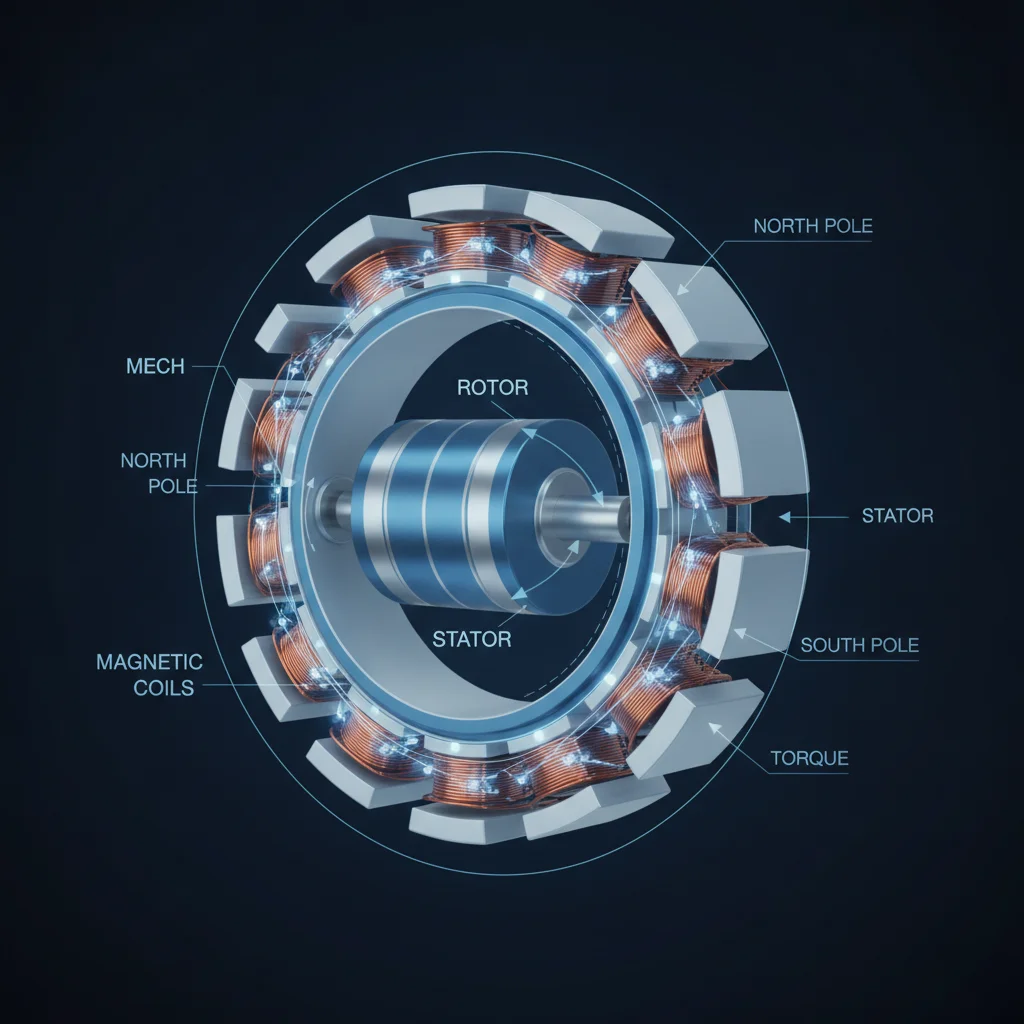
The physics comes down to how electric motors generate force. Inside an electric motor, torque is produced by the interaction between magnetic fields — specifically, the force exerted when current flows through a conductor in a magnetic field. The amount of torque produced is directly proportional to the amount of electrical current supplied.
When you press the accelerator in an EV, the car's controller tells the inverter to deliver current to the motor — essentially at the speed of electricity. The motor responds immediately. You don't need combustion, you don't need a starter sequence, you don't need fuel ignition. Current in, torque out, essentially instantaneously.
For a much deeper look at the internal mechanics, see how electric motors convert battery power into motion.
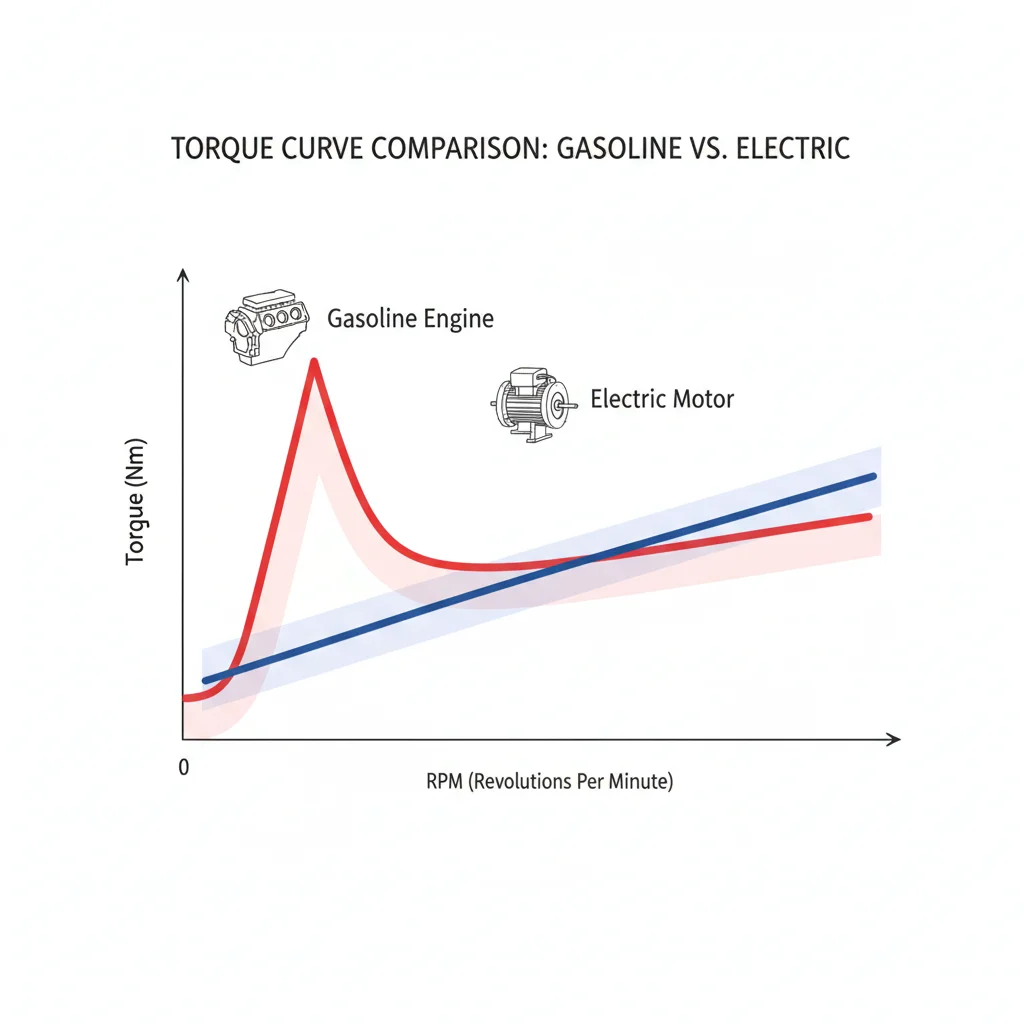
Gasoline engines, by contrast, use controlled explosions to push pistons, which turn a crankshaft. The torque generated depends on combustion pressure, which depends on how fast the engine is cycling (RPM). At low RPM, there are fewer combustion events per second, so less torque. You have to spin the engine faster — via revving or letting a torque converter do it — before the force builds up enough to feel strong.
Torque Is Managed, Not Simply Unleashed
Most EVs use software-controlled torque limits, especially in slippery conditions. The full instant-torque capability is modulated by traction control and stability systems to prevent wheelspin. This is why aggressive launches in wet conditions often feel more controlled in an EV than you might expect — the car is actively managing how quickly it delivers that available force.
Regenerative Braking Uses the Same Motor
The same electric motor that delivers instant torque on acceleration also acts as a generator during deceleration in regenerative braking mode. When you lift off the accelerator, the motor reverses its role and converts kinetic energy back into electrical energy stored in the battery. This is why EV drivers often describe 'one-pedal driving' — the car slows meaningfully without touching the brake pedal.
Performance Varies Significantly Between EV Models
Not all EVs are performance vehicles. An entry-level electric commuter like the Nissan Leaf will still feel quicker than a comparable gas economy car off the line, but its instant torque is far more modest than a dual-motor performance sedan. When comparing EVs, look at the stated torque figure (lb-ft) alongside the 0–60 time for the most complete picture of what to expect.
The Role of Gears — and Why Most EVs Don't Have Them
Traditional automatic and manual transmissions exist largely to keep gasoline engines operating in their narrow peak-power RPM range as vehicle speed changes. Low gears multiply torque from the engine (useful for starting), while higher gears reduce torque multiplication but allow the engine to maintain an efficient RPM at highway speeds. Shifting between gears takes a fraction of a second — and during that moment, there's a brief interruption in power delivery.
Electric motors don't need this. Because an electric motor can produce usable torque across a very wide RPM range — from zero to many thousands of RPM — a single fixed-ratio gear reduction is sufficient for most driving situations. You accelerate from 0 to highway speed without a single gear change, which means no interruption in that smooth power delivery.
For a complete breakdown of why most EVs are single-speed and when multiple speeds make sense, see single-speed vs. multi-speed EV drivetrains.
Test the 0–30 mph Pull, Not Just 0–60
When test-driving an EV, pay specific attention to how the car feels from a complete stop to about 30 mph. This is the range where electric motors have their biggest advantage over gasoline engines, and it's the speed range you'll use most in daily driving. A short 0–60 time is nice to have, but that 0–30 surge is what you'll actually live with every day.
Budget for Tires from Day One
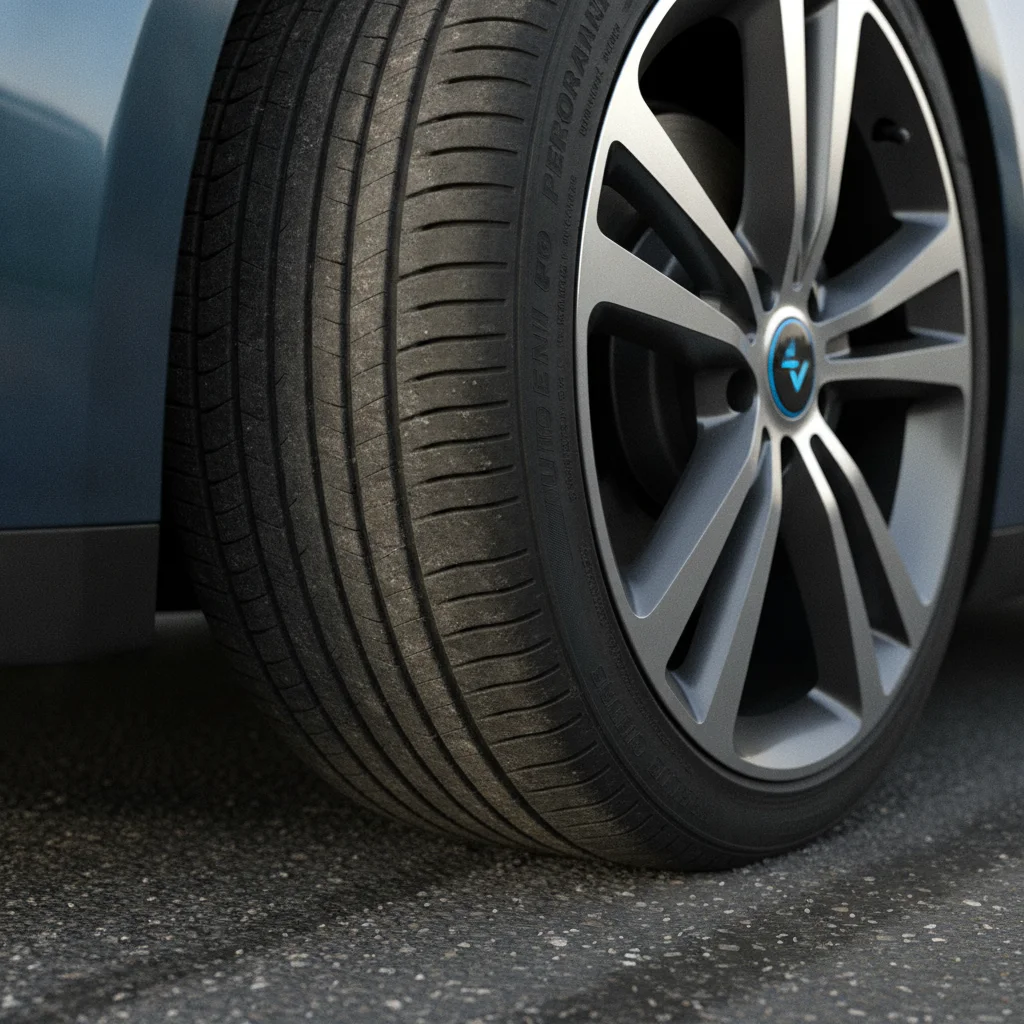
EV tires wear faster than most buyers expect due to instant torque and added vehicle weight. When calculating your total cost of ownership, factor in more frequent tire rotations (every 5,000–6,000 miles is common) and potentially shorter tire replacement cycles. Choosing EV-rated tires designed to handle torque loads can help extend wear life.
The practical result: in a gas car with an automatic transmission, you feel the car pull, then briefly settle, then pull again with each upshift. In an EV, the pull is continuous and unbroken from the moment you press the pedal to the moment you lift off. That smoothness amplifies the perception of speed even when the raw numbers might be similar.
What This Means When You're Shopping
Understanding instant torque changes how you should read EV performance specs — and how you should think about performance claims from automakers.
0–60 mph Times Are Useful but Incomplete
A 0–60 mph time captures the total run from standstill to highway speed. It's a useful benchmark for comparing vehicles, but it doesn't tell you how the power is distributed across that run. An EV that posts a 5.5-second 0–60 time might feel dramatically quicker than a gas car with the same number because most of that 5.5 seconds is spent accelerating above 40 mph. Below 40 mph — where most real-world driving happens — the EV is often far ahead of its gas rival.
Dual-Motor AWD Compounds the Effect
Many EVs offer dual-motor all-wheel drive, which places a separate electric motor on each axle. This arrangement doubles the torque available for launch and improves traction, allowing more of that instant torque to reach the ground without wheelspin. Performance EVs from brands across the spectrum use this architecture to achieve sub-3-second 0–60 times that rival exotic sports cars costing three times as much.
Don't Ignore What Instant Torque Costs You
Instant torque isn't all upside. The same force that makes your EV feel like a rocket off the line is constantly working on your tires every time you accelerate. EVs are also heavier than equivalent gas cars due to their battery packs, which compounds the wear. Tire wear on electric vehicles happens faster than most new EV owners expect — budget for it and check your rotation schedule.

If you're still sorting out which type of electrified vehicle makes sense for your situation, the EV Types Explained hub compares BEVs, PHEVs, and HEVs in plain terms. And if you're curious about how the broader EV lineup is named and categorized across brands, how automakers classify their electrified lineups is worth a read before you step onto a dealer lot.
Test the 0–30 mph Pull, Not Just 0–60
When test-driving an EV, pay specific attention to how the car feels from a complete stop to about 30 mph. This is the range where electric motors have their biggest advantage over gasoline engines, and it's the speed range you'll use most in daily driving. A short 0–60 time is nice to have, but that 0–30 surge is what you'll actually live with every day.
Budget for Tires from Day One
EV tires wear faster than most buyers expect due to instant torque and added vehicle weight. When calculating your total cost of ownership, factor in more frequent tire rotations (every 5,000–6,000 miles is common) and potentially shorter tire replacement cycles. Choosing EV-rated tires designed to handle torque loads can help extend wear life.
The Bottom Line on EV Acceleration
The reason EVs feel so fast off the line isn't marketing language — it's physics. Electric motors deliver peak torque at zero RPM, require no gear changes to maintain power delivery, and respond to driver input at the speed of electrical current. That combination creates an acceleration character that is genuinely different from anything a gasoline powertrain can replicate without extraordinary mechanical complexity.
As a buyer, this means you should test-drive an EV with specific attention to the 0–30 mph range, not just the 0–60 headline. That initial surge is what you'll experience at every stoplight, every merge, every parking-lot exit for as long as you own the car. For most drivers who experience it, it becomes one of the hardest things to give up when considering a return to a conventional vehicle.
Torque Is Managed, Not Simply Unleashed
Most EVs use software-controlled torque limits, especially in slippery conditions. The full instant-torque capability is modulated by traction control and stability systems to prevent wheelspin. This is why aggressive launches in wet conditions often feel more controlled in an EV than you might expect — the car is actively managing how quickly it delivers that available force.
Regenerative Braking Uses the Same Motor
The same electric motor that delivers instant torque on acceleration also acts as a generator during deceleration in regenerative braking mode. When you lift off the accelerator, the motor reverses its role and converts kinetic energy back into electrical energy stored in the battery. This is why EV drivers often describe 'one-pedal driving' — the car slows meaningfully without touching the brake pedal.
Performance Varies Significantly Between EV Models
Not all EVs are performance vehicles. An entry-level electric commuter like the Nissan Leaf will still feel quicker than a comparable gas economy car off the line, but its instant torque is far more modest than a dual-motor performance sedan. When comparing EVs, look at the stated torque figure (lb-ft) alongside the 0–60 time for the most complete picture of what to expect.
Know what you're getting into on the ownership side — tire wear, charging logistics (see AC vs. DC charging explained), and battery range — and the instant-torque experience becomes a sustainable advantage rather than a novelty. It's one of the genuinely compelling reasons to make the switch.

All claims are backed by peer-reviewed research. Sources on request.