Key Takeaways
PHEV Charge-Sustaining Mode
When a plug-in hybrid's battery pack is fully depleted, the vehicle automatically switches into what engineers call "charge-sustaining mode." In this state, the gasoline engine becomes the primary power source, keeping the battery at a minimum reserve level rather than letting it drain completely. The car keeps moving — you won't notice a sudden stall — but the fuel economy and driving dynamics shift noticeably from what you experienced in electric-only mode.
Charge-sustaining mode is distinct from a conventional hybrid's normal operation because PHEV gas engines are often tuned or sized primarily around the EV-first architecture, which can make them less thermally efficient in sustained charge-sustaining operation than a purpose-built full hybrid powertrain.
The Short Answer: The Gas Engine Steps In, Seamlessly
If you've ever wondered what happens the moment a plug-in hybrid's battery gauge hits zero, the straightforward answer is: not much that you'll physically feel. The transition is automatic and smooth. The gasoline engine, which has been waiting in the background, takes over propulsion. The car doesn't hesitate, lurch, or warn you to pull over.
What does change — sometimes significantly — is how efficiently the vehicle operates and how much you're spending per mile. That's the part most PHEV shoppers underestimate before they sign.
To understand why this matters, you need a quick picture of how a PHEV is fundamentally different from both a battery electric vehicle and a traditional full hybrid. A PHEV is designed to run on electricity first, using a relatively large battery pack (typically 8–25 kWh depending on the model) to cover a meaningful all-electric range — often 20 to 50 miles. The gasoline engine is physically present but deliberately kept out of the picture as long as there's charge available.
Plug-in hybrids exist precisely because most people's daily driving falls within that electric range, meaning many PHEV owners almost never burn gas on routine trips — as long as they plug in consistently.
What Charge-Sustaining Mode Actually Means
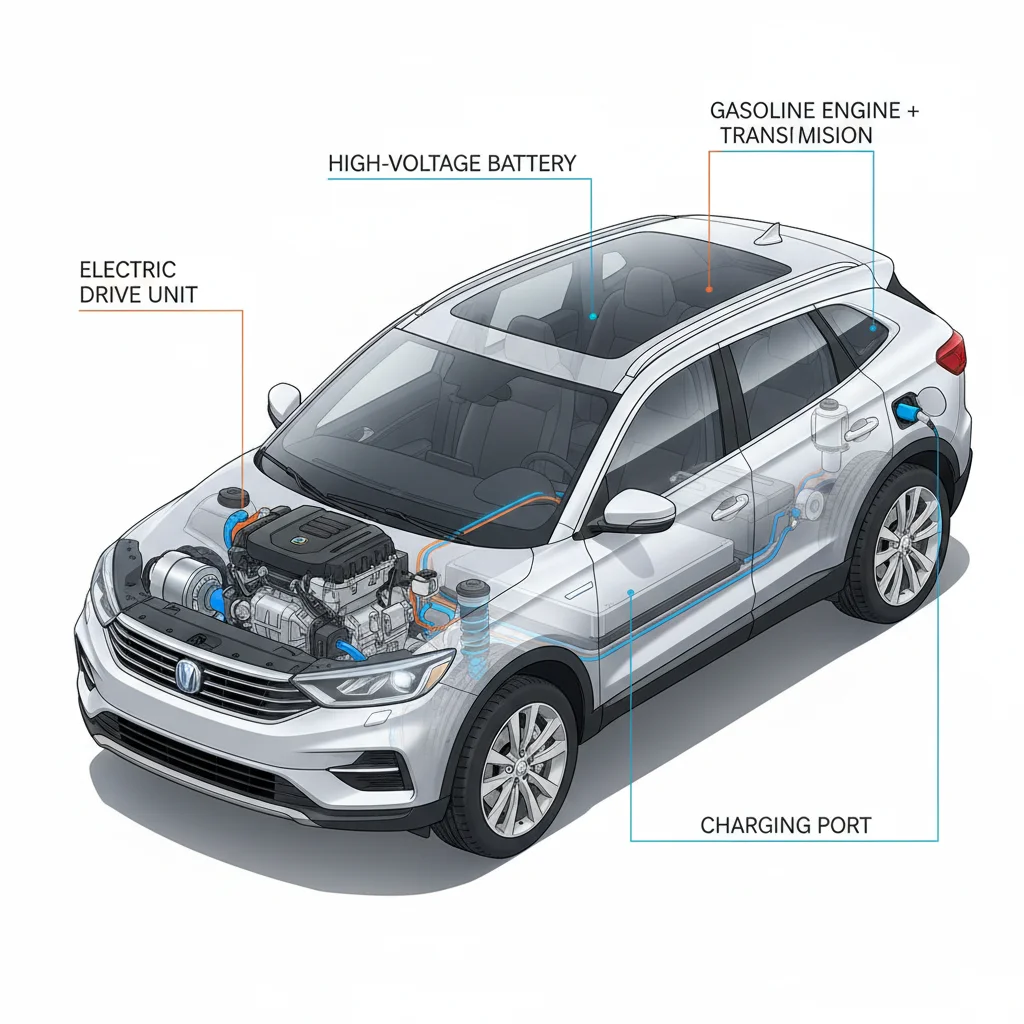
The technical term for a PHEV operating on a depleted battery is charge-sustaining mode. Once the usable battery pack is exhausted, the vehicle's control system shifts its objective: instead of drawing down stored electricity, it now works to hold the battery at a minimum reserve level — usually somewhere between 15% and 30% state of charge. That small reserve isn't wasted; it still allows the electric motor to assist during acceleration and captures energy through regenerative braking.
Here's what's actually happening under the hood in this mode:
- The gasoline engine runs more frequently, often continuously at highway speeds rather than cycling on and off as it does in a pure hybrid.
- The electric motor assists during hard acceleration, drawing on that small reserve buffer and replenishing it from the engine's generator function and regenerative braking.
- The battery neither fully charges nor fully drains — the system walks a narrow band, which is thermally and chemically kinder to battery longevity than constantly bottoming out.
This is meaningfully different from how a purpose-built full hybrid like a Toyota Camry Hybrid or Honda Accord Hybrid operates. Those vehicles have smaller batteries calibrated specifically for the constant charge-sustaining dance. Their powertrains, software, and engine sizing are all tuned around that operating mode as the primary use case. A PHEV's gas engine, by contrast, was designed to be the backup — and that distinction has real efficiency implications.
“Plug-in hybrids are genuinely efficient for the drivers they're designed for — but the data shows that a large share of PHEV owners never plug in regularly, effectively paying for an electric system they don't use while accepting lower fuel economy than a conventional hybrid would deliver.”
— John German, Senior Fellow, International Council on Clean Transportation (ICCT)
The difference between a full hybrid and a plug-in hybrid comes down to that charging capability — and what each architecture is optimized to do when electricity isn't available.
PHEV Fuel Economy Labels Can Be Misleading
EPA window stickers for PHEVs show two separate fuel economy figures: one for EV-only operation and one for charge-sustaining (gas-only) mode. The headline "MPGe" figure blends both, which can overstate real-world economy for drivers who don't charge regularly. Always look at the charge-sustaining MPG figure — that's what you'll live with if you're frequently on long drives or undercharging the vehicle.
Not All PHEVs Handle Charge-Sustaining Mode Equally
Toyota's PHEV systems (RAV4 Prime, Prius Prime) are widely considered among the best at efficient charge-sustaining operation, drawing on decades of hybrid powertrain refinement. Some European PHEVs — particularly those that bolted large battery systems onto existing gas platforms — are considerably less polished in this mode. Do your research on the specific model's charge-sustaining MPG before assuming all PHEVs behave similarly.
PHEVs and Mild Hybrids Are Not the Same Thing
A mild hybrid (MHEV) uses a small 48V battery to assist the engine but cannot propel the car on electricity alone — it has no plug and no meaningful EV range. A PHEV has a full electric drive capability and a plug. Conflating the two leads to misplaced expectations in both directions. <a href="/electric-vehicles/ev-basics/ev-types-explained/mild-hybrids-the-electrification-that-doesnt-drive-your-car">What mild hybrids actually do</a> is a more modest efficiency assist, not a backup drive system.
The MPG Reality: What to Expect at the Pump
Here's where things get concrete and sometimes uncomfortable for PHEV enthusiasts. In charge-sustaining mode, most PHEVs return fuel economy that is lower than what a comparable conventional hybrid would deliver on the same route — sometimes by a notable margin.
20–26 MPG
Typical PHEV gas-only fuel economy (charge-sustaining mode)
Based on EPA ratings for popular models including the Jeep Wrangler 4xe (~20 MPG) and Mitsubishi Outlander PHEV (~26 MPG combined) when operating without battery charge.
~38 MPG
Toyota RAV4 Hybrid combined MPG (no plug required)
The RAV4 Hybrid, a purpose-built full hybrid, outperforms most PHEVs on gas-only efficiency because its powertrain is optimized for charge-sustaining operation from the ground up.
20–50 miles
Typical PHEV all-electric range before engine engages
EPA all-electric range estimates vary widely by model — from around 20 miles for older PHEVs to over 40 miles for newer designs like the Toyota RAV4 Prime or Hyundai Tucson PHEV.
15–30%
Battery reserve maintained in charge-sustaining mode
Most PHEV systems maintain a minimum state of charge buffer — typically 15–30% — to support electric motor assist and protect battery longevity even when the 'usable' range is exhausted.
200–400 lbs
Estimated battery weight penalty vs. full hybrid
A PHEV's larger battery pack adds significant mass compared to a conventional hybrid's compact unit, which the gas engine must haul in charge-sustaining mode with no EV benefit to offset it.
Why the gap? Several engineering realities converge:
- Battery weight penalty. A PHEV carries a battery pack that can weigh 200–400 lbs more than a full hybrid's smaller unit. When the engine is doing all the work, it's hauling that extra mass for no EV benefit.
- Engine calibration priorities. Many PHEV engines are sized or tuned to complement an electric motor, not to operate at peak thermal efficiency on their own across varied real-world conditions.
- Less sophisticated hybrid integration in some designs. European automakers in particular have sometimes fitted large EV systems to gas engines that don't blend as gracefully as Toyota's or Honda's decades-refined hybrid systems.
Take the Mitsubishi Outlander PHEV as a practical example. Its EPA-rated fuel economy in charge-sustaining mode sits around 26 MPG combined — a reasonable number, but notably behind a non-plug-in Toyota RAV4 Hybrid at 38 MPG combined. The Jeep Wrangler 4xe, another popular PHEV, manages roughly 20 MPG when running on gas alone. If you frequently exhaust the battery without recharging, you're not just failing to capture the PHEV's advantage — you're potentially doing worse than a simpler, cheaper vehicle would have.
This is not a knock on PHEVs as a category. It's a calibration of expectations. For drivers who actually use the plug-in capability, the math works in their favor. For drivers who treat a PHEV like a conventional car, it rarely does.
Use the Charge-Sustaining MPG Number to Plan Your Costs
Before buying a PHEV, find the EPA's charge-sustaining MPG figure on fueleconomy.gov — not the blended MPGe. Calculate your cost for any portion of your driving that exceeds the EV range using that number. If the result isn't competitive with alternatives, the PHEV premium may not pay off for your specific commute pattern.
Learn Your PHEV's Hold Mode Before Your First Long Trip
Most PHEVs bury driving mode controls in infotainment menus or steering wheel paddle combos. Spend 10 minutes with your owner's manual before a highway trip to locate Hold and Save modes. Using Hold on efficient highway segments preserves battery for city driving at either end of your journey, improving your overall trip economy without any extra cost.
Does the Gas Engine Recharge the Battery? Sort Of.
This is one of the most persistent misunderstandings about PHEVs. Many buyers assume that driving long enough on gas will eventually top up the battery back to full. The reality is more nuanced.
In standard charge-sustaining mode, the engine and regenerative braking do maintain that minimum reserve — but they're not designed to push the battery back to 80–100% state of charge. Doing so would require the engine to run inefficiently as a generator, spending significant fuel energy just to produce electricity that could've come from the grid for a fraction of the cost.
Some PHEVs do offer a deliberate "Charge" mode (separate from charge-sustaining) that actively uses the engine to rebuild battery charge to a user-specified level. This is occasionally useful — for example, before entering a city with an EV zone requirement, or before a mountain descent where you want maximum regenerative braking capacity. But using this mode routinely as a substitute for plugging in is expensive and environmentally counterproductive. You're essentially burning gasoline to make electricity at roughly 20–25% efficiency, when grid electricity — even from a relatively carbon-heavy grid — delivers the same result far more cheaply.
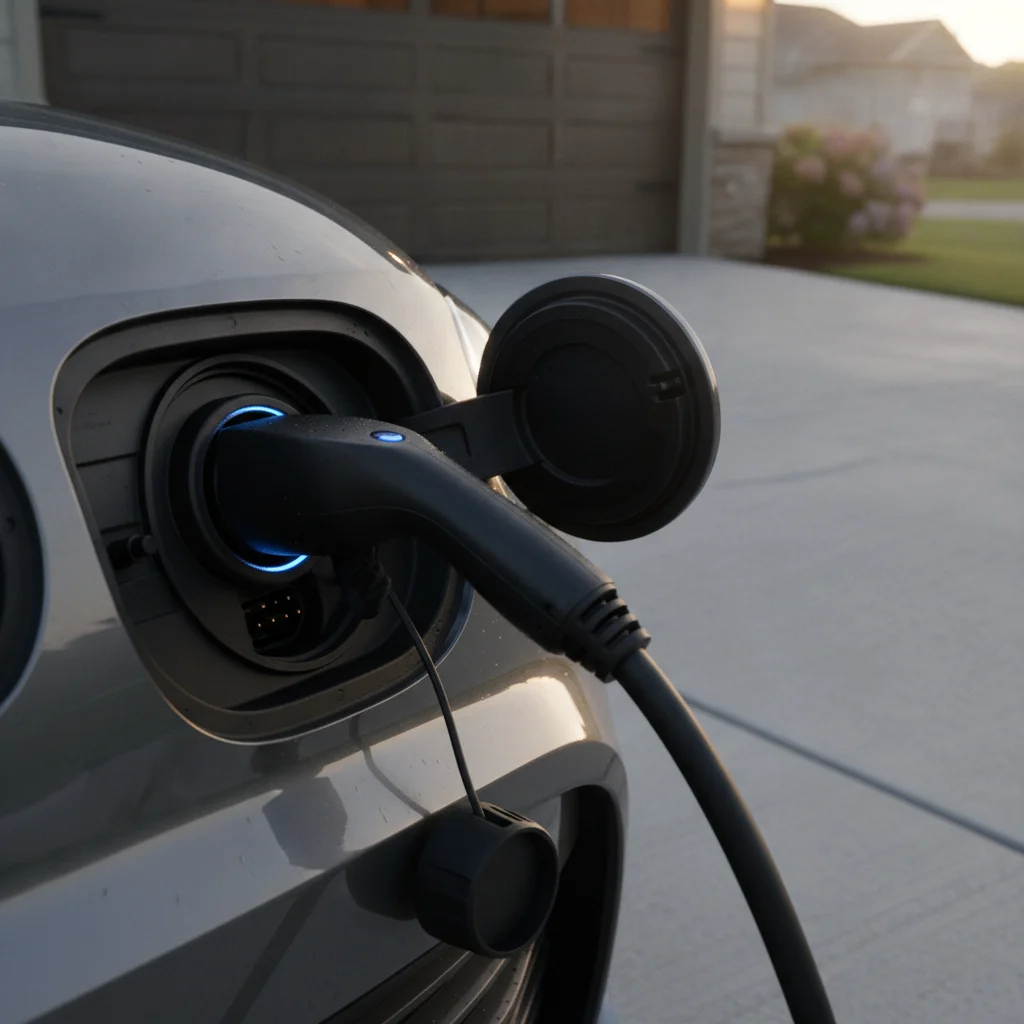
For a full picture of how a vehicle that never uses gasoline handles its energy, see how a battery electric vehicle powers itself. The contrast clarifies why PHEVs are a deliberate compromise, not a deficient EV.
Hold Mode and Save Mode: Tools Worth Knowing
Most modern PHEVs ship with driving modes that give you more control over when and how the gas engine engages. The two most practically useful are:
- Hold Mode (also called EV Hold or Battery Hold)
- Instructs the vehicle to maintain the current battery state of charge rather than drawing it down further. The car runs like a conventional hybrid, keeping the battery where it is. Use this when you want to preserve electric range for a portion of your trip where it's more valuable — city driving, traffic, or an emissions-restricted zone.
- Save Mode (or Charge Mode)
- Actively uses the engine to rebuild battery charge while driving. As noted above, this burns fuel to generate electricity, so it's not efficient as a daily habit — but it's occasionally the right tool for specific route planning.
- EV Mode
- Forces the car to run on electricity only, even at speeds or loads where the system might otherwise bring in the engine. Useful for short urban segments. Most systems will override this if battery falls below a safety threshold or if you demand maximum acceleration.
Understanding these modes transforms a PHEV from a car you just drive into a vehicle you can actively optimize. The drivers who get the best real-world numbers from PHEVs are the ones who engage with these controls deliberately, not just leaving the car in default "Auto" mode and hoping for the best.
Use the Charge-Sustaining MPG Number to Plan Your Costs
Before buying a PHEV, find the EPA's charge-sustaining MPG figure on fueleconomy.gov — not the blended MPGe. Calculate your cost for any portion of your driving that exceeds the EV range using that number. If the result isn't competitive with alternatives, the PHEV premium may not pay off for your specific commute pattern.
Learn Your PHEV's Hold Mode Before Your First Long Trip
Most PHEVs bury driving mode controls in infotainment menus or steering wheel paddle combos. Spend 10 minutes with your owner's manual before a highway trip to locate Hold and Save modes. Using Hold on efficient highway segments preserves battery for city driving at either end of your journey, improving your overall trip economy without any extra cost.
How a full hybrid manages energy without any of these mode choices is an interesting contrast — the simplicity of a conventional hybrid has its own appeal for drivers who don't want to think about charge management.
Who Actually Benefits From a PHEV — and Who Doesn't
The charge-sustaining mode question cuts right to the heart of the PHEV value proposition. These vehicles are architected for a specific driver profile, and they work exceptionally well for that profile while underperforming for nearly everyone else.
PHEVs make strong financial and practical sense for drivers who:
- Have a daily commute of 20–45 miles that falls within or near the EV range
- Have reliable access to Level 1 or Level 2 charging at home or work
- Take occasional longer trips where gas range matters and range anxiety around BEVs is a concern
- Live in a region with EV incentives — PHEVs often qualify for federal tax credits as well, though the structure differs from full EVs. See how the federal tax credit treats PHEVs vs. BEVs for a direct comparison.
PHEVs make less sense for drivers who:
- Lack home charging and would rely on public L2 or DC fast charging (which most PHEVs don't support at high speeds)
- Drive long highway miles daily, consistently beyond EV range
- Have no intent to plug in regularly — in which case a conventional hybrid or even a well-specified gas vehicle may deliver better value
The gas engine in a PHEV is not a flaw — it's a feature for a specific use case. But it only earns its keep when the electric system is doing the heavy lifting on daily miles, and the gas system handles what the battery can't. If the battery is always empty, the architecture is working against you.
PHEV Fuel Economy Labels Can Be Misleading
EPA window stickers for PHEVs show two separate fuel economy figures: one for EV-only operation and one for charge-sustaining (gas-only) mode. The headline "MPGe" figure blends both, which can overstate real-world economy for drivers who don't charge regularly. Always look at the charge-sustaining MPG figure — that's what you'll live with if you're frequently on long drives or undercharging the vehicle.
Not All PHEVs Handle Charge-Sustaining Mode Equally
Toyota's PHEV systems (RAV4 Prime, Prius Prime) are widely considered among the best at efficient charge-sustaining operation, drawing on decades of hybrid powertrain refinement. Some European PHEVs — particularly those that bolted large battery systems onto existing gas platforms — are considerably less polished in this mode. Do your research on the specific model's charge-sustaining MPG before assuming all PHEVs behave similarly.
PHEVs and Mild Hybrids Are Not the Same Thing
A mild hybrid (MHEV) uses a small 48V battery to assist the engine but cannot propel the car on electricity alone — it has no plug and no meaningful EV range. A PHEV has a full electric drive capability and a plug. Conflating the two leads to misplaced expectations in both directions. <a href="/electric-vehicles/ev-basics/ev-types-explained/mild-hybrids-the-electrification-that-doesnt-drive-your-car">What mild hybrids actually do</a> is a more modest efficiency assist, not a backup drive system.
For context on what you give up at the other end of the spectrum — vehicles where there's no engine at all — understanding how EVs work at a mechanical level helps clarify the trade-offs involved in any electrified powertrain choice.
Maintenance Implications When Running Mostly on Gas
One subtle but real concern for PHEV owners who rarely plug in: some components that benefit from electric-mode operation may see more wear than intended. Specifically:
- Engine wear at cold start: PHEVs that use EV mode for cold morning commutes reduce the number of cold-start engine cycles — among the most wear-intensive moments for any gasoline engine. Owners who skip plugging in lose this benefit.
- Brake wear is already low (regenerative braking handles much of the deceleration), but brake fluid and caliper maintenance still apply and shouldn't be overlooked. EV maintenance basics covers what's shared and what's different across electrified vehicles.
- Oil change intervals: Because PHEVs using EV mode may run the engine less frequently, some manufacturers extend oil change intervals — but this only applies if you're actually accumulating fewer engine-on miles. Drivers in charge-sustaining mode most of the time should follow conventional oil change schedules.
- Transmission fluid and cooling system: The hybrid system's power electronics and thermal management components have their own service needs, separate from the gas drivetrain — check your owner's manual rather than assuming standard intervals.
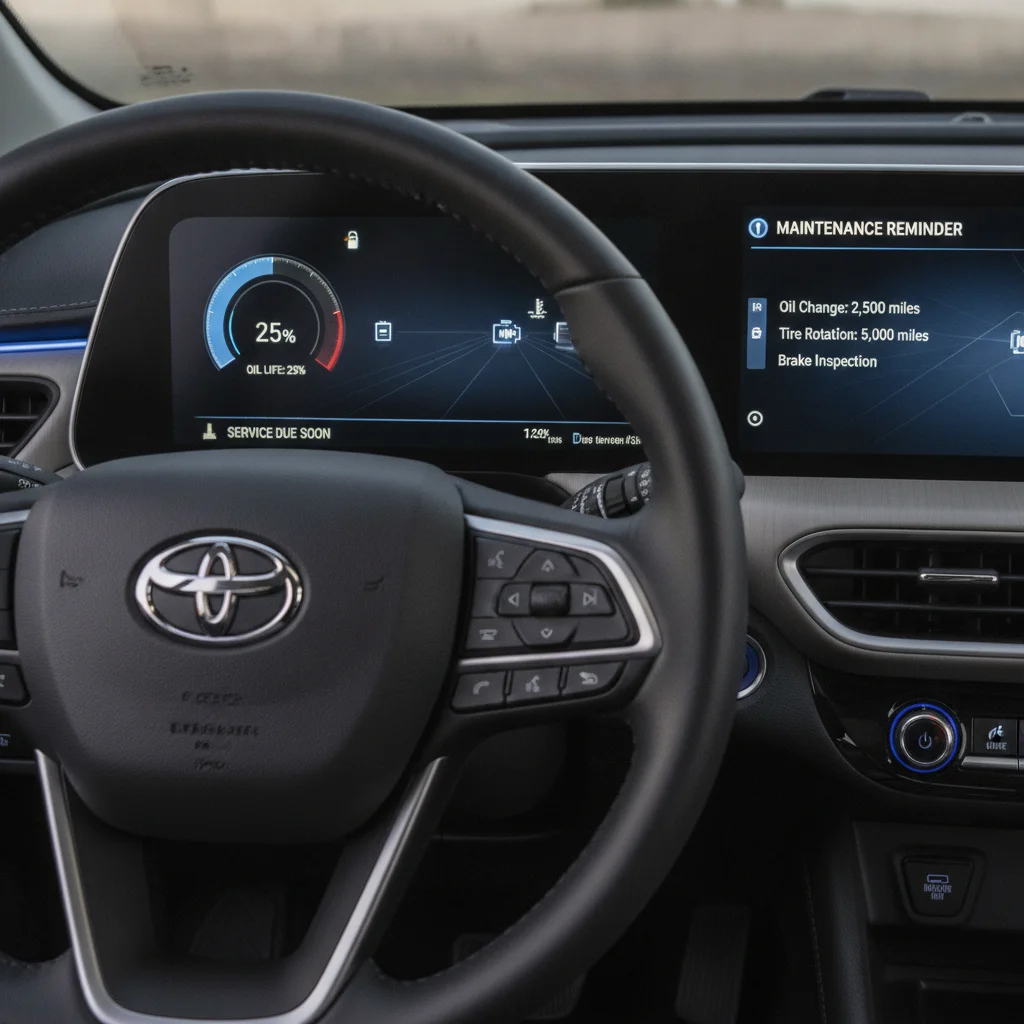
None of this is dramatically different from conventional vehicle ownership, but it does mean a PHEV isn't a simple car — it's two powertrains in one, each with its own upkeep considerations.

All claims are backed by peer-reviewed research. Sources on request.