Key Takeaways
Battery Electric Vehicle (BEV)
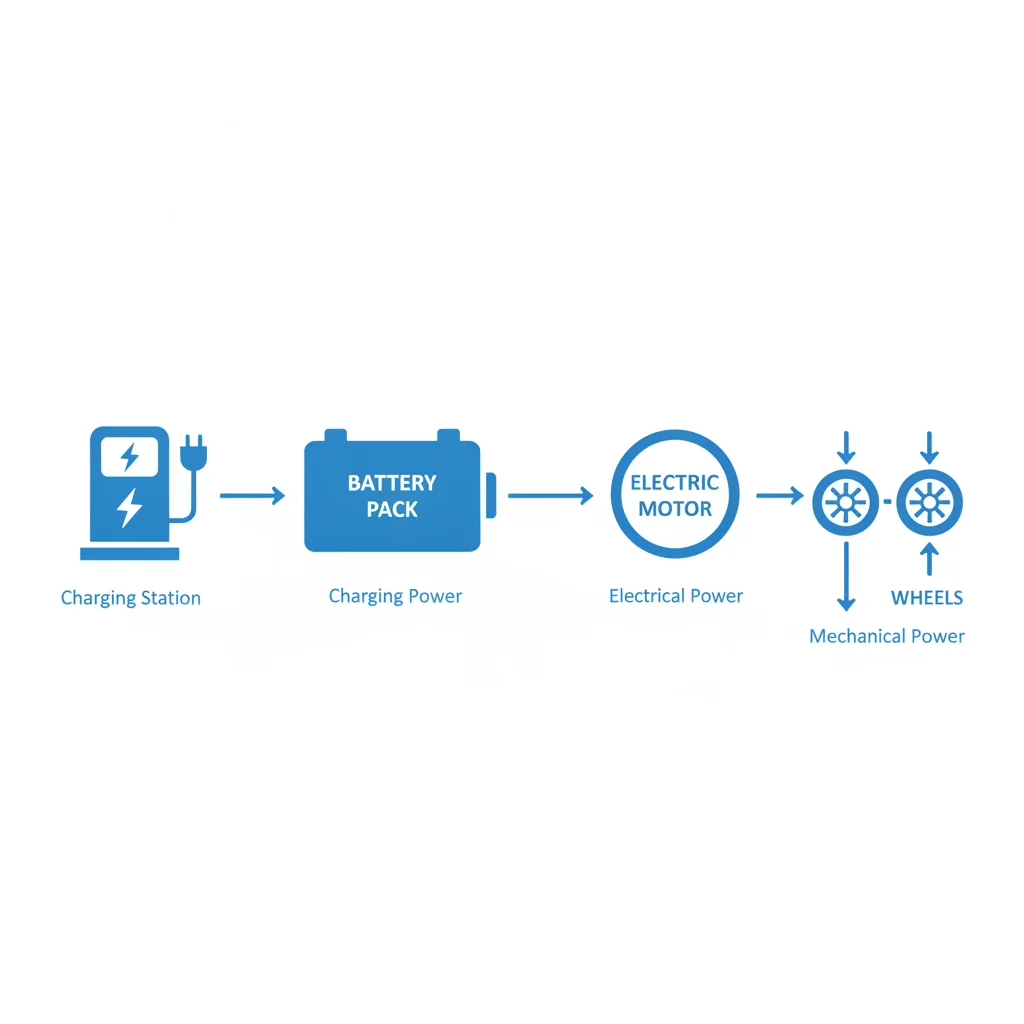
A battery electric vehicle is a car, truck, or SUV that runs entirely on electricity stored in a large onboard battery pack. There is no gasoline engine, no fuel tank, and no exhaust pipe. You charge the battery from an external power source — a home outlet, a Level 2 charger, or a DC fast charger — and the stored energy powers one or more electric motors that turn the wheels. When the battery is depleted, you recharge it; you never visit a gas station.
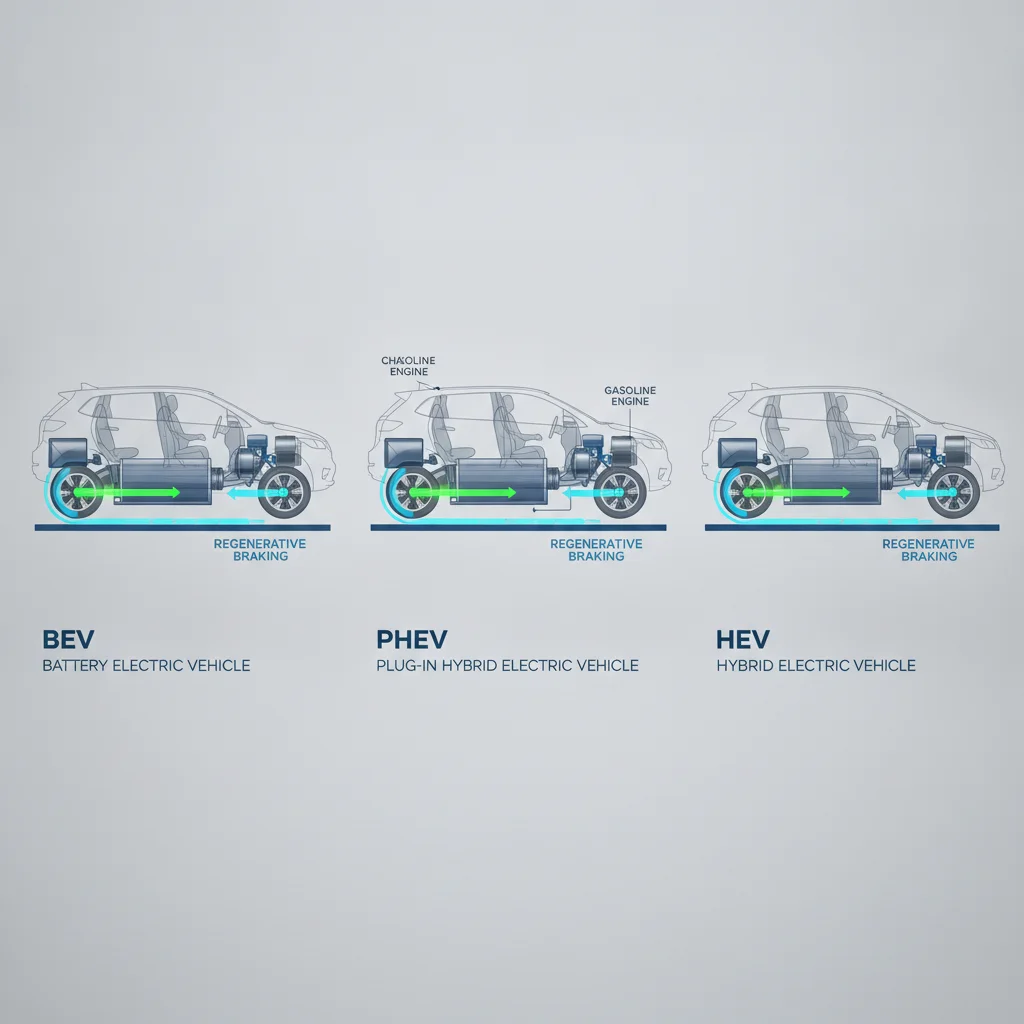
BEVs are distinct from plug-in hybrid electric vehicles (PHEVs) and hybrid electric vehicles (HEVs), both of which retain internal combustion engines. A BEV's drivetrain converts electrical energy to mechanical energy with roughly 85–90% efficiency, compared to roughly 30–40% for a conventional gasoline engine.
The Core Idea: Stored Electricity Replaces Liquid Fuel
Every vehicle needs an energy source and a way to convert that energy into motion. A gasoline car burns fuel inside an engine to create heat and pressure, which pushes pistons that ultimately turn the wheels. It's a chain of controlled explosions happening dozens of times per second — and most of that energy is lost as heat before it ever moves the car.
A battery electric vehicle skips combustion entirely. Instead, it stores electrical energy in a large battery pack — think of it as a very sophisticated, very large rechargeable battery — and delivers that energy to an electric motor on demand. The motor converts electrical energy directly into rotational force. The process is quieter, cleaner, and considerably more efficient than anything a combustion engine can match.
Understanding how that energy flows from the wall outlet to the wheels helps you evaluate BEVs more objectively — and understand why they behave so differently from gas vehicles in everyday use. For a broader look at the full powertrain, see our complete introduction to the all-electric powertrain.
The Battery Pack: Where the Energy Lives
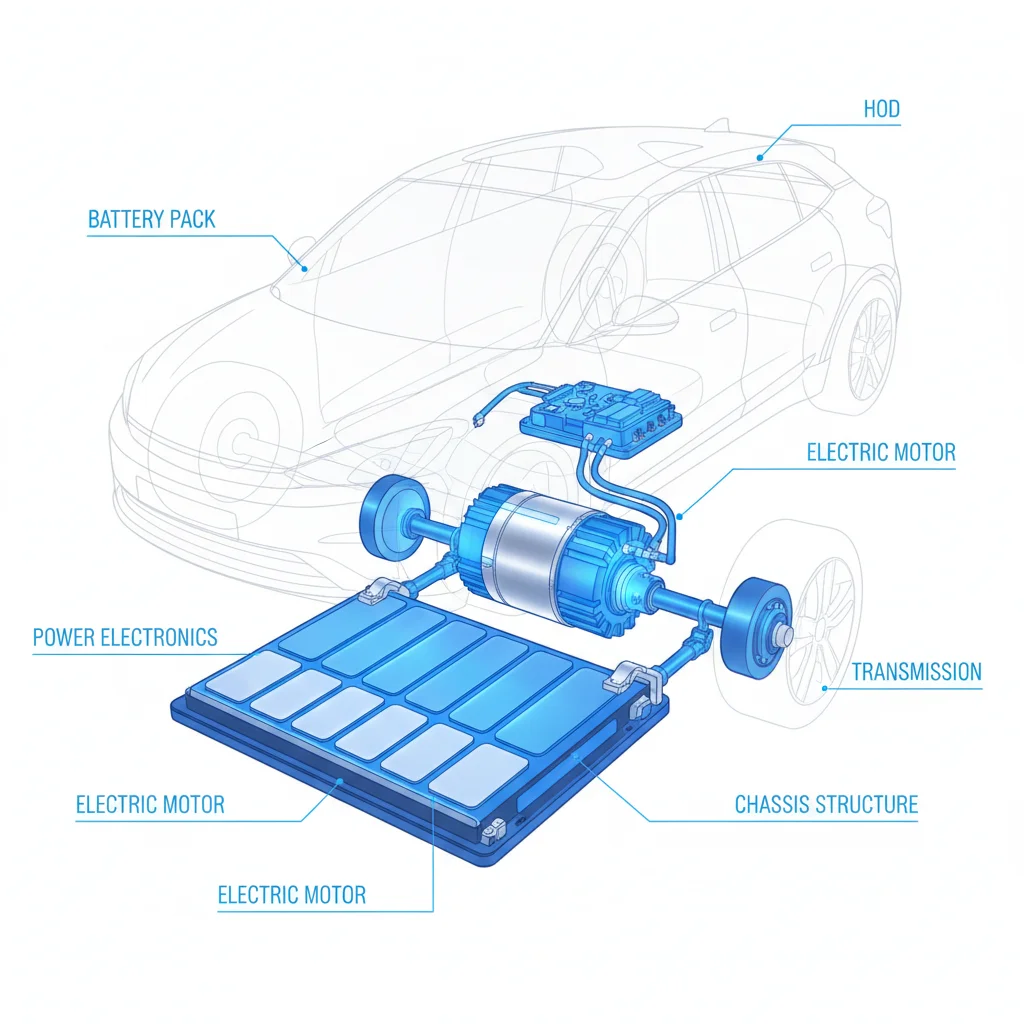
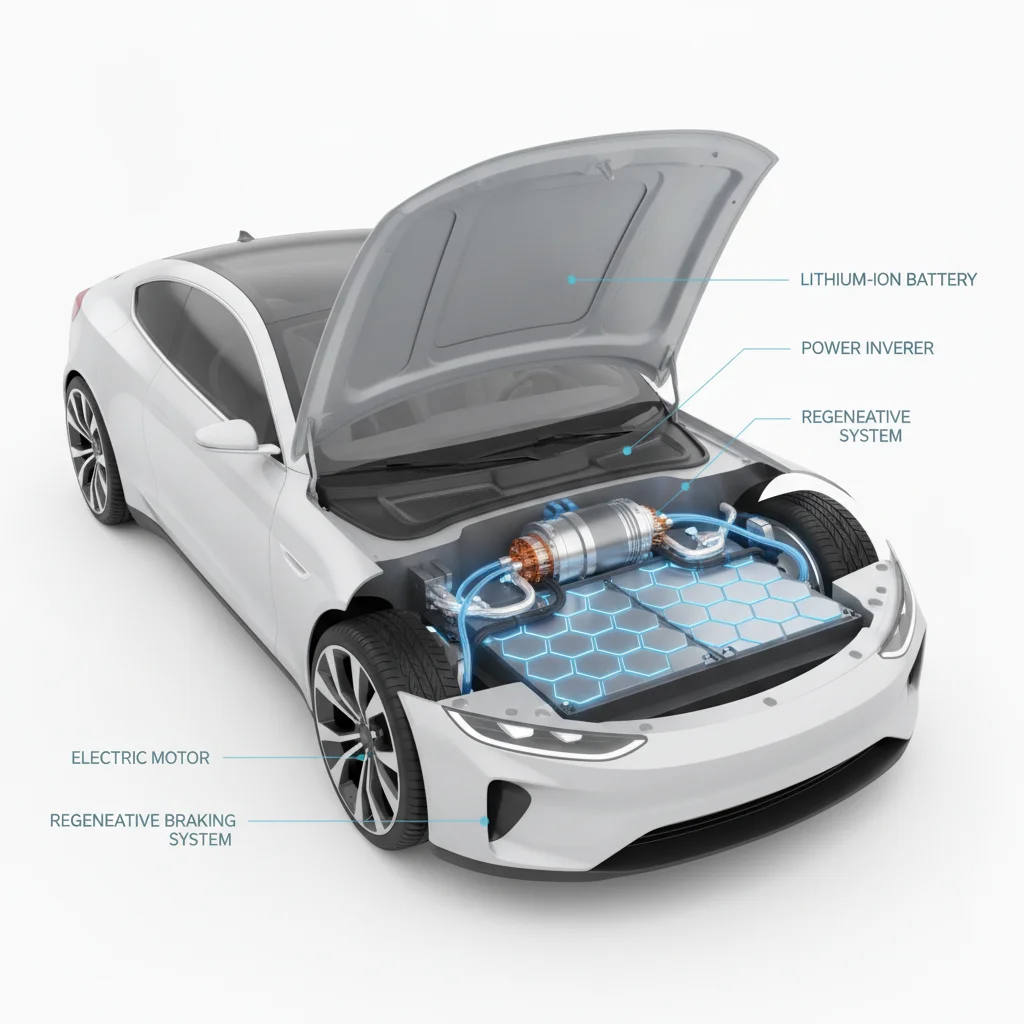
The battery pack is the heart of a BEV. It's typically mounted flat along the vehicle's floor — a configuration called a skateboard platform — which lowers the center of gravity and improves handling. The pack is composed of thousands of individual battery cells grouped into modules, which are then assembled into the full pack.
Most BEVs today use lithium-ion chemistry, the same fundamental technology in your smartphone or laptop, but engineered to a completely different scale. Battery capacity is measured in kilowatt-hours (kWh). A compact commuter EV might carry a 40–60 kWh pack. A long-range truck or SUV can exceed 130 kWh. More capacity generally means more range, but also more weight and a higher purchase price.
85–90%
BEV powertrain energy efficiency
Electric drivetrains convert roughly 85–90% of stored energy into wheel motion, versus roughly 30–40% for conventional gasoline engines, per U.S. Department of Energy data.
100,000 mi
Federal EV battery warranty minimum
U.S. federal regulations require automakers to warranty EV battery packs for at least 8 years or 100,000 miles, whichever comes first.
200+ miles
Typical BEV range added per DCFC session
A 20–40 minute DC fast charging session can add over 200 miles of range on many current-generation BEVs, depending on the vehicle's acceptance rate and charger output.
~3¢–5¢
Average cost per mile to charge at home
Based on national average electricity rates and typical BEV efficiency figures, home charging typically costs 3–5 cents per mile, versus 10–15 cents per mile for a gasoline vehicle at current fuel prices.
1
Moving parts in a basic electric motor
A brushless electric motor has essentially one primary moving part — the rotor — compared to hundreds of moving parts in a typical internal combustion engine, per engineering literature.
The battery management system (BMS) is the software layer that monitors every cell in the pack. It regulates temperature, balances charge distribution across cells, and enforces charge and discharge limits to protect longevity. Without the BMS, a lithium-ion pack would degrade rapidly or, in extreme cases, become a safety hazard. It's one of the most important engineering components in any BEV, and it operates invisibly in the background every time you drive or charge.
Why Battery Thermal Management Matters
Lithium-ion cells perform best within a specific temperature range — typically around 60°F to 90°F. Charging or discharging a battery pack when it's very cold or very hot accelerates degradation. This is why most BEVs include active thermal management systems (liquid cooling or heating) for the battery pack. Some manufacturers also offer a "battery preconditioning" feature that brings the pack to optimal temperature before DC fast charging, which speeds up charging and reduces wear on the cells.
BEV vs. Fuel Cell Electric Vehicle
A fuel cell electric vehicle (FCEV) also uses an electric motor but generates its electricity onboard by combining hydrogen and oxygen in a fuel cell stack, rather than drawing from a stored battery pack. Both are zero-emission at the tailpipe, but they represent fundamentally different energy storage and delivery strategies. FCEVs remain niche in the U.S. market due to limited hydrogen fueling infrastructure.
The Inverter: Translating Power the Motor Can Use
Here's a detail that surprises many first-time EV shoppers: the battery stores energy as direct current (DC), but most electric motors in BEVs run on alternating current (AC). The inverter bridges that gap.
The inverter is a power electronics unit that converts DC from the battery into three-phase AC electricity, which the motor uses to generate torque. It also controls motor speed and output by adjusting the frequency and amplitude of that AC signal. In practical terms, the inverter is what makes the throttle response so immediate and precise in an electric vehicle — there's no lag, no gear hunting, no waiting for a turbocharger to spool up.
When the car decelerates or brakes, the inverter runs the process in reverse: it converts the motor's generated AC back to DC to recharge the battery. That's regenerative braking in action — a topic covered in depth in our article on how regenerative braking works across different EV types.
The Electric Motor: Turning Electricity Into Motion
Electric motors work through electromagnetism. When alternating current flows through the motor's stator (the stationary outer component), it creates a rotating magnetic field. The rotor (the spinning inner component) follows that field, converting electrical energy into rotational mechanical energy. That rotation is transmitted to the wheels, directly or through a fixed-ratio gearbox — no traditional multi-speed transmission required.
This is why BEVs deliver maximum torque from a standstill. In a combustion engine, torque builds as the engine accelerates through its RPM range. In an electric motor, peak torque is available the instant current flows. It's the physical reason a modest-looking electric sedan can out-accelerate a much more powerful-looking sports car from a traffic light.
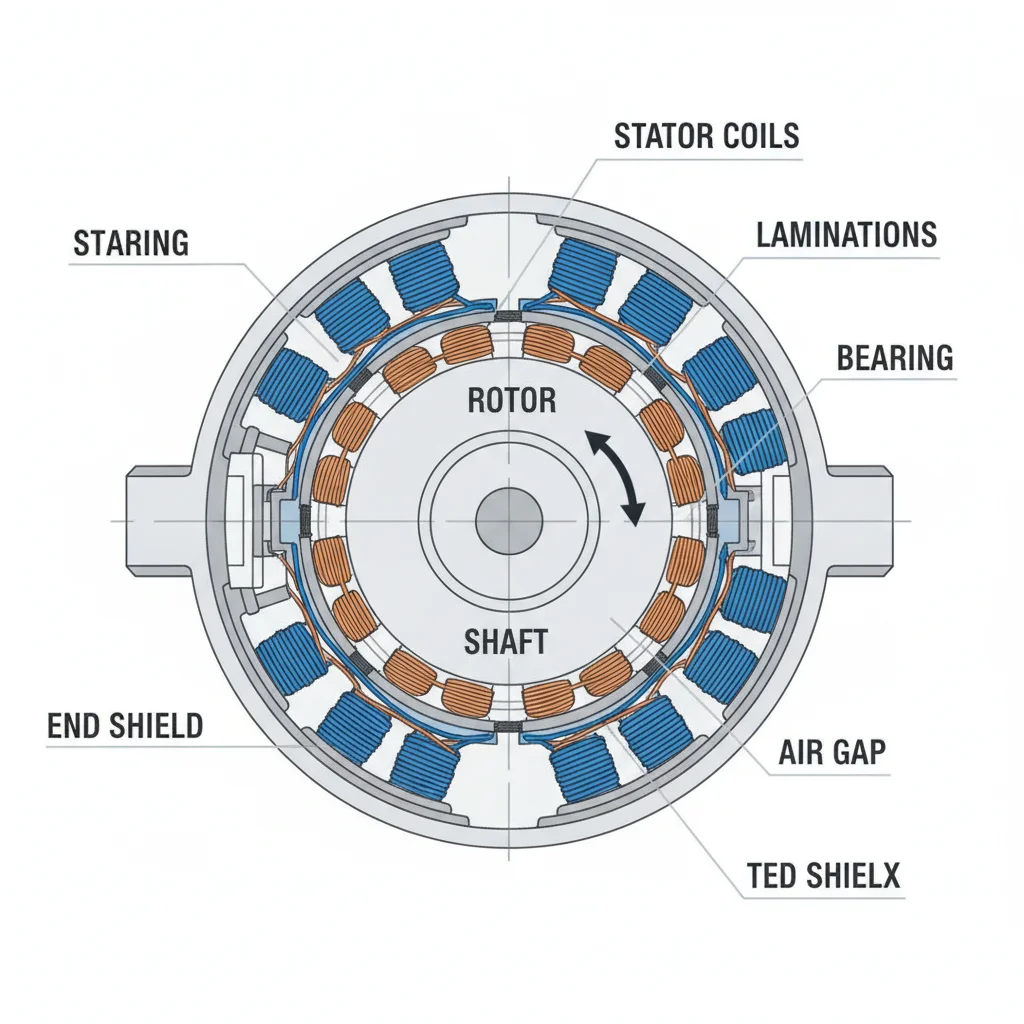
BEVs may use different motor types depending on the manufacturer's priorities:
- Permanent magnet synchronous motors (PMSM): High efficiency and strong power density. Common in most mainstream BEVs including many Tesla models and most Korean and Japanese offerings.
- Induction (AC asynchronous) motors: Durable and cost-effective, without relying on rare-earth magnets. Tesla used these in earlier rear-drive models; some manufacturers combine both types across axles.
- Wound-rotor synchronous motors: Used by some manufacturers (notably Renault and some GM applications) to avoid rare-earth dependency while maintaining efficiency.
Many BEVs use dual-motor all-wheel-drive setups, with one motor per axle. This gives engineers precise, millisecond-level torque vectoring between the front and rear — traction and handling performance that mechanical AWD systems can't match.
“The electric motor is one of the most efficient machines humans have ever engineered. When you pair that with modern lithium-ion storage, you get a drivetrain that makes the internal combustion engine look extraordinarily wasteful by comparison.”
— Venkat Srinivasan, Director, Argonne Collaborative Center for Energy Storage Science, Argonne National Laboratory
How Charging Works: Refilling the Tank Electrically
Charging a BEV is conceptually simple: you connect the car to an electrical power source, and current flows into the battery. The complexity lies in how fast that transfer happens, and what hardware sits between the outlet and the cells.
There are three levels of charging commonly discussed in the U.S.:
- Level 1 (120V AC): Standard household outlet. Adds roughly 3–5 miles of range per hour. Practical for plug-in hybrids or BEV drivers with modest daily mileage, but slow for most full-electric use cases.
- Level 2 (240V AC): Requires a dedicated circuit and either a portable EVSE or a hardwired wall unit. Adds 15–30+ miles per hour depending on the car's onboard charger capacity. The standard home charging solution for BEV owners.
- DC Fast Charging (DCFC): Bypasses the onboard charger and delivers high-voltage DC directly to the battery. Adds 100–200+ miles in 20–40 minutes on capable vehicles. The road trip solution, found at public charging networks like Tesla Supercharger, Electrify America, and EVgo.
One technical limit to be aware of: the car's onboard charger determines how fast it can accept AC power. A vehicle with a 7.2 kW onboard charger will charge at that rate regardless of whether the Level 2 station could deliver more. DCFC bypasses this constraint, which is why fast charging rates are often listed separately and tend to be much higher.
Set Your Home Charger to Charge Overnight
Most utility companies offer off-peak electricity rates during overnight hours — typically midnight to 6 a.m. — that can cut your charging cost by 30–50% compared to peak daytime rates. Set your BEV's built-in charge scheduler to take advantage of these windows. Over the course of a year, it can add up to hundreds of dollars in savings with zero change to your morning routine.
Limit Frequent 100% Charges for Long-Term Battery Health
Charging to 100% regularly can accelerate lithium-ion degradation over time. Most BEV manufacturers recommend keeping daily charges in the 80–90% range and reserving full charges for long trips. Many vehicles let you set a charge limit in the app or infotainment system. Check your owner's manual for the manufacturer's specific recommendation — some packs are engineered to tolerate regular full charges better than others.
Regenerative Braking: Getting Energy Back on Every Trip
One of the underappreciated efficiencies of a BEV is that deceleration is never purely wasted energy. When you lift off the accelerator or apply the brakes, the electric motor reverses its role and functions as a generator. The wheels' rotational energy spins the rotor, which induces current in the stator, which flows back through the inverter and into the battery pack as DC electricity.
The amount of energy recovered depends on how aggressively the car is set to regen, how fast you're decelerating, and the battery's current state of charge. In urban driving with frequent stops, regenerative braking can meaningfully extend range — some drivers report 10–15% improvements in city driving versus what they'd achieve with conventional friction braking alone.
Many BEVs allow drivers to adjust regen intensity. Some offer a "one-pedal driving" mode where lifting off the accelerator brings the car nearly to a stop without touching the brake pedal. It's a driving style that takes some adjustment but quickly becomes intuitive — and it's easier on brake pads too, since friction brakes are needed less often. For a deeper look at how this works across different electrified vehicle categories, see our article on regenerative braking across EV types.
How BEVs Compare to PHEVs and Hybrids
Understanding a BEV is easier when you compare it directly to its electrified cousins. All three — BEV, PHEV, and HEV — use electric motors and batteries, but the role of each component differs significantly.
| Feature | BEV | PHEV | HEV |
|---|---|---|---|
| Has a gas engine? | No | Yes | Yes |
| Plugs in to charge? | Yes | Yes | No |
| Can run on electricity only? | Always | Limited range | Only at low speeds briefly |
| Fuel required? | Never | Yes, once battery depletes | Always |
| Battery size | Large (40–130+ kWh) | Medium (8–25 kWh) | Small (1–2 kWh) |
The PHEV is often marketed as a "best of both worlds" option, but it carries the mechanical complexity of both powertrains simultaneously. Once the battery is drained, the gas engine takes over in a PHEV — and not with the efficiency of a dedicated hybrid. For buyers who can charge regularly, a BEV eliminates that compromise entirely.
The practical upshot for buyers: if your daily driving needs fall within a BEV's range and you have access to home or workplace charging, the all-electric option is almost always the most efficient and lowest-cost-to-operate choice over time. For more on that calculus, see BEV pros and cons: life without a gas engine.
What This Means for Maintenance and Ownership Costs
The mechanical simplicity of a BEV's powertrain has a direct effect on what it costs to own one. No combustion means no oil changes, no spark plugs, no timing belts, no exhaust system, no catalytic converters. Electric motors have one moving part. Transmissions, if present, are fixed-ratio units with no clutch packs to wear out.
What BEVs do require: tire rotations (actually more frequent, because EVs are heavier and torque can accelerate tire wear), cabin air filter replacements, brake fluid checks, and windshield wiper maintenance. The battery pack and thermal management system require periodic monitoring, and the cooling system for the battery should be serviced per manufacturer recommendations.
Long-term, the big unknown for most buyers is battery degradation. Lithium-ion cells lose capacity over time and charge cycles, though the rate is slower than many people fear. Data from high-mileage BEV fleets suggests that most packs retain 80–90% of original capacity at 100,000 miles under normal use. The battery management system's role in preventing thermal stress and overcharging is the primary reason for that durability.
For a comprehensive breakdown of what routine EV ownership actually entails, explore our EV maintenance basics hub. And for the foundational understanding of how all these components fit together, the How EVs Work hub covers motors, batteries, and drivetrains in plain language.
Set Your Home Charger to Charge Overnight
Most utility companies offer off-peak electricity rates during overnight hours — typically midnight to 6 a.m. — that can cut your charging cost by 30–50% compared to peak daytime rates. Set your BEV's built-in charge scheduler to take advantage of these windows. Over the course of a year, it can add up to hundreds of dollars in savings with zero change to your morning routine.
Limit Frequent 100% Charges for Long-Term Battery Health
Charging to 100% regularly can accelerate lithium-ion degradation over time. Most BEV manufacturers recommend keeping daily charges in the 80–90% range and reserving full charges for long trips. Many vehicles let you set a charge limit in the app or infotainment system. Check your owner's manual for the manufacturer's specific recommendation — some packs are engineered to tolerate regular full charges better than others.

All claims are backed by peer-reviewed research. Sources on request.