Key Takeaways
PHEV Electric Range
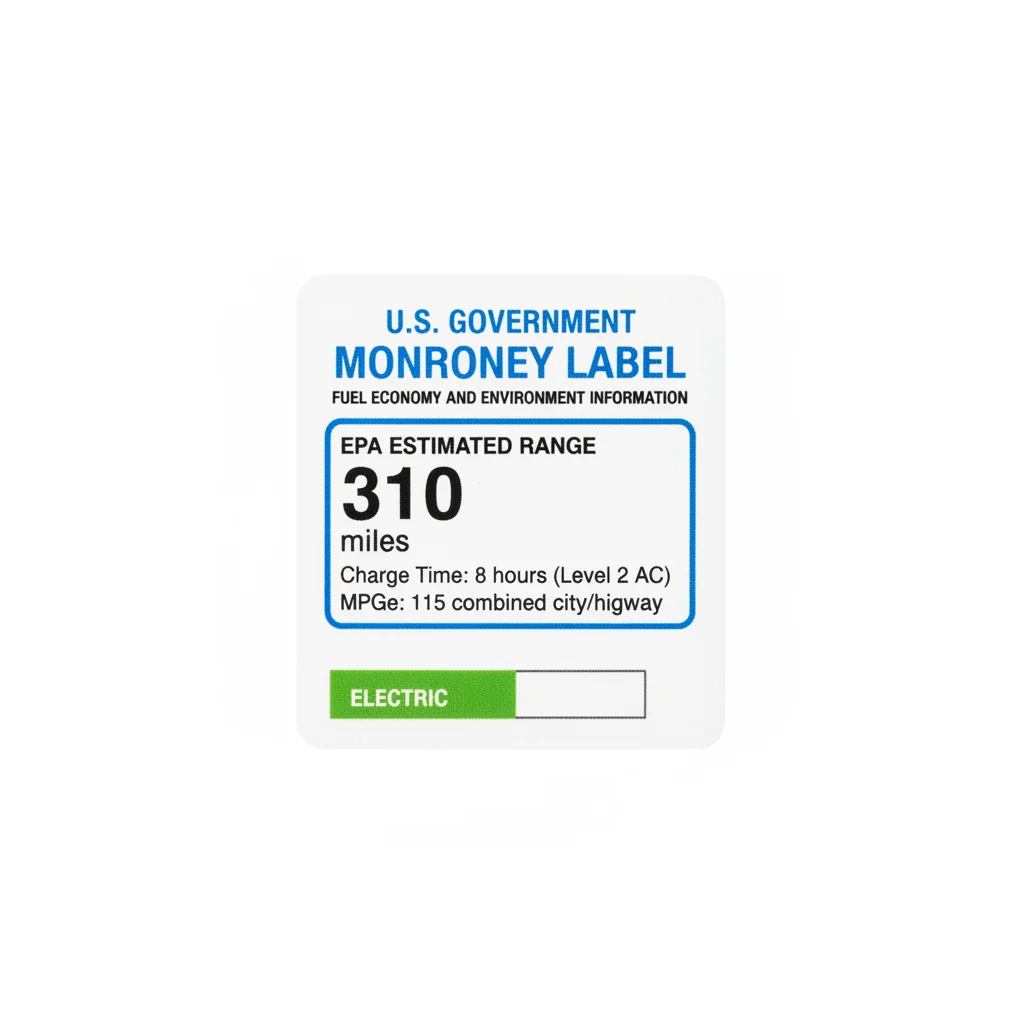
The 'electric range' figure on a plug-in hybrid electric vehicle (PHEV) window sticker is the EPA's estimate of how many miles the car can travel using only battery power before the gasoline engine takes over. It is tested under controlled laboratory conditions and represents an idealized scenario, not your real-world commute. Most PHEVs today show electric ranges between 20 and 50 miles.
The EPA measures PHEV electric range using a two-cycle test (City and Highway), and the combined figure is calculated at a specific ambient temperature and steady load. Battery capacity usable for propulsion is always less than the gross kWh figure on the spec sheet due to buffer zones built in by the manufacturer.
Why the Window Sticker Number Needs a Second Look
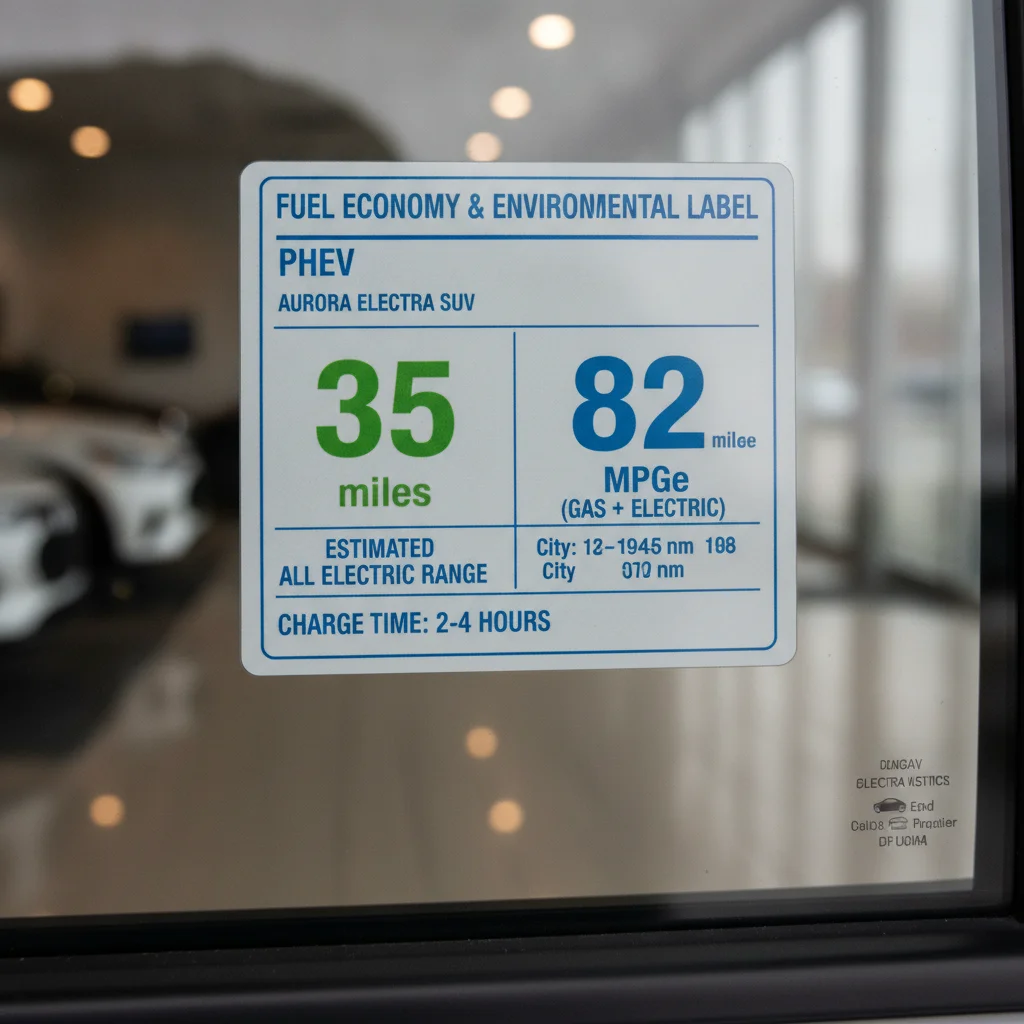
Walk onto any dealership lot and you'll see a PHEV window sticker proudly listing something like "30 miles electric range" or "42 miles EV-only." It sounds precise. It sounds like a promise. It is neither.
That number is the EPA's official estimate, produced in a laboratory under conditions that rarely match your actual drive to work. Understanding what that figure captures — and what it quietly ignores — is one of the most practical things you can do before signing a purchase agreement on a plug-in hybrid.
The confusion is understandable. PHEVs sit in a genuinely complex middle ground between conventional hybrids and fully battery-electric vehicles. They have two powertrains, two fuel sources, and two separate efficiency ratings on the same sticker. For a buyer coming from a gasoline car, parsing all of that in a showroom is not easy.
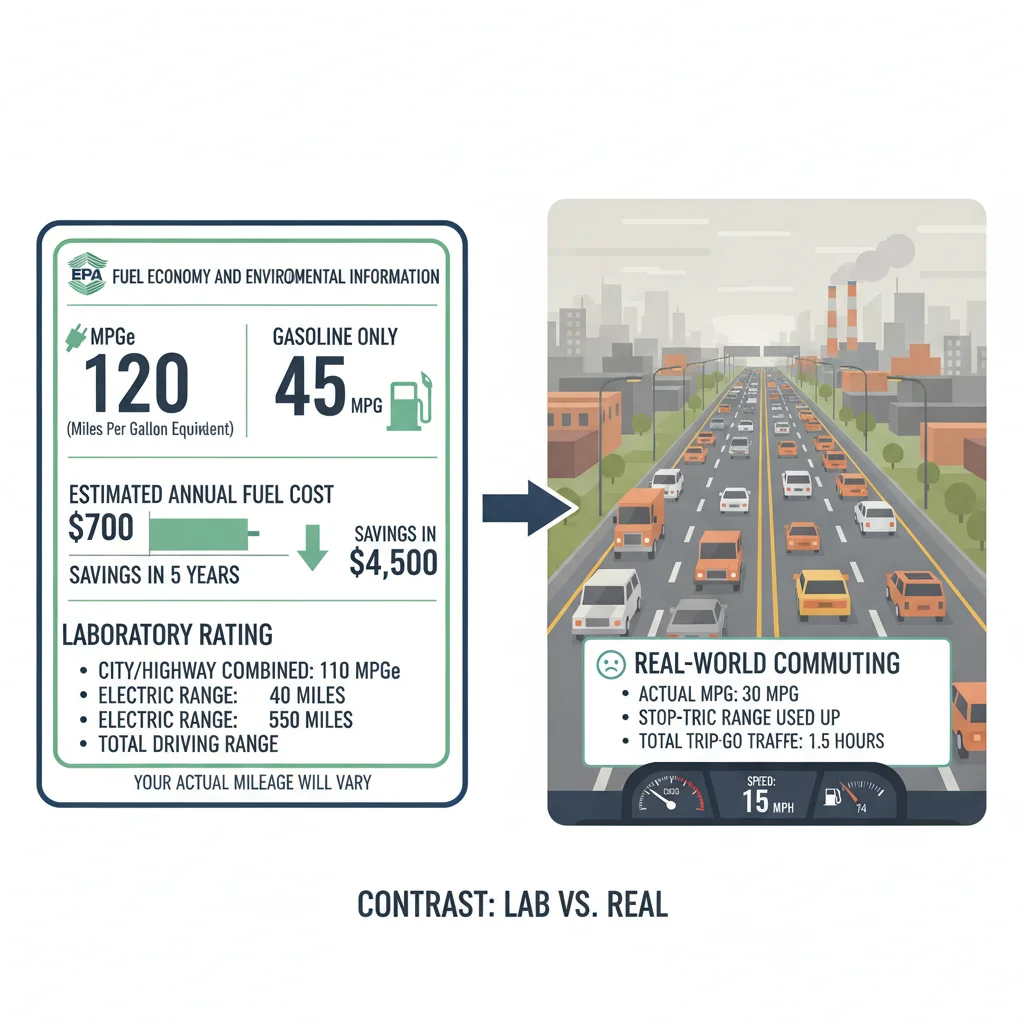
This article focuses specifically on the electric range figure — what it measures, how the EPA derives it, why it falls short in real life, and how to use it intelligently when comparing PHEV models. For a broader look at how range ratings work across all electrified vehicles, see the EPA range ratings explained guide.
How the EPA Tests PHEV Electric Range
The EPA doesn't test PHEVs quite the same way it tests a pure battery-electric vehicle. For PHEVs, it uses a two-phase measurement process:
- Charge-depleting test: The vehicle starts with a fully charged battery and is driven through standard city and highway drive cycles until the battery is effectively depleted. The distance covered is the basis for the electric range figure.
- Charge-sustaining test: The battery-depleted vehicle is then driven using only the gasoline powertrain (and regenerative braking). This produces the conventional MPG figures you see in the lower portion of the sticker.
The result is combined into what the EPA calls the UF-weighted (utility factor weighted) MPGe figure, which attempts to model how often a typical driver would actually plug in. That weighting is important: it means the MPGe number on the sticker is partly a statistical assumption, not purely a measurement of your car.
EPA Cold-Weather Testing Is Not Standard
The EPA does conduct supplemental cold-temperature range testing for PHEVs and EVs, but this data is not always prominently displayed on the window sticker itself. You can find cold-weather range estimates on fueleconomy.gov under the specific model's detail page. If you live in a cold climate, this figure is arguably more relevant to your daily driving than the standard rating.
Charge-Sustaining MPG Can Be Lower Than Expected
Because PHEVs carry a significantly heavier battery pack than conventional hybrids, their charge-sustaining fuel economy is sometimes lower than a comparable non-plug-in hybrid. The Toyota RAV4 Hybrid, for example, often achieves better real-world MPG than the RAV4 Prime in charge-sustaining mode due to weight differences. This trade-off disappears if you plug in regularly, but it matters for buyers who may not.
The ambient temperature during EPA testing is 68–86°F (20–30°C). Cold weather performance is tested separately and can appear as an optional disclosure, but it is not the headline number. This matters significantly for anyone buying a PHEV in a northern climate.
For a deeper look at what kWh figures mean on PHEV and EV spec sheets, the kilowatts and kilowatt-hours reference guide breaks down the terminology clearly.
Charge-Depleting vs. Charge-Sustaining: The Mode Distinction That Changes Everything
To read a PHEV window sticker accurately, you need to understand two operating modes. They're not always labeled clearly on the sticker, but they determine the entire economic case for buying a PHEV over a conventional hybrid.
Charge-Depleting (CD) Mode
This is when the vehicle draws primarily from the battery pack. The car is consuming stored electricity, and the battery state of charge is falling. Most PHEVs prioritize this mode when the battery is sufficiently charged, typically running the gasoline engine only at very high power demands (like hard acceleration or sustained highway speeds).
Charge-Sustaining (CS) Mode
Once the battery depletes to its minimum threshold — typically around 20–30% state of charge, depending on the manufacturer — the vehicle switches to hybrid mode. It now acts like a conventional hybrid: the gasoline engine drives the wheels and charges the battery through regenerative braking, but you are no longer consuming grid electricity.
Always Check fueleconomy.gov Before You Buy
The EPA's fueleconomy.gov site publishes not just the standard electric range figure but also cold-weather estimates and annual fuel cost projections for most PHEV models. Spending five minutes there before a dealer visit gives you an objective baseline that no salesperson can easily contradict.
Match Electric Range to Your Actual Commute
Pull your last three months of driving history from your phone's navigation app or odometer records. If your average daily mileage sits below the PHEV's real-world electric range (EPA figure minus 20%), the vehicle is likely a strong financial fit. If it consistently exceeds it, reconsider whether a full hybrid or BEV makes more economic sense.
Don't Overlook the Charge-Sustaining MPG
Before finalizing any PHEV purchase, find the charge-sustaining MPG figure — the fuel economy when the battery is depleted and the car runs on gasoline alone. This number tells you the vehicle's performance floor on long trips or when you haven't charged. For some PHEVs with heavy battery packs, it can be lower than a non-plug-in hybrid alternative.
The Blended Mode Problem
Here's where buyers get caught off guard. Some PHEVs — particularly those with smaller batteries or less sophisticated power management — run the gasoline engine even while the battery still has charge. This is called blended mode operation. The Prius Prime, for example, is largely EV-only at low speeds but blends in the gas engine at highway speeds. If your daily commute includes significant freeway driving, your real electric range will fall well below the EPA figure.
15–30%
Typical real-world shortfall vs. EPA electric range
Based on aggregated owner data and independent testing by organizations including Consumer Reports and Edmunds across multiple PHEV model years.
~40%
Cold-weather electric range loss in severe conditions
EPA and AAA testing show PHEVs can lose up to 40% of rated electric range when ambient temperatures drop to around 20°F (-7°C).
20–50 mi
Typical PHEV electric range on 2024 models
According to EPA data on fueleconomy.gov, the majority of 2024 model-year PHEVs fall within this electric range band.
7 kWh
Minimum battery size for federal tax credit eligibility
Under the Inflation Reduction Act, PHEVs must have at least 7 kWh of battery capacity to qualify for any federal clean vehicle tax credit.
3–5 kW
Power draw from resistive cabin heating
Testing by EV advocacy groups and OEM disclosures indicate resistive electric heaters consume 3–5 kW, representing a significant drain on PHEV battery packs during cold months.
Why Real-World Electric Range Falls Short
Even if your PHEV never touches blended mode, you should expect real-world electric range to come in below the window sticker. These are the main culprits:
Temperature
Lithium-ion batteries lose capacity in cold weather — sometimes dramatically. A PHEV with a 30-mile EPA electric range may deliver only 18–22 miles on a 20°F morning. The EPA publishes cold-weather range estimates for some models on fueleconomy.gov, but this disclosure is not standardized and not always easy to find.
Speed
Aerodynamic drag increases with the square of speed. At 75 mph versus 55 mph, a vehicle can consume 30–40% more energy per mile. PHEVs tested on the EPA's highway cycle top out at lower sustained speeds than most real highway driving. The result: your electric miles evaporate faster on the interstate.
Climate Control
Running the cabin heater (resistive heat, not a heat pump) can consume 3–5 kW of battery power — a significant draw on a PHEV with a 10–18 kWh pack. Air conditioning is less severe but still meaningful. In extreme climates, HVAC alone can cut electric range by 20–35%.
Payload and Grade
Passengers, cargo, and hills all increase the energy demand on the electric motor. A PHEV hauling four adults over rolling terrain will exhaust its battery noticeably faster than the solo-driver, flat-road EPA test cycle.
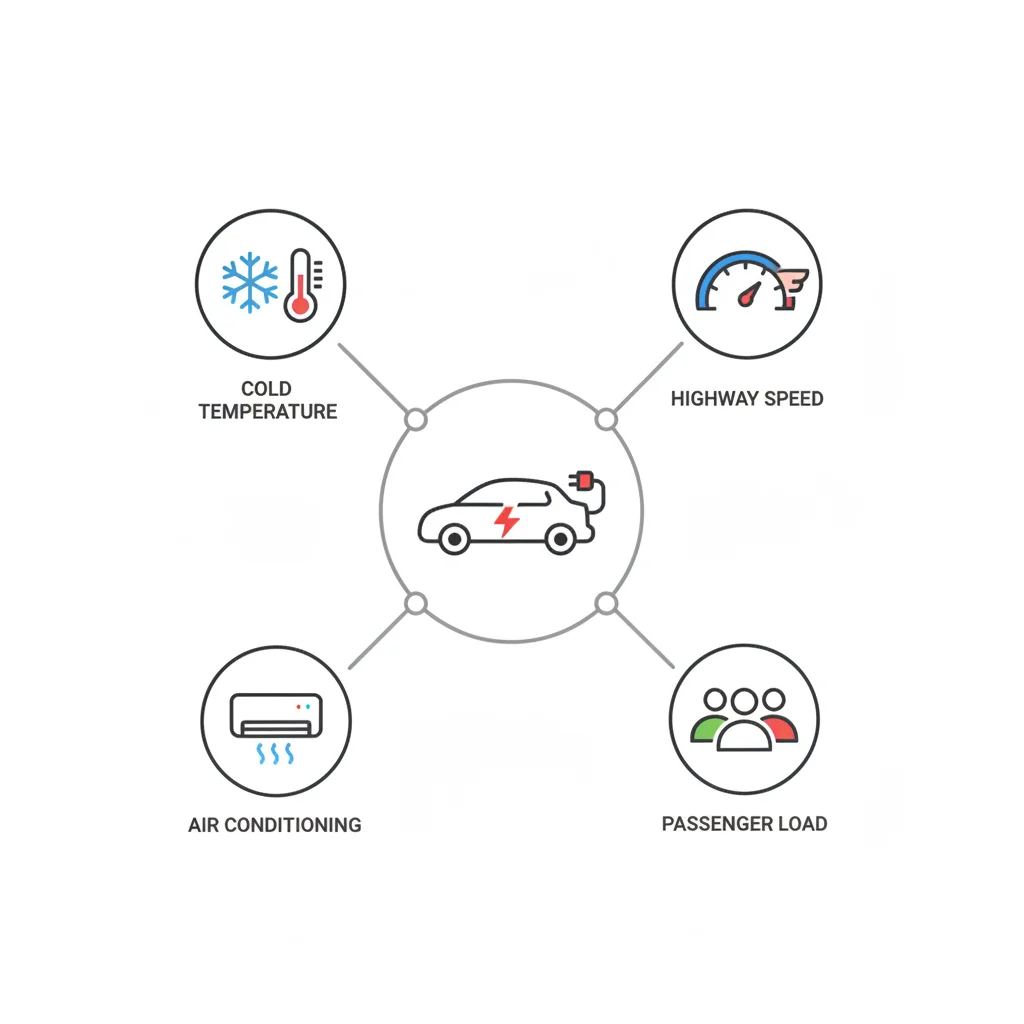
If you want a structured checklist for evaluating real-world range performance before buying, the range performance pre-purchase checklist is worth reviewing.
What the Two MPG Figures on the Sticker Actually Mean
A PHEV window sticker shows two distinct fuel economy ratings, and conflating them is a common and expensive mistake:
| Rating | What it measures | When it applies |
|---|---|---|
| MPGe (charge-depleting) | Equivalent miles per gallon while running on electricity | When the battery is charged and you're in CD mode |
| MPG (charge-sustaining) | Conventional miles per gallon on gasoline | When the battery is depleted or you're in CS mode |
The MPGe number will look impressive — often 70–120 MPGe — because electricity is cheap per mile. But that number only applies for as long as your battery holds. Once you're running on gasoline, the charge-sustaining MPG kicks in, and for many PHEVs that number is 30–45 MPG — reasonable, but not the headline figure you might be anchored to.
“The utility factor assumption built into PHEV MPGe ratings presumes drivers charge frequently and drive within the electric range most days. For buyers who don't match that profile, the sticker's efficiency figures can be deeply misleading as a predictor of real-world fuel costs.”
— John German, Senior Fellow, International Council on Clean Transportation (ICCT)
The practical takeaway: if your daily driving stays within the electric range and you charge regularly, the MPGe figure reflects your actual operating cost. If you regularly drive beyond the electric range — or forget to plug in — the charge-sustaining MPG becomes the number that matters to your wallet.
EPA Cold-Weather Testing Is Not Standard
The EPA does conduct supplemental cold-temperature range testing for PHEVs and EVs, but this data is not always prominently displayed on the window sticker itself. You can find cold-weather range estimates on fueleconomy.gov under the specific model's detail page. If you live in a cold climate, this figure is arguably more relevant to your daily driving than the standard rating.
Charge-Sustaining MPG Can Be Lower Than Expected
Because PHEVs carry a significantly heavier battery pack than conventional hybrids, their charge-sustaining fuel economy is sometimes lower than a comparable non-plug-in hybrid. The Toyota RAV4 Hybrid, for example, often achieves better real-world MPG than the RAV4 Prime in charge-sustaining mode due to weight differences. This trade-off disappears if you plug in regularly, but it matters for buyers who may not.
Matching Electric Range to Your Actual Driving Pattern
The electric range figure is only meaningful relative to your daily mileage. Here's how to think about the fit:
The Commuter Sweet Spot
If your round-trip daily commute is shorter than the PHEV's real-world electric range (not the EPA figure — discount it by 15–20%), you can theoretically run on electricity for most of your driving and rarely visit a gas station. This is the scenario where a PHEV's economics make the strongest case.
The Mixed-Use Driver
If some days you commute 25 miles and others you drive 150 miles, a PHEV can serve both use cases. Short trips run on electricity; long trips use gasoline. The key is honest accounting: you'll spend more time in charge-sustaining mode than the window sticker math might imply.
The Frequent Long-Haul Driver
If most of your driving involves routes well beyond the electric range, a PHEV carries the worst of both worlds: the weight of a large battery pack degrading gasoline fuel economy, without the fuel savings to offset it. In this scenario, a conventional hybrid or a full BEV with a larger pack may make more financial sense.
Always Check fueleconomy.gov Before You Buy
The EPA's fueleconomy.gov site publishes not just the standard electric range figure but also cold-weather estimates and annual fuel cost projections for most PHEV models. Spending five minutes there before a dealer visit gives you an objective baseline that no salesperson can easily contradict.
Match Electric Range to Your Actual Commute
Pull your last three months of driving history from your phone's navigation app or odometer records. If your average daily mileage sits below the PHEV's real-world electric range (EPA figure minus 20%), the vehicle is likely a strong financial fit. If it consistently exceeds it, reconsider whether a full hybrid or BEV makes more economic sense.
Don't Overlook the Charge-Sustaining MPG
Before finalizing any PHEV purchase, find the charge-sustaining MPG figure — the fuel economy when the battery is depleted and the car runs on gasoline alone. This number tells you the vehicle's performance floor on long trips or when you haven't charged. For some PHEVs with heavy battery packs, it can be lower than a non-plug-in hybrid alternative.
For new owners adjusting to electric range realities across all electrified vehicles, the EV range guide for new owners provides a practical foundation for setting the right expectations from day one.
The EV range and efficiency hub also aggregates the key resources on this topic if you want to go deeper on any of the metrics covered here.
How to Compare PHEV Electric Range Across Models
Shopping across PHEV models requires a consistent framework. Here's what to look at beyond the headline electric range number:
Usable Battery Capacity (kWh)
Manufacturers publish gross battery size, but usable capacity — what's actually available for driving — is smaller due to buffer zones that protect battery longevity. A 14 kWh gross pack might have 11–12 kWh usable. This matters because it's the usable figure that determines how far you can actually go electrically. Cross-referencing usable kWh against electric range gives you an efficiency ratio that helps compare models on an apples-to-apples basis. The full data-driven range reference covers efficiency metrics in detail.
Operating Mode Architecture
Ask specifically whether the vehicle is EV-first (runs on electricity until depletion, then switches) or blended (mixes power sources throughout). EV-first PHEVs will come closer to their rated electric range. Blended PHEVs will fall short, especially on highways.
Onboard Charger Speed
Electric range is only useful if you can replenish it. PHEVs come with onboard chargers ranging from 3.3 kW to 7.2 kW or more. A larger charger cuts recharge time significantly — a 14 kWh pack takes about 4 hours on a 3.3 kW charger but under 2 hours on a 7.2 kW unit using a Level 2 home charger.
Cold-Weather Disclosure
Check fueleconomy.gov for cold-temperature range data if you live in a region where winter temperatures drop below 40°F. Some PHEVs maintain electric range reasonably well in cold weather (particularly those using heat pump climate systems); others lose 40% or more.
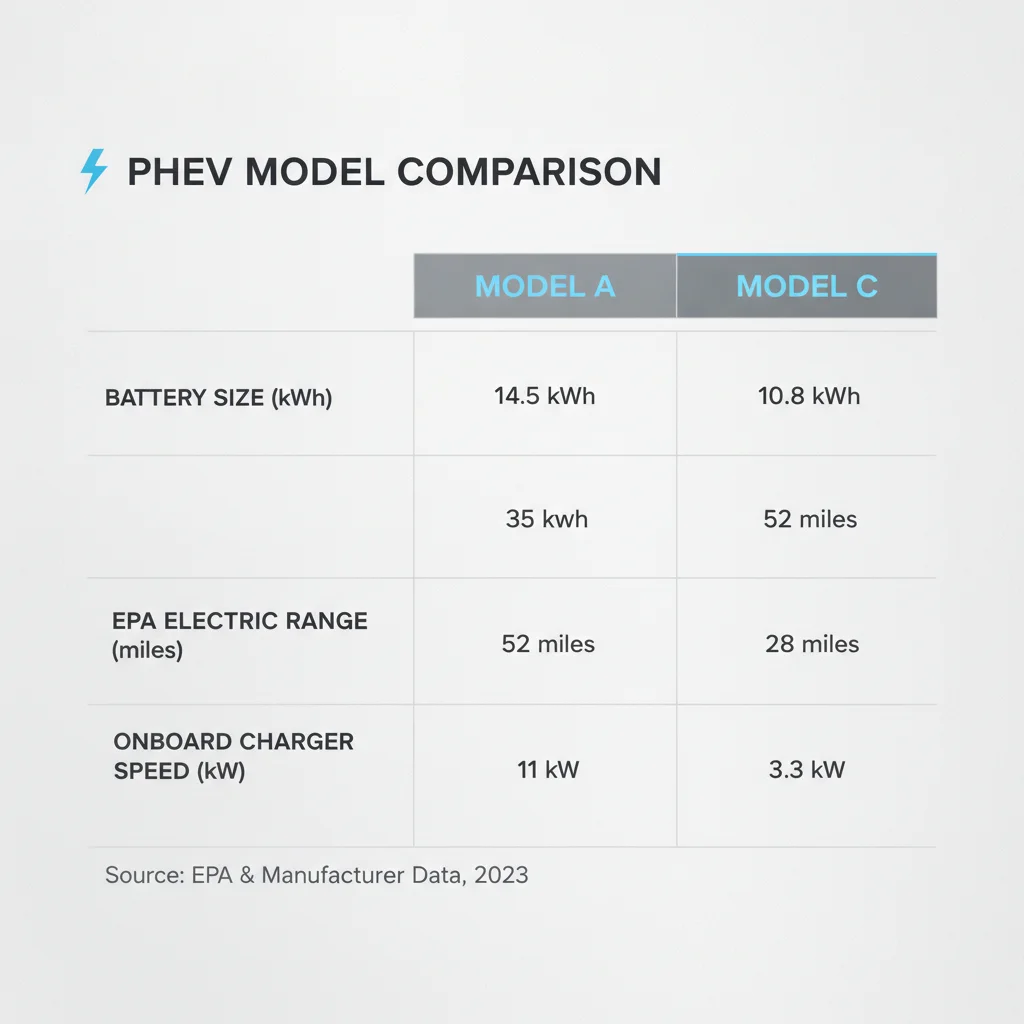
If you're also weighing insurance costs as part of the total ownership picture, the EV insurance guide explains how PHEV coverage compares to both conventional hybrids and full EVs.
Reading the Window Sticker Like a Pro
When you're standing in front of a PHEV on the lot, here's a quick field guide to reading the sticker correctly:
- Find the electric range figure — typically displayed prominently near the top of the fuel economy section. This is the EPA charge-depleting range in miles.
- Apply a real-world discount — reduce it by 15–20% for a conservative everyday estimate. In cold climates or highway-heavy driving, use 25–30%.
- Locate the charge-sustaining MPG — this is the gasoline-only fuel economy, listed separately. It tells you what you'll get when the battery runs out.
- Check the MPGe figure — this is a combined efficiency metric useful for cost comparisons, but it assumes a specific plug-in frequency. If you rarely charge, disregard it.
- Note the battery size — sometimes on the sticker, always in the spec sheet. Cross-reference against the electric range to get a sense of efficiency.
- Look for annual fuel cost estimates — the EPA provides estimated annual fuel costs based on national average electricity and gasoline prices, and assumed mileage splits. These are useful directionally but will vary based on your local utility rates.
Always Check fueleconomy.gov Before You Buy
The EPA's fueleconomy.gov site publishes not just the standard electric range figure but also cold-weather estimates and annual fuel cost projections for most PHEV models. Spending five minutes there before a dealer visit gives you an objective baseline that no salesperson can easily contradict.
Match Electric Range to Your Actual Commute
Pull your last three months of driving history from your phone's navigation app or odometer records. If your average daily mileage sits below the PHEV's real-world electric range (EPA figure minus 20%), the vehicle is likely a strong financial fit. If it consistently exceeds it, reconsider whether a full hybrid or BEV makes more economic sense.
Don't Overlook the Charge-Sustaining MPG
Before finalizing any PHEV purchase, find the charge-sustaining MPG figure — the fuel economy when the battery is depleted and the car runs on gasoline alone. This number tells you the vehicle's performance floor on long trips or when you haven't charged. For some PHEVs with heavy battery packs, it can be lower than a non-plug-in hybrid alternative.
Armed with these numbers and an honest assessment of your daily driving, you're in a far stronger position than the buyer who takes the headline electric range at face value. PHEVs can be genuinely excellent vehicles for the right driver — the key is knowing whether that driver is you.

All claims are backed by peer-reviewed research. Sources on request.