Key Takeaways
Our Verdict
Regenerative braking is present in all electrified vehicles, but the depth, flexibility, and real-world impact differ sharply by powertrain type. BEVs are the clear leaders in energy recovery thanks to large batteries and aggressive regen tuning. PHEVs capture meaningful energy but are architecturally constrained. HEVs use regen as a maintenance tool rather than a deep energy harvester. For buyers prioritizing maximum efficiency gains from regen, a BEV is the strongest choice — but even a conventional hybrid delivers a measurable benefit over a gas-only vehicle.
| Best for | Recommended |
|---|---|
| Maximum energy recovery and range extension | Battery Electric Vehicle (BEV) |
| Balanced regen with occasional gas backup | Plug-In Hybrid (PHEV) |
| Regen benefits without plugging in | Hybrid Electric Vehicle (HEV) |
| Aggressive one-pedal driving and adjustable regen settings | Battery Electric Vehicle (BEV) |
The Same Principle, Very Different Results
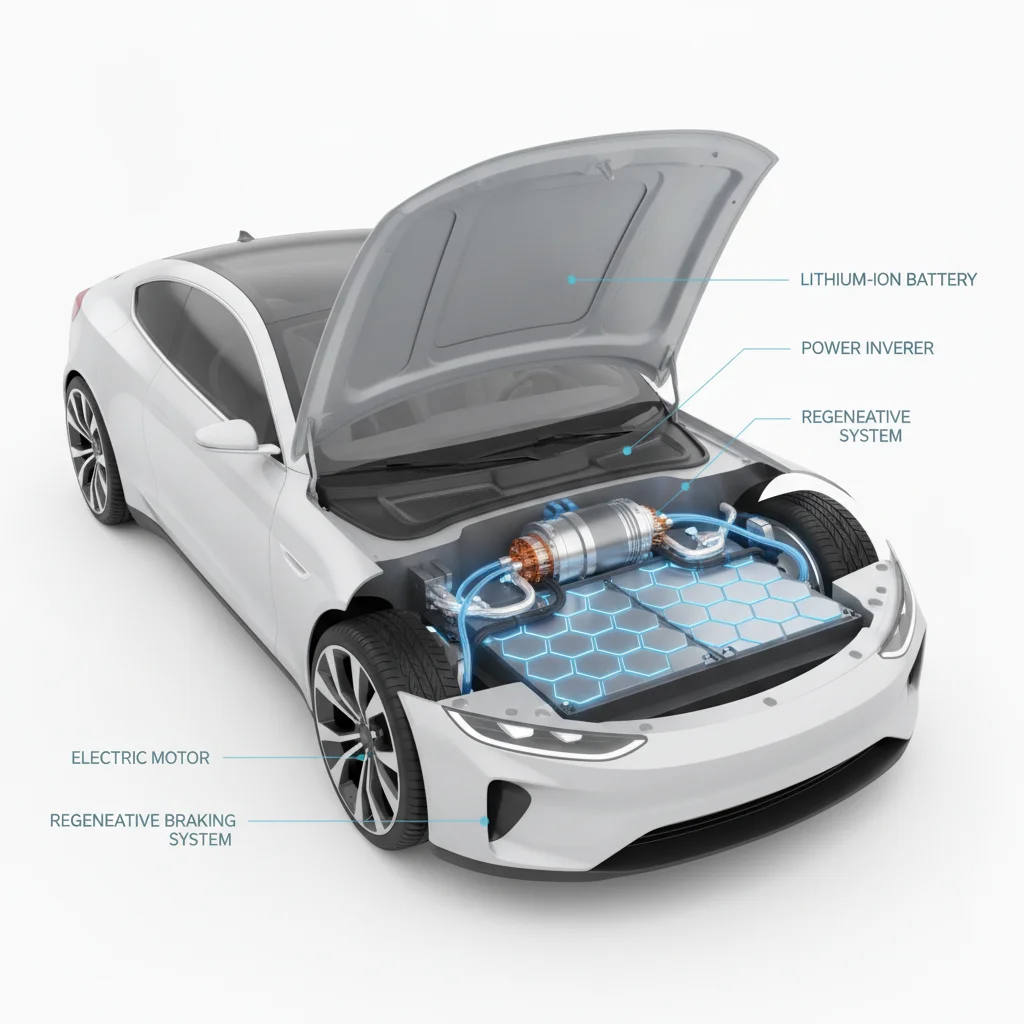
Regenerative braking works on a single physical principle: when you lift off the accelerator or apply the brakes, the electric motor reverses its role and acts as a generator, converting the vehicle's kinetic energy into electricity rather than bleeding it off as heat through friction pads. Every electrified vehicle — battery electric, plug-in hybrid, and conventional hybrid — uses this concept. But the hardware, software, and battery architecture behind each platform shapes how aggressively that energy is captured and how much practical difference it makes.
Think of it this way: the generator is roughly the same idea across all three platforms. The bucket you're pouring that energy into is radically different in size and design. And the sophistication of the plumbing connecting the two varies just as much.
For a full breakdown of the underlying physics, see how regenerative braking extends your EV's range. This article focuses specifically on how the system behaves differently depending on which powertrain type you're driving.
Battery Electric Vehicles: Regen at Full Throttle
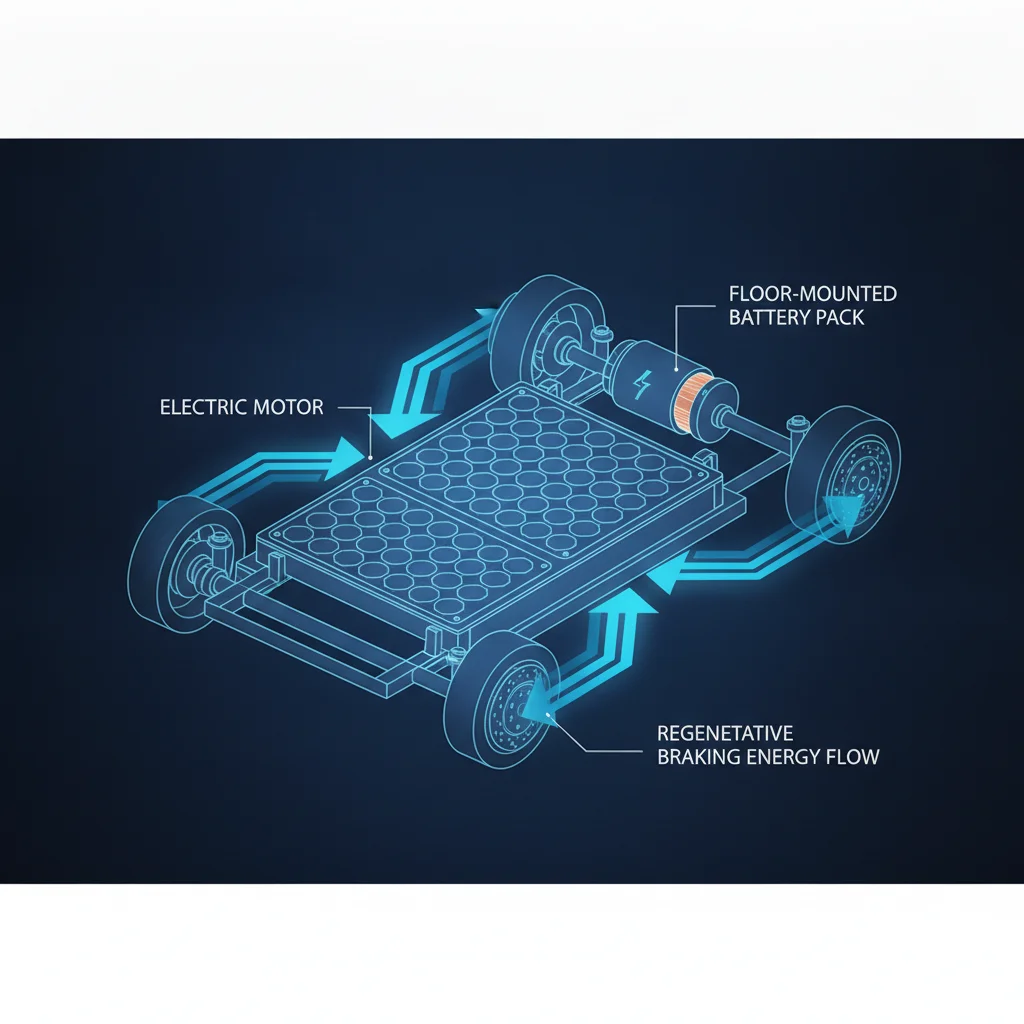
BEVs are purpose-built around electrification, and that shows up clearly in how they handle regenerative braking. With no combustion engine competing for system resources and a large high-voltage battery pack as the destination for recovered energy, BEVs can implement regen more aggressively than any other platform.
Why BEVs Capture the Most Energy
The primary electric motor in a BEV is typically rated at hundreds of kilowatts of output power. When running as a generator during deceleration, that same motor can absorb a significant proportion of braking force. High-capacity battery packs — commonly ranging from 60 kWh to over 100 kWh in today's market — provide plenty of headroom to accept recovered energy even when the battery is already partially charged.
Software plays a critical role here. BEV manufacturers tune their regenerative braking algorithms to balance several factors: how quickly the car decelerates, how much current the battery can safely accept at a given state of charge and temperature, and how the system blends regen with friction brakes to maintain predictable stopping behavior. On many BEVs, drivers can select regen intensity from a low setting (minimal drag when lifting off the pedal) to a high setting that allows what's commonly called one-pedal driving.
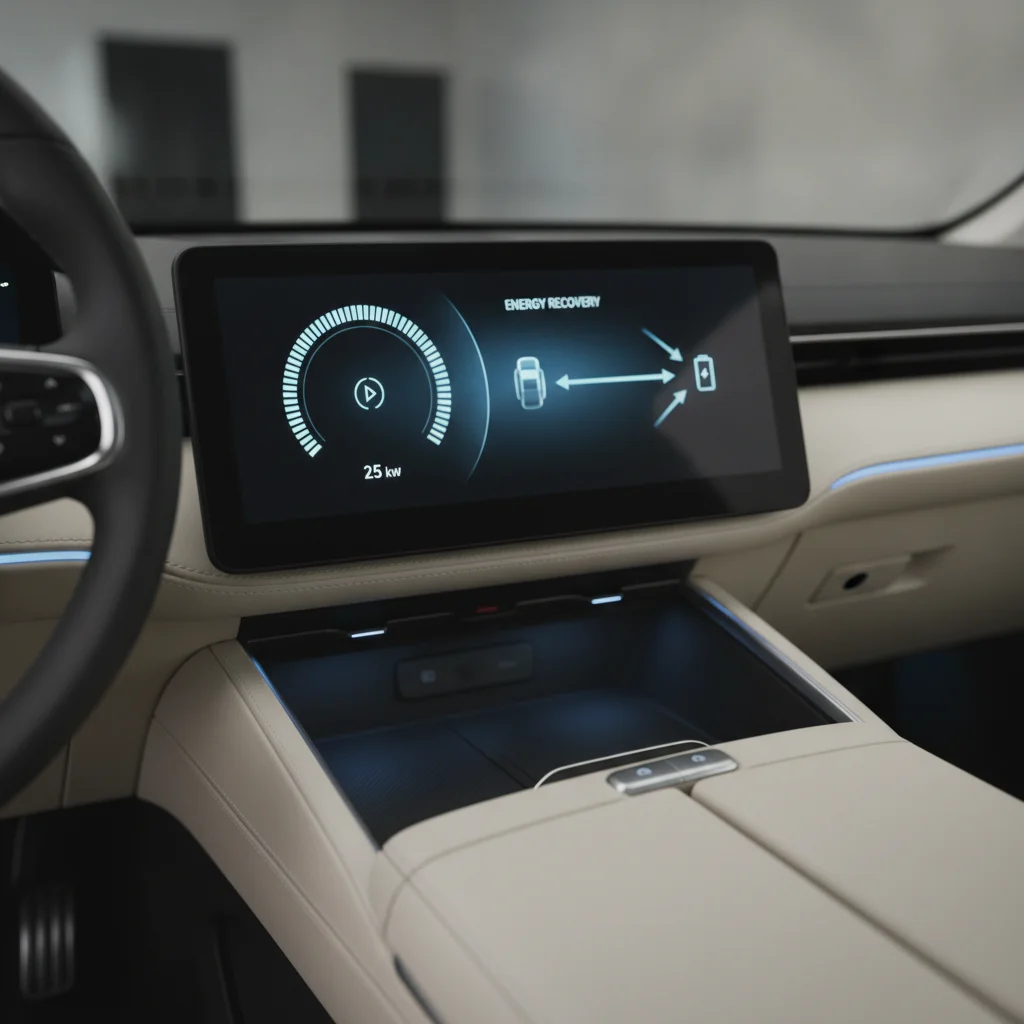
One-pedal driving is almost exclusively a BEV feature. It allows drivers to modulate speed almost entirely through the accelerator pedal — pressing brings acceleration, releasing brings braking — without touching the friction brakes except for final stops. This style of driving, especially in city traffic, captures a substantial portion of deceleration energy that would otherwise be wasted.
Up to 30%
Range recovered via regen in city driving
U.S. Department of Energy estimates regenerative braking can recover up to 30% of the energy used in city driving cycles under optimal conditions.
100,000+
Miles some BEV owners report on original brake pads
Real-world reports from BEV owners using aggressive regen settings indicate dramatically extended brake service intervals compared to the 30,000–70,000 mile typical range for gas vehicles.
~1–2 kWh
Usable battery in a typical HEV
Conventional hybrid battery packs are engineered as small energy buffers, not storage reserves — a Toyota Prius Gen 4, for example, uses approximately 1 kWh of usable capacity.
8–20 kWh
Typical PHEV battery range
Current market PHEVs span from around 8 kWh (shorter electric range models) to over 20 kWh on extended-range vehicles like the Chrysler Pacifica Hybrid.
Real-World Range Impact
The range contribution from regen on a BEV is most noticeable in urban and suburban driving patterns — exactly the stop-and-go conditions where conventional combustion engines are least efficient. Highway driving at steady speeds provides fewer deceleration events and thus fewer regen opportunities, which is part of why many BEVs show better city range estimates than highway range estimates — the inverse of most gas vehicles.
For a deeper look at how BEVs convert stored energy into motion in the first place, this explanation of how a BEV powers itself covers the full powertrain picture.
Plug-In Hybrids: Real Recovery, Structural Limits
PHEVs occupy the middle ground. They carry a meaningful battery pack — typically 8 to 20 kWh depending on the model — and a dedicated electric motor that can both drive the wheels and recover energy. That combination means regen on a PHEV is genuine and measurable, not token. But several structural factors keep it from matching the BEV experience.
Where PHEVs Excel at Regen
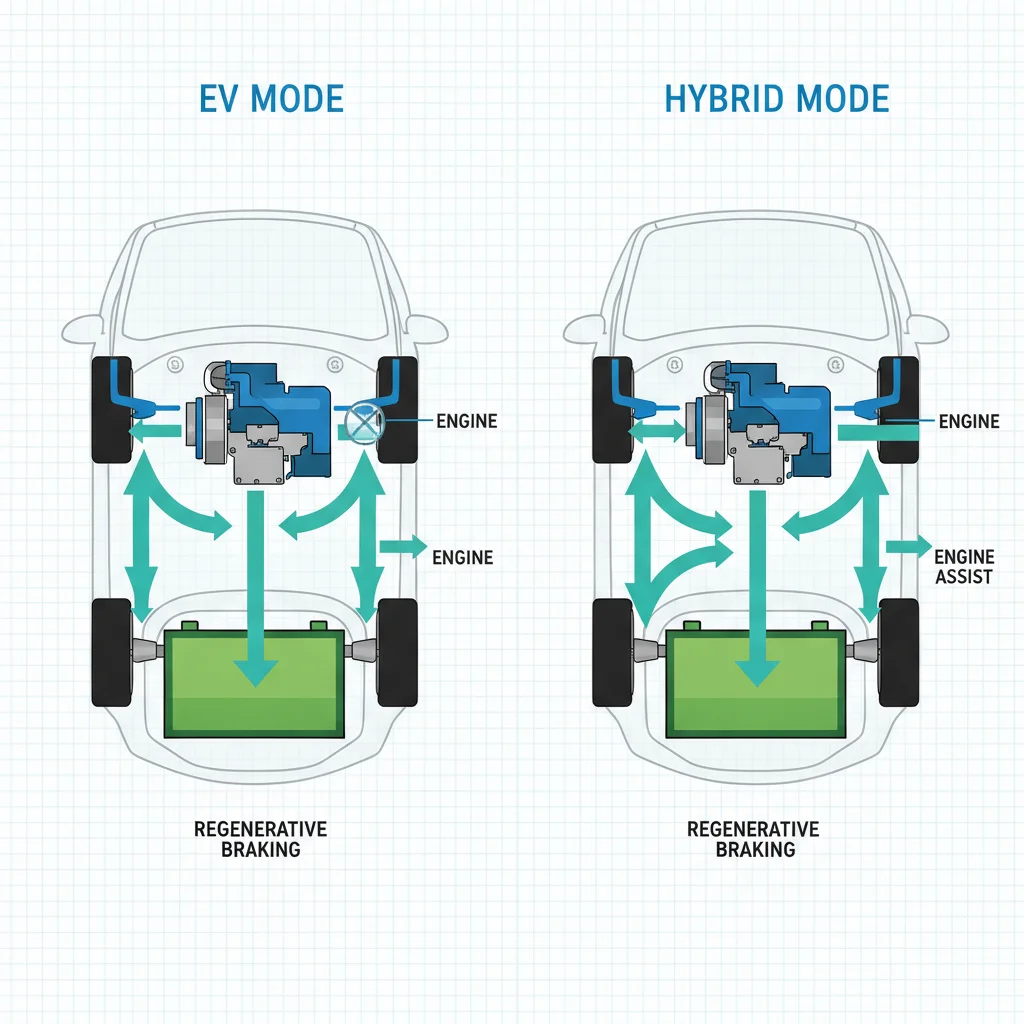
In full electric mode, a PHEV behaves much like a BEV in terms of regen behavior. The combustion engine is off, the electric motor handles propulsion, and braking energy flows back into the battery. Many PHEVs support adjustable regen intensity in EV mode, and some even offer a version of one-pedal driving, though typically with less deceleration force than a dedicated BEV.
In hybrid mode — when the gas engine is running — regen still occurs, but energy management gets more complex. The car's control system must balance whether to use recovered energy immediately to assist the gas engine, store it in the battery for later electric driving, or some combination. This juggling act is handled automatically, but it means the driver has less direct influence over regen behavior.
The Battery Size Constraint
A PHEV battery is sized for a specific electric range target — typically 20 to 50 miles — not for maximum energy capture. Once the battery is fully charged (either from a plug or from aggressive regen), the system has nowhere to store additional recovered energy. At that point, the regenerative braking effect is reduced or the car relies more heavily on friction brakes.
Maximize PHEV Regen with Smart Mode Selection
If your PHEV allows you to choose between EV-only and hybrid modes at trip start, consider using hybrid mode for the first portion of a route that includes frequent stops or hills. This preserves battery headroom so the regen system has somewhere to put recovered energy. Switch to EV mode once you've consumed some charge capacity.
Test Regen Settings Before You Buy
When test-driving a BEV, specifically ask to try different regen intensity settings and, if available, one-pedal driving mode. The difference between low and high regen feel is significant, and some drivers strongly prefer one over the other. A five-minute city-traffic test drive will tell you more about whether the regen tuning suits your style than any spec sheet.
This is an important nuance for PHEV owners: you get the most regen benefit when your battery has significant remaining charge capacity. If you start a trip with a full battery, the first portion of deceleration energy may not be effectively captured. This is one reason some PHEV owners intentionally start trips in hybrid mode to preserve regen headroom.
Conventional Hybrids: Regen as a Buffer, Not a Deep Reserve
Traditional HEVs — think Toyota Prius, Honda Accord Hybrid, Ford Escape Hybrid — do not plug in. Their battery packs are small by design, often holding only 1 to 2 kWh of usable capacity. The regenerative braking system exists not to store large amounts of energy for later use, but to maintain the battery's state of charge within a narrow operating window.
How HEV Regen Actually Works
The hybrid control system in a conventional HEV is constantly managing a small energy buffer. Regen braking tops up this buffer; the electric motor draws from it to assist the gas engine during acceleration or low-speed driving. It's a dynamic balancing act optimized for fuel efficiency rather than for meaningful all-electric range.
Because the battery is small and nearly always close to its target state of charge, an HEV's regenerative braking is calibrated conservatively. The motor-generator still captures energy on deceleration, but if the battery is already near full, the system immediately routes that energy back into propulsion assistance rather than storage. The efficiency gain is real but functions differently than in a BEV.
Why hybrids get better city MPG goes into this energy buffer concept in more detail, including why it flips the typical city/highway MPG relationship that gas-only drivers are used to.
No One-Pedal Driving, Limited Driver Control
Conventional hybrids generally don't offer driver-selectable regen intensity in the way BEVs do. The system manages itself, and the driver's input is primarily through the brake pedal. There's no one-pedal driving mode. The regen contribution is real — it's a significant reason why a Prius achieves 50+ MPG in city conditions — but it's baked into the background operation rather than being a driver-tunable feature.
Don't Assume Regen Replaces Normal Braking
Regenerative braking supplements friction brakes — it doesn't replace them in all conditions. At very low speeds, during ABS activation, and in certain cold-weather scenarios, friction brakes take over or blend in. Always maintain your friction brake system on schedule, even if your regen usage is aggressive. Skipping brake inspections because 'the regen does all the work' is a real mistake some EV owners make.
Side-by-Side: How the Three Platforms Compare
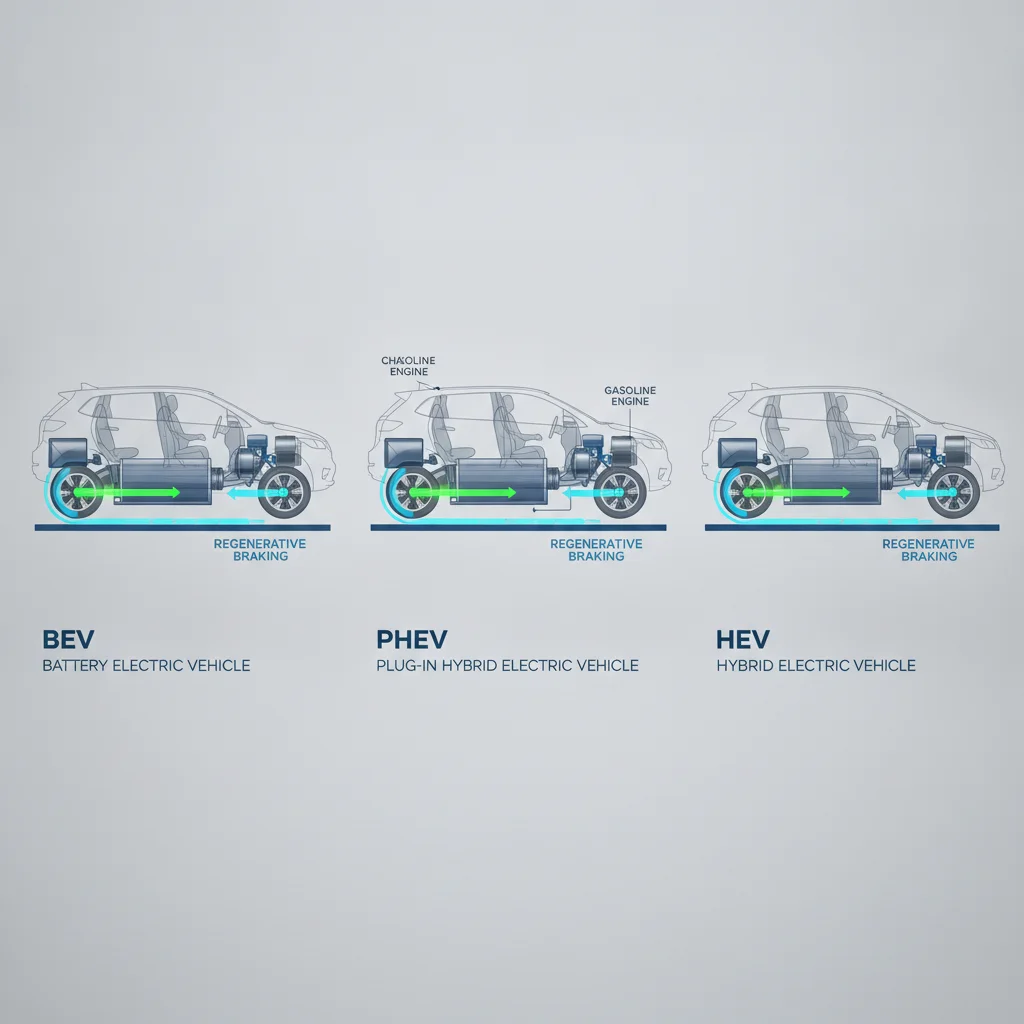
The differences between these platforms matter for buyers evaluating which type of electrified vehicle best fits their driving patterns. Here's a structured comparison across the factors that most directly affect real-world regen performance:
| Battery Electric (BEV) | Plug-In Hybrid (PHEV) | Hybrid (HEV) | |
|---|---|---|---|
| Typical battery capacity | 60–100+ kWh | 8–20 kWh | 1–2 kWh usable |
| Regen energy storage depth | High — large reserve available | Moderate — limited by pack size | Low — small buffer only |
| Driver-adjustable regen intensity | Yes — multiple levels on most models | Partial — often in EV mode only | Rarely — system-controlled |
| One-pedal driving available | Yes — standard on most BEVs | Sometimes — limited versions | No |
| City driving efficiency gain from regen | Very high (10–30% range improvement) | Moderate (meaningful in EV mode) | Significant (major MPG contributor) |
| Friction brake wear reduction | Dramatic — pads can last 100k+ mi | Moderate — especially in EV mode | Noticeable vs. gas-only vehicles |
| Regen behavior when battery is full | Reduced — friction brakes compensate | Reduced — system switches modes | Energy used immediately for assist |
| Peak regen braking force | Highest — large motor capacity | Moderate — smaller motor systems | Lower — conservative calibration |
A few points worth emphasizing from this comparison:
- Battery size is the single biggest determinant of regen capacity. All the sophisticated software in the world can't store energy in a battery that's already full or too small to accept it.
- Motor power ratings affect peak regen force. More powerful motors can slow the car more aggressively through regen alone, which is why high-performance BEVs often have the most aggressive one-pedal feel.
- Driver control varies dramatically. BEV drivers can actively manage regen intensity; most HEV drivers cannot.
Brake Wear Implications Across EV Types
One practical downstream effect of regenerative braking that varies by vehicle type is friction brake wear. Since regen handles a portion of deceleration that would otherwise require the friction brakes, all electrified vehicles see reduced brake pad and rotor wear compared to conventional gas cars. But the magnitude of that benefit tracks closely with regen intensity.
BEV drivers using aggressive regen or one-pedal driving can go tens of thousands of additional miles between brake service intervals compared to gas-car drivers. Some Tesla owners have reported going 100,000+ miles on original brake pads, though driving style and climate conditions influence this significantly.
PHEV drivers see meaningful brake longevity improvements, particularly in EV mode. HEV drivers benefit as well, though the effect is somewhat smaller given the more conservative regen calibration.
Why EV brakes last so much longer covers the science behind this in detail, and what's actually happening to your brake pads explains the maintenance implications for EV owners specifically.

One caveat worth noting: because regenerative braking reduces friction brake use so dramatically on BEVs, the brakes can develop surface corrosion if the friction system goes too long without use. This is especially common in wet climates. Manufacturers are aware of this and most modern BEVs include logic that applies the friction brakes periodically — even when regen alone could handle the stop — specifically to keep the rotors clean. It's a minor consideration, but one that EV maintenance basics is worth understanding.
What This Means When You're Shopping
If you're evaluating electrified vehicles and regen efficiency is part of your decision matrix, here's how to think through it practically:
City vs. Highway Driving Mix
Regen braking benefits are heavily front-loaded toward city and suburban driving with frequent stops. If 70% or more of your miles are highway, the marginal regen advantage of a BEV over a PHEV is smaller in practice. The BEV still wins on pure efficiency, but the regen component specifically is less of a differentiator on long open-road stretches.
Battery State of Charge Habits Matter for PHEVs
If you own a PHEV and typically plug in overnight, you'll start most trips with a full battery. This is optimal for electric driving range but means early regen energy has less room to go. If your route involves a lot of early-trip deceleration (a hilly neighborhood, for example), consider starting in hybrid mode to preserve battery headroom for regen capture.
Adjustable Regen is a Real Quality-of-Life Feature
For drivers who enjoy actively optimizing their driving, adjustable regen intensity on BEVs is genuinely useful — not just a marketing checkbox. Being able to dial in one-pedal driving in city traffic and reduce regen on the highway (where it can feel jerky when you lift for a lane change) is a meaningful usability advantage that HEVs and most PHEVs don't offer.
For a comprehensive look at how EVs work across different powertrain configurations, the hub covers motor types, battery architecture, and drivetrain design in plain language.
Maximize PHEV Regen with Smart Mode Selection
If your PHEV allows you to choose between EV-only and hybrid modes at trip start, consider using hybrid mode for the first portion of a route that includes frequent stops or hills. This preserves battery headroom so the regen system has somewhere to put recovered energy. Switch to EV mode once you've consumed some charge capacity.
Test Regen Settings Before You Buy
When test-driving a BEV, specifically ask to try different regen intensity settings and, if available, one-pedal driving mode. The difference between low and high regen feel is significant, and some drivers strongly prefer one over the other. A five-minute city-traffic test drive will tell you more about whether the regen tuning suits your style than any spec sheet.

All claims are backed by peer-reviewed research. Sources on request.