Key Takeaways
Mild Hybrid (MHEV)
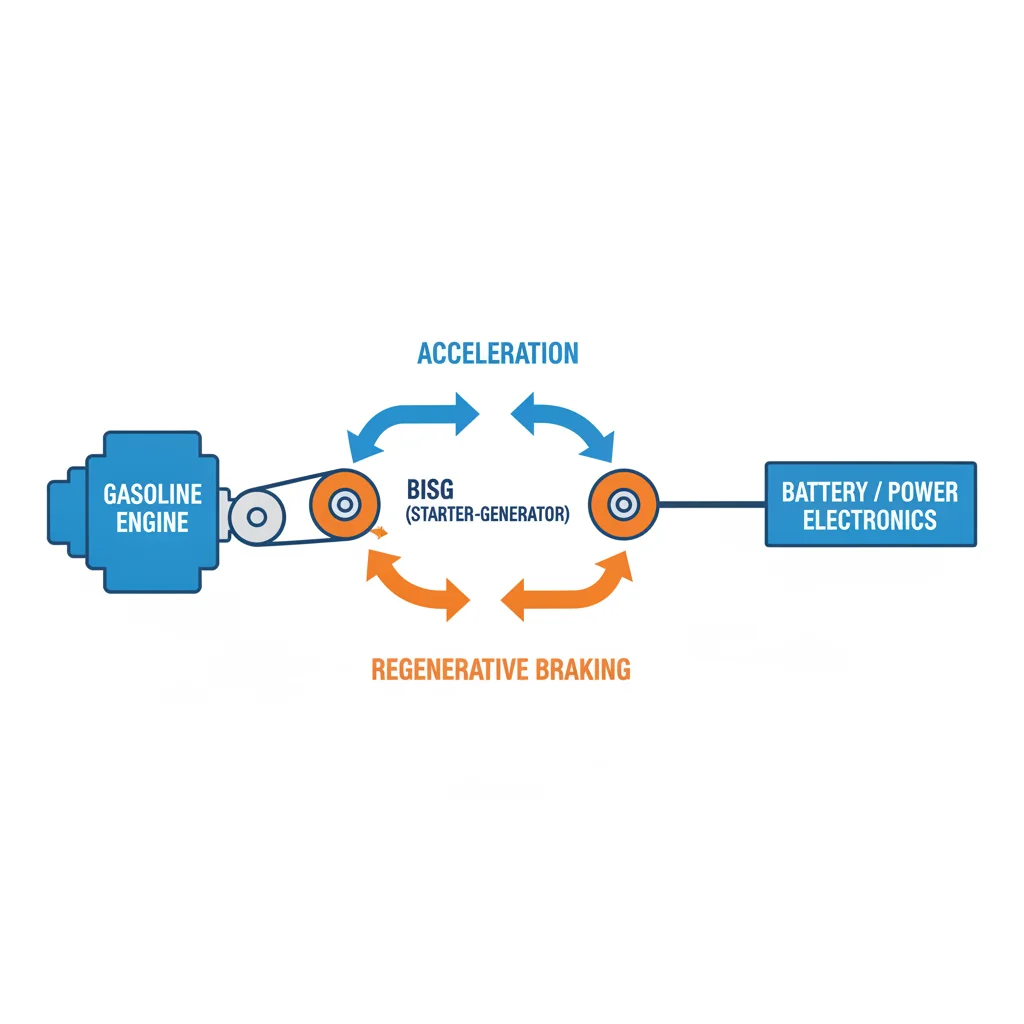
A mild hybrid vehicle uses a small battery and an electric motor-generator to assist a conventional gasoline or diesel engine, but unlike a full hybrid, it cannot propel the car on electricity alone. The electric system reduces the load on the engine during acceleration and captures energy during braking, improving efficiency. Think of it as an electric helper rather than an electric driver.
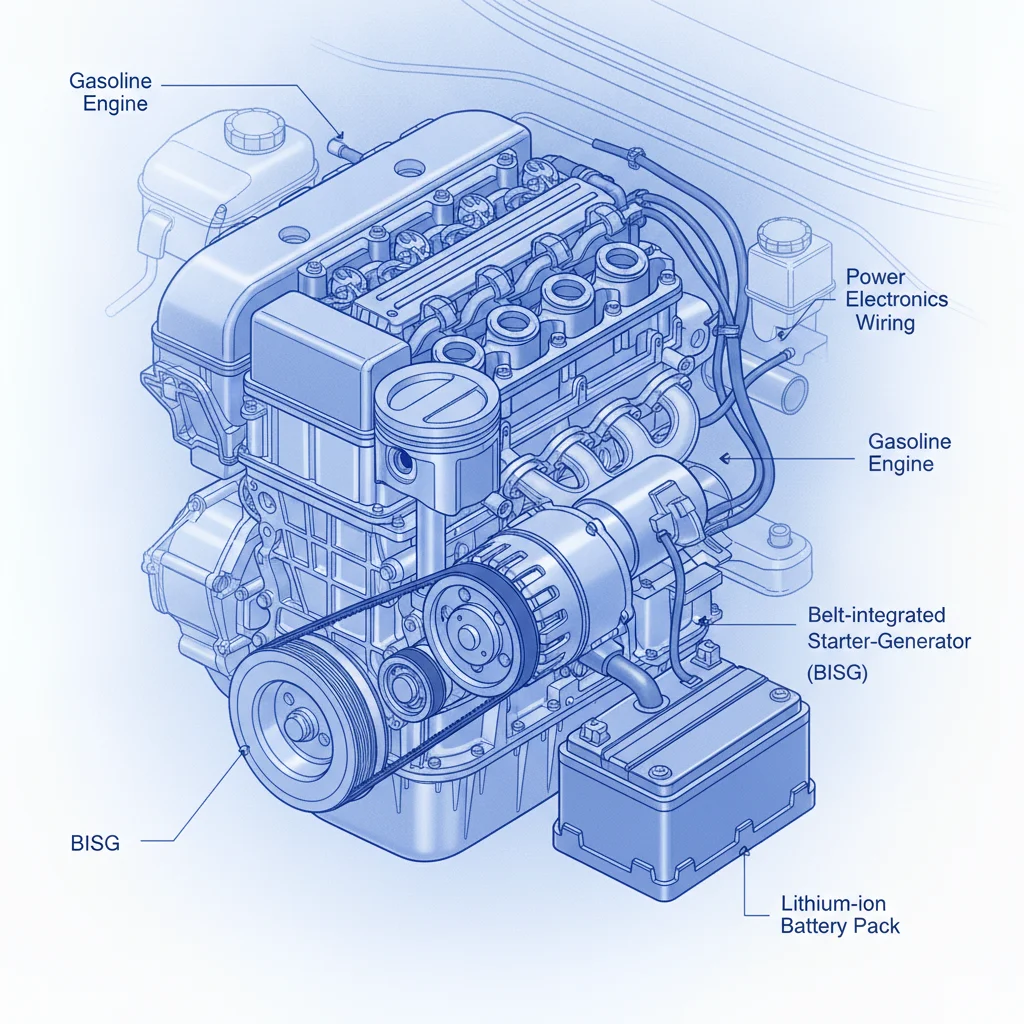
Most modern mild hybrids operate on a 48-volt electrical architecture paired with a belt-integrated starter-generator (BSG) or integrated starter-generator (ISG), though some older systems used 12V. The 48V system allows more meaningful energy recovery and torque assist than a standard alternator can provide.
What a Mild Hybrid Actually Does
The name is deliberately modest, and for good reason. A mild hybrid — also labeled MHEV (Mild Hybrid Electric Vehicle) — is the least electrified category in the hybrid family. Its defining characteristic is what it cannot do: it cannot move the car on electric power alone, even for a few feet at low speed. That immediately separates it from every other type of hybrid and from battery electric vehicles.
What it can do is use a small motor-generator to take some of the strain off the combustion engine at moments when the engine works hardest. During acceleration from a stop, for instance, the electric motor-generator provides a brief torque supplement — reducing how hard the engine has to work and, by extension, how much fuel it burns. During deceleration and braking, the same unit runs in reverse, converting kinetic energy back into electricity stored in the battery. This process is called regenerative braking, though at a much smaller scale than you'd see in a full hybrid or a BEV.
The result is an engine that coasts, idles, and accelerates more efficiently than it otherwise would — but one that is always in charge of actually moving the car. For a clear comparison of where MHEV fits within the broader electrification spectrum, see our full breakdown of BEV, PHEV, HEV, and MHEV labels.
The 48-Volt System: Why It Matters
To understand why mild hybrids work the way they do, you need to understand the electrical architecture behind them. Standard cars run on a 12-volt electrical system — fine for lights, infotainment, and a conventional starter motor, but not capable of delivering meaningful electric torque assist. Early mild hybrids attempted to stretch 12V systems but achieved only marginal gains.
Modern mild hybrids overwhelmingly use a 48-volt system. That's enough voltage to run a belt-integrated starter-generator (BSG) or an integrated starter-generator (ISG) that can actually push torque into the drivetrain during acceleration and recover useful amounts of energy under braking. The 48V battery is typically a lithium-ion pack of modest capacity — often between 0.3 and 1.0 kWh — housed discreetly under the floor or in the trunk.
A 48V system also enables a much smoother stop-start experience. Conventional stop-start systems use the 12V starter motor, which produces the familiar lurch and noise when the engine restarts at a traffic light. With a BSG spinning the engine at speed before combustion begins, the restart is nearly imperceptible — a real quality-of-life improvement for city drivers.
MHEV Is Not the Same as a 'Self-Charging Hybrid'
Some manufacturers market full hybrids as 'self-charging hybrids' to distinguish them from PHEVs that require plugging in. A mild hybrid is not a self-charging hybrid in this sense — it doesn't store enough energy to meaningfully drive the car. Be precise when reading window stickers and marketing materials: MHEV and HEV are different classifications with very different capabilities.
Warranty Coverage for the 48V Battery
Most automakers cover the mild hybrid battery under a separate powertrain or hybrid component warranty, often 8 years/100,000 miles in line with federal emissions warranty requirements for hybrid components. Check your specific vehicle's warranty terms, as coverage varies between brands and some limit the high-voltage component warranty to emissions-related failures only.
It's worth noting that the 48V battery in a mild hybrid is not the same category of battery as the high-voltage pack in a full hybrid (typically 200–300V) or a BEV (300–800V). The MHEV battery is smaller, lighter, and cheaper — which is partly why MHEVs cost less. But it also means the electric assist is genuinely limited.
5–15%
Typical urban fuel economy improvement from MHEV
Based on independent testing by automotive publications and EPA methodology comparisons across mild hybrid vehicles from multiple manufacturers.
48V
Standard voltage for modern mild hybrid systems
The European 48V mild hybrid standard, adopted broadly by Audi, Volvo, Mercedes, Ford, and others, enables meaningful torque assist where 12V systems fell short.
$500–$1,500
Typical MHEV price premium over non-hybrid equivalent
Estimated based on manufacturer pricing comparisons across U.S.-market mild hybrid vehicles from model years 2022–2024.
2–5%
Highway fuel economy improvement from MHEV
Steady-state highway driving offers the mild hybrid system few opportunities to intervene, resulting in significantly lower gains than city driving conditions.
0.3–1.0 kWh
Typical MHEV battery capacity
Far smaller than the 8–25 kWh packs in PHEVs or the 50–100+ kWh batteries in BEVs, reflecting the limited energy storage needed for assist-only operation.
How Mild Hybrids Compare to Full Hybrids and PHEVs
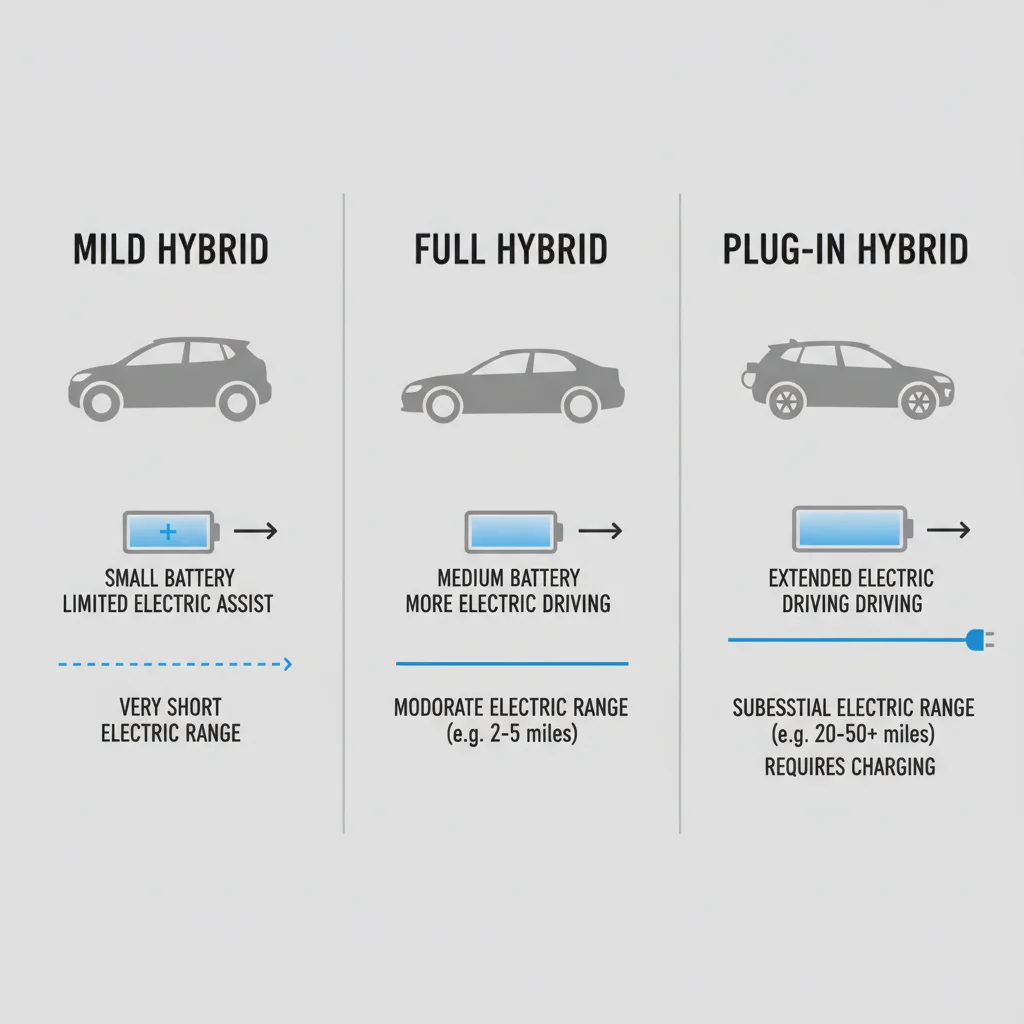
Buyers frequently encounter all three hybrid types in dealership showrooms and online configurators, often with similar-sounding marketing language. The distinctions matter for fuel savings, price, and ownership experience.
A full hybrid (HEV) — such as the Toyota Camry Hybrid or Ford Escape Hybrid — has a significantly larger battery and a more powerful electric motor that can propel the car at low speeds without the engine running. At urban speeds and in stop-and-go traffic, a full hybrid can actually drive on electricity alone, which is where the biggest fuel savings occur. Full hybrids have genuine limitations too, but their fuel economy gains are typically 25–40% over a comparable non-hybrid — far more than a mild hybrid delivers.
A plug-in hybrid (PHEV) takes the concept further still: a much larger battery that you charge from an outlet, enabling all-electric range of typically 20–50 miles before the gas engine takes over. PHEVs are a different ownership proposition entirely — with higher purchase prices, charging infrastructure needs, and dramatically higher fuel savings for drivers who charge regularly.
The mild hybrid sits below both in electrification depth, but also below both in cost premium. A typical MHEV adds $500–$1,500 to a vehicle's price over its non-hybrid equivalent. A full hybrid often adds $2,000–$4,000. A PHEV adds $5,000–$10,000 or more. Whether the MHEV's modest efficiency gains justify even its smaller premium depends entirely on your driving patterns and how long you keep the vehicle.
Real-World Fuel Savings: What to Expect
Marketing materials for mild hybrid vehicles often headline impressive-sounding claims. The reality is more nuanced. Fuel economy improvements from MHEV technology depend heavily on driving conditions — specifically on how often you accelerate from rest and brake to a stop.
In urban and suburban driving with frequent stops, the regenerative braking and torque-fill benefits are more frequent, and real-world gains of 8–15% over an equivalent non-hybrid are plausible. On a highway at steady cruise, the mild hybrid system has little opportunity to intervene — the engine is just doing its job — and fuel economy improvements may be negligible. Many independent tests have found that mild hybrids improve highway fuel economy by only 2–5%.
This is a fundamentally different profile from a full hybrid, which can switch off its engine entirely during highway coasting and delivers consistent gains across all driving scenarios. If the majority of your miles are highway, a mild hybrid's efficiency case weakens considerably. For drivers weighing a full hybrid against a PHEV, the calculus is different again.
Check EPA Ratings for Both Versions
When comparing a mild hybrid trim to its non-hybrid sibling, look up the EPA fuel economy ratings for both on fueleconomy.gov. This gives you a concrete, standardized measure of the efficiency gain before you factor in the price premium. If the MHEV adds $1,200 to the price and saves you 2 MPG, you can calculate roughly how many miles you'd need to drive to break even.
Don't Confuse MHEV With EV Capability
If a salesperson describes a mild hybrid as having 'electric assistance,' ask directly: 'Can this car drive on electricity alone at any speed?' If the answer is no, it's a mild hybrid — useful, but not the same as a full hybrid's EV mode. Setting expectations clearly before purchase prevents disappointment later.
“Mild hybridization is essentially an engine efficiency tool that borrows the language of electrification. It's valuable, but buyers shouldn't confuse it with the EV experience they might be picturing.”
— John Voelcker, Veteran automotive journalist and EV analyst
Who Should — and Shouldn't — Consider a Mild Hybrid
Mild hybrids make the most sense as a transparent upgrade — when automakers include the technology as a standard feature on a trim you were already going to buy, at little or no price premium. In that scenario, you get marginally better fuel economy, smoother stop-start behavior, and slightly crisper throttle response without paying extra or changing your ownership habits at all. No plugs. No new infrastructure. No behavior change required.
Where mild hybrids make less sense is when a buyer actively chooses them over a full hybrid, expecting comparable fuel savings. If you drive mostly in city traffic, put significant miles on your vehicle each year, and care primarily about minimizing fuel costs, a full hybrid will return its higher purchase price premium faster and keep returning it over the life of the vehicle.
Mild hybrids also aren't a meaningful step toward EV ownership. The 48V battery is not user-accessible, not chargeable from outside the car, and not a path to all-electric driving. Buyers who want to reduce their dependence on gasoline are better served by a PHEV or BEV. For a plain-language explanation of how electric motors and drivetrains actually work across vehicle types, our guide to how EVs work is a useful starting point.
MHEV makes sense if:
- The mild hybrid version of your target vehicle costs the same or slightly more than the base model
- You drive primarily in urban or suburban stop-and-go conditions
- You value smoother stop-start behavior and minor fuel savings without lifestyle changes
- You're not in a position to install a home charger for a PHEV or BEV
MHEV probably isn't enough if:
- Fuel savings are your primary motivation for going electrified
- You drive mostly highway miles
- You can afford the premium for a full hybrid or PHEV
- You want to substantially reduce your dependence on gasoline
Maintenance, Reliability, and Ownership Costs
One underappreciated advantage of mild hybrids is their mechanical simplicity relative to full hybrids and PHEVs. There is no high-voltage system to service, no complex transmission-integrated motor, and no large battery pack to manage. The 48V battery is generally sealed for life and not user-serviceable. In the event of failure, replacement costs are lower than a full hybrid battery, though out-of-warranty repairs can still be in the $1,000–$3,000 range depending on the vehicle.
The BSG unit itself — the belt-integrated starter-generator — is a new component not found on conventional vehicles, but early reliability data across Audi, Volvo, Ford, and Mercedes mild hybrid models suggests it is generally durable. The component that benefits most from mild hybridization is arguably the engine itself: because the BSG smooths out start-stop cycles and reduces peak load demands, some engineers argue the combustion engine sees less wear over time. Whether this translates to measurable real-world longevity differences remains to be seen at scale.
Brakes often last longer on mild hybrids than on conventional vehicles because regenerative braking handles some of the deceleration load, reducing friction brake wear — though not to the same degree as a full hybrid or BEV. For broader context on how electrified vehicle maintenance differs from conventional ownership, our EV maintenance basics hub covers the landscape across vehicle types.
MHEV Is Not the Same as a 'Self-Charging Hybrid'
Some manufacturers market full hybrids as 'self-charging hybrids' to distinguish them from PHEVs that require plugging in. A mild hybrid is not a self-charging hybrid in this sense — it doesn't store enough energy to meaningfully drive the car. Be precise when reading window stickers and marketing materials: MHEV and HEV are different classifications with very different capabilities.
Warranty Coverage for the 48V Battery
Most automakers cover the mild hybrid battery under a separate powertrain or hybrid component warranty, often 8 years/100,000 miles in line with federal emissions warranty requirements for hybrid components. Check your specific vehicle's warranty terms, as coverage varies between brands and some limit the high-voltage component warranty to emissions-related failures only.
Mild Hybrid Vehicles on the Market Today
Mild hybrid technology has spread broadly across mainstream and premium brands over the past five years, largely because it allows manufacturers to improve fleet fuel economy averages without the cost and complexity of full hybridization. You'll find 48V mild hybrid systems in vehicles ranging from compact SUVs to full-size trucks.
Notable examples in the U.S. market include the Ford F-150 PowerBoost adjacent mild hybrid system, Ram 1500 eTorque (one of the earliest mainstream truck mild hybrids), Jeep Wrangler 4xe siblings, the Audi A4 and A6 MHEV variants, and the Volvo XC40 and XC60 mild hybrids. Many base-trim European imports now include 48V mild hybridization as a standard feature rather than an optional upgrade.
In the sedan and crossover segments, mild hybridization is increasingly the default powertrain on mid-range and upper trims even when a brand also offers a full hybrid or PHEV in the same model line. This means many buyers end up with MHEV technology without explicitly choosing it — which is actually the best-case scenario, since the cost is baked into the vehicle's standard pricing. Understanding where a mild hybrid sits relative to a full EV helps set realistic expectations before you sign anything.


All claims are backed by peer-reviewed research. Sources on request.