Key Takeaways
Rolling Resistance
Rolling resistance is the energy a tire must expend simply to keep moving along a road surface. The more a tire deforms as it rolls — due to low pressure, soft rubber compounds, or heavy loads — the more energy is consumed overcoming that deformation. For EVs, where every watt-hour of stored energy has a direct impact on range, minimizing rolling resistance is a measurable efficiency strategy, not just a theoretical concern.
Rolling resistance is quantified as a coefficient (Crr), typically ranging from 0.006 to 0.015 for passenger vehicle tires; lower-rolling-resistance EV tires often target Crr values below 0.008.
The Physics Behind the Problem
Every time an EV tire completes a revolution, the section of rubber contacting the road compresses slightly under the vehicle's weight and then springs back as the tire rolls forward. This cycle of compression and recovery — known as hysteretic deformation — dissipates energy as heat. The softer or more pliable a tire is, the more pronounced this deformation becomes, and the more energy is consumed without moving the vehicle forward a single inch.
This is rolling resistance in its most literal form, and it is always working against your drivetrain. In a gasoline vehicle, where fuel energy is already being wasted at roughly 60–70% thermal efficiency, rolling resistance is one loss among many. In an electric vehicle, where the drivetrain converts energy to motion at 85–95% efficiency, rolling resistance becomes a proportionally larger share of total losses — which is precisely why tire engineers and EV manufacturers treat it as a primary design constraint rather than an afterthought.
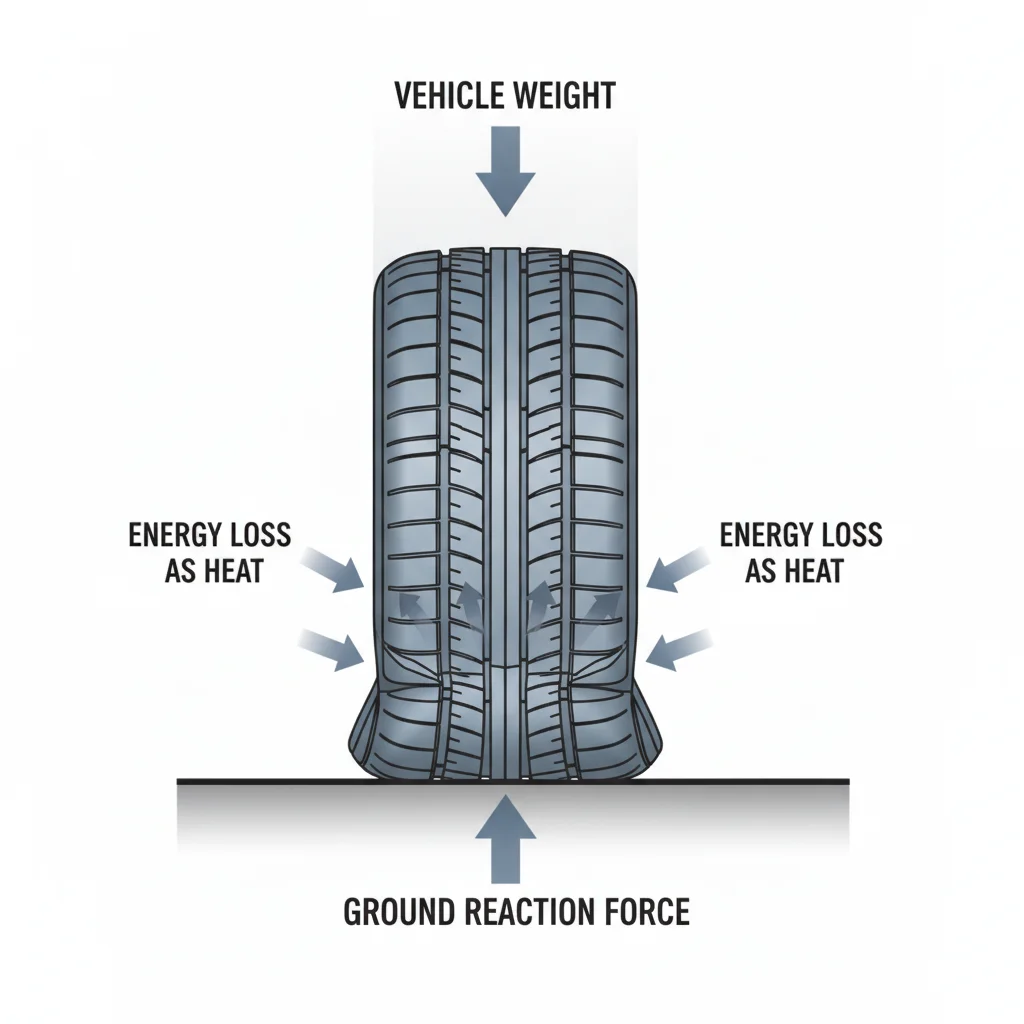
The relationship between tire pressure and rolling resistance is direct: lower pressure means a larger, softer contact patch, more deformation per revolution, and more energy lost to heat. Higher pressure stiffens the sidewall, reduces deformation, and shrinks energy waste. It is a straightforward mechanical relationship, though as we will examine, the optimal balance is not simply inflating to the highest possible pressure.
Understanding how EVs convert energy to motion provides useful context for why efficiency losses that seem minor in isolation — a few watts here, a percentage point there — accumulate into meaningful range reductions over a driving session.
Putting Numbers to the Range Impact
The theoretical physics are intuitive, but EV owners reasonably want to know: how much range am I actually losing from under-inflated tires? The answer depends on several interacting variables — vehicle weight, speed, ambient temperature, and how far below specification the pressure has dropped — but credible data points establish a useful range of expectations.
~1–2%
Efficiency loss per 10 PSI under-inflation
Extrapolated from U.S. Department of Energy data indicating roughly 0.2% efficiency loss per 1 PSI of under-inflation across all four tires.
1 PSI
Pressure drop per 10°F temperature decrease
A well-established rule of thumb validated by tire industry testing and cited by the Rubber Manufacturers Association.
1 PSI/month
Natural pressure loss through permeation
Standard passenger tires lose approximately 1 PSI per month through normal gas permeation even without any leak, per industry data.
0.006–0.015
Rolling resistance coefficient range for passenger tires
EV-specific low-rolling-resistance tires typically target Crr values below 0.008, according to tire engineering literature.
25%
Below-spec pressure threshold for TPMS alert
U.S. federal regulations require TPMS systems to alert drivers when pressure drops 25% below the placard specification — a level already well into efficiency-degrading territory.
The U.S. Department of Energy has cited figures suggesting that under-inflation of approximately 1 PSI across all four tires can reduce fuel or energy efficiency by about 0.2%. Extrapolating to a realistic scenario where all four tires are 10 PSI low — not unusual in winter months — that compounds to roughly a 2% efficiency penalty. For an EV rated at 300 miles of EPA range, a 2% penalty equates to 6 miles of lost range per full charge.
That number may sound modest in isolation, but consider the cumulative picture. If you charge twice a week and drive 52 weeks a year, a chronic 2% efficiency loss costs you over 600 miles of effective range annually — range you paid for in the vehicle's battery pack but are unable to access because of maintenance avoidance.
“Tires are the single point of contact between a vehicle and the road. Everything the powertrain does — accelerate, brake, corner — is filtered through four contact patches about the size of a human hand each. Getting tire pressure right is not optional maintenance; it is the foundation on which every other performance parameter rests.”
— Tom Bürckhardt, Tire Systems Engineer, published contributor to SAE International technical papers on EV-specific tire development
Speed amplifies the effect. Rolling resistance is a primary energy drain at lower speeds, while aerodynamic drag dominates at highway speeds. This means tire pressure has an outsized impact on city and suburban driving — the daily commute profile where most EV miles are actually accumulated. The full picture of why EVs underperform EPA estimates addresses how these factors interact across different driving scenarios.
How EV-Specific Tires Approach the Problem Differently
Most EVs sold today ship with tires that differ meaningfully from standard passenger car rubber, even when the size looks identical. Low-rolling-resistance (LRR) tires represent the primary engineering response to the range efficiency challenge, and they achieve their performance through several design strategies that compound together.
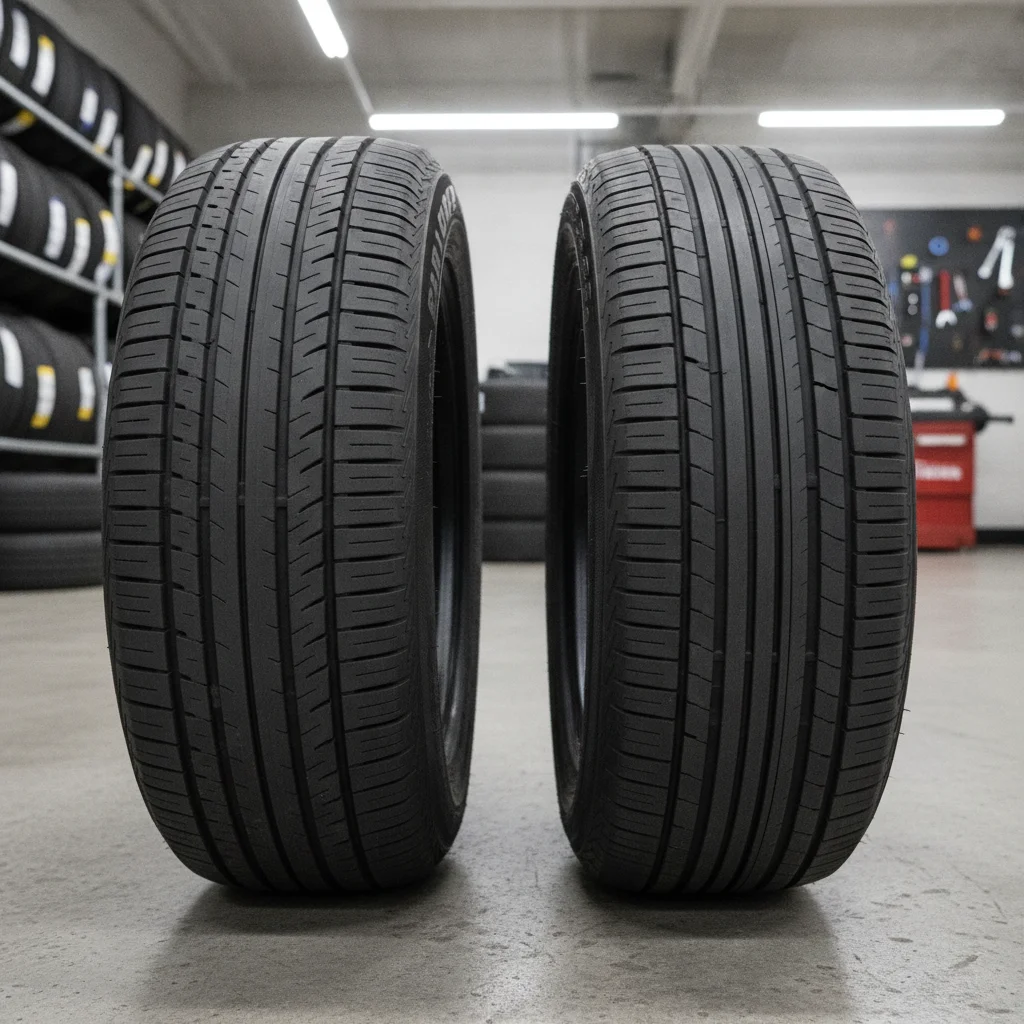
Compound formulation is the most impactful lever. LRR tires use silica-enriched rubber blends that remain stiffer during the compression-and-recovery cycle, releasing more of the deformation energy elastically rather than dissipating it as heat. This is the same basic principle behind high-rebound rubber, but tuned for thermal efficiency rather than athlete performance.
Sidewall construction also matters. EV tires often feature reinforced sidewalls that resist the lateral flex created by heavier vehicle curb weights — something a Tesla Model Y, GMC Sierra EV, or Rivian R1T requires that a comparable gas vehicle does not, given the added mass of battery packs. Stiffer sidewalls reduce rolling losses while also improving handling predictability under the instant torque delivery that characterizes electric motors.
Tread pattern optimization completes the picture. Aggressive, open tread patterns that maximize wet-weather grip increase rolling resistance. LRR tires use shallower, more continuous rib patterns that reduce road noise and rolling energy simultaneously — a tradeoff that also tends to wear more evenly on EV applications where regenerative braking reduces rear brake use.
OEM Tire Specs Matter at Replacement Time
When factory tires wear out, the temptation to choose on price alone is understandable — but EV owners replacing OEM low-rolling-resistance tires with standard alternatives may see a range reduction of 2–5% depending on the specific compound difference. Many tire retailers now filter search results by LRR designation; it is worth using that filter before narrowing by price. Confirming the load index is also critical for EVs, which are typically heavier than comparable gas vehicles.
TPMS Is a Warning System, Not a Maintenance Tool
The Tire Pressure Monitoring System required on all U.S. vehicles since 2008 is calibrated to alert at 25% below placard pressure — a level already associated with meaningful efficiency loss and elevated safety risk. Relying on the TPMS light as a maintenance signal means tires are already significantly under-inflated before any action is taken. Use a calibrated gauge on a regular schedule rather than waiting for the dashboard to intervene.
When it is time to replace factory tires, matching the original LRR specification is worth the research effort. EV tires wear faster than most owners expect, and replacement decisions have downstream consequences for both range and safety that go beyond price-per-tire.
Finding the Right Pressure: The Door Jamb Spec Explained
The most consequential practical question for any EV owner is simple: what PSI should my tires actually be at? The answer is equally simple, though frequently misunderstood: the number on the door jamb sticker, not the maximum pressure molded into the tire sidewall.
The door jamb placard — typically found on the driver's door frame — lists the manufacturer's recommended cold inflation pressure for front and rear tires. This figure accounts for the vehicle's weight distribution, load rating, suspension geometry, and the specific tires it was engineered with. It reflects a calculated balance between rolling resistance, handling, ride comfort, braking performance, and tire longevity.
Check Pressure Cold for Accurate Readings
Always measure tire pressure before driving, or after the vehicle has sat for at least three hours. Driving heats the air inside tires, raising pressure 4–6 PSI above true cold readings. Adjusting based on warm readings will leave tires systematically under-inflated once they cool, undermining the efficiency benefit you were trying to capture.
A Portable Compressor Pays for Itself
A compact 12V tire inflator ($30–$60 at most auto parts retailers) allows precise at-home inflation to the exact door jamb specification without relying on gas station air pumps, which are often poorly calibrated and inconveniently located. For EV owners who park in a home garage, filling tires at the same time as plugging in for overnight charging creates a frictionless maintenance habit.
The maximum pressure embossed on the tire sidewall (often 44, 50, or 51 PSI on many EV fitments) represents the tire's structural limit — the absolute ceiling above which casing integrity could be compromised. It is not a target. Inflating to the maximum sidewall pressure would harden the ride, shrink the contact patch, reduce wet-grip performance, and create uneven center tread wear.
A subtlety worth noting: cold inflation pressure means the reading taken when the tire has not been driven on for at least three hours. Tires heat up during driving and pressure rises — typically 4–6 PSI above cold readings after highway driving. Checking and adjusting pressure immediately after driving will lead to systematic under-inflation once the tires cool. Always check cold.
For EV owners in climates with significant seasonal temperature swings, pressure management requires seasonal attention. Pressure drops approximately 1 PSI for every 10°F decrease in ambient temperature. A tire correctly inflated to 42 PSI in October can read 36–37 PSI by January in a Northern climate without a single slow leak. The TPMS warning light on most vehicles activates at roughly 25% below recommended pressure — which is considerably lower than the point where range efficiency begins degrading. Under-inflated tires also carry significant safety implications that extend well beyond range concerns.
The Overinflation Tradeoff
Some EV owners, aware that higher pressure reduces rolling resistance, deliberately overinflate their tires to chase extra range. It is a logical instinct, but the tradeoffs make it a poor optimization strategy beyond modest deviations from specification.
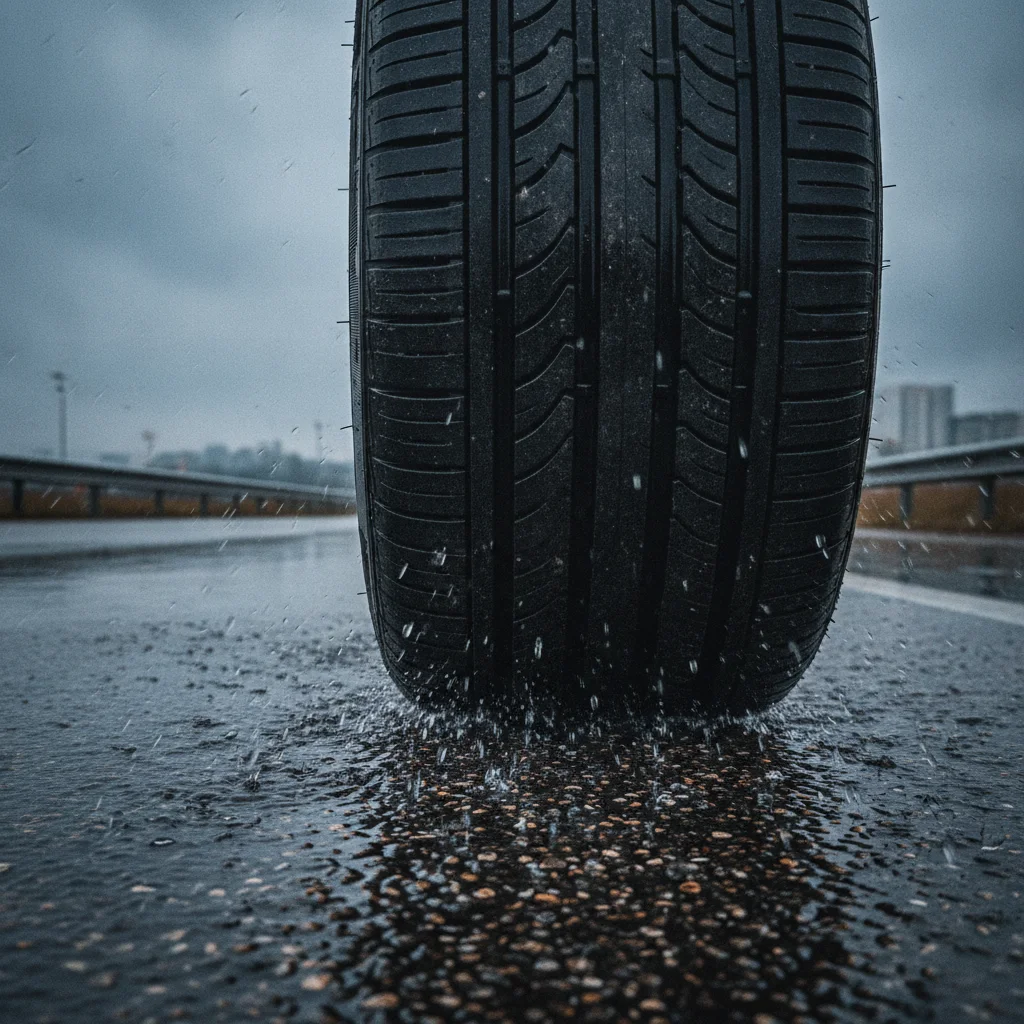
Overinflated tires develop a smaller, more rigid contact patch — the area of rubber actually touching the pavement. A smaller contact patch means less friction available for braking and cornering. In emergency braking scenarios, particularly on wet surfaces, this reduction in grip can translate to meaningfully longer stopping distances. The National Highway Traffic Safety Administration has documented the relationship between improper inflation and crash risk, and the risk is not trivially small.
Beyond safety, overinflation accelerates center tread wear, where the middle of the tire wears faster than the outer edges because it bears disproportionate contact load when the sidewall is overstretched. This pattern reduces tire lifespan and can necessitate earlier replacement, negating any efficiency savings many times over in replacement cost.
Vehicle loading affects optimal tire pressure in ways worth understanding — a heavily loaded EV may benefit from pressures at the higher end of the manufacturer's specified range, while an empty vehicle does not. Some manufacturers provide separate placard pressures for loaded versus unloaded conditions precisely for this reason.
The practical recommendation: stay within 2–3 PSI of the door jamb specification in either direction. If an inflation experiment is conducted, document the difference and observe real-world range using the vehicle's energy consumption display over several charge cycles before concluding anything definitive.
Building a Tire Pressure Maintenance Routine
The efficiency argument for correct tire pressure is strong enough that it justifies making pressure checks a structured habit rather than an occasional reaction to a dashboard warning. The good news is that the practical requirements are minimal.
Check Pressure Cold for Accurate Readings
Always measure tire pressure before driving, or after the vehicle has sat for at least three hours. Driving heats the air inside tires, raising pressure 4–6 PSI above true cold readings. Adjusting based on warm readings will leave tires systematically under-inflated once they cool, undermining the efficiency benefit you were trying to capture.
A Portable Compressor Pays for Itself
A compact 12V tire inflator ($30–$60 at most auto parts retailers) allows precise at-home inflation to the exact door jamb specification without relying on gas station air pumps, which are often poorly calibrated and inconveniently located. For EV owners who park in a home garage, filling tires at the same time as plugging in for overnight charging creates a frictionless maintenance habit.
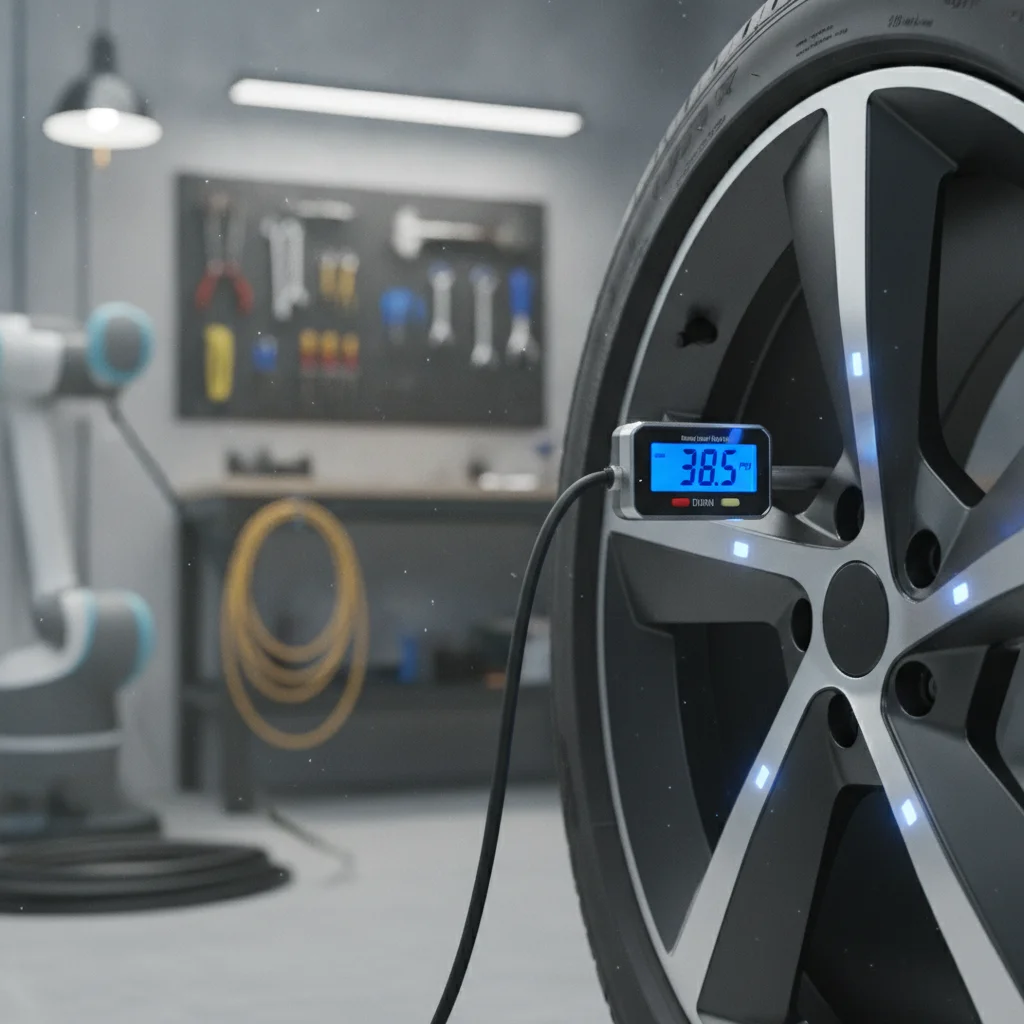
A quality digital tire pressure gauge costs less than $20 and provides readings accurate to 0.5 PSI — sufficient precision for this task. Analog dial gauges and stick-type gauges introduce more error and are less preferable for systematic use. Keep the gauge in the vehicle, not in the garage.
The recommended checking cadence for EV owners:
- Monthly: Check all four tires cold, before the first drive of the day. Compare to the door jamb specification and adjust at a service station air pump or with a portable compressor.
- Seasonally: Check and adjust immediately after a significant temperature shift — specifically when ambient temperatures drop by 15°F or more between seasons.
- Before long trips: A pre-trip pressure check is particularly valuable for EVs where efficient range maximization may determine whether a charging stop is necessary.
- After any suspected impact: Curb strikes and pothole impacts can cause slow leaks or bead seal damage that TPMS may not immediately detect at a threshold level.
Many modern EVs display individual tire pressure readings through the infotainment system — a useful reference but not a substitute for a cold-measurement check with a calibrated gauge, since displayed values reflect real-time (often warm) pressure and may show slightly elevated figures after recent driving.
Tire pressure management is part of a broader EV maintenance discipline that distinguishes EV owners who consistently achieve near-rated range from those who chronically underperform their vehicle's potential. Tire pressure ranks among the most controllable range factors — which makes it a logical priority for any efficiency-conscious owner.
All claims are backed by peer-reviewed research. Sources on request.