Key Takeaways
Idle Fee
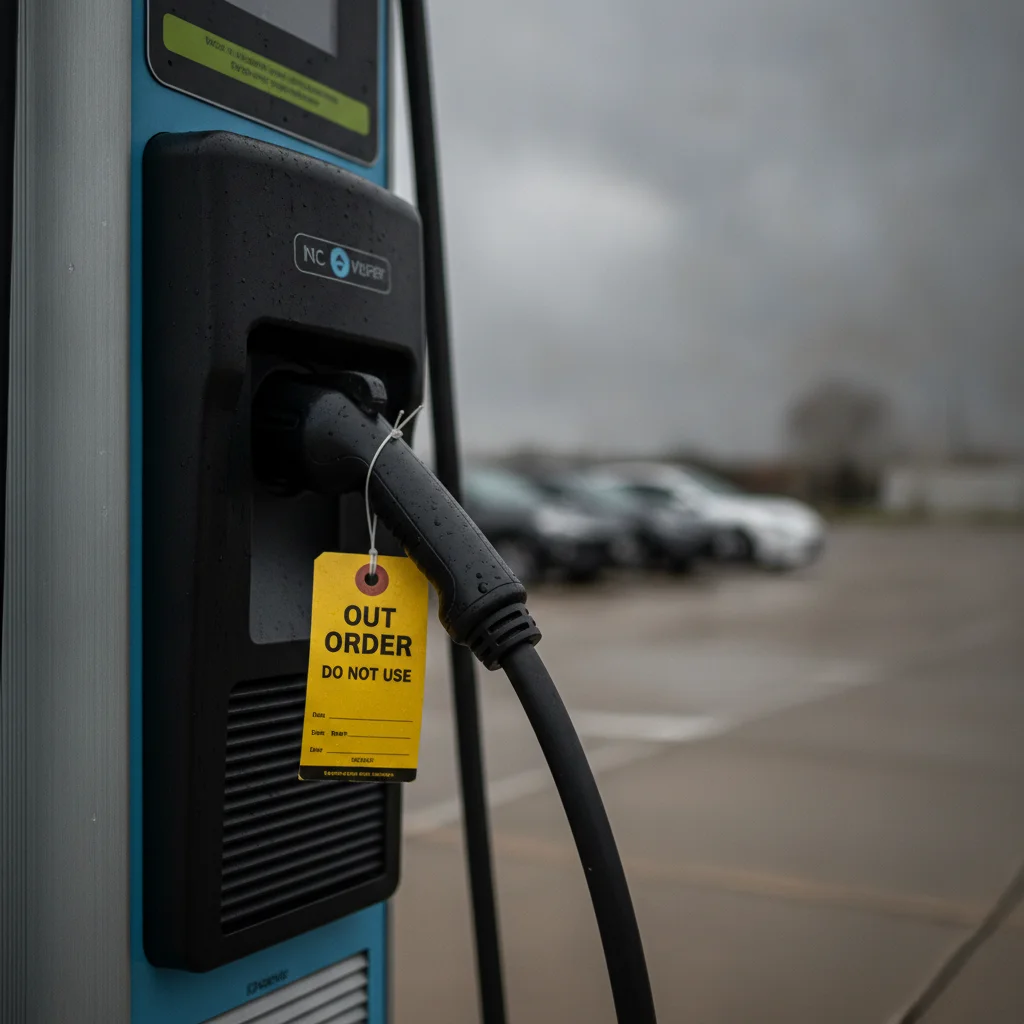
An idle fee is a per-minute charge that public EV charging networks apply after your vehicle has finished charging and is still occupying the stall. The fee is designed to encourage drivers to move their cars promptly so other EV owners can access the charger. It is separate from the energy or session fees you pay to actually charge your battery.
Idle fees are typically triggered once state-of-charge reaches 100% or, on some networks, once charging rate drops below a defined threshold — not simply after a fixed time window.
Why Idle Fees Exist in the First Place
Public EV charging infrastructure is expanding fast, but stall availability remains the single biggest bottleneck at busy corridors. A driver who leaves a fully charged car parked for 30 minutes at a highway DC fast charger effectively blocks that stall for the next driver who may have 20 miles of range left and nowhere else to go.
Charging networks introduced idle fees to solve a behavioral problem, not a technical one. As long as parking a fully charged EV at a charging stall carries no financial cost, some percentage of drivers will leave their cars there indefinitely — grabbing lunch, shopping, or simply forgetting. Idle fees convert that time into a tangible penalty, creating an incentive to move on.
The model borrows loosely from the parking industry, where dynamic pricing has long been used to manage scarce urban spaces. In the EV context, the fee is more targeted: it only activates after the vehicle has finished charging, so a driver who needs three hours at a Level 2 charger to get a full battery isn't penalized for using the equipment for its intended purpose.
It's worth distinguishing idle fees from the broader category of charging cost surprises. Charging cost mistakes that quietly drain EV savings covers a wider range of errors — overusing fast chargers, ignoring time-of-use rates — but idle fees represent one of the most avoidable line items on a charging receipt.
How Major Networks Structure Their Idle Fees
Idle fee policies differ meaningfully across networks, and knowing the specifics before you plug in can save real money. Here is how the major players handle it as of 2024:
Tesla Supercharger
Tesla's idle fee system is the most sophisticated. At Supercharger locations where every stall is occupied, the idle fee is $1.00 per minute. If at least one other stall is open, the fee drops to $0.50 per minute. When the station is less than 50% full, no idle fee is charged at all. Tesla sends a push notification through its mobile app when charging is complete, and drivers who move their car within five minutes of that alert are not charged. Idle fees are waived entirely for non-Tesla vehicles using a Magic Dock adapter stall at some locations.
Electrify America
Electrify America charges $0.40 per minute in idle fees after a 10-minute grace period following charge completion. The grace period is the same whether you're a pass member or paying the default rate. Notifications are sent via the EA app. The network does not vary the idle fee by station occupancy the way Tesla does.
ChargePoint
ChargePoint's idle fee policy is set by the site host — the business or property owner who operates the charger — rather than by ChargePoint centrally. That means idle fees vary from $0 at some locations to $10 per hour at others. Always check the ChargePoint app for location-specific pricing before you unplug your cable and head inside.
EVgo
EVgo charges $0.40 per minute in idle fees with no published grace period listed in its standard terms. Like other networks, it notifies drivers through its app when a session ends.
$1.00/min
Tesla peak idle fee (fully occupied station)
Tesla's idle fee structure charges $1.00 per minute when all Supercharger stalls are occupied, dropping to $0.50/min when at least one stall is open.
$0.40/min
Electrify America & EVgo idle fee rate
Both Electrify America and EVgo charge $0.40 per minute after a session ends, with Electrify America offering a 10-minute grace period before fees begin.
5 min
Tesla grace period after charge-complete alert
Tesla drivers who move their vehicle within five minutes of receiving the session-complete notification are not charged an idle fee.
$24/hr
Equivalent hourly idle cost at $0.40/min networks
At the standard $0.40/min idle rate used by Electrify America and EVgo, a one-hour delay after charging generates $24 in idle fees alone.
10 min
Electrify America grace period after session ends
Electrify America allows a 10-minute grace period after charge completion before its $0.40/min idle fee begins accumulating.
Blink
Blink applies idle fees on a location-by-location basis, similar to ChargePoint. Some Blink-hosted stations charge $0.10 per minute, others more. Again, in-app pricing is the authoritative source.
Idle Fees Are Reported on Your Receipt
Most charging networks itemize idle fees separately on your session receipt or billing history in the app. If you notice an idle charge you believe was applied incorrectly — for example, because a charger malfunctioned and cut your session short — document the session ID and contact the network's support line. Networks including Tesla and Electrify America have reversed erroneous idle fees when presented with session log evidence.
State Laws May Limit Idle Fees
A small number of states and municipalities have proposed or enacted regulations governing how EV charging stations price overstay time. Rules in this area are evolving rapidly. If you're in California, New York, or another state with active EV infrastructure legislation, check your state's public utilities commission website for current guidance on allowable idle fee structures.
Level 2 Chargers Rarely Trigger Idle Fees in Practice
While Level 2 stations can technically have idle fee policies, the long session durations involved — often four to eight hours for a full charge — mean drivers are usually back before the session ends. Idle fees are primarily a DC fast charger concern, where 20–45 minute sessions create a window during which drivers are often away from their vehicles.
The Real-World Math on Idle Fees
The per-minute figures can seem small in isolation, but they compound quickly. Consider a driver at a busy Tesla Supercharger who wraps up a charge, grabs a coffee, and wanders back to the car 20 minutes later. With all stalls occupied, that's $20 in idle fees — more than the cost of the actual electricity for many partial charges.
Electrify America's $0.40 per minute rate translates to $24 per hour. A driver who falls asleep in a nearby restaurant booth for 90 minutes after a long highway segment could return to a $36 idle fee tacked onto their session. That is not a hypothetical: charging session data shows idle accumulation clustered around meal times at highway corridor locations.
The math also reveals why idle fees hit DC fast charger drivers hardest. Level 2 AC charging sessions typically last two to eight hours, which means drivers are usually parked with intent and return well before charging ends. A 30-minute DC fast charge at 150–350 kW is the session most likely to complete while the driver is still nearby but distracted.
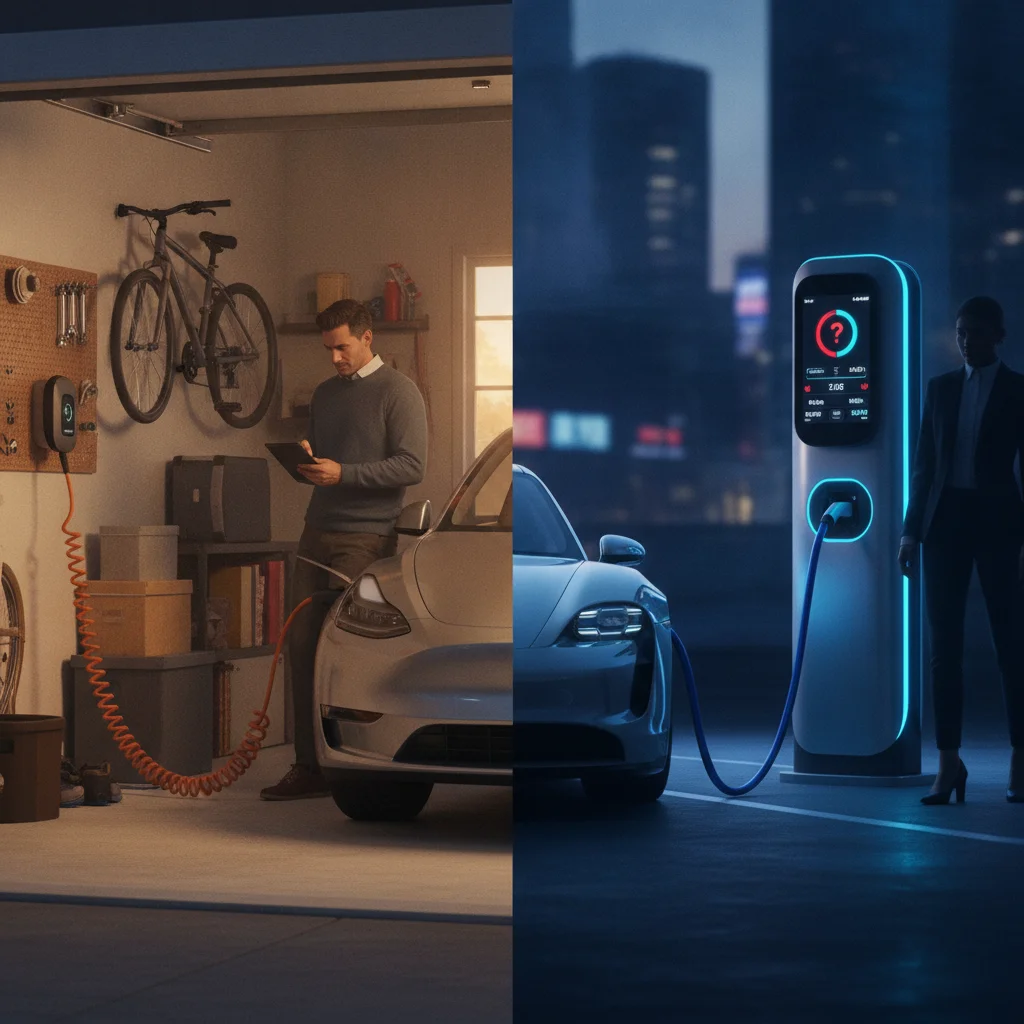
For a more complete picture of where idle fees fit within your total charging spend, the home charging vs. public charging cost breakdown puts per-session fees, idle fees, and energy costs in direct comparison with what you'd pay plugging in at home.
Why Notifications Don't Always Save You
Every major network sends a push notification when a session ends. In theory, this gives drivers a heads-up with enough time to return before idle fees kick in or before a grace period expires. In practice, several failure points undermine this system.
First, notification delivery depends on a working cellular connection at the charging station. Some highway locations — mountain passes, rural corridors, tunnel-adjacent rest stops — have marginal signal, which can delay or drop push notifications entirely. Second, drivers who silence their phones, leave them in the car, or use do-not-disturb during a meal won't receive the alert at all. Third, if the network's app is not set up to bypass battery optimization settings on Android, the OS may suppress background notifications.
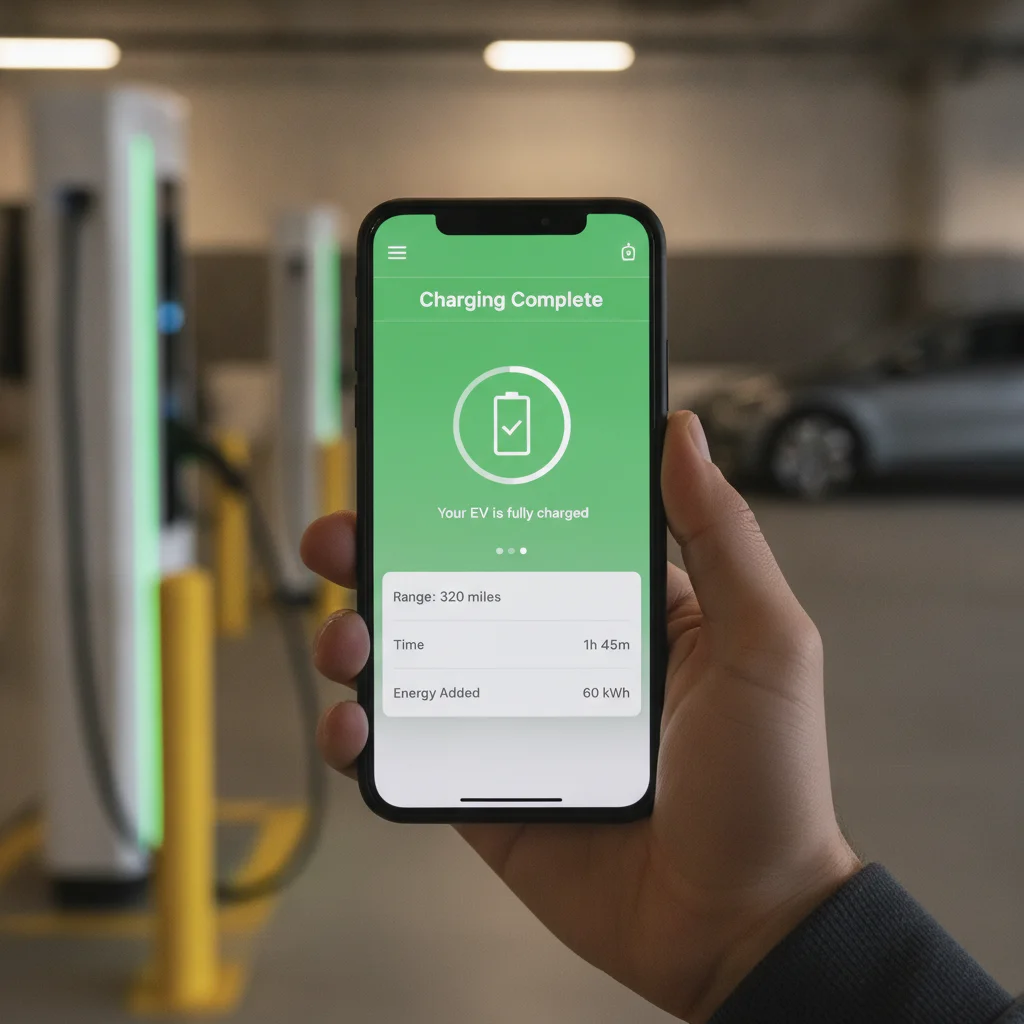
The grace period is your actual safety net. At Electrify America, you have 10 minutes from charge completion to unplug before fees begin. At Tesla, you have five minutes after the notification arrives. Understanding that the clock starts at charge completion — not when you read the notification — is the critical distinction.
Set Your Charge Limit to 80–90%
Lowering your charge target at public DC fast chargers achieves two goals simultaneously: it shortens your session so you're more likely to be nearby when it ends, and it reduces the time your battery spends at high state-of-charge — which battery researchers consistently link to slower long-term degradation. Most EVs let you set this limit in the vehicle's settings menu or companion app before you arrive at the station.
Configure Smartwatch Alerts for Charge Completion
Smartwatch haptic alerts are far more reliable than phone notifications for catching a charge-complete event, especially during a noisy meal or a crowded venue. Check whether your EV's manufacturer app or the charging network's app offers watchOS or Wear OS notification support, and configure it before your first long trip. A gentle buzz on the wrist beats missing a $20 idle fee by a wide margin.
Dispute Errors Quickly — Session Logs Expire
If you believe an idle fee was charged in error, file a dispute through the network's app or customer service within 48–72 hours of the session. Charging networks retain session logs, but support teams are better equipped to assist when the event is recent. Include your session ID, the station ID, and the time of charge completion in your dispute message.
It's also worth noting that app reliability varies. Charger downtime and reliability issues extend beyond hardware failures; software glitches that cut sessions short or fail to communicate accurate state-of-charge data can trigger premature idle-fee clocks. If you believe an idle fee was charged in error, most networks offer in-app dispute tools or customer service lines that will review session logs.
Practical Strategies to Avoid Idle Fees
Avoiding idle fees requires nothing more than awareness and a small shift in habit. These strategies work consistently across networks:
- Set a charge target below 100%. Most EVs allow you to set a charge limit in the vehicle's settings or the manufacturer's app. Setting a target of 80–90% at a DC fast charger reduces session time, gets you back on the road faster, and means the session ends while you're still likely nearby. It also reduces battery degradation over time — a secondary benefit.
- Enable app notifications with high priority. Go into your phone's notification settings for each charging app you use and ensure notifications are set to bypass do-not-disturb and battery optimization. Test this before your first long trip.
- Use your EV's built-in timer or departure alert. Many EVs — including those from Ford, Hyundai, Kia, and GM — allow you to set charge-complete alerts directly in the vehicle's infotainment system or companion app, independent of the network app.
- Plan meals and stops to align with charge time. If your session is projected to take 25 minutes, pick a restaurant within a five-minute walk — not a sit-down place a quarter mile away. Most charging network apps display estimated completion time before you even plug in.
- Monitor the session on a smartwatch. If you wear an Apple Watch, Galaxy Watch, or similar device, configure the EV or network app to deliver notifications to the watch. Haptic alerts are far harder to miss than phone pings.
For a deeper look at how public charging behavior intersects with courtesy and cost, public charging etiquette every EV driver should know covers both the unwritten norms and formal fee policies that govern shared charging stations.
“Idle fees aren't punitive — they're a supply-demand signal. When charging infrastructure is scarce, the only fair mechanism for allocating stall time is price. Drivers who understand that dynamic make better decisions about when to linger and when to move on.”
— Tom Moloughney, EV charging infrastructure analyst and long-range EV advocate
Idle Fees vs. Other Hidden Charging Costs
Idle fees are one of several line items that can make a public charging session cost more than expected. Understanding how they compare to other surprise charges helps you prioritize where to focus your attention.
Session Fees
Some networks charge a flat session initiation fee — typically $0.99 to $1.99 — on top of energy costs. This is unrelated to idle time and applies whether or not you charge the battery. Level 2 networks are more likely to use session fees than DC fast chargers.
Demand Charges (for business accounts)
Individual drivers do not see demand charges directly, but they affect network pricing strategy. Demand charges are utility billing mechanisms triggered when a site draws high power over a short period — directly relevant to DC fast chargers. Networks pass some of that cost into per-kWh pricing, which is why fast charging costs more per kilowatt-hour than Level 2.
Membership vs. Pay-As-You-Go Pricing
Most networks offer monthly memberships that lower per-kWh or per-minute rates in exchange for a recurring fee. If you use public charging regularly, running the numbers on membership cost versus pay-as-you-go savings is worthwhile. Idle fees are charged at the same rate regardless of membership tier at most networks.
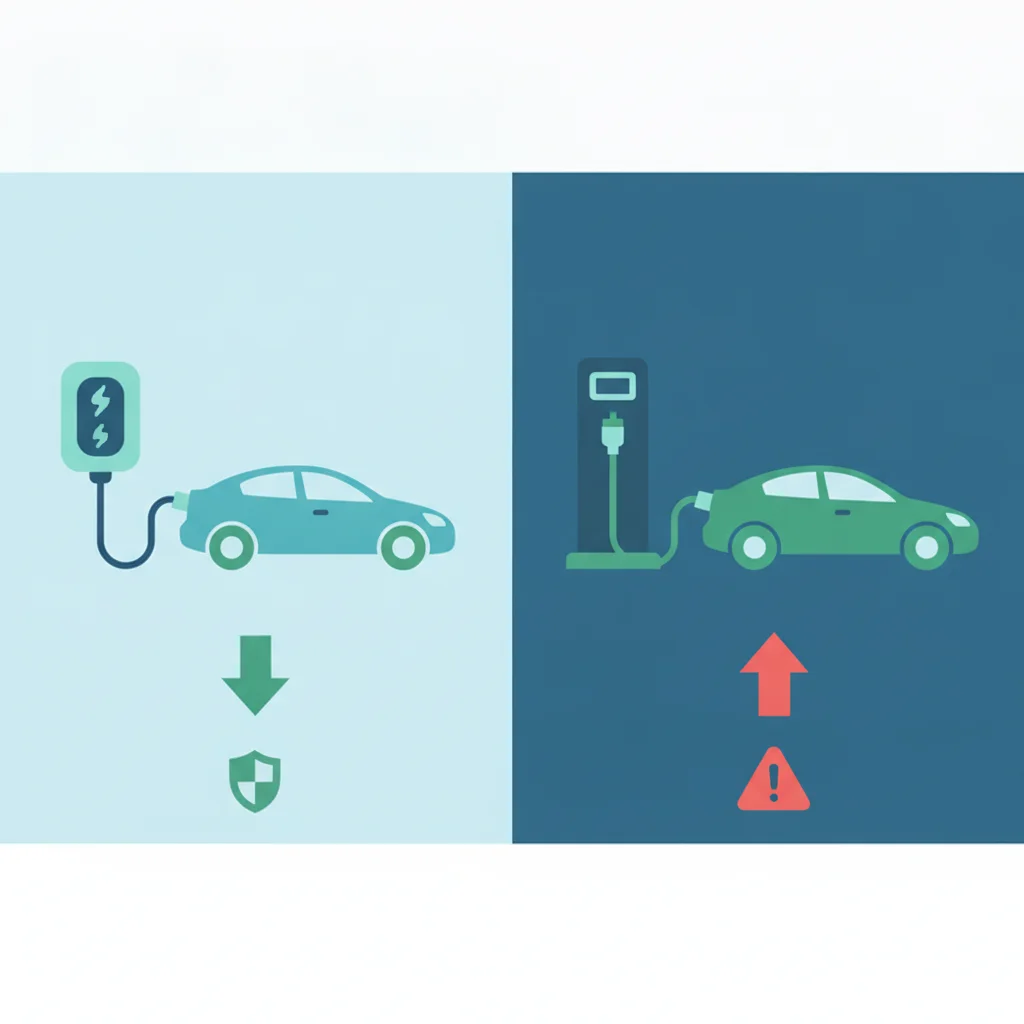
The bottom line: idle fees are uniquely avoidable compared to most other public charging costs. You can't negotiate the per-kWh rate at a given station, but you can control how long your car sits idle after charging completes. That makes behavioral awareness the most powerful cost-control tool available to public charging users.
If you're evaluating whether frequent public charging is even the right strategy for your situation, home charging setup options may provide a more cost-stable alternative for drivers who can charge overnight.
All claims are backed by peer-reviewed research. Sources on request.