Key Takeaways
DC Fast Charging
DC fast charging (DCFC) is a method of charging an electric vehicle that delivers direct current (DC) electricity straight to the car's battery, bypassing the vehicle's slower onboard charger. Because the conversion from AC to DC happens inside the charging station rather than inside the car, far more power can be delivered in a short time. Most DC fast chargers can add 100 to 200 miles of range in 20 to 40 minutes depending on the vehicle.
DCFC stations are classified under SAE J1772 as Level 3 charging; they operate at voltages typically ranging from 200 V to 1,000 V DC and can deliver anywhere from 50 kW to 350 kW of power, depending on both the station hardware and the vehicle's maximum charge acceptance rate.
Why DC Fast Charging Is a Different Animal
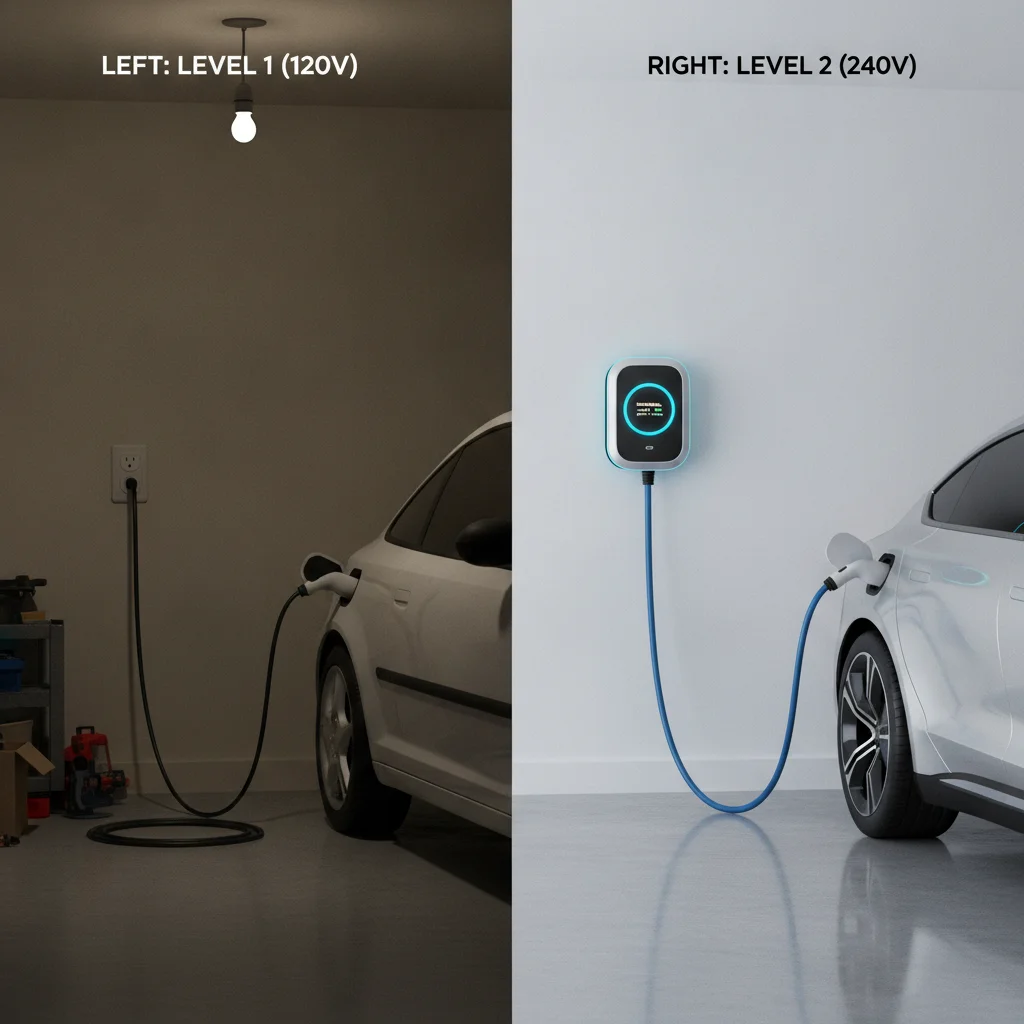
Plug a car into a standard wall outlet or even a dedicated Level 2 home charger, and something critical happens inside the vehicle: an onboard charger converts the alternating current (AC) from the grid into the direct current (DC) that the battery actually stores. That onboard charger is a physical component with a hard power limit—typically 7.2 kW to 19.2 kW on modern EVs—and that limit caps how fast the battery can fill regardless of how much power the grid could supply.
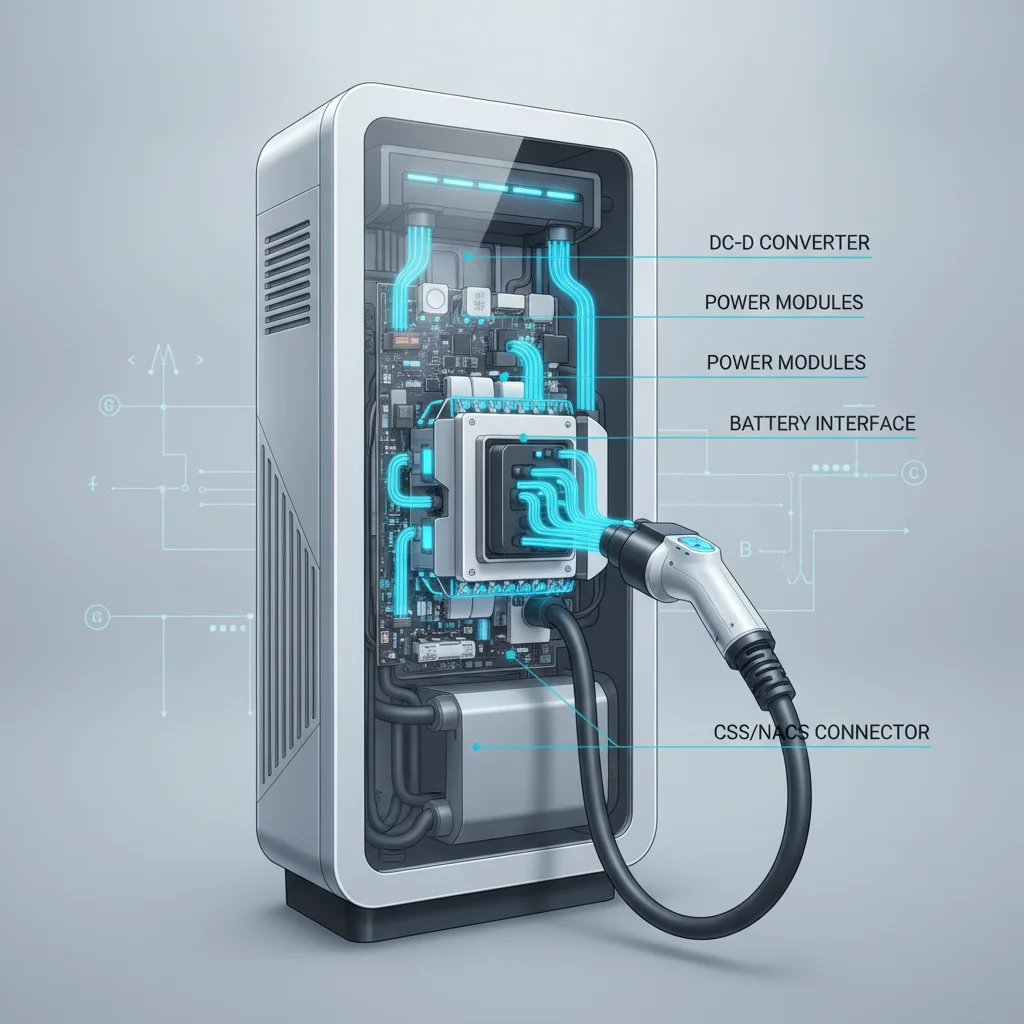
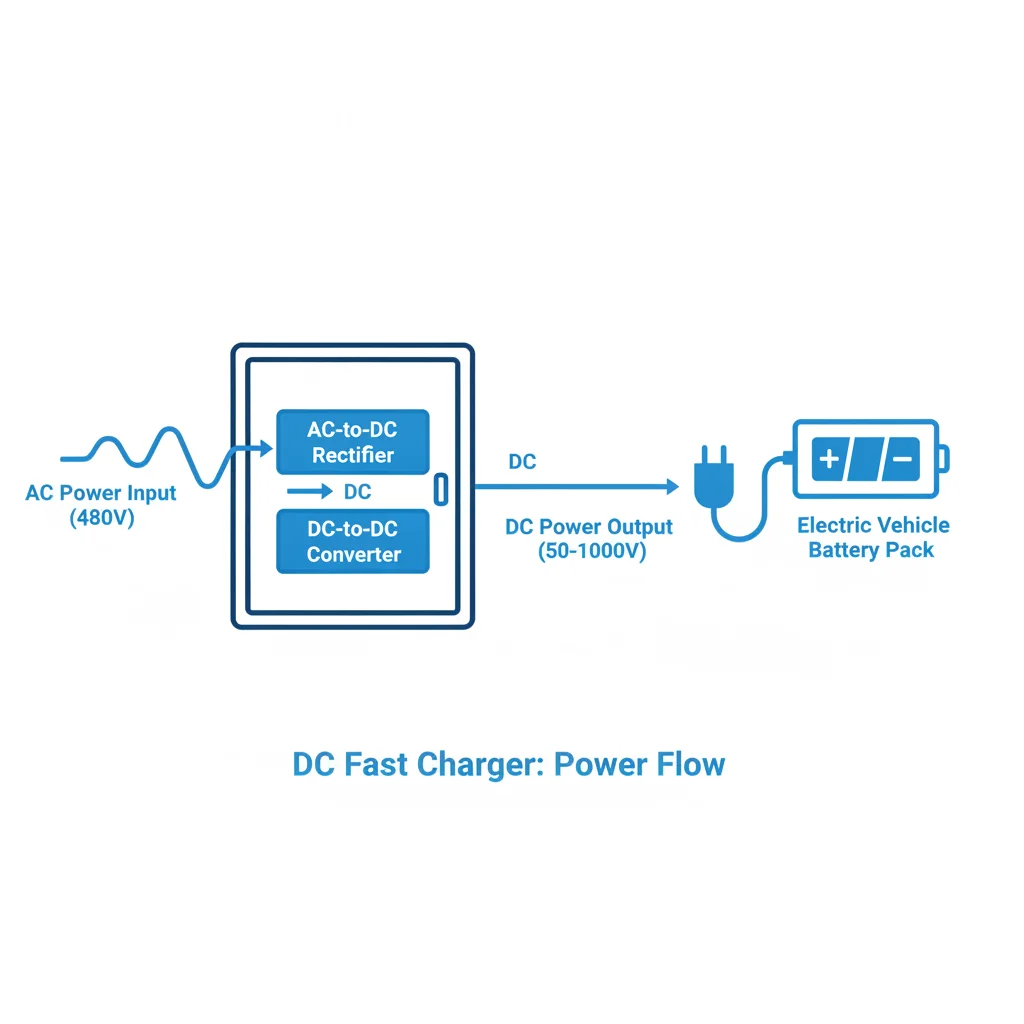
DC fast charging sidesteps this bottleneck entirely. The charging station itself contains the conversion hardware—large rectifiers, power factor correction circuits, and cooling systems—that transform grid AC into DC at much higher power levels. The resulting DC flows directly into the battery, with the vehicle's battery management system (BMS) acting as the gatekeeper rather than an onboard charger acting as a bottleneck.
This architectural difference is why a Level 2 charger might deliver 25 miles of range per hour while a DC fast charger can deliver 800 miles per hour on the right vehicle. The grid connection is the same; what changes is where the conversion work happens and at what scale.
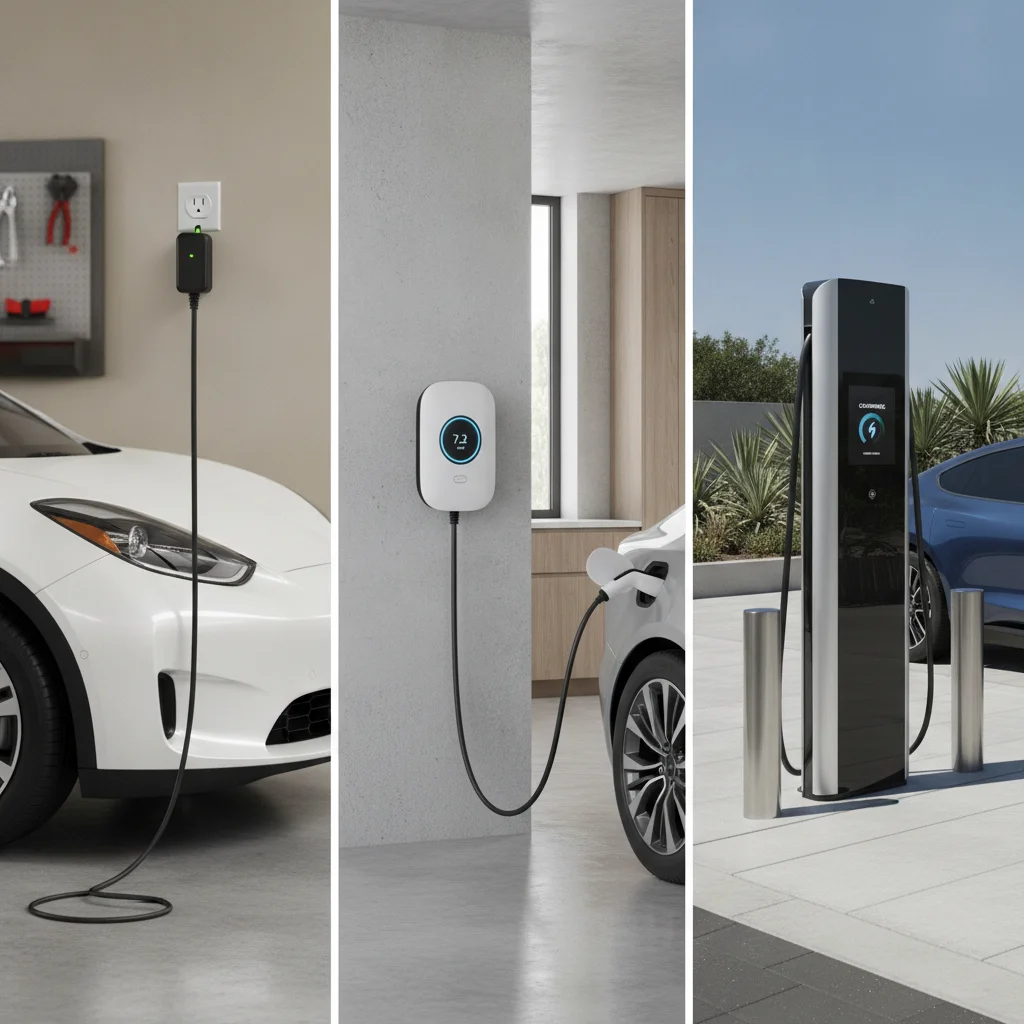
For a side-by-side look at how these charging tiers compare on cost and daily usability, see Level 1, Level 2, and DC Fast Charging: Cost and Speed Compared.
Inside the Station: What the Hardware Actually Does
Walk up to a DC fast charger and what you see is a cabinet—sometimes freestanding, sometimes wall-mounted—with a thick cable and a connector. Inside that cabinet is sophisticated power electronics doing considerable work.
AC Input and Power Factor Correction
The station draws high-voltage AC from the utility grid—typically three-phase 480 V AC in commercial installations. Before conversion, power factor correction (PFC) circuits ensure the station draws current efficiently and doesn't introduce disruptive harmonic distortion back into the grid. Poor power factor wastes electricity and can trigger utility penalties; PFC keeps the station operating cleanly.
Rectification: AC Becomes DC
Rectifier banks—arrays of diodes or, in more modern designs, active switching transistors (IGBTs or MOSFETs)—convert the incoming AC into raw DC. Active rectification using transistors is more efficient than passive diode bridges and allows the station to regulate output voltage precisely as the vehicle's needs change during a session.
DC-DC Conversion and Output Regulation
The raw rectified DC is rarely at the exact voltage a battery needs. DC-DC converter stages step the voltage up or down and regulate it precisely. A vehicle starting a charge at a low state of charge may accept a different voltage than one at 60% charge; the charger adjusts dynamically throughout the session in response to signals from the car's BMS.
Thermal Management
All that power conversion generates substantial heat. High-power DCFC cabinets use liquid cooling loops, fans, or both to keep power electronics within operating temperature. On very hot days, a thermally stressed charger may reduce its output to protect its own hardware—a real-world phenomenon road trippers in desert climates sometimes encounter.
350 kW
Peak output of today's fastest public DCFC stations
Electrify America's Ultra-Fast chargers are rated at 350 kW, though only 800V vehicles can currently access this full rate.
20–40 min
Typical time to charge from 10% to 80%
Most modern EVs using a 150–350 kW DC fast charger complete a 10%–80% charge in this window under ideal temperature conditions.
~3%
Additional capacity loss from frequent DCFC use
Idaho National Laboratory's multi-year EV charging study found fast-charge-primary vehicles showed modestly higher degradation over three years compared to Level 2 primary users.
800 V
Battery voltage in next-gen high-speed platforms
Vehicles like the Hyundai IONIQ 6 and Porsche Taycan use 800V architectures that enable peak charging rates of 270–350 kW with reduced thermal stress.
55,000+
Public DCFC ports in the United States (2024)
The U.S. Department of Energy's Alternative Fuels Station Locator recorded over 55,000 DC fast charging ports nationwide as of early 2024, a figure growing rapidly under federal infrastructure investment.
The communication layer is equally important. The charger and vehicle exchange continuous digital signals—using protocols like DIN 70121 or ISO 15118—that govern how much current to deliver, when to start and stop, and how to authenticate payment. This conversation happens over the pilot signal wire embedded in the charging cable.
What Limits Your Actual Charging Speed
Understanding the hardware inside the station is only half the picture. The speed you actually experience is determined by the weakest link in a chain of constraints.
Your Vehicle's Maximum Charge Acceptance Rate
Every EV has a published maximum DC fast charge rate measured in kilowatts. A 2023 Chevrolet Bolt EV accepts up to 55 kW. A Hyundai IONIQ 6 with the 77.4 kWh battery accepts up to 350 kW on a capable station. A Ford F-150 Lightning Standard Range peaks at 80 kW. Plugging a 55 kW vehicle into a 350 kW charger doesn't make it charge faster—it charges at 55 kW. The vehicle always controls the ceiling.
Battery State of Charge
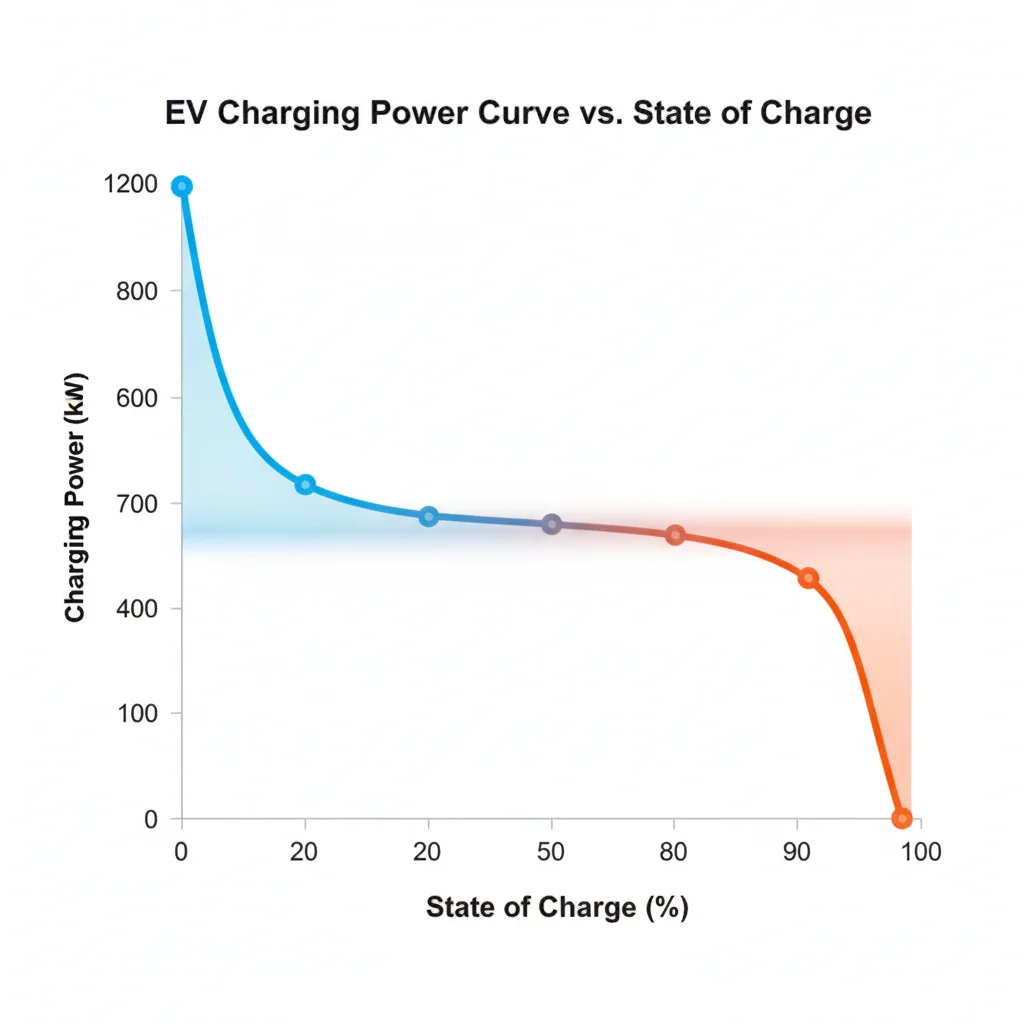
Lithium-ion cells accept charge fastest when they are neither nearly full nor extremely depleted. From roughly 20% to 80% state of charge, most EVs accept current at or near their peak rate. Below 10%, some BMS systems limit current to protect deeply discharged cells. Above 80%, the BMS begins tapering current progressively to prevent lithium plating—a form of battery damage that reduces capacity and can create safety risks. This taper is why charging the last 20% takes nearly as long as the first 80%.
Battery Temperature
Cold batteries have higher internal resistance and cannot accept fast charge current safely. Many EVs include a battery preconditioning feature that heats the pack while driving to a charging stop, maximizing charge acceptance on arrival. Plugging into a DCFC in sub-freezing temperatures without preconditioning can result in charge rates 50% to 70% lower than peak. Conversely, an already-hot battery from repeated fast charging or sustained highway driving may also see reduced acceptance rates as the BMS protects against thermal stress.
Activate Battery Preconditioning Before You Arrive
If your EV supports navigation-triggered battery preconditioning, enter the charging station as a destination in the car's built-in navigation—not just a phone GPS app—before you leave. This allows the vehicle to heat or cool the battery to its optimal charge temperature en route. In cold weather especially, arriving with a preconditioned battery can double your initial charge rate compared to arriving cold.
Plan Stops for the 10–80% Sweet Spot
Charging from 10% to 80% almost always delivers the fastest average rate across a session. Attempting to charge above 80% for 'extra range insurance' typically costs disproportionate time, since the BMS progressively reduces power above that threshold. On long drives, multiple shorter stops in the fast-charge window are usually faster than fewer stops that chase 100%.
Station Power and Cable Sharing
High-power DCFC installations often share a power cabinet across multiple charging stalls. If both stalls are occupied simultaneously, available power may be split—meaning a station rated at 350 kW per stall might deliver only 175 kW to each vehicle when both are in use. Check the station's documentation or app listing to understand how power is allocated at busy locations.
For a deeper technical breakdown of these interacting variables, How Charging Speed Is Actually Determined covers each bottleneck in detail.
Connector Standards: CCS, NACS, and the Legacy of CHAdeMO
The physical connection between charger and car is not universal, and connector compatibility is a practical concern for any EV owner planning to use public fast charging.
CCS (Combined Charging System)
CCS—more precisely CCS1 in North America—has been the dominant DCFC standard for non-Tesla vehicles sold in the U.S. since roughly 2013. The connector combines the J1772 AC pins used for Level 2 charging with two additional DC pins below, allowing a single port to handle both charging speeds. Most major public charging networks—Electrify America, EVgo, ChargePoint—support CCS.
NACS (North American Charging Standard)
Tesla developed its proprietary connector and opened the design as the North American Charging Standard (NACS) in 2022. Ford, GM, Rivian, Volvo, Mercedes-Benz, Honda, and other manufacturers have since announced adoption of NACS for future models, and SAE International formally standardized it as SAE J3400 in 2023. NACS-equipped Superchargers are increasingly accessible to non-Tesla vehicles via adapter or native port, representing a significant consolidation in the connector landscape.
CHAdeMO
CHAdeMO, developed in Japan, was the dominant DCFC standard for the original Nissan LEAF and early Kia and Mitsubishi EVs. New CHAdeMO installations in the U.S. are now extremely rare, and the standard is effectively in decline domestically. Owners of older CHAdeMO vehicles should map charging locations carefully, as coverage gaps are growing.
Adapter Availability Is Expanding
As the industry transitions toward NACS as a common standard, adapters allowing CCS vehicles to use Tesla Superchargers—and NACS vehicles to use CCS networks—are becoming more widely available. Before a long trip, check whether your vehicle manufacturer offers an official adapter and whether your target charging networks support your connector. Compatibility information changes frequently as the industry standardizes.
ISO 15118 and Plug-and-Charge
The ISO 15118 communication protocol, supported by an increasing number of DCFC stations and vehicles, enables 'Plug-and-Charge' functionality: the vehicle authenticates and authorizes payment automatically upon connection, without an app or RFID card. This feature requires both the station and the vehicle to support the protocol and is not yet universally available, but it is increasingly common on newer hardware.
High-Voltage Architecture and the 800V Advantage
Not all EVs are engineered equally when it comes to fast charging capability, and battery voltage architecture is the defining variable.
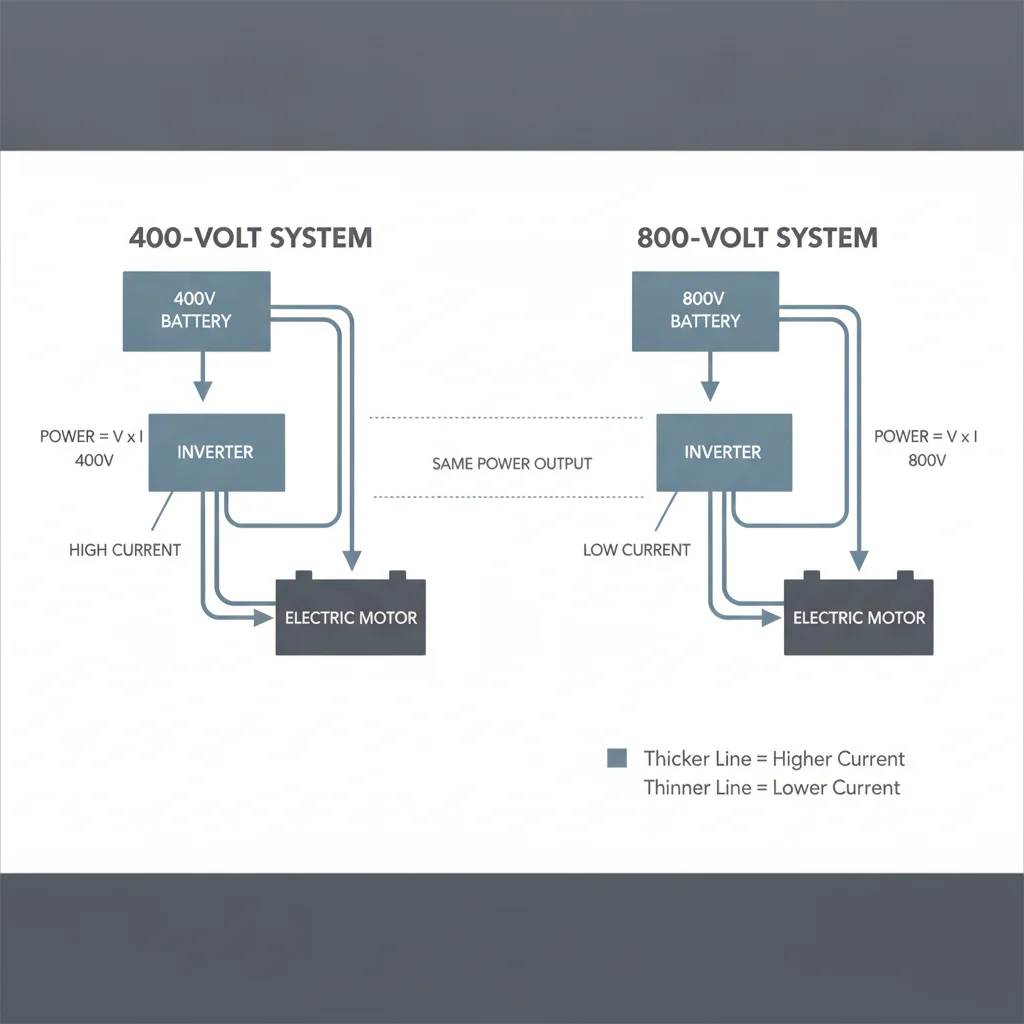
Traditional EV platforms operate on 400-volt battery systems. To charge at, say, 150 kW on a 400V system, the vehicle must accept roughly 375 amps of current—a demanding requirement that generates substantial heat in cables and connectors. There are physical limits to how high current can safely go before thermal management becomes a serious engineering challenge.
Newer 800-volt architectures—pioneered by the Porsche Taycan and Hyundai's E-GMP platform (IONIQ 5, IONIQ 6, Kia EV6)—achieve the same 150 kW charge rate at approximately 187 amps by doubling the voltage. At 350 kW—the ceiling of current public charging infrastructure—an 800V vehicle accepts about 437 amps versus the 875 amps a 400V vehicle would theoretically require. The result is faster charging with less heat and thinner, lighter cables.
Some 400V vehicles use onboard DC-DC boost converters to interface with 800V charging stations, achieving higher charge rates than their native architecture would otherwise allow—though not at the full rate an 800V-native vehicle achieves.
“The shift to 800-volt architectures isn't just about faster charging—it's about making high-power charging thermally sustainable. When you halve the current for a given power level, you quarter the resistive heat. That changes the engineering calculus for everything from cable thickness to battery longevity.”
— Sandra Winkler, Automotive electrical systems engineer and EV powertrain consultant
The practical takeaway: if ultrafast charging capability matters to your road trip planning, checking a vehicle's battery voltage architecture and peak charge rate is as important as checking its rated range. These specs are listed in the vehicle's technical documentation and on manufacturers' websites.
For broader context on how EVs convert and manage electrical power, see the How EVs Work hub.
Does DC Fast Charging Degrade Your Battery?
The question of whether fast charging damages EV batteries is one of the most persistent concerns among prospective EV buyers—and the answer is nuanced.
DC fast charging does expose battery cells to higher current and, consequently, greater heat than Level 2 charging. Heat is the primary accelerant of lithium-ion battery degradation, causing the loss of active lithium and electrolyte decomposition over time. A 2020 study by Idaho National Laboratory found that EVs charged primarily via DCFC showed slightly greater capacity loss over three years compared to those using Level 2 as a primary method—though the difference was meaningful only after sustained, repeated fast-charging cycles over years.
Modern thermal management systems have substantially narrowed this gap. Active liquid cooling keeps cell temperatures within safe ranges during fast charging sessions, and BMS firmware limits charge current when temperatures rise. Battery chemistry improvements—particularly the adoption of lithium iron phosphate (LFP) cathodes in many entry-level EVs—have also reduced fast-charging sensitivity, since LFP cells are inherently more thermally stable than NMC alternatives.
The practical guidance from most automakers: use Level 2 charging for routine daily charging and reserve DCFC for road trips or urgent situations. This approach maximizes long-term battery health without meaningfully constraining everyday usability. Level 1 vs Level 2 Home Charging: What the Speed Difference Actually Means for Daily Driving explains why most EV owners find Level 2 sufficient for the vast majority of their charging needs.
Planning Around DC Fast Charging in the Real World
For road trippers and commuters alike, understanding DCFC physics translates directly into better decisions at the planning stage.
Target the 10–80% Window
The fastest charging happens in the middle of the battery's state of charge. On long drives, plan stops that bring you in at 10–15% and out at 80%. Fighting for that last 20% can take as long as the first 80% took and rarely makes sense except when no other charging opportunity exists ahead.
Use Preconditioning
If your EV supports navigation-triggered battery preconditioning, use it. Entering a route destination in the car's navigation system (rather than a phone mount) typically activates heating or cooling of the battery pack to its optimal charge temperature before arrival. The difference in charge speed can be dramatic in cold weather.
Match the Station to the Moment
Not every stop calls for a DC fast charger. Lunch breaks, overnight hotel stays, and workplace parking are better served by Level 2 destination charging—cheaper and gentler on the battery. DCFC shines when time is genuinely short. Workplace and Destination Charging vs. DC Fast Charging: Knowing Which to Use helps map those decisions to specific scenarios.
Factor in Pricing
DCFC pricing is considerably higher per kilowatt-hour than home charging, and pricing models vary—some networks bill per minute, others per kWh, and some use membership tiers that change the math significantly. DC Fast Charging Is Convenient—But Here's What It Actually Costs breaks down what you'll actually pay across the major networks.
Activate Battery Preconditioning Before You Arrive
If your EV supports navigation-triggered battery preconditioning, enter the charging station as a destination in the car's built-in navigation—not just a phone GPS app—before you leave. This allows the vehicle to heat or cool the battery to its optimal charge temperature en route. In cold weather especially, arriving with a preconditioned battery can double your initial charge rate compared to arriving cold.
Plan Stops for the 10–80% Sweet Spot
Charging from 10% to 80% almost always delivers the fastest average rate across a session. Attempting to charge above 80% for 'extra range insurance' typically costs disproportionate time, since the BMS progressively reduces power above that threshold. On long drives, multiple shorter stops in the fast-charge window are usually faster than fewer stops that chase 100%.
All claims are backed by peer-reviewed research. Sources on request.