Key Takeaways
Why Pre-Purchase Cost Estimates Matter More Than You Think
Buying an EV involves a fundamental shift in how you think about fuel. Gasoline has a posted price at every corner station, making monthly fuel budgeting intuitive. Electricity is different: it flows through your home's circuits invisibly, arrives bundled into a bill shared with your refrigerator and air conditioner, and costs wildly different amounts depending on where you live and when you charge.
That complexity trips up a lot of first-time EV buyers. Some assume charging will be nearly free and are surprised when their electricity bill climbs by $60–$90 a month. Others overestimate costs because they're comparing to public fast-charging rates — typically two to three times more expensive than home electricity — rather than the home rate they'll actually use most of the time.
Running a proper estimate before you buy solves both problems. It gives you a defensible monthly number grounded in your actual driving habits and local electricity prices, not national averages or marketing copy. It also lets you compare specific EV models on the metric that matters most for ownership costs: efficiency, measured in kWh per 100 miles.

This guide walks through each calculation step by step. You'll need about 20 minutes, your electricity bill, and some honest mileage data. The result is a monthly charging estimate accurate enough to use in a real budget — and a framework you can revisit after your first 60 days of EV ownership to see how well the projection held up.
What you will need
Recent Electricity Bill (PDF or Paper)
Provides your actual total kWh consumed and total dollar amount to calculate your all-in effective rate per kWh.
Utility's Online Rate Schedule
Shows available tariff options including any EV-specific time-of-use rates that could lower your charging cost.
EPA Fuel Economy Website (fueleconomy.gov)
Lists the official efficiency rating in kWh per 100 miles for every EV model sold in the U.S.
Spreadsheet App (Excel, Google Sheets, or Numbers)
Lets you build a reusable charging cost model you can update as your driving habits or rates change.
PlugShare or ABRP (A Better Route Planner)
Helps estimate realistic public charging frequency and network pricing for road-trip or commute scenarios.
Odometer Photos or Mileage Tracking App
Provides accurate monthly mileage data rather than guessing from national averages.
Understanding the Key Variables Before You Calculate
Three numbers drive virtually every EV charging cost estimate: how far you drive, how efficiently your vehicle converts electricity to motion, and how much you pay per kWh. Each of these deserves a moment of scrutiny before you plug them into formulas.
Mileage: The Most Personal Variable
National average figures like 14,200 miles per year exist to fill in gaps, not to describe you. Remote workers, retirees, and urban apartment dwellers frequently drive half the national average. Suburban parents shuttling kids to activities often exceed it. Your actual monthly mileage is the foundation everything else sits on — get it right.
Efficiency: Where Models Diverge Sharply
Not all EVs are created equal on efficiency. A compact sedan rated at 25 kWh/100 miles uses roughly half the electricity per mile of a large electric pickup at 47 kWh/100 miles. That gap, multiplied by 12,000 miles per year, translates to a cost difference of hundreds of dollars annually — even before you factor in electricity rates. Efficiency is the vehicle-selection variable with the biggest financial leverage.
Electricity Rate: The Variable You Can Actually Control
Unlike the weather or traffic that affects your range, your electricity rate is partly within your control. Enrolling in a time-of-use tariff, scheduling charging for off-peak hours, and understanding your utility's EV incentive programs can reduce your effective charging rate by 30–50% compared to the standard flat rate. This step alone often saves $15–$35 per month for an average driver.
For a comprehensive treatment of every variable in the charging cost equation, see our end-to-end guide to EV charging costs.
Your Rate on the Bill Is Not Your Full Rate
Most utility bills show an 'energy charge' in cents per kWh, but the true cost per kWh includes delivery fees, distribution charges, and taxes spread across your total usage. Dividing your total monthly bill by total kWh consumed gives you the all-in effective rate — and that number is what you should use in every calculation here. Using only the advertised energy charge will cause you to underestimate your charging cost by 15–40%.
Public Fast-Charging Costs Can Be 3× Higher
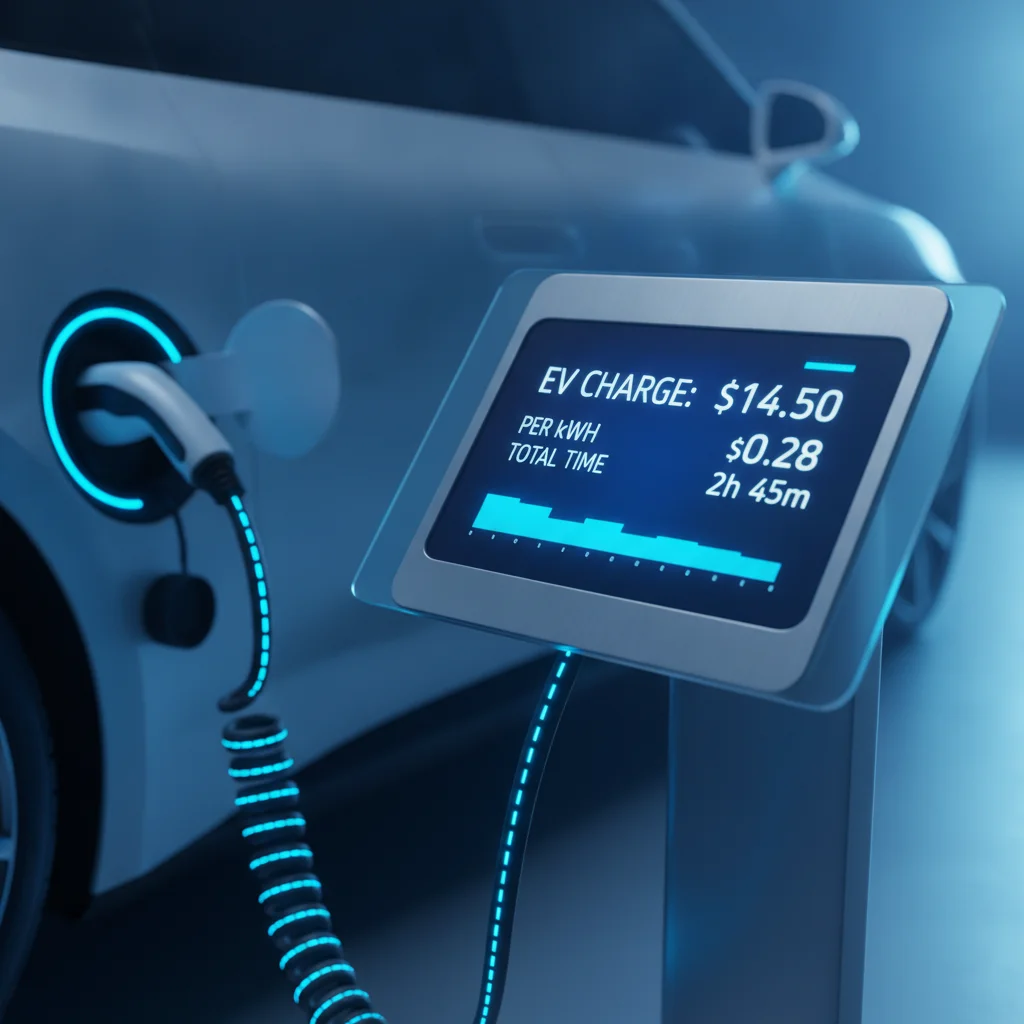
DC fast charging at third-party networks like Electrify America or EVgo is priced by the minute or per kWh, and rates typically range from $0.28 to $0.48 per kWh — sometimes higher during peak periods. If you rely on public charging for more than 20% of your miles, your monthly estimate will climb significantly above a home-charging-only scenario. Factor in realistic public charging frequency before finalizing your budget.
Winter Range Loss Affects Your Cost Math
Cold weather reduces real-world EV efficiency by 15–40% depending on the model and temperature. If you live in a cold climate, use a winter efficiency figure — not EPA-rated efficiency — when calculating how many kWh you'll need per month from October through March. Ignoring seasonal variation can cause you to underestimate your winter charging bill substantially.
Apartment and Condo Dwellers: Verify Charging Access First
If you cannot install a Level 2 charger at home, your charging costs and convenience will differ dramatically from the home-charging model used in this guide. Relying entirely on public charging nearly always costs more per mile. Confirm your living situation's charging options before treating home electricity rates as your primary cost basis.
Calculate Your Average Monthly Miles
Start with the single most personal input in this entire calculation: how far you actually drive. Pull odometer readings from your current vehicle's maintenance records, your insurance documents (which often list annual mileage), or a mileage-tracking app. Aim for a 3–6 month average to smooth out vacation spikes or unusually quiet stretches.
If you don't have records, the U.S. average is roughly 1,183 miles per month (about 14,200 miles per year), but that figure masks enormous individual variation. Remote workers may drive 400 miles a month; suburban commuters often exceed 1,500. Your real number is the only one that matters for this estimate.
Write down your monthly miles as M.
Find the EV's Real-World Efficiency Rating
Every EV sold in the U.S. carries an EPA efficiency rating expressed as kWh per 100 miles (you can also think of this as miles per kWh — just divide 100 by the kWh figure). Visit fueleconomy.gov or check the window sticker on the vehicle you're considering.
Common real-world examples:
- Tesla Model 3 Long Range AWD: ~25 kWh/100 mi
- Chevrolet Equinox EV: ~28 kWh/100 mi
- Ford F-150 Lightning (extended range): ~47 kWh/100 mi
- Hyundai Ioniq 6 RWD: ~24 kWh/100 mi
EPA figures are measured under controlled conditions. In cold weather or at highway speeds above 70 mph, real-world consumption often runs 10–20% higher than the rated figure. For a conservative estimate, add 15% to the EPA number if you frequently drive in cold conditions or at sustained high speed.
Record your efficiency as E (kWh per 100 miles).
Calculate Your Monthly kWh Requirement
Now combine your mileage and efficiency to determine how much electricity your EV will actually consume in an average month. The formula is straightforward:
Monthly kWh = (M ÷ 100) × EExample: You drive 1,000 miles per month (M = 1,000) in a vehicle that consumes 28 kWh per 100 miles (E = 28).
Monthly kWh = (1,000 ÷ 100) × 28 = 280 kWhThat 280 kWh figure is the gross energy your driving requires. However, charging is not perfectly efficient — Level 2 chargers typically operate at 85–92% efficiency, meaning some electricity is lost as heat during the charging process. To account for this, divide your result by 0.88 (a reasonable mid-range charging efficiency factor):
Adjusted monthly kWh = 280 ÷ 0.88 ≈ 318 kWhRecord this adjusted figure as K.
Determine Your All-In Electricity Rate
This step is where most DIY estimates go wrong. Your utility bill lists an 'energy charge' in cents per kWh, but that is only part of what you pay. Distribution charges, transmission fees, renewable energy surcharges, and local taxes all add to the true cost of each kWh you consume.
To get your real effective rate, use this simple approach:
- Find your total monthly bill amount (the dollar figure you actually paid)
- Find your total kWh consumed that month (listed on every utility bill)
- Divide:
Effective rate = Total bill ÷ Total kWh
Example: You paid $148 for 920 kWh.
Effective rate = $148 ÷ 920 = $0.161 per kWhAverage effective rates across U.S. states range from about $0.10/kWh (Louisiana, Oklahoma) to over $0.28/kWh (California, Hawaii). Use 2–3 months of bills and average the results for a more stable rate. For state-by-state context, see how electricity prices vary by state.
Record your effective rate as R.
[in_content_images:0]Compute Your Monthly Home Charging Cost
With K (adjusted monthly kWh) and R (effective rate per kWh) established, the home charging cost calculation is a single multiplication:
Monthly home charging cost = K × RContinuing the example:
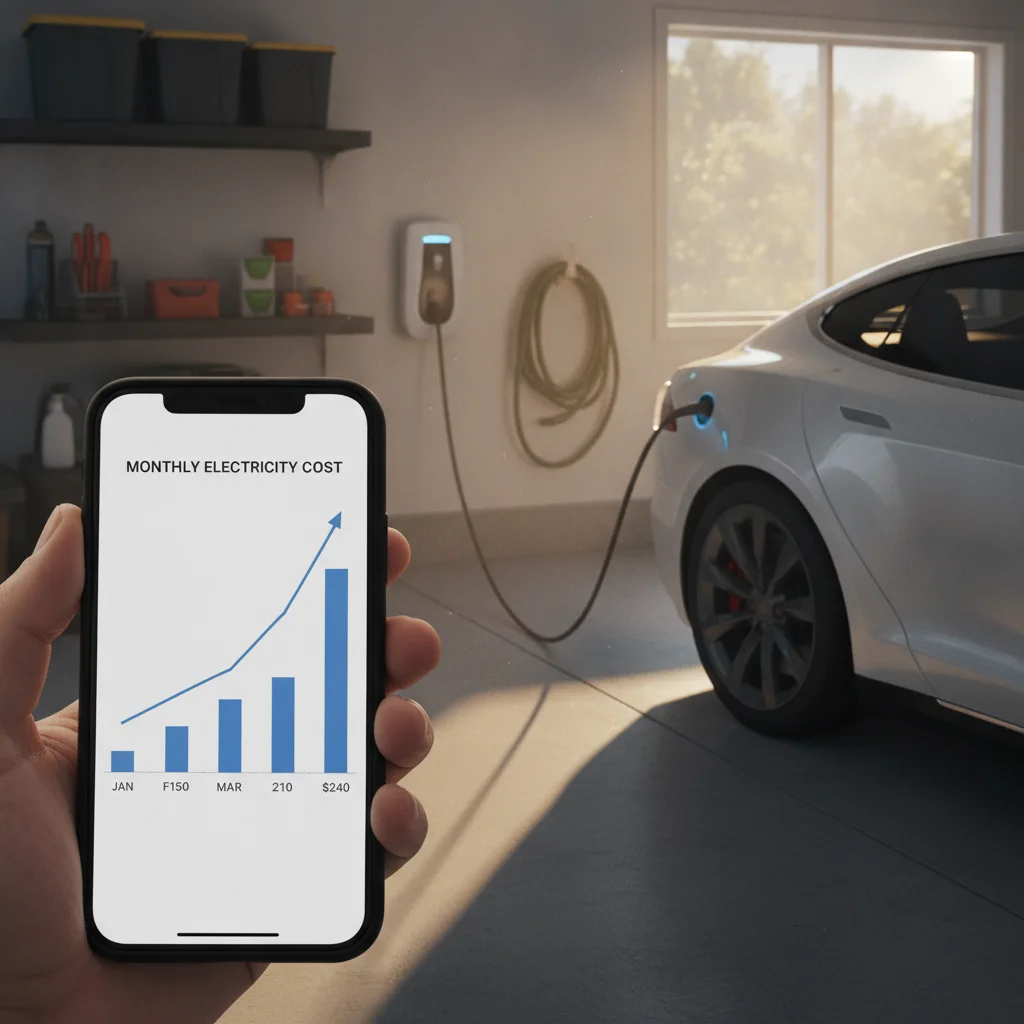
Monthly home charging cost = 318 kWh × $0.161 = $51.20This is your baseline home charging cost — what shows up as incremental added charges on your electricity bill if 100% of your charging happens at home. For most U.S. drivers doing 900–1,200 miles per month in a mid-size EV, this figure lands between $35 and $70 per month.
To understand the full picture of how that cost appears on your bill, read our guide to decoding your electricity bill — it walks through every line item that contributes to your total charge.
Add an Estimate for Public Charging
Unless you exclusively charge at home, your real monthly cost includes some public charging spend. Estimate this separately using your best guess of how often you charge away from home.
A practical approach:
- Estimate the percentage of your miles that require public charging (e.g., 15%)
- Multiply your monthly miles by that percentage:
1,000 × 0.15 = 150 public miles - Calculate kWh needed:
(150 ÷ 100) × 28 = 42 kWh - Apply the public charging rate. A reasonable U.S. average for DC fast charging is $0.35/kWh, though rates vary significantly by network and location.
- Public charging cost:
42 kWh × $0.35 = $14.70
Combined monthly estimate: $51.20 (home) + $14.70 (public) = $65.90/month.
For a deeper look at the variables driving public vs. home cost differences, see which inputs matter most in an EV charging cost calculator.
[in_content_images:1]Compare Against Your Current Gas Spend
Now comes the number that makes the case — or raises a flag. Calculate what your current gasoline vehicle costs in fuel for the same number of miles, then place the two figures side by side.
Monthly gas cost = (M ÷ MPG) × Gas price per gallonExample: 1,000 miles ÷ 28 MPG × $3.50/gallon = $125.00/month
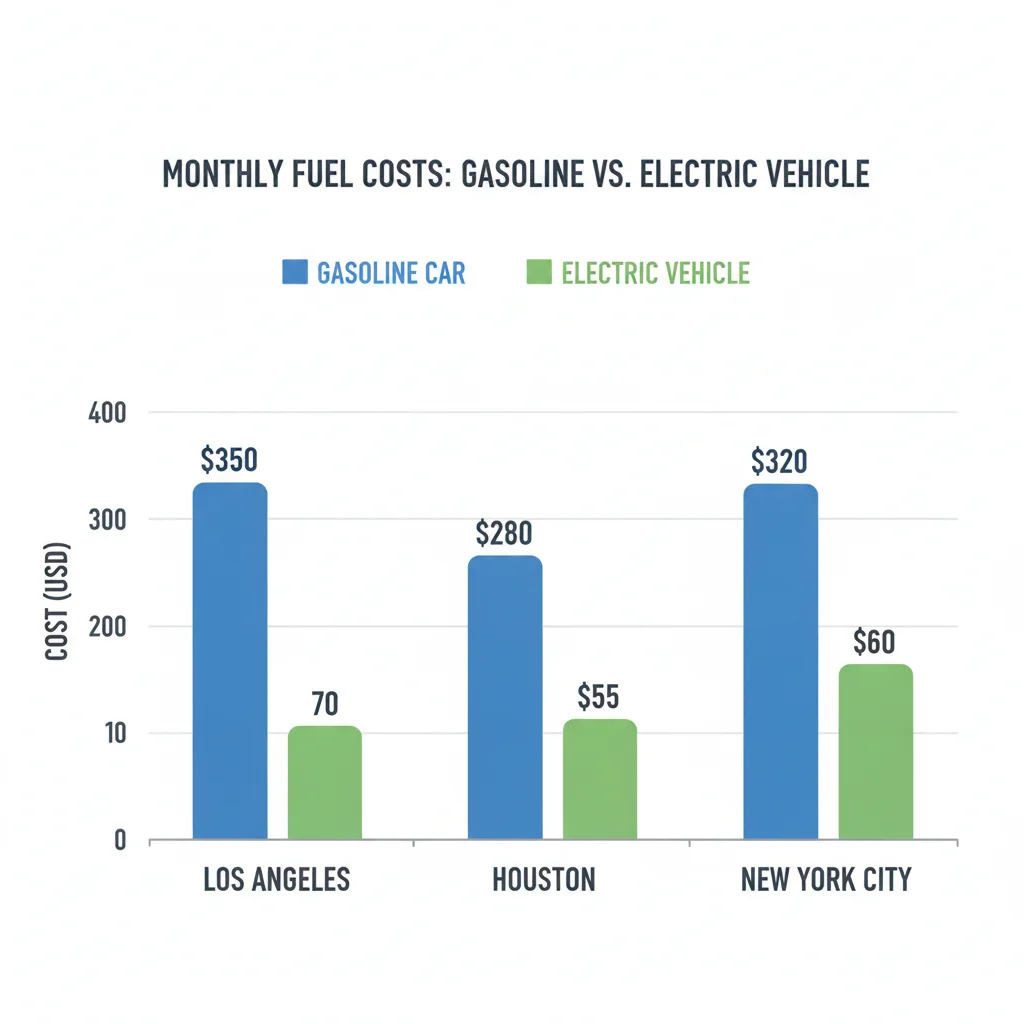
Compared to the EV estimate of $65.90/month, the potential monthly fuel savings are roughly $59 — about $708 per year. Over five years, that's $3,540 in fuel savings before accounting for any rate or gas price changes.
These savings compound alongside lower maintenance costs (no oil changes, fewer brake replacements due to regenerative braking), which makes the complete picture of EV ownership costs look even more favorable for high-mileage drivers.
Stress-Test With High and Low Scenarios
A single estimate is a point, not a range. Build two additional scenarios — optimistic and conservative — to understand your best and worst-case monthly charging costs.
| Scenario | Monthly Miles | Efficiency (kWh/100 mi) | Rate ($/kWh) | Est. Monthly Cost |
|---|---|---|---|---|
| Optimistic | 800 | 25 | $0.11 (TOU off-peak) | ~$22 |
| Base Case | 1,000 | 28 | $0.161 | ~$51 |
| Conservative | 1,300 | 32 | $0.22 | ~$97 |
The conservative scenario — higher mileage, a less efficient vehicle, and a high-rate state like California or Massachusetts — can push monthly charging costs toward $100 or more. That's still likely below equivalent gasoline costs in those states, but the gap narrows. Knowing your realistic range prevents sticker shock when that first post-EV electricity bill arrives.
For a real-world breakdown of how home EV charging actually affects your electricity bill, we've modeled the math across a range of household usage profiles.
Putting Your Estimate to Work
A completed monthly charging estimate is more than a budget line item — it's a decision-making tool you can use in several ways before signing any paperwork.
Compare Models Side by Side
Run the calculation for two or three EV models you're considering. Use each vehicle's actual EPA efficiency rating and your personal mileage and electricity rate. The monthly cost difference between, say, a 25 kWh/100 mi sedan and a 42 kWh/100 mi SUV can be $25–$50 per month — $300–$600 per year — at average electricity prices. Over a five-year ownership period, that's a $1,500–$3,000 difference in charging costs alone, which may shift the value calculation between trim levels or models.
Factor in Home Charging Infrastructure
If your estimate reveals you'll add 250–400 kWh per month to your home consumption, that's a meaningful load increase that justifies upgrading to a Level 2 home charger. A 48-amp Level 2 unit can fully replenish most EV batteries overnight, eliminating range anxiety and making your charging schedule predictable. Learn how to choose and install the right home charger before your EV arrives.
Incorporate Charging Costs Into Total Ownership Cost
A monthly charging estimate combined with insurance, loan payments, and maintenance projections gives you a true monthly cost of ownership figure. EV insurance can differ from gasoline car coverage — our EV insurance guide covers what drives those differences and how to shop for the best rate. With all cost components quantified, you can make an apples-to-apples comparison against keeping your current gasoline vehicle or buying a different model.
Use Your Current Gas Spend as a Benchmark
Pull three months of gas receipts or bank statements and average your monthly fuel spend. Running that number against your projected EV charging estimate gives you an immediate, visceral comparison — and often the most persuasive case for switching. The average U.S. driver saves $700–$1,200 per year on fuel by moving to an EV.
Sign Up for a Time-of-Use Rate Before Your First Charge
Many utilities offer EV-specific time-of-use (TOU) tariffs with off-peak rates as low as $0.06–$0.10 per kWh after midnight. Enrolling before your vehicle arrives means every charge from day one benefits from lower rates. Call your utility or check their website — most enrollments take less than ten minutes online.
Revisit Your Estimate After 60 Days of Ownership
Your first two months of electricity bills after getting an EV are the most accurate data you'll ever have. Compare your actual added cost against your pre-purchase estimate, then adjust for any seasonal or behavioral changes. This feedback loop improves every future projection and helps you optimize charging habits.
Revisit After Real-World Experience
Your pre-purchase estimate is a projection. After 60 days of EV ownership, pull your electricity bills, subtract your pre-EV baseline usage, and calculate what the vehicle actually cost you to fuel. Compare that against your estimate. Most drivers find the projection lands within 10–15% of actual costs — close enough to validate the framework and identify any habits (more highway driving, colder temperatures, more public charging) that warrant a budget adjustment.
Understanding every line item that contributes to that real-world bill is the logical next step: our guide to reading an electricity bill as an EV owner explains exactly what to look for and how to isolate your charging cost from the rest of your household electricity use.
All claims are backed by peer-reviewed research. Sources on request.