Key Takeaways
Start here
Why Home Charging Matters So Much for EV Renters
Build the basics
Level 1 vs. Level 2 Charging: A Quick Primer for Renters
Know your rights
Your Legal Rights as a Renter: EV Charging Laws by State
Take action
How to Negotiate EV Charging Access with Your Landlord
Landlord perspective
What Landlords Need to Know: Costs, Liability, and Opportunity
If all else fails
When Home Charging Isn't an Option: Your Backup Plan
Why Home Charging Matters So Much for EV Renters
About one-third of U.S. households rent. A significant and growing slice of those renters own — or want to own — an electric vehicle. The catch: the single biggest convenience advantage of EV ownership is charging at home overnight, and that advantage isn't automatic when you don't control the building's electrical infrastructure.
For homeowners, plugging in at home is straightforward. For renters, it can mean navigating landlord approval, lease clauses, electrical access, and cost-splitting arrangements — all before you ever charge your first kilowatt-hour. The stakes are real: without reliable home charging, EV operating costs can actually be higher than for a homeowner, since you're forced onto public networks where per-mile costs climb. See our look at the true cost picture for renters relying on public charging for a detailed breakdown.
This guide is built for both sides of the landlord-tenant relationship. Tenants will find out what rights they actually have, how to make the case to a landlord, and what agreement terms to insist on. Landlords will find out what installation really costs, what liability exposure looks like, and why adding charging can be a net-positive property upgrade rather than a headache.

Level 1 vs. Level 2 Charging: A Quick Primer for Renters
Before you can have a productive conversation with your landlord — or make a realistic plan — you need to understand what you're actually asking for. There are two charging levels relevant to home and rental situations.
Level 1 Charging
Charging from a standard 120-volt household outlet. No special installation needed, but adds only 3–5 miles of range per hour.
Level 2 Charging
Charging from a dedicated 240-volt circuit, similar to a dryer outlet. Requires professional installation but adds 12–30 miles of range per hour.
EVSE
Electric Vehicle Supply Equipment — the technical term for what most people call a "charger" or "charging station." It's the box on the wall that manages the flow of electricity to your car.
Right-to-Charge Law
A state law that prevents landlords or HOAs from outright banning EV charger installations, while still allowing them to set reasonable conditions.
Submetering
Installing a secondary electricity meter on a specific circuit so a tenant's EV charging usage can be measured and billed separately from the building's main meter.
Lease Addendum
A written amendment to a lease agreement that adds specific terms — in this context, the rules governing EV charger installation, electricity costs, and move-out responsibilities.
DC Fast Charging (Level 3)
High-powered public charging that uses direct current to replenish 100–200 miles of range in 20–40 minutes. Not installable at home; found at commercial charging stations.
30C Tax Credit
A federal tax credit covering 30% of EV charger installation costs, up to $1,000 for individuals. Available to both homeowners and qualified renters who pay for their own installation.
Level 1: The Plug-In Option
Level 1 charging uses a standard 120-volt household outlet — the same type you plug a lamp into. Every EV comes with a Level 1 cord as standard equipment. No installation is required beyond access to an outlet near your parking spot.
What it delivers: Roughly 3–5 miles of range per hour of charging. On an 8-hour overnight charge, that's about 40–50 miles of range restored — enough for many commuters, but tight for anyone driving 50+ miles daily or owning a larger-battery vehicle like a long-range Tesla or Rivian.
The practical ask to your landlord with Level 1: access to a nearby outlet, and ideally a written agreement on who pays the electricity. This is the lowest-friction request you can make, but it still requires a conversation about electricity cost recovery.
Level 2: The Real Upgrade
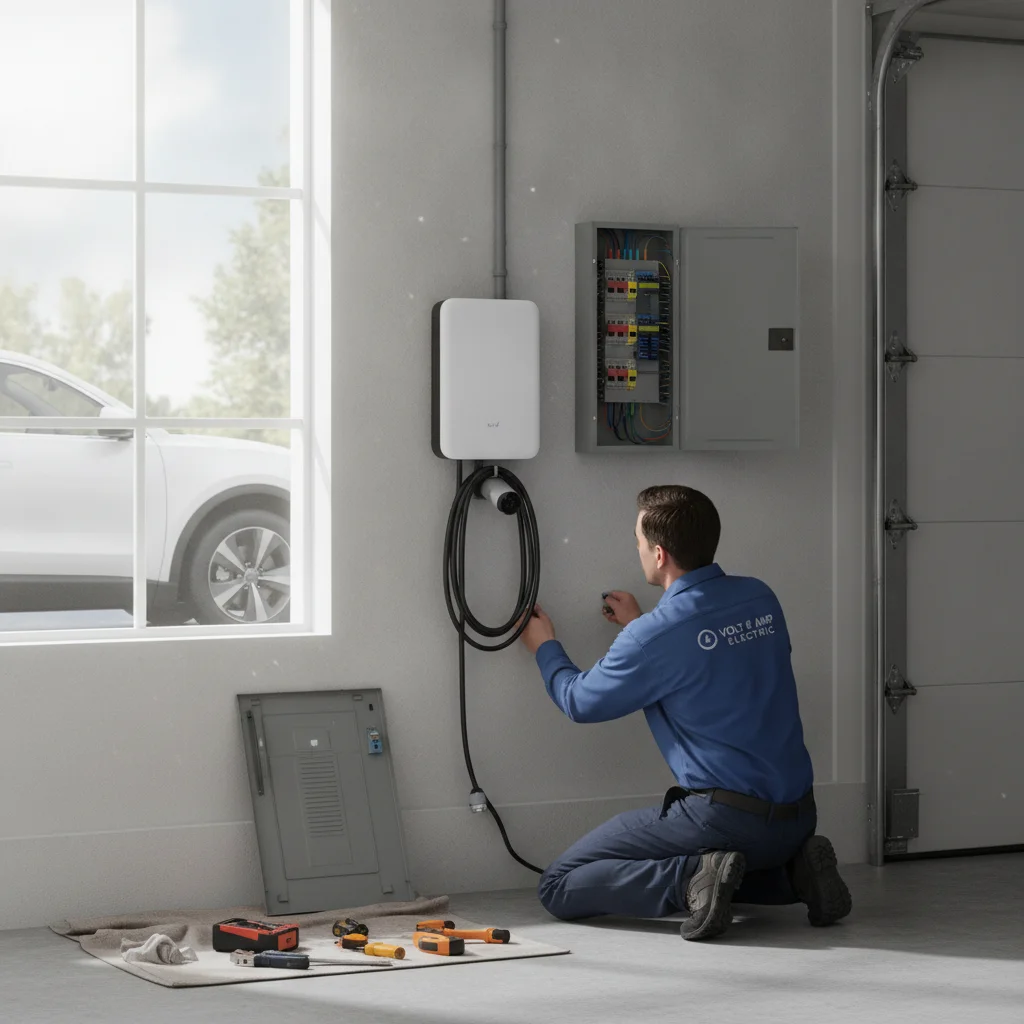
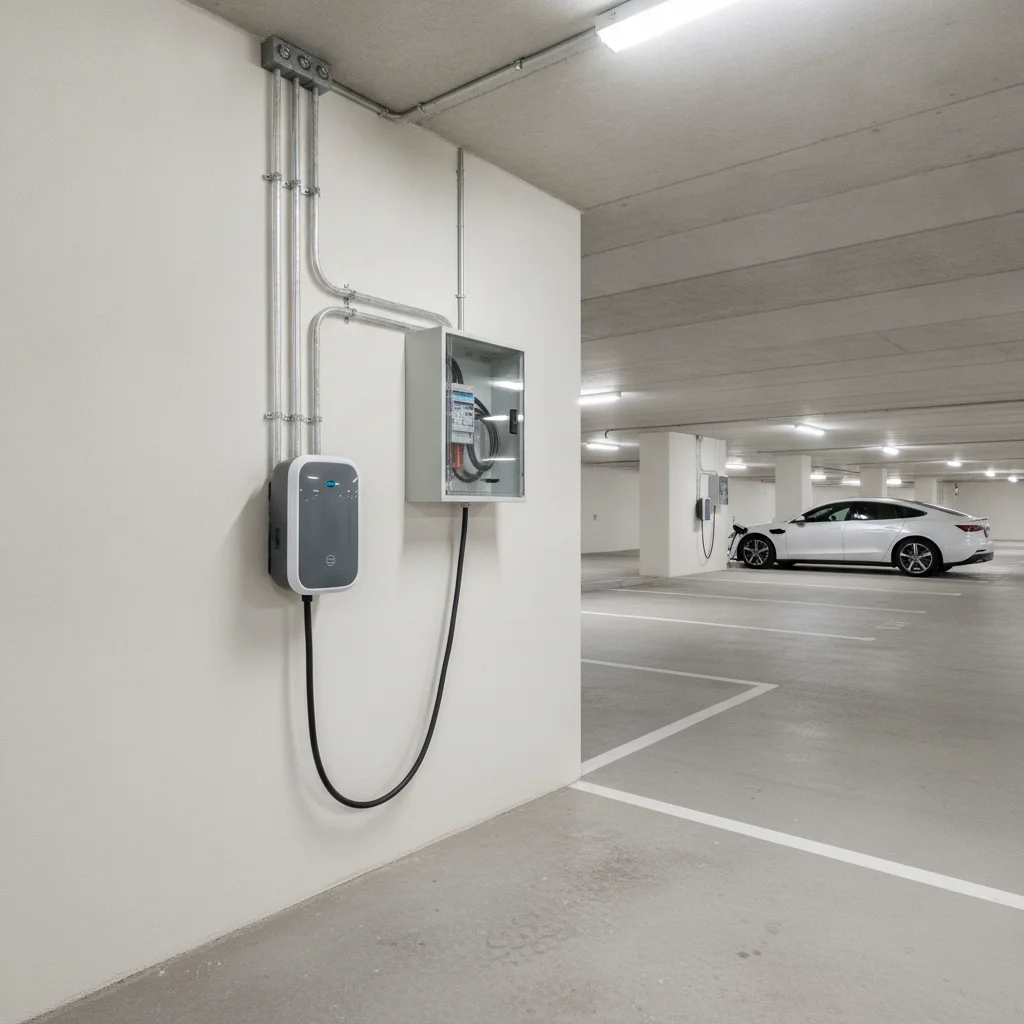
Level 2 charging uses a 240-volt circuit — the same voltage as a clothes dryer. It delivers 12–30 miles of range per hour, meaning most EVs charge fully overnight even from near-empty. This requires dedicated electrical work: a new 240V circuit, a proper outlet or hardwired connection, and a wall-mounted charging unit (EVSE).
Total installed cost for a Level 2 home charger typically runs $800–$2,500, depending on your electrical panel's capacity and how far the circuit needs to run. For a deeper look at all the options involved, our complete beginner's guide to home charging options walks through each setup type in detail.
Check Your Parking Situation First
Before approaching your landlord, confirm you have a dedicated parking spot close enough to a wall or electrical source for a cord or circuit run. Shared lots and street parking make any home charging setup nearly impossible regardless of what your lease or local law says. The physical setup is just as important as the legal right.
Smart Chargers Simplify Billing Disputes
A Wi-Fi-connected Level 2 charger that tracks kWh usage eliminates arguments about electricity costs. Brands like ChargePoint Home Flex and Enel X JuiceBox log every session with timestamps and energy delivered. Share monthly reports with your landlord automatically — it removes the main source of landlord hesitation around ongoing billing fairness.
The ask to your landlord with Level 2 is more significant — you're requesting a permanent electrical modification to their property. That's why the legal and negotiation sections below matter so much.
Your Legal Rights as a Renter: EV Charging Laws by State
"Right to charge" laws are the most important piece of legal context in this conversation. Over a dozen states have enacted statutes that restrict how much a landlord can limit a tenant's ability to install EV charging. These laws don't give renters unlimited rights — but they do shift the default from "landlord has total control" to "landlord must engage reasonably."
States with Right-to-Charge Protections (as of 2024)
| State | Key Provision |
|---|---|
| California | Landlords cannot unreasonably prohibit EV charger installation; tenants may be required to carry insurance and restore property on move-out |
| Florida | HOAs and landlords with 10+ units cannot prohibit EV charging outright; reasonable conditions allowed |
| Colorado | Landlords of multifamily units cannot ban EV chargers; must negotiate in good faith |
| New York | Requires landlords to permit installation with tenant-paid costs and insurance |
| Virginia | Prohibits HOAs from banning chargers; landlord-tenant provisions evolving |
| Oregon | Restricts outright prohibitions in multifamily settings |
| Hawaii | Landlords must permit charging with reasonable conditions |
Even in states with these laws, landlords retain the right to set reasonable conditions: requiring a licensed electrician, mandating specific equipment types, requiring the tenant to carry additional liability insurance, or requiring restoration of the space on move-out. "You can't do it" is increasingly impermissible; "here are my conditions" is still very much in play.
Laws Change — Verify Your State's Current Rules
Right-to-charge legislation is actively evolving. Several states have introduced or amended relevant laws in 2023–2024. Always verify the current statute in your state directly, either through your state legislature's website or by consulting a local tenant rights organization. The table in this article reflects laws as of mid-2024 but is not a substitute for current legal advice.
Consider a PHEV If Charging Access Is Uncertain
If you're not yet locked into a fully electric vehicle purchase and home charging is genuinely uncertain, a plug-in hybrid gives you EV benefits on short trips while falling back on gasoline when needed. This significantly reduces the urgency of resolving the charging access question before you can comfortably own the vehicle.
In states without right-to-charge laws, your leverage comes from negotiation, not statute. That's covered in the next section. And regardless of state law, the permit process for the installation itself is a separate matter — our guide to EV charger permits by state explains what inspectors require and how to stay compliant.
How to Negotiate EV Charging Access with Your Landlord
Negotiation works best when you understand what the other side actually worries about. Landlords typically have three concerns: cost, liability, and property damage. Address those concerns proactively and you dramatically improve your odds of a yes.
Step 1: Start with a Written Request
Don't raise this verbally and leave it vague. Submit a written request that specifies exactly what you're asking for — Level 1 outlet access or a Level 2 installation — along with your proposed approach to costs, insurance, and move-out restoration. A written request signals seriousness and creates a paper trail if the landlord refuses in a right-to-charge state.
Step 2: Offer to Cover All Costs
The fastest path to yes is making clear the landlord pays nothing. Offer to hire and pay a licensed electrician, cover the permit fees, purchase the equipment, and pay for the electricity you use. Some tenants even offer to pay a small monthly fee above actual electricity costs in exchange for installation approval.
Step 3: Address Liability Head-On
Offer to add a liability endorsement to your renters insurance policy covering the charging equipment and any related incident. Check whether your current renters policy actually covers a Level 2 charger before this conversation — you may need a specific endorsement, and offering to secure it in writing removes one of the landlord's biggest objections.
Step 4: Propose a Move-Out Agreement
Specify in writing what happens at lease end: will you remove the equipment and restore the wall, or leave the charger as a property improvement? Most landlords prefer the latter once they realize a charger adds value — but make the offer explicit so there's no ambiguity.
Step 5: Put Everything in Writing
Whatever you agree on — cost responsibility, electricity billing method, insurance requirements, move-out terms — get it added as a lease addendum signed by both parties. A verbal okay is worth nothing if there's a dispute later.
Never Install Without Written Permission
Even in a right-to-charge state, installing any electrical equipment without landlord approval in writing is a lease violation that could cost you your security deposit or trigger eviction proceedings. Verbal approval isn't enough — get the signed lease addendum before any work begins, and make sure the permit is pulled in the correct party's name.
What Landlords Need to Know: Costs, Liability, and Opportunity
If you're a landlord reading this, your tenant has probably already done research and believes they have some right to ask. Here's an honest assessment of what you're actually dealing with — and why the calculus often favors working with them rather than against them.
What Installation Actually Costs
A Level 2 circuit installation by a licensed electrician runs $500–$1,500 for labor and materials, plus $200–$800 for the EVSE unit itself. If the electrical panel needs an upgrade to handle the new circuit, add $1,500–$3,000. If the tenant is covering all costs (which they typically offer to do), your out-of-pocket may be zero.
Liability and Insurance Considerations
A professionally installed, permitted Level 2 charger presents minimal liability risk. The risk profile is similar to any other 240V appliance on the property. Require the tenant to carry liability coverage, require a licensed electrician and permit pull, and ensure the work passes inspection — those three conditions reduce your exposure to near-zero. Unpermitted, DIY work is where problems actually happen, which is exactly why requiring permits protects you as much as the tenant.
The Property Value Angle
EV ownership in the U.S. is growing rapidly. A parking spot with a dedicated Level 2 charger is increasingly a differentiating amenity — particularly in urban and suburban markets where EV penetration is highest. Landlords in California, for example, are finding that charging access is now a search filter on rental platforms. If the tenant is paying for installation and leaving the equipment behind, you're gaining a property upgrade at no cost.
Electricity Billing Options
You have several practical options for handling electricity costs: (1) have the tenant pay their own sub-metered circuit, which requires a separate meter install; (2) use a smart charger that tracks kWh and bill the tenant directly; (3) charge a flat monthly fee estimated from typical EV usage; or (4) include it in rent with a documented adjustment. Smart charger billing is the cleanest approach for most situations — brands like ChargePoint and Enel X Way offer landlord-facing management software specifically for this use case.
PlugShare
A crowdsourced map of public and shared private charging locations across North America. Useful for renters scoping out nearby charging options as a backup to home charging.
ChargePoint Home Flex
A popular Level 2 EVSE with built-in kWh tracking and app reporting — helpful for documenting usage when negotiating electricity cost-sharing with a landlord.
AFDC Alternative Fuels Station Locator
The U.S. Department of Energy's official tool for locating public EV charging stations. Useful for renters building a charging plan that doesn't rely entirely on home access.
State Right-to-Charge Law Tracker
The National Conference of State Legislatures (NCSL) maintains an updated database of EV charging access laws by state — the most reliable source for checking your current legal standing as a renter.
IRS Form 8911 (Alternative Fuel Vehicle Credit)
The federal tax form for claiming the 30C EV charger installation credit. If you're paying for installation yourself as a renter, this credit may offset a significant portion of your cost.
Tenant Rights Hotlines (NHLP)
The National Housing Law Project connects renters with legal aid resources. Useful if a landlord in a right-to-charge state refuses to engage or retaliates for the request.
When Home Charging Isn't an Option: Your Backup Plan
Sometimes the landlord says no, the building's electrical capacity is genuinely inadequate, or your parking situation makes any installation impossible. That's a real constraint, but it doesn't make EV ownership unworkable — it just changes the math.
Workplace Charging
Many employers — especially larger companies and government employers — offer Level 2 charging at work, often free or heavily subsidized. If you commute to a fixed office location, check whether your employer has chargers or would consider adding them. Workplace charging during the day can substitute almost entirely for overnight home charging for moderate daily drivers.
Public Fast-Charging Networks
DC fast-chargers (Level 3) can replenish 100–200 miles of range in 20–40 minutes, making them viable for regular top-ups rather than emergency use only. The cost per mile is higher than home charging — typically $0.30–$0.50 per kWh versus $0.10–$0.18 at home — but for drivers without home charging access, it's a workable routine. See the full cost breakdown for public-network-dependent EV drivers to understand exactly what you'd be spending. You can also explore the major DC fast-charging networks to identify the best coverage in your area.
Destination Charging
Hotels, shopping centers, gyms, and grocery stores increasingly offer Level 2 charging — often free or at low cost — as a customer amenity. Running regular errands at locations with chargers can add meaningful range without any home infrastructure.
Reassess the Vehicle Choice
If you're still in the car-shopping phase and home charging genuinely isn't accessible, consider a plug-in hybrid (PHEV) rather than a battery-electric vehicle. PHEVs can run on gasoline when the battery depletes, giving you the EV experience on short trips without the range anxiety of relying entirely on public infrastructure.
Laws Change — Verify Your State's Current Rules
Right-to-charge legislation is actively evolving. Several states have introduced or amended relevant laws in 2023–2024. Always verify the current statute in your state directly, either through your state legislature's website or by consulting a local tenant rights organization. The table in this article reflects laws as of mid-2024 but is not a substitute for current legal advice.
Consider a PHEV If Charging Access Is Uncertain
If you're not yet locked into a fully electric vehicle purchase and home charging is genuinely uncertain, a plug-in hybrid gives you EV benefits on short trips while falling back on gasoline when needed. This significantly reduces the urgency of resolving the charging access question before you can comfortably own the vehicle.
Whatever your situation, going in with a clear-eyed picture of your charging access — before you buy the vehicle — is the single most important step. The charging conversation is easier to navigate before you sign the purchase contract than after.

All claims are backed by peer-reviewed research. Sources on request.