Key Takeaways
Why These Two Systems Are a Natural Pair — But Not Automatic
The pitch sounds simple: install solar panels, charge your car for free. In practice, the relationship between rooftop solar and home EV charging is more nuanced. The two systems don't automatically coordinate with each other out of the box, and your savings depend heavily on how you configure them, what your utility allows, and whether the timing of your driving and charging habits aligns with when your panels actually produce power.
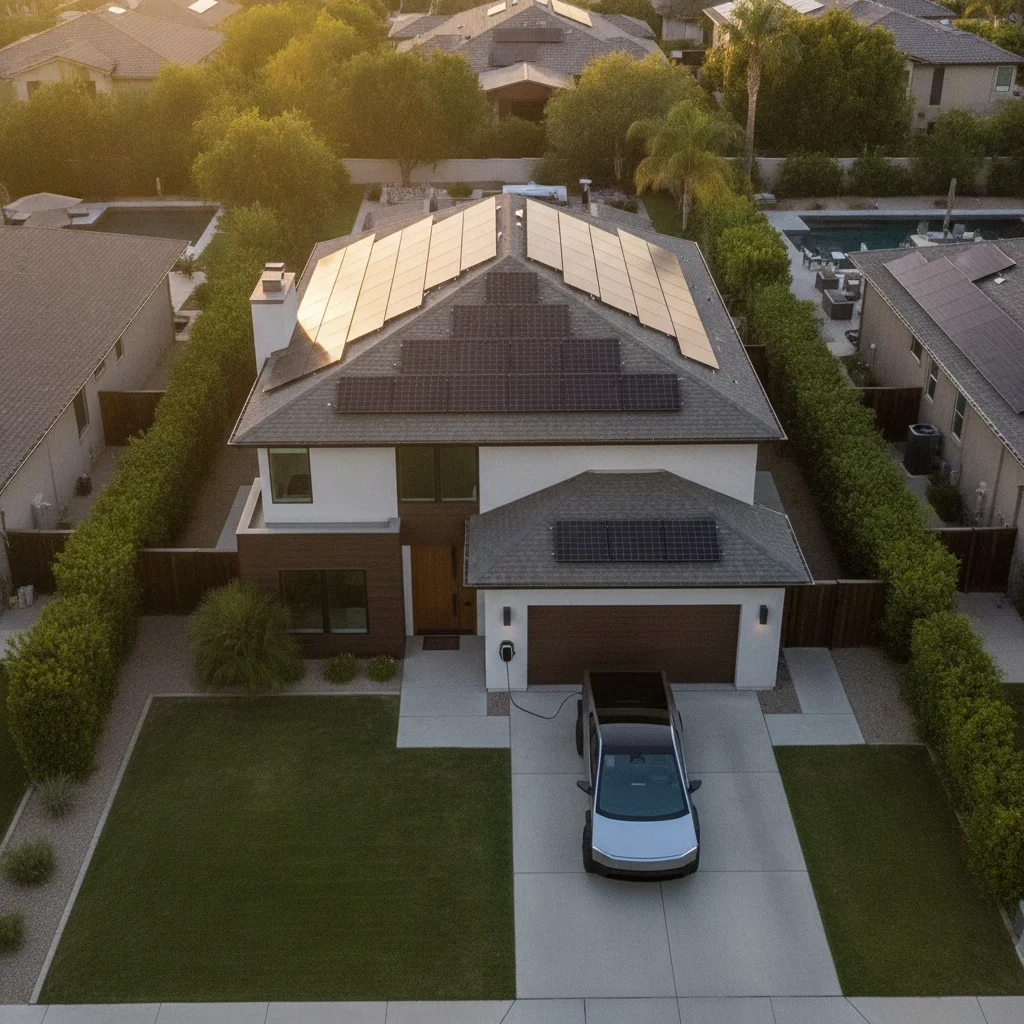
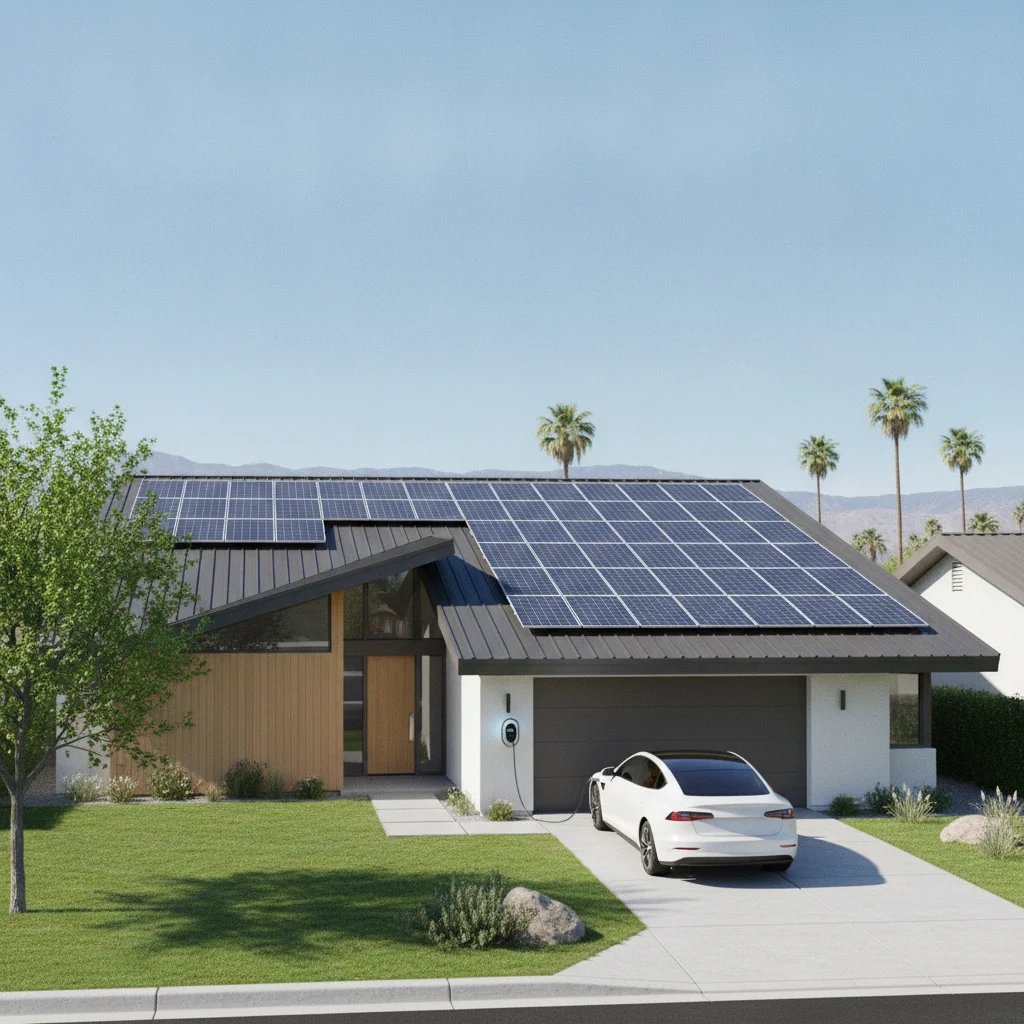
That said, the combination is genuinely compelling. The average American drives about 37 miles per day. At roughly 3–4 miles per kWh for most EVs, that's about 10–12 kWh of daily charging demand. A modest 4–6 kW solar array in a sunny region can generate 16–24 kWh on a good day — more than enough to cover daily driving and home base load. When you get the setup right, your effective per-mile fuel cost can drop to near zero.
This guide walks you through the practical decisions: choosing the right charger level, understanding how solar and charging hardware interact, sizing your system, and scheduling charging to maximize solar use. If you're starting from scratch on home charging, see our overview of what home EV charging installation involves before diving in here.
What You'll Need Before You Start
Before you configure anything, make sure you have the physical infrastructure and information in place. This isn't a software setup — you're dealing with electrical systems, utility agreements, and potentially a permit process.
What you will need
Level 2 EVSE (240V home charger)
Charges your EV at 11–19 miles of range per hour — the practical minimum for solar-paired home charging.
Solar inverter with EV scheduling or smart export
Allows your inverter to signal the charger when excess solar is available, maximizing direct solar-to-car charging.
Smart EV charger with scheduling app
Enables time-of-use and solar-optimized charge scheduling even without direct inverter integration.
Home energy management system (HEMS)
Coordinates solar output, battery state, and EV charger draw in real time for maximum efficiency.
Home battery storage (e.g., Powerwall, Enphase IQ)
Stores excess daytime solar generation so your EV can charge from solar power in the evening.
Load management device
Limits EV charger draw when the rest of the home is consuming heavily, preventing panel overload.
How Solar Generation and EV Charging Interact
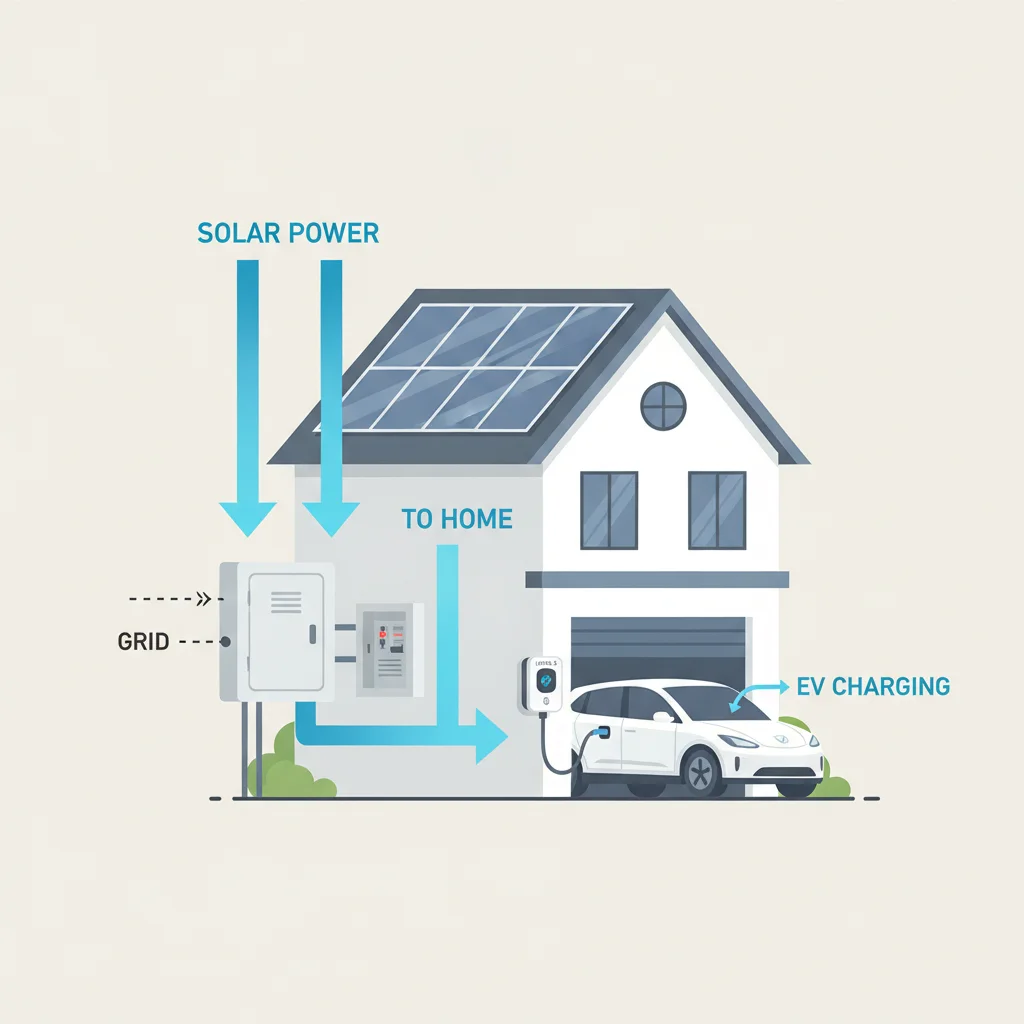
Here's what's actually happening electrically: your solar panels generate DC electricity, which an inverter converts to AC power that flows into your home's main electrical panel. Your EV charger — whether a Level 1 plug or a Level 2 EVSE — draws from that same panel. From the panel's perspective, the charger is just another load, no different from your dishwasher or air conditioner.
The grid acts as a buffer. When your panels produce more than your home is consuming, excess power flows out to the grid (if your utility allows net metering). When you're pulling more than the panels produce — say, on a cloudy day or at night — you draw from the grid at standard retail rates. This is the core dynamic: solar charges your car most cheaply when generation and charging overlap in time.
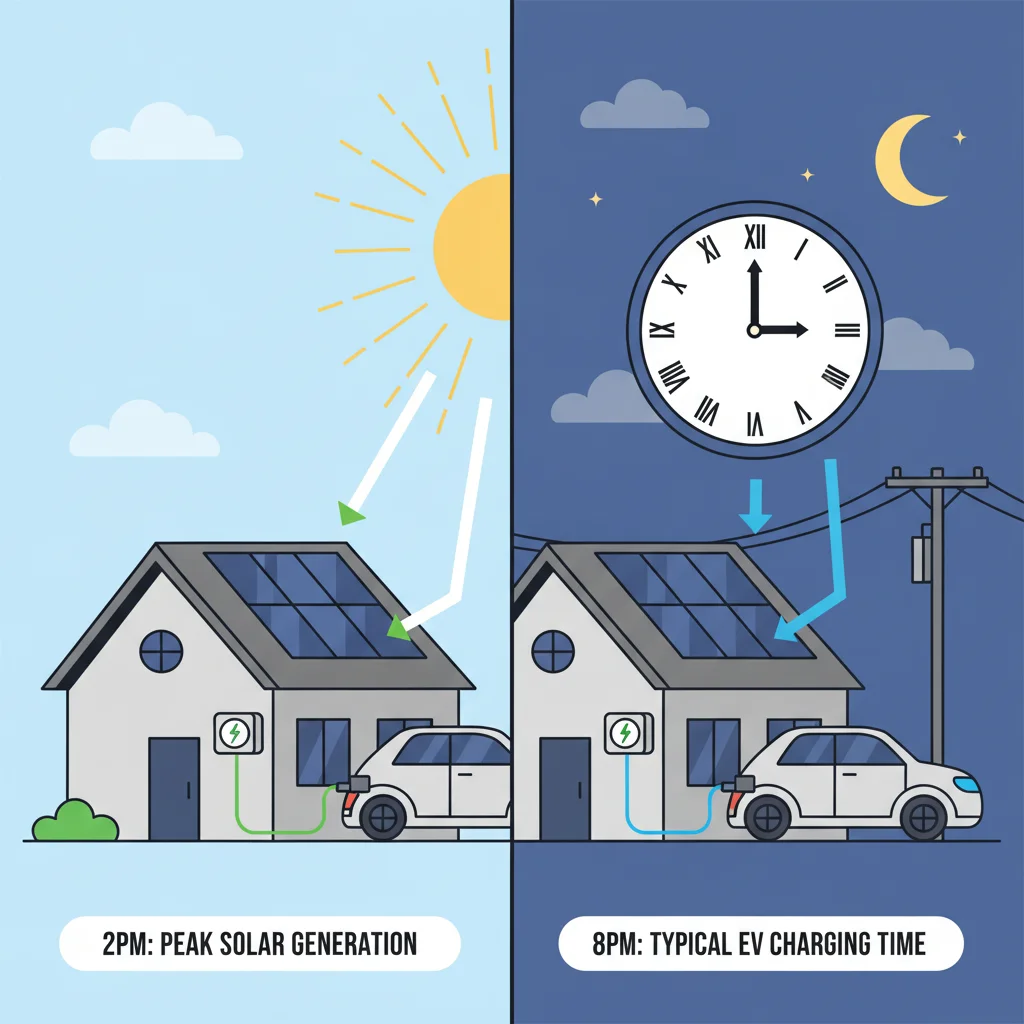
The problem for most working households is that peak solar generation occurs between 10 a.m. and 3 p.m. — exactly when cars are parked at the office. A few configurations solve this:
- Schedule charging for midday if you work from home or charge a second household vehicle that stays home during the day.
- Add a home battery (e.g., Tesla Powerwall, Enphase IQ Battery) to store daytime solar generation for evening charging.
- Rely on net metering — export daytime surplus to the grid, import equivalent cheap credits at night when you charge.
Net metering is the most common and lowest-cost approach, but it's not available everywhere and is being scaled back in several states. Before counting on it, verify your utility's current net metering policy — some have moved to avoided-cost compensation that pays you far less per kWh than retail rates. For a frank look at whether the solar-EV pairing pencils out financially in your market, see Solar Panels and EV Charging: Real Savings or Overstated Promise?.
Net Metering Reductions Are Real and Ongoing
Several states have significantly cut solar export compensation in the last two years. California's NEM 3.0, effective April 2023, reduced export rates by roughly 75% compared to NEM 2.0. If your solar savings math relies on high-value net metering, verify current rules with your utility before signing a solar contract. The calculus for adding battery storage changes substantially under reduced net metering.
Step-by-Step: Setting Up Solar-Integrated Home EV Charging
The following steps assume you're either adding EV charging to an existing solar system or planning a combined installation from scratch. If you're still deciding whether to install solar alongside your charger, the steps still apply — just work through the sizing and utility steps first before committing to equipment.
Calculate your daily solar generation versus EV charging demand
Start with the math before touching any hardware. You need to know whether your existing (or planned) solar array can realistically cover your EV's daily energy needs on top of your home's baseline consumption.
- Find your EV's energy consumption rate in kWh per 100 miles (listed in the owner's manual or on the EPA's fueleconomy.gov). Divide by 100 to get kWh per mile, then multiply by your daily mileage.
- Look at your last 12 months of utility bills to find average daily home electricity consumption in kWh.
- Add the two figures together. This is your total daily demand target.
- Use the PVWatts Calculator (pvwatts.nrel.gov) to estimate how many kWh per day a given solar array size would produce at your address. Enter your roof's azimuth and tilt if known.
- Compare production to demand. If you're adding solar, size the array to meet or exceed the combined figure. If solar is already installed, determine whether your existing system has surplus capacity.
Confirm your utility's net metering policy
Before designing your system around exporting solar power and drawing it back at night, verify what your utility actually pays for exported electricity. Log into your utility account or call the customer service line and ask specifically:
- Does the utility offer net metering, and at what rate (retail, avoided cost, or a fixed export rate)?
- Is there a cap on system size for net metering eligibility?
- Does the utility offer a time-of-use (TOU) rate that rewards off-peak charging (typically nights and weekends)?
If your utility has moved away from retail-rate net metering, the economics shift: storing solar in a home battery before charging at night becomes more valuable than exporting and re-importing. Factor this into your battery decision in Step 4.
Choose and install a Level 2 EVSE
Unless your daily driving is under 20 miles and you have a plug-in hybrid, a Level 2 (240V) charger is the correct choice for solar integration. Level 1 (120V) tops out at about 4–5 miles of range per hour — too slow to make meaningful use of midday solar surplus and too slow to reliably top up overnight if you've been running the battery low.
When selecting a Level 2 EVSE for solar pairing, prioritize these features:
- Wi-Fi connectivity and scheduling app — essential for time-of-use or solar-matched scheduling
- Adjustable amperage — lets you dial back draw during high home-consumption periods without stopping charging entirely
- Solar inverter integration — some chargers (Wallbox, myenergi Zappi, certain ChargePoint models) can receive a signal from compatible inverters and automatically ramp up when excess solar is available
- ENERGY STAR certification — required for the federal tax credit eligibility
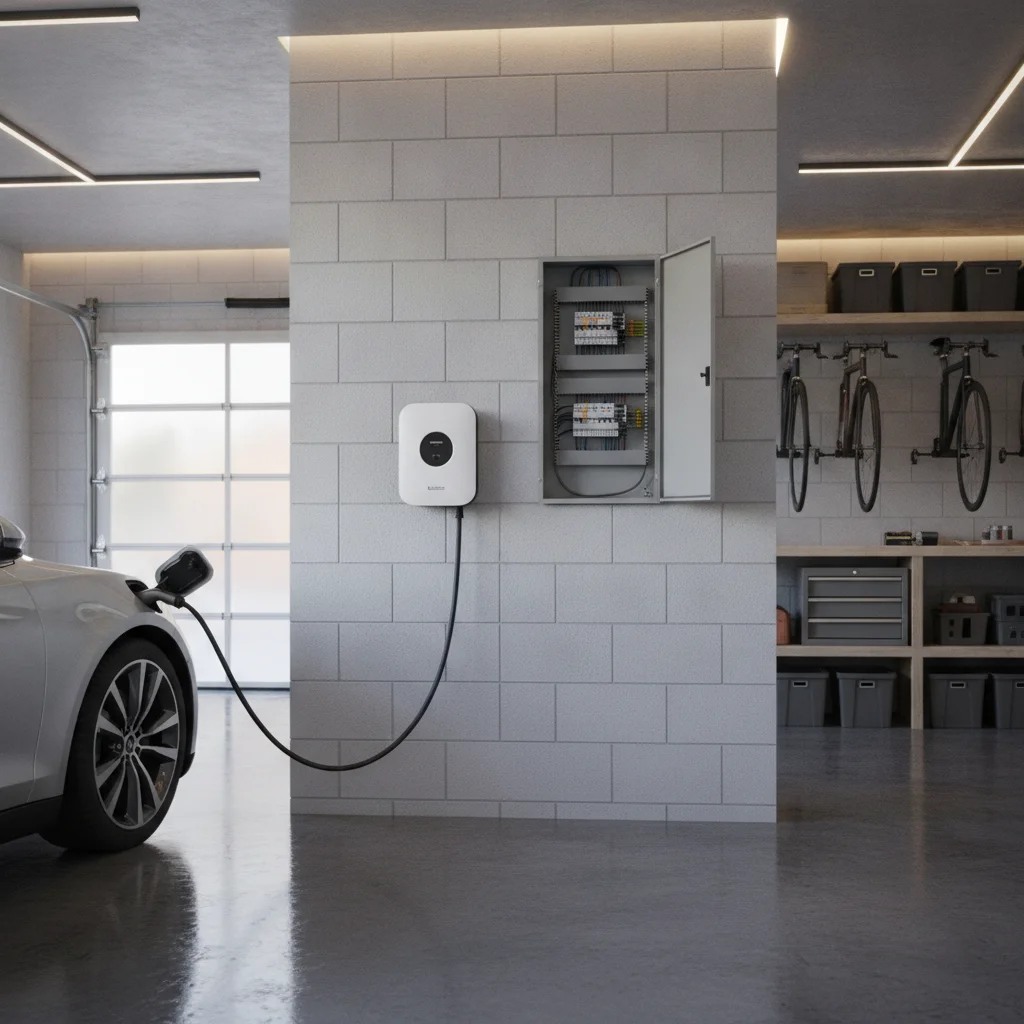
Have a licensed electrician install a dedicated 240V circuit with a breaker sized to 125% of the charger's continuous draw (a 40A charger needs a 50A breaker). Confirm with your electrician that your main panel has the capacity — this is also the moment to discuss whether a panel upgrade is needed. See our detailed breakdown of what home EV charging installation involves for the full electrical requirements.
Decide whether to add home battery storage
Home battery storage is optional but meaningfully changes the solar-EV equation. Without it, you depend on net metering to 'bank' daytime solar for nighttime charging. With it, you physically store solar energy on-site and use it when you need it.
Battery storage makes the most sense when:
- Your utility has unfavorable net metering (avoided-cost compensation rather than retail rate)
- You're on a time-of-use rate with high peak pricing in the evenings
- You want backup power capability in addition to EV charging
- Your primary EV regularly charges in the evening after peak solar hours
The math: a 10 kWh usable battery at roughly 90% round-trip efficiency delivers about 9 kWh to your charger. At 3.5 miles/kWh, that's about 31 miles of range per charge cycle — adequate for typical daily driving but not a large buffer. If you drive more than 30–35 miles daily and want full solar coverage, plan for a two-battery system or accept that some grid charging will supplement.
Battery systems that qualify as standalone storage (not co-located with solar) became eligible for the 30% federal tax credit starting in 2023 under the IRA — confirm this with your tax advisor.
Configure your charging schedule to align with solar production
This step is where the system actually starts saving you money. Without scheduling, your charger will draw from whatever source is available — likely the grid at peak rates if you plug in when you get home from work.
There are two main configuration approaches depending on your hardware:
Option A: Time-based scheduling (any smart Level 2 charger)
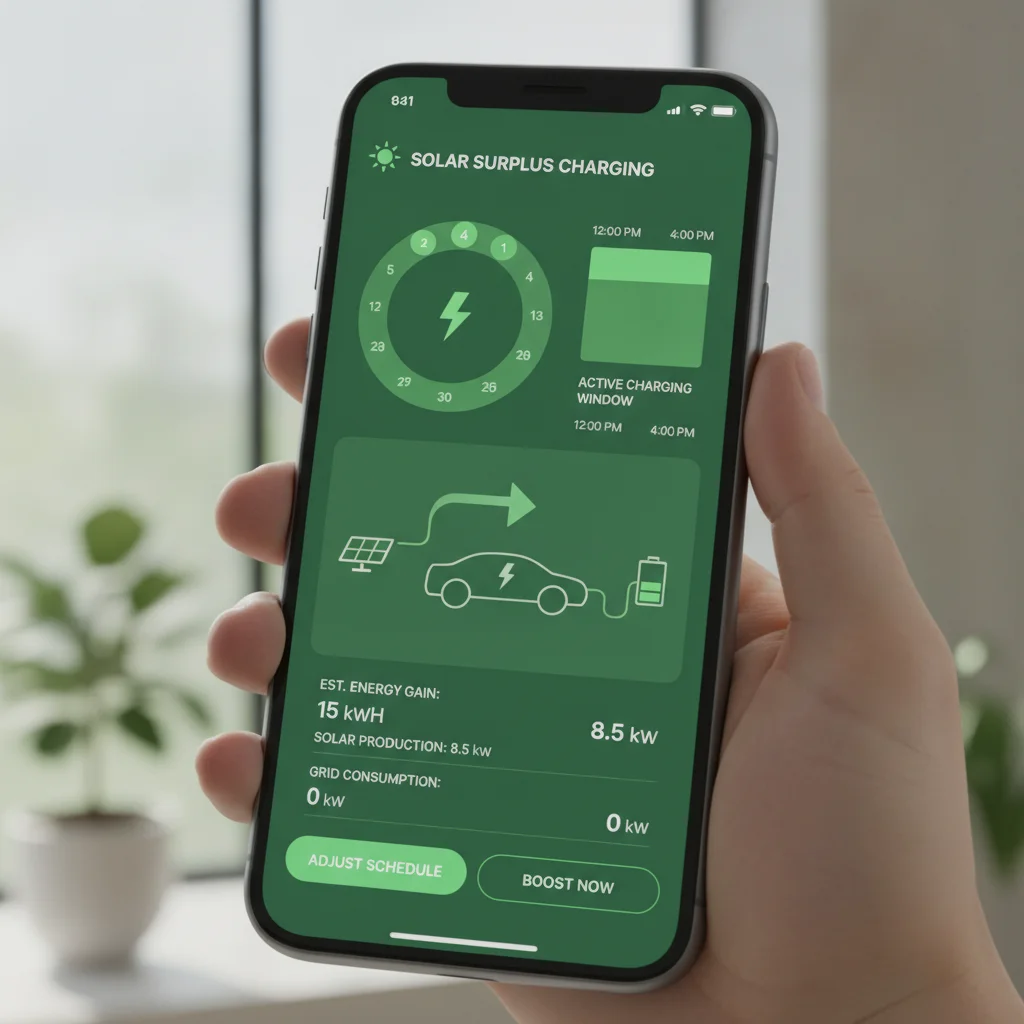
Set your charger to begin charging at a time that aligns with peak solar production: typically 10 a.m.–2 p.m. if a vehicle is home during the day, or late evening if your utility's TOU off-peak window starts at 9 p.m. or later. Set a target departure charge level so the car is ready when you need it. Most charger apps (ChargePoint, Emporia, Wallbox, Enel X) support this directly.
Option B: Solar-matched charging (compatible inverter + charger pairs)
If your solar inverter and EVSE support integration — for example, SolarEdge with its EV charger, Enphase with compatible Wallbox units, or a myenergi Zappi with its solar divert mode — configure the charger to draw only when panels are producing a surplus above your home's baseline load. The charger will automatically throttle up or down based on real-time solar output. This eliminates guesswork and maximizes direct solar-to-car transfer without exporting to the grid.
Also configure your EV's in-car charge scheduling (most EVs have this) as a backup layer, pointing it to your lowest-cost charging window. Two layers of scheduling protection means a forgotten plug-in won't default to expensive peak-rate charging.
Monitor system performance and adjust over time
A solar-plus-EV system is not set-and-forget. Conditions change: driving habits shift, solar production varies seasonally (expect 30–50% less output in winter in northern states), and utility rate structures can be revised. Plan to review your system's performance quarterly for the first year.
Key metrics to track:
- Solar self-consumption rate: What percentage of your solar generation is consumed on-site vs. exported? Aim for 60–80% self-consumption with EV charging included. A very low rate means you're exporting too much and may benefit from battery storage or shifting more home loads to daytime.
- EV charging cost per kWh: Your inverter or charger app should report kWh delivered to the vehicle. Divide your monthly utility bill by total home consumption to get your blended rate, then compare to what you'd pay for gasoline at equivalent miles.
- Grid import during charging periods: If your system is pulling from the grid during peak solar hours, the schedule may need adjustment or your array may be undersized.
Most solar inverter apps (Enphase Enlighten, SolarEdge mySolarEdge, Tesla Energy app) provide real-time and historical production data that you can cross-reference with your charger's session data. After 6–12 months, you'll have enough data to make an informed decision about whether battery storage would improve your economics.
Check for Solar-EV Bundled Installer Deals
Some solar installers now offer bundled packages that include a compatible Level 2 EVSE and a single permit pull for the whole system. This can save $500–$1,500 in permitting and installation labor versus adding the charger separately. Ask any solar quote to include a EVSE line item and compare against standalone charger quotes.
Size Your Array for Future EV Needs
If you're installing solar now but plan to add a second EV in the next few years, oversize your array by 20–30% from the start. Adding panels later often costs more per watt due to separate permitting and labor, and your roof may not have the optimal space available when you need it.
Don't Overload Your Electrical Panel
A Level 2 charger adds a significant continuous load — typically 7.2 kW to 11.5 kW depending on amperage. Before installation, your electrician must verify that your main panel has sufficient capacity for this addition on top of existing loads, including any solar system interconnection. An overloaded panel is a fire hazard. If your panel is near capacity, a panel upgrade ($1,500–$4,000) may be required — factor this into your budget before committing to a charger.
Troubleshooting and Common Pitfalls
Even a well-planned system can run into friction points. Here are the issues homeowners most commonly encounter after installation:
The car charges mostly at night, not on solar
This happens when your car's default charging schedule isn't configured to align with solar production hours, or when you rely entirely on net metering without realizing your utility has reduced export rates. Fix: program your charger's schedule through the EVSE app (most Level 2 chargers offer this) or through your solar inverter's EV scheduling feature if it supports direct integration.
The solar system trips or dims when the charger kicks on
A Level 2 charger draws 24–48 amps. If your panel is near capacity or the inverter output is limited, the sudden load can cause voltage sag or inverter throttling. Fix: confirm your panel has adequate headroom before installation (your electrician should check this), or install a load management device that limits charger draw during high home-consumption periods.
Battery storage isn't covering nighttime charging as expected
Home batteries marketed as providing a day's worth of home backup often reserve capacity for outage protection, not routine EV charging. A 10 kWh usable battery might reserve 20–30% for emergency use, leaving 7 kWh — enough for about 21–28 miles. If your daily commute is longer, you need either a larger battery bank or supplemental grid charging. Check your battery settings: many systems let you set the minimum reserve level.
The EV and solar inverter won't communicate
Not all solar inverters support direct integration with all EV chargers. Enphase works well with ChargePoint and some Wallbox models; SolarEdge has its own EV charger product. Tesla's ecosystem is self-contained. If you're mixing brands, you may need a third-party energy management hub or rely on time-of-use scheduling instead of real-time solar-matched charging. Check compatibility before you buy hardware.
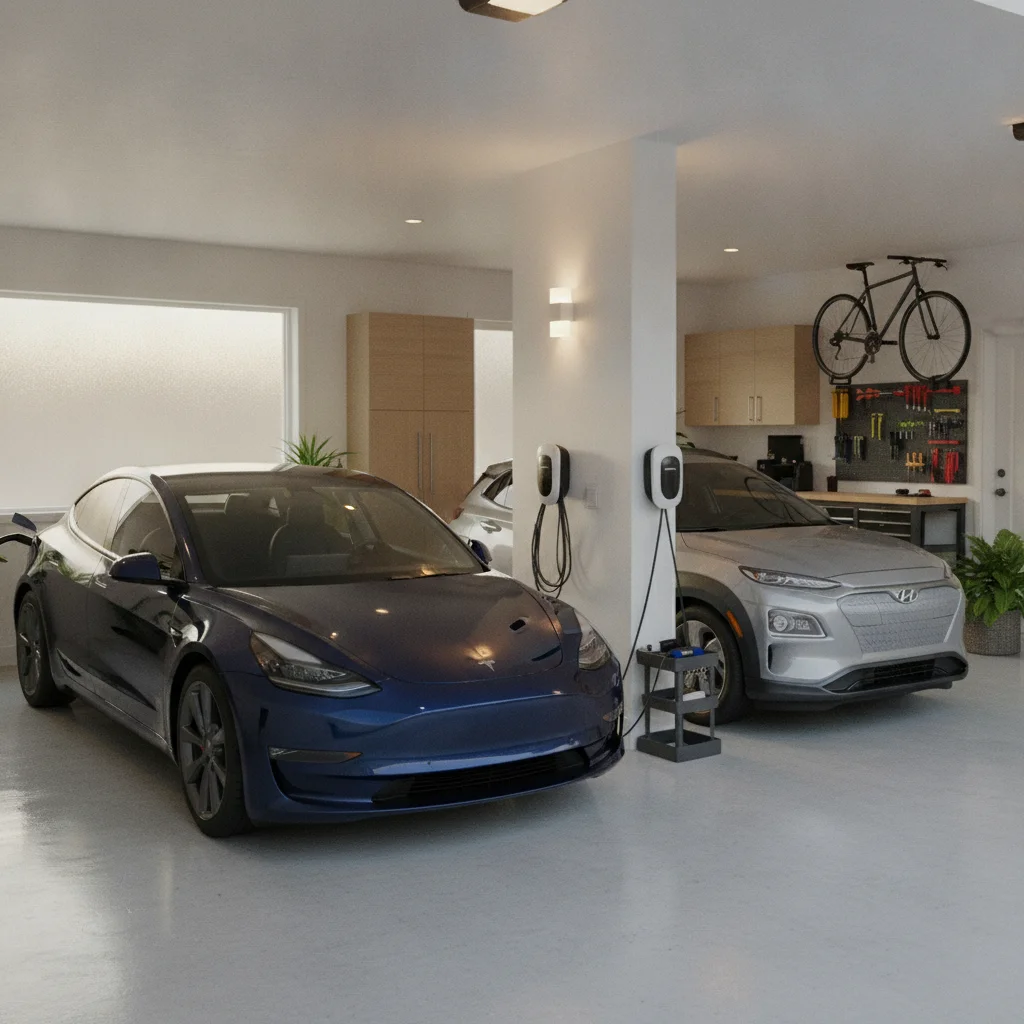
For households with multiple EVs or shared charging setups, managing load and scheduling gets more complex. See our guide to charging etiquette and best practices for shared home setups for strategies.
Costs, Incentives, and the Bottom Line
Here's a realistic cost picture for a combined solar-plus-EV-charging setup in 2024:
| Component | Typical Cost Range | Federal Tax Credit (IRA) |
|---|---|---|
| Solar array (6 kW) | $15,000–$22,000 installed | 30% of installed cost |
| Level 2 EVSE hardware | $400–$900 | 30% (up to $1,000 total credit) |
| EVSE installation (electrical) | $300–$1,500 | Included in charger credit |
| Home battery (10 kWh) | $10,000–$15,000 installed | 30% of installed cost |
The federal Residential Clean Energy Credit covers 30% of solar and battery costs with no dollar cap through 2032. The EV charger qualifies under the Alternative Fuel Vehicle Refueling Property Credit, capped at $1,000 for homeowners. Many states and utilities stack additional rebates on top — Federal and State Incentives That Reduce EV Charging Costs has a current breakdown by program type.
Payback periods depend on local electricity rates, solar irradiance, and how much you drive. In high-electricity-rate states like California, New York, or Massachusetts, a solar-plus-EV system can pay back in 6–9 years including the charger. In lower-rate states, expect 10–14 years for solar alone. The EV charger itself typically pays back in under two years when you account for avoided gasoline costs.
For the complete picture on what a home charging installation involves from the electrical panel outward, see our Home EV Charging Setup: Everything You Need to Know Before You Begin. And if you want to benchmark home solar charging costs against public DC fast charging, the Charging Costs and Savings hub is the right starting point.
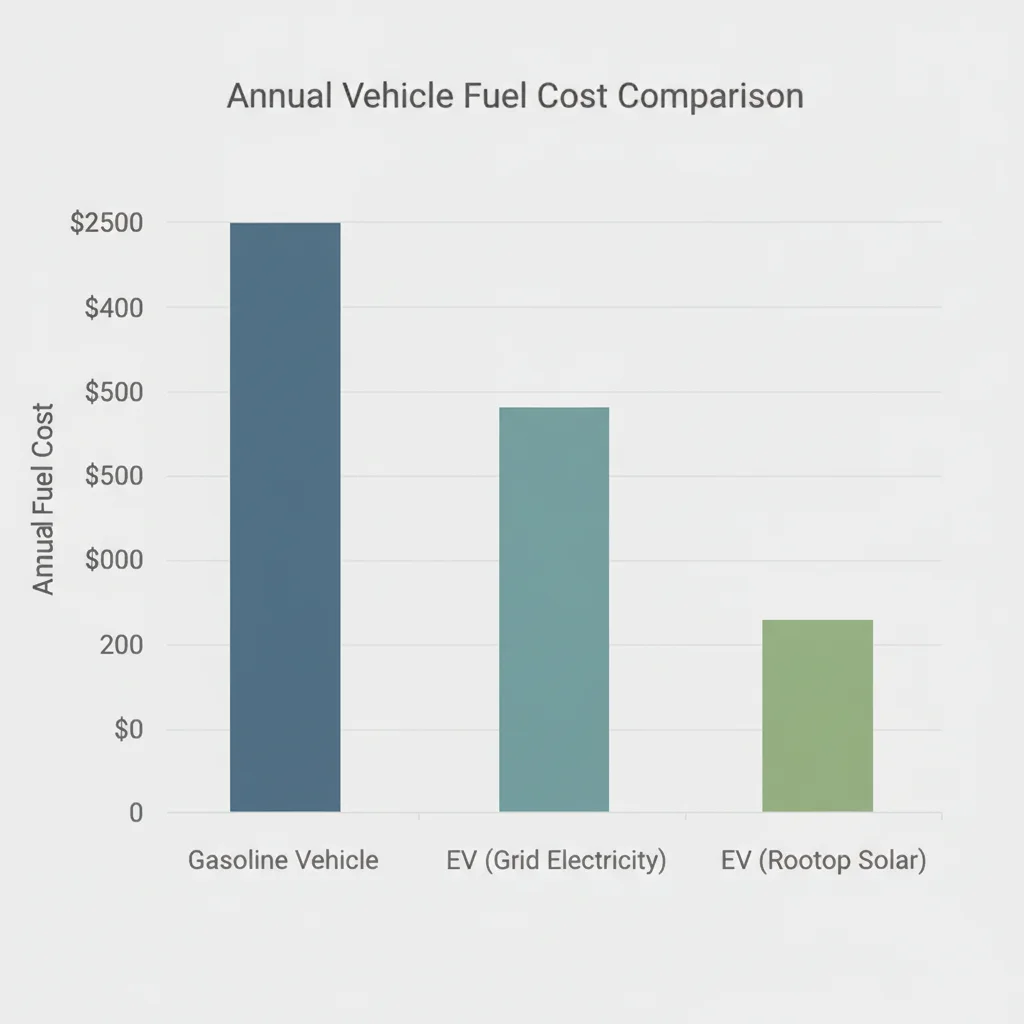
The honest bottom line: solar-integrated home EV charging works best if you have favorable net metering, enough roof space for a properly sized array, and daily driving habits that don't wildly exceed what a 5–7 kW system can cover. If those conditions apply to you, this is one of the few home upgrades that genuinely pays for itself while reducing your dependence on gasoline and grid electricity simultaneously.

All claims are backed by peer-reviewed research. Sources on request.