Key Takeaways
Why Those 'Switch and Save' Ads Are Built to Mislead
You've seen the ads. A friendly gecko promises hundreds in savings. A caveman implies your current insurer is prehistoric. A mayhem character threatens disaster while a competitor offers rescue. The message is always the same: switch to us, and you'll save a dramatic, specific amount of money.
Those claims aren't fabricated, exactly — but they're not telling you what you think they're telling you. Insurance companies are required to substantiate advertising claims, so the savings figures you see are grounded in actual customer data. The problem is which customers that data comes from, and how it's framed.
When an insurer says "drivers who switched saved an average of $487," they're pulling from a dataset of people who actually completed a switch to that company. Those are people who shopped around, got a better quote, and pulled the trigger. By definition, that sample is pre-filtered to include only people for whom switching made financial sense. People who got a quote and stayed put? Not in the average.

This article breaks down six of the most pervasive myths about switching savings — and gives you a framework for separating genuine opportunity from marketing noise. For a broader look at misconceptions that cost drivers real money, see common auto insurance myths that many policyholders fall for.
The Myths, Debunked
Let's get into the specific claims and misconceptions that shape how most drivers think about switching — and what the evidence actually shows.
Myth
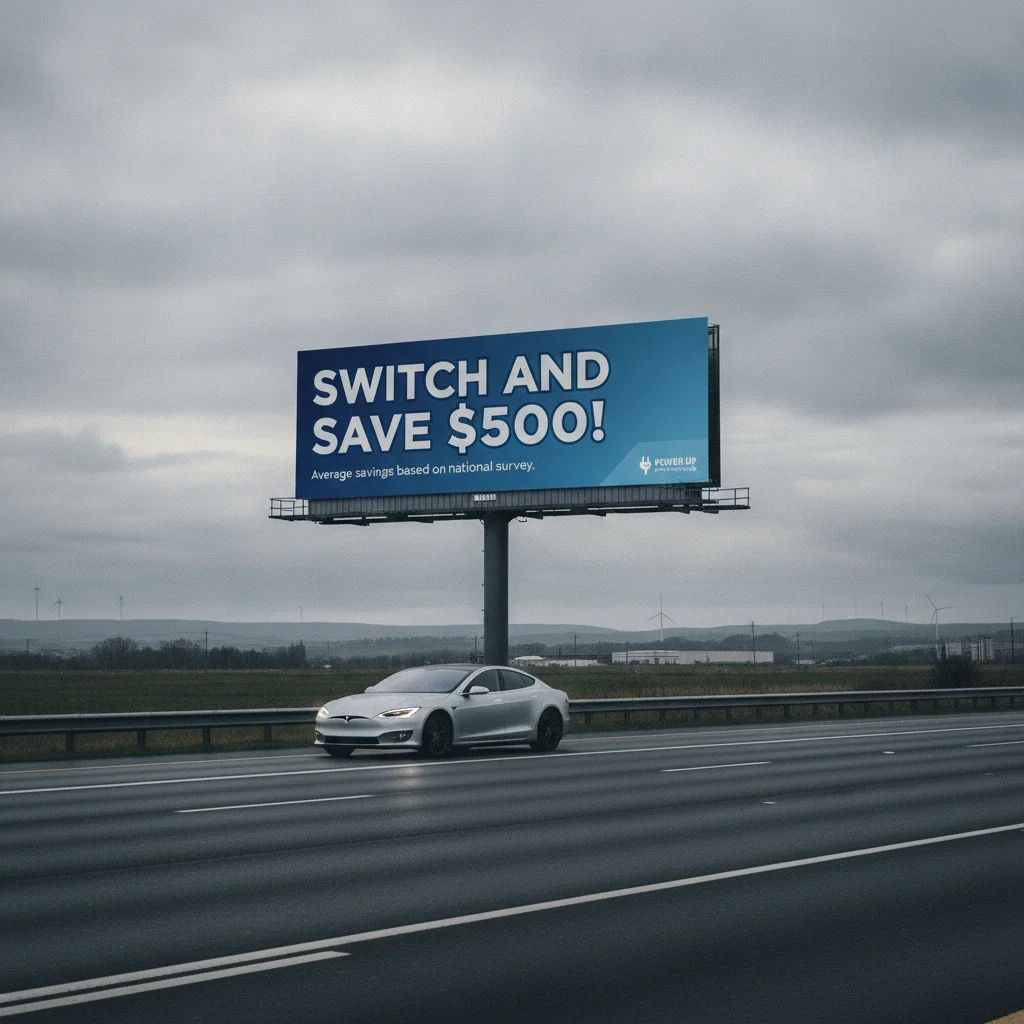
If an insurer advertises 'average savings of $500,' I should expect to save roughly that amount by switching.
Fact
That average is drawn only from customers who actually switched — a group pre-selected because switching benefited them. It tells you nothing about what you'd save.
Statisticians call this survivorship bias. The pool of drivers whose data generates the advertised average excludes everyone who got a quote, found no meaningful savings, and stayed put. Insurers are not required to disclose how many drivers shopped and didn't save, or what the distribution of savings looks like — only what the average was for switchers.
In practice, the distribution is wide. Some switchers save $1,200 a year because they were significantly overpriced. Others save $40. A few see no change at all after comparing equivalent coverage. The headline average obscures all of that variance.
What this means for you: treat advertised averages as evidence that some savings exist for some drivers — not as a personal forecast. Your actual outcome depends on your driving record, location, vehicle, coverage level, and whether your current insurer has been pricing you competitively.
Myth
Switching insurers automatically gets me a better deal — staying loyal to my current company is always a mistake.
Fact
Loyalty discounts and rate stability can sometimes offset switching savings, especially for drivers with clean records in competitive markets.
The insurance market is not uniformly stacked against existing customers. Some carriers — particularly regional and mutual insurers — actively reward tenure with discounts, dividend programs, or preferred pricing tiers that kick in after multiple claim-free years. Leaving those benefits on the table to chase a competitor's introductory rate can be a net loss.
That said, many large insurers do practice what critics call price optimization — a modeling approach that identifies policyholders unlikely to shop and gradually raises their rates above what the open market would bear. If you haven't gotten a competing quote in three or more years, you may have drifted into that zone.
The honest answer is that neither loyalty nor switching is automatically the right strategy. The right strategy is to re-shop at every renewal and compare what loyalty gets you against what switching would cost and save. Our breakdown of loyalty discounts vs. switching bonuses gives you a side-by-side framework for making that call.
Myth
A lower-premium quote means I'm getting a better deal — price is price.
Fact
A lower premium only represents savings if the coverage is equivalent. Differences in deductibles, limits, and optional coverages can easily exceed the apparent discount.
This is where shoppers get burned most reliably. Online quote tools are optimized to show you a low number quickly — and they do that partly by defaulting to lower coverage limits or higher deductibles than you currently carry. A quote that looks $300 cheaper annually may have a $500 higher collision deductible, which means the first time you have a claim, you're net worse off.
The comparison that actually matters is cost per unit of protection, not raw premium. Before you conclude that a competing quote is cheaper, pull out your declarations page and verify every line item:
- Bodily injury liability limits (e.g., 100/300 vs. 50/100)
- Property damage liability limit
- Collision deductible
- Comprehensive deductible
- Uninsured/underinsured motorist coverage
- Medical payments or PIP limits
- Optional coverages: rental reimbursement, roadside assistance, gap insurance
Only when those fields match is the price comparison meaningful. Anything else is comparing apples to oranges — and insurers are counting on you not noticing the difference.
Myth
Switching insurers mid-policy is seamless — you can do it anytime without any financial consequence.
Fact
Mid-policy switches can involve cancellation fees, pro-rated refund calculations, and brief coverage gaps if the timing isn't managed carefully.
Most insurers allow you to cancel mid-policy and will issue a pro-rated refund for the unused portion of your premium. But "pro-rated" varies by company — some calculate it on a true daily basis, others use a short-rate method that slightly penalizes early cancellation. A handful of insurers charge a flat cancellation fee.
Beyond the refund mechanics, the coordination risk is real. If your new policy doesn't activate before your old one cancels, even a one-day gap in coverage can have consequences: a lapse on your record that future insurers use to justify higher rates, and exposure if an incident occurs during that window.
The cleaner path, when possible, is to time your switch to coincide with your renewal date. Your current insurer gives you 30-day advance notice of renewal pricing, which is your window to shop and switch without cancellation friction. For a detailed breakdown of both approaches, see switching at renewal vs. mid-policy.
Myth
Getting multiple insurance quotes will hurt my credit score.
Fact
Insurance companies use a soft credit inquiry — or in some states no credit check at all — which does not affect your credit score.
This myth stops a lot of people from shopping as aggressively as they should, and it's simply not accurate. When you request an auto insurance quote, insurers pull what's called a soft inquiry on your credit file — a read-only check used to generate an insurance score. Soft inquiries are not visible to lenders and have no impact on your FICO score or any credit scoring model used by lenders.
This is categorically different from a hard inquiry, which occurs when you apply for credit (a car loan, credit card, or mortgage). Hard inquiries can shave a few points off your score temporarily. Soft inquiries cannot.
Additionally, California, Hawaii, Massachusetts, and Michigan prohibit insurers from using credit information in auto insurance pricing altogether. If you live in one of those states, the credit question is moot for insurance purposes entirely.
The practical implication: get as many quotes as you want, from as many carriers as you want. There is no credit cost to shopping thoroughly.
Myth
The insurer with the lowest quote will always deliver the best overall value.
Fact
A cheap premium from an insurer with poor claims handling can cost you far more than the savings when you actually need to file a claim.
Price is what you pay when nothing goes wrong. Claims satisfaction is what determines your experience when everything goes wrong — and that experience has real financial stakes. An insurer that slow-walks claims, disputes reasonable payouts, or makes the process difficult can cost you rental car expenses, out-of-pocket repair overruns, and lost time that a slightly higher premium would have spared you.
Fortunately, claims performance data is publicly available. The National Association of Insurance Commissioners (NAIC) complaint index shows each insurer's complaint volume relative to their market share — a ratio above 1.0 means they draw more complaints than their size would predict. J.D. Power publishes annual auto insurance claims satisfaction studies. AM Best and Demotech provide financial strength ratings that tell you whether the insurer can actually pay claims at scale.
A carrier with a 15% lower premium and a 2.3 NAIC complaint index should give you pause. A carrier with a 10% lower premium and strong J.D. Power scores may genuinely be a better deal. See our full guide to comparing insurers on claims satisfaction for the methodology.
Teaser Rates Don't Always Last
Some insurers offer a lower introductory rate for the first policy term, then adjust upward at renewal once they've built a claims history with you. Before switching, ask the new insurer whether your quoted rate is guaranteed for more than one term or subject to adjustment at renewal. If they can't confirm rate stability, factor that uncertainty into your decision.
Online Quote Tools Often Default to Low Coverage
Many comparison websites and carrier quote tools default to minimum state liability limits or high deductibles to generate a low number that gets you in the door. Always manually check the coverage selections before accepting a quote as your baseline. If you let the tool default, you may be comparing stripped-down coverage against your current, more robust policy — and calling the difference 'savings.'
Discount Stacking Requires Active Claiming
Most insurers do not automatically apply every discount you qualify for — you have to ask. Telematics programs, defensive driving course discounts, low-mileage rates, and affinity group discounts (through employers, alumni associations, or professional groups) often require manual enrollment. Call your current insurer and ask for a discount audit before concluding that switching is your only path to savings.
Before you act on any quote comparison, it's worth understanding how the timing of your switch affects refunds, cancellation fees, and coverage continuity. Our guide on switching at renewal vs. mid-policy covers those mechanics in detail.
What Actually Determines Your Potential Savings
Once you've cleared out the mythology, you're left with a practical question: how much could you actually save? The answer depends on a cluster of personal factors that advertising can't account for.
Your Current Premium vs. the Market
Savings potential is fundamentally a gap question. If your current insurer is pricing you competitively for your risk profile, there may be little room for another company to undercut them significantly. If you've been with the same insurer for a decade and never re-shopped, you may have accumulated rate increases that have quietly moved you above market.
~$540
Average annual savings reported by switchers
According to Insurify's 2023 analysis of auto insurance switching behavior, drivers who actively compared and switched saved approximately $540 per year on average — but this reflects only those for whom switching made financial sense.
29%
Drivers who shopped but didn't switch
A 2022 J.D. Power Insurance Shopping Study found roughly 29% of auto insurance shoppers obtained competing quotes but ultimately chose to stay with their current insurer after finding comparable or superior value.
3+ years
Median time since last rate comparison among over-paying drivers
Consumer advocacy research consistently finds that drivers paying above-market premiums have typically not re-shopped in three or more years, allowing rate drift to compound quietly.
Up to 15%
Typical discount for bundling auto and home
Most major carriers offer a multi-policy (bundle) discount ranging from 5% to 15% when you combine auto with homeowners or renters insurance — a savings opportunity that doesn't require switching at all.
4 states
States banning credit-based insurance scoring
California, Hawaii, Massachusetts, and Michigan prohibit the use of credit history in auto insurance pricing, making credit-based rate differences irrelevant for drivers in those states.
Discounts You're Not Currently Claiming
Sometimes the savings opportunity isn't about switching at all — it's about claiming discounts you already qualify for but haven't activated. Bundling auto with home or renters insurance, installing a telematics device, completing a defensive driving course, or simply asking about loyalty discounts can shift your premium meaningfully without changing carriers. See our comparison of loyalty discounts vs. switching bonuses to understand which path tends to deliver more.
Coverage Level Mismatches
A lower quote is only genuinely cheaper if it covers the same risks at the same limits. A quote that strips out rental reimbursement, reduces uninsured motorist coverage, or bumps your deductible by $500 isn't an apples-to-apples comparison. When you're evaluating competing quotes, use a line-item checklist — coverage type, limit, deductible — before you declare one cheaper than another.

Claims History and Risk Profile
If you've had at-fault accidents or violations in the past three to five years, your savings potential through switching is more limited. Most insurers price recent claims similarly, because the actuarial signal is hard to argue with. Where you can find differentiation is in how each insurer treats older incidents as they age off your record, or how they score specific violation types.
For a full picture of what to evaluate beyond price — including claims satisfaction data that actually predicts your experience when something goes wrong — see comparing insurers on claims satisfaction.
Never Let Coverage Lapse Between Policies
A single day without auto insurance coverage can show up on your insurance history as a lapse — and insurers use that lapse to justify rate increases for the next three to five years. Before canceling your existing policy, confirm the exact start date and time of your new policy in writing. Overlap by at least one day if you can; you can request a pro-rated refund for the overlap period from your old insurer.
How to Run an Honest Quote Comparison
If you want to know whether switching is worth it for you specifically, you need a process — not another ad. Here's how to run a comparison that produces actionable results.
- Pull your declarations page. Before you get any quotes, have your current policy's declarations page in front of you. This is the one-page summary that lists your coverage types, limits, and deductibles. It's your baseline for comparison.
- Get at least three quotes. One quote is an anecdote. Three quotes are the beginning of a market signal. Request quotes from at least two direct carriers (companies you contact directly, like GEICO or Progressive) and at least one quote through an independent agent who can access multiple carriers simultaneously.
- Match coverage exactly. When entering your information on competitor sites, replicate your current coverage levels exactly — same liability limits, same deductibles, same optional coverages. If you want to explore changing your coverage, do that separately after you've established the apples-to-apples baseline.
- Ask about every discount. Don't assume the online quote tool has surfaced all available discounts. Call or chat and ask explicitly: do you offer a multi-policy discount? Safe driver? Good student? Paperless billing? Low mileage? Anti-theft device? These often require manual application.
- Factor in switching costs. If you're mid-policy, check whether your current insurer charges a cancellation fee. Calculate your pro-rated refund. Weigh those against projected savings. If you're within 60 days of renewal, it's almost always cleaner to let the policy expire and start fresh. Our article on when switching saves money vs. creates a gap walks through this calculation.
- Check claims reputation. Your premium is what you pay when nothing goes wrong. Claims satisfaction is what matters when everything goes wrong. J.D. Power, the NAIC complaint index, and AM Best financial strength ratings are publicly available and worth 10 minutes of your time before you commit to a new carrier.

If a competitor's quote is more than 10–15% lower than your current premium for identical coverage, that's a meaningful signal worth acting on. If it's 3–5% lower, the math may not survive switching friction — especially mid-policy. Savings in the range of 5–10% warrant a closer look at coverage details and discount eligibility before you decide.
For context on the full landscape of policy comparison tools and methodology, the comparing policies hub is a useful resource to bookmark.
The Bottom Line on Switching Savings
Insurance companies aren't lying when they advertise switching savings. But they are framing a selective truth in the most favorable possible light. The real story is more conditional: switching can save you money, and for a meaningful share of drivers it does — but only if your current rate is above what the market would charge for your specific risk profile, and only if you're comparing equivalent coverage.
The drivers who consistently pay less for auto insurance aren't the ones who respond to every ad. They're the ones who re-shop at every renewal, claim every discount they qualify for, and evaluate new carriers on both price and claims performance. That's the habit worth building — not brand loyalty to an advertiser, and not reflexive switching every time a mailer arrives.
Run the comparison. Do the math. And read the declarations page before you sign anything.


All claims are backed by peer-reviewed research. Sources on request.