
Key Takeaways
Why the Finance Office Loves Gap Insurance
Gap insurance — technically GAP insurance — covers the difference between what you owe on a car loan and what the car is actually worth when it's totaled or stolen. On paper, that's a legitimate consumer protection product. In the F&I office, it's one of the highest-margin items on the menu.
Here's the insider math: a dealer might pay a wholesale cost of $150–$300 for a gap contract through an insurance-backed administrator. They'll sell it to you for $600–$900, sometimes over $1,000. The markup is buried in the total financed amount, so it rarely feels like a $700 charge — it just looks like a slightly higher monthly payment. That's by design.
Finance managers are trained to present gap insurance as a brief, almost obvious add-on during a long and mentally exhausting closing process. By the time you're signing documents, you've already committed to the car, the rate, and the term. Adding another $18 a month — which is how they'll frame it — feels trivial. Over a 60-month loan, that's $1,080. Over 72 months, it's $1,296, plus the interest you're paying on the financed premium.

Understanding what gap insurance actually is and where it comes from gives you leverage. See our complete breakdown of gap insurance coverage to understand the basics before you walk in. The pitch in the F&I office will make a lot more sense — and a lot less convincing — once you do.
The Myths That Keep Gap Insurance Profitable for Dealers
Dealers rely on a handful of persistent misconceptions to close gap sales. Some are outright false. Others are half-truths that only hold up if you never ask the follow-up question. Let's work through each one.
Myth
You have to buy gap insurance from the dealership — it's part of the financing.
Fact
Gap insurance is an optional product you can purchase from your auto insurer, credit union, or a standalone provider — often at a fraction of the dealer price.
This is the most common and most profitable myth in the F&I playbook. Finance managers sometimes imply — without saying it outright — that gap coverage is a lender requirement tied to your loan approval. It isn't. Lenders may require you to carry comprehensive and collision insurance on the vehicle, but gap insurance is a separate, optional product.
The dealer packages it alongside required disclosures in a way that can blur the line between what's mandatory and what's optional. Your job is to ask directly: 'Is this required for loan approval?' If the answer is anything other than a clear 'yes,' treat it as optional — because it is.
You have the legal right to decline dealer-sold gap coverage and purchase it elsewhere. Your auto insurer can typically add a gap endorsement to your policy within minutes of a phone call, and at a dramatically lower cost. See our comparison of when gap insurance makes financial sense to weigh your options before the F&I appointment.
Myth
Dealer gap insurance is basically the same product wherever you buy it.
Fact
Dealer gap contracts vary significantly in benefit caps, exclusions, and claims processes — and are typically far more expensive than alternatives with comparable or better terms.
Not all gap policies are created equal. Dealer-sold gap contracts are underwritten by third-party administrators, and the terms differ widely. Many dealer contracts cap the maximum payout at a fixed dollar amount — commonly $5,000 or less — which can fall short on luxury vehicles or trucks with large loan balances. Others exclude or limit coverage of your primary insurance deductible, leaving you with an out-of-pocket expense at the worst possible moment.
By contrast, gap endorsements through major auto insurers are typically cleaner in structure and easier to claim against, since you're dealing with the same company handling your primary claim. Credit union gap programs are similarly straightforward. The administrative complexity of a dealer contract — which routes through the dealer, then the administrator, then the insurer — adds friction and potential for disputes at claim time.
Before you sign anything, ask the finance manager for the full contract language, specifically the maximum benefit cap and any exclusions. If they can't produce it on the spot, that's a red flag.
Myth
Gap insurance pays off your entire loan balance if your car is totaled.
Fact
Gap insurance pays the difference between your insurer's actual cash value payout and your loan balance — but only within the policy's limits and exclusions.
Here's what actually happens in a total-loss scenario: your primary auto insurer determines the ACV of your vehicle — what it's worth on the market at the time of the loss. They pay that amount, minus your deductible. If you owe more on your loan than the ACV payout, gap coverage is supposed to make up the difference.
The word 'supposed' matters. Many dealer gap contracts have benefit caps, meaning they'll only pay up to a certain dollar amount above the ACV — commonly $5,000. If you're $8,000 underwater, you're still on the hook for $3,000. Additionally, some contracts deduct your primary insurance deductible from the gap benefit, so if you have a $1,000 deductible and a $4,500 gap, you might only receive $3,500 from the gap policy.
Overdue payments, late fees, and charges for add-on products you financed are also typically excluded from gap coverage — meaning those balances remain your responsibility even after a gap claim. The product is useful, but its limitations are rarely disclosed clearly during the F&I presentation.
Myth
If you have a good credit score, you probably don't need gap insurance.
Fact
Credit score doesn't determine whether you're underwater on a loan — loan-to-value ratio and down payment size do.
Credit score affects your interest rate and your ability to get approved for financing. It has no bearing on whether your loan balance will exceed your vehicle's market value. A buyer with a 780 credit score who puts 5% down on a 72-month loan is more financially exposed than a buyer with a 640 score who puts 25% down on a 48-month loan.
The factors that create gap risk are: low or no down payment, long loan terms, high depreciation vehicles, and rolled-over negative equity from a trade-in. None of those are credit score variables. Finance managers sometimes reference your strong credit as a reason you're 'approved' for gap coverage — the implication being that it's a benefit tied to your creditworthiness. It isn't. It's a product available to any buyer willing to pay for it.
Evaluate your need for gap coverage based on the numbers: how much are you financing relative to the vehicle's projected value in 12 months? That's the only calculation that matters. Buying a new car typically comes with steep first-year depreciation that makes this calculation especially important.
Myth
Rolling gap insurance into your loan is the easiest and cheapest way to pay for it.
Fact
Financing gap coverage means you pay interest on the premium for the full loan term — adding meaningful cost to an already expensive product.
When gap insurance is rolled into your financed amount, it becomes part of the principal balance. On a $700 gap policy financed at 7% APR over 60 months, you'll pay roughly $140 in interest on top of the premium itself — bringing the effective cost to around $840. Over 72 months at the same rate, you're looking at closer to $900 total.
Dealers roll everything into the financed amount because it obscures the true cost. A $700 charge sounds significant when quoted directly. As a monthly delta, it's nearly invisible. When you pay cash — or purchase gap separately through your insurer for a flat annual premium — the cost is transparent and there's no interest accumulation.
If you genuinely need gap coverage and the dealer's contract is your only realistic option, ask to pay for it separately as a cash add-on rather than rolling it into the loan. Many dealers will accommodate this request; they just won't offer it proactively. For more detail on what that contract actually contains, see gap insurance in the finance contract.
Myth
Gap insurance protects you for the entire loan term.
Fact
Most gap policies are only relevant — and sometimes only active — during the period when you're actually underwater on your loan.
This myth cuts both ways. On one hand, some buyers assume they need gap coverage forever once they buy it. On the other, some assume it's always active and always paying in full. The reality is more nuanced.
Gap coverage makes financial sense only while your loan balance exceeds your vehicle's market value. For most loans with reasonable down payments, that window is 12–36 months. After that point, normal amortization and market value stabilization typically put you above water — meaning a total loss would be covered in full by your primary insurer without any gap shortfall to fill.
Some dealer gap contracts automatically terminate at a certain point (often when the loan balance drops below a threshold) or are written with a fixed benefit period. Others remain technically active but provide no practical benefit once you're no longer underwater. If you've had gap coverage through a dealer for three or more years and you're on a standard 60-month loan, it's worth checking whether you still need it — and whether you can cancel for a prorated refund. Many dealer gap contracts are cancellable, and dealers are required to refund the unused portion.
When Gap Coverage Actually Makes Sense
None of the above means gap insurance is worthless. For certain buyers in certain situations, it's a genuinely smart purchase. The key is knowing when the math actually supports it — and making that determination yourself rather than letting a finance manager do it for you.
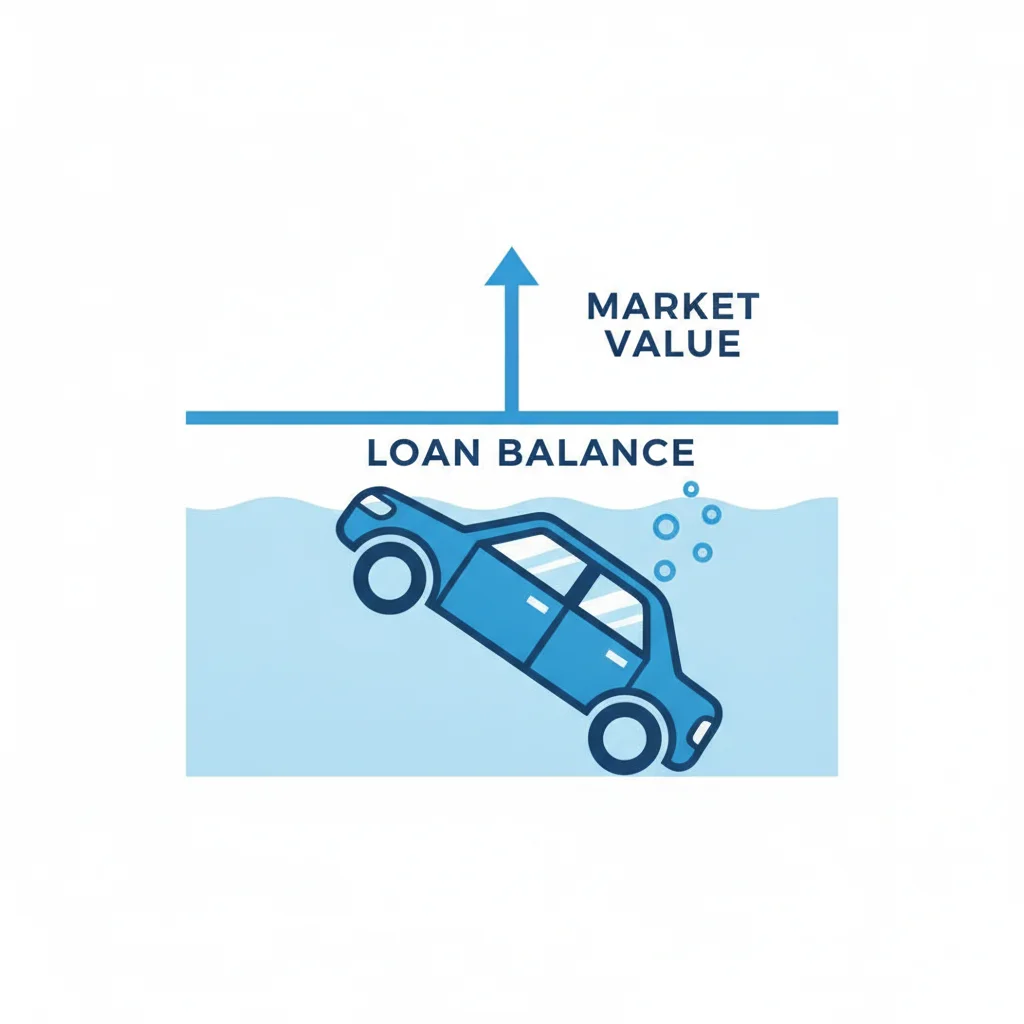
You're a strong candidate for gap coverage if:
- You financed with less than 20% down — depreciation outpaces loan paydown in the early months, and you're likely underwater from day one.
- You're on a 72- or 84-month term — longer loans amortize slowly, keeping your balance high relative to value longer into the loan.
- You're buying a vehicle with high first-year depreciation (most mainstream sedans and compact SUVs qualify).
- You're rolling over negative equity from a previous trade-in — a practice that almost guarantees an upside-down position from the start.
- You're leasing — most lease agreements require gap coverage, and in that case it's usually already built in.
To get concrete, run the numbers yourself before you sit down in the F&I office. Check what the vehicle is expected to be worth in 12 months using a tool like Kelley Blue Book or NADA Guides, then compare that to your projected loan balance using an amortization calculator. If you'd be meaningfully underwater, gap coverage has real value. If you're putting 20% down on a 48-month loan, you're likely back above water within a year and the coverage may not justify any price.
300%+
Typical dealer markup on gap insurance
Industry estimates suggest dealers mark up gap contracts 200–400% above wholesale cost, making it one of the highest-margin F&I products.
$20–$50/yr
Average insurer gap endorsement cost
Most major auto insurers offer gap or loan/lease payoff coverage as a policy endorsement at a fraction of the dealer-sold price.
44%
New car buyers who financed 84-month terms in 2023
According to Edmunds data, longer loan terms have become increasingly common, extending the period buyers remain underwater on their loans.
$6,054
Average negative equity rolled into new car loans
Edmunds reported in 2023 that the average negative equity amount being rolled into new vehicle purchases reached a record high, sharply increasing gap risk.
20%
Down payment threshold that typically eliminates gap risk
Buyers who put 20% or more down on a standard loan term generally emerge from the underwater period within 12 months, reducing the need for gap coverage.
For a deeper look at how depreciation creates — and eventually closes — the gap, see how gap insurance relates to depreciation curves. Understanding the timeline matters more than most buyers realize.
Beware of Benefit Caps That Don't Match Your Exposure
Some dealer gap contracts cap payouts at $5,000, which is insufficient for luxury vehicles, trucks, or buyers who rolled over significant negative equity. Before signing, confirm the policy's maximum benefit and compare it to your realistic worst-case gap — the difference between what you'd owe in month two and what the vehicle would realistically appraise for after a loss. If the cap doesn't cover the worst case, the product isn't providing the protection you're paying for.
Don't Cancel Gap Too Early
If you're genuinely underwater on your loan — especially in the first 24 months — don't cancel gap coverage to save a few dollars without first verifying your current loan-to-value ratio. Use your lender's online portal to pull your remaining balance, then compare it to your car's current market value on Kelley Blue Book or NADA. Only cancel when you're confident the vehicle is worth more than you owe.
Where to Buy Gap Insurance Instead
The dealership is the most expensive place to buy gap coverage. Here are three better options, in roughly ascending order of hassle.
Your Auto Insurer
Most major insurers — including Progressive, Nationwide, and USAA — offer gap coverage or a similar product called loan/lease payoff coverage as an endorsement on your existing policy. Prices typically range from $20–$50 per year. That's $100–$250 over five years, compared to $600–$1,000 at a dealer. Call your insurer before delivery day and add it on the spot.
Your Credit Union or Bank
If you're financing through a credit union or community bank, ask about their gap program at the time of loan origination. Credit union rates average $200–$350 for the life of the loan, with no interest markup since it's a flat fee — not rolled into your financed balance. This is usually the cleanest, most transparent option available.
Standalone Gap Providers
Companies like EFG, Safe-Guard, and others sell directly to consumers online. Prices vary, but you can typically get coverage in the $200–$400 range. Vet the administrator's reputation before buying — you want a company with a track record of paying claims promptly.
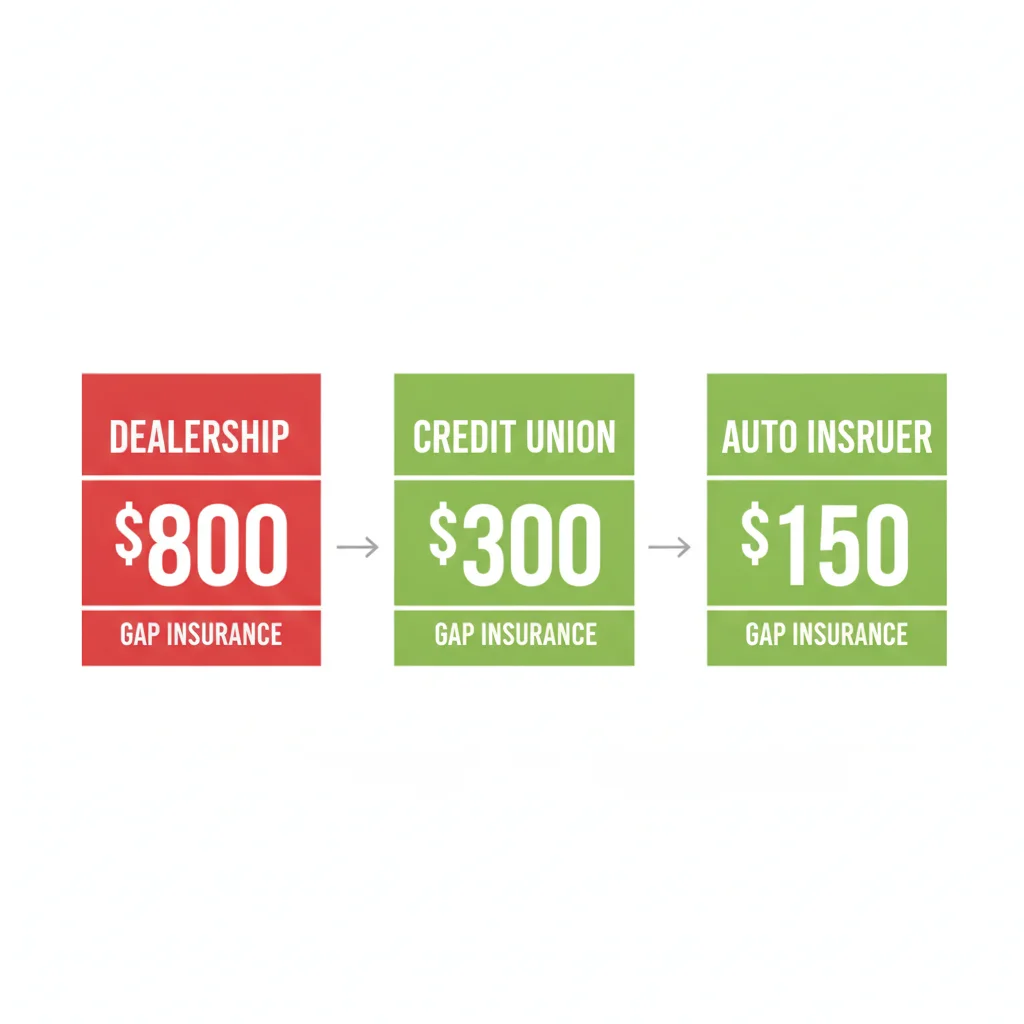
One important note: if you're financing through the dealer and want gap coverage from an outside source, buy the car first, then add the coverage. Some dealers will resist this because they lose the back-end profit — but you're under no obligation to buy it from them. See our guide to what you're agreeing to when gap appears in your finance contract if the F&I manager tries to insist it's required as part of financing.
For context on how down payment size changes your exposure — and your need for gap — read how down payments and gap insurance work together. Making a larger down payment is often cheaper over time than buying gap coverage to protect a small one.
How to Handle the Gap Pitch in the F&I Office
Preparation is your best defense. When the finance manager slides the gap waiver across the table, you don't need to be confrontational — you just need to be ready.
- Know your loan-to-value ratio before you arrive. If you've run the depreciation math and determined you need coverage, great — but tell them you're adding it through your insurer.
- Ask for the cost as a lump sum, not a monthly figure. Finance managers routinely quote add-ons as monthly amounts to minimize perceived cost. Demand the total. Then ask what their wholesale cost is — they won't always answer, but it signals you know what you're doing.
- Ask for the administrator's name. Every dealer gap product is underwritten by a third-party administrator. Get the name, look them up, and check their Better Business Bureau rating and claims history before agreeing.
- Read the benefit cap language. Ask specifically: is there a maximum payout cap on this policy? What deductibles from my primary insurer does it cover? Some contracts will not cover your primary policy's deductible — a major omission that's rarely disclosed upfront.
- Tell them you'll decide after delivery. Gap coverage can be added after you take the car. If you're feeling pressure, decline it in the office and give yourself 24 hours to compare alternatives.
Gap Contracts Are Usually Cancellable
If you already purchased gap insurance through a dealer and later realize you don't need it — or found a better price elsewhere — you can typically cancel the contract and receive a prorated refund. Request the cancellation form directly from the dealer's F&I department and confirm the refund will be applied to your loan balance, not issued as a check. Federal and most state regulations require dealers to honor cancellation requests within specified timeframes. Don't assume you're locked in.
Dealer negotiation extends well beyond the sticker price. The F&I office is where many buyers unknowingly give back everything they saved on the front end. See the full dealer negotiation hub for strategies that apply to the entire buying process, not just the initial price. And if your dealer marked up your interest rate on top of the gap upsell, our article on dealer markup on auto loan interest explains exactly how to spot and push back on that practice.

Gap insurance isn't a scam — it's a real product with real value for the right buyer. What makes it problematic is the opacity of the markup, the pressure of the closing environment, and the sheer number of misconceptions dealers lean on to sell it. Armed with accurate information, you're in a position to make a rational choice rather than an emotional one.

All claims are backed by peer-reviewed research. Sources on request.