Key Takeaways
Down Payment + GAP Insurance
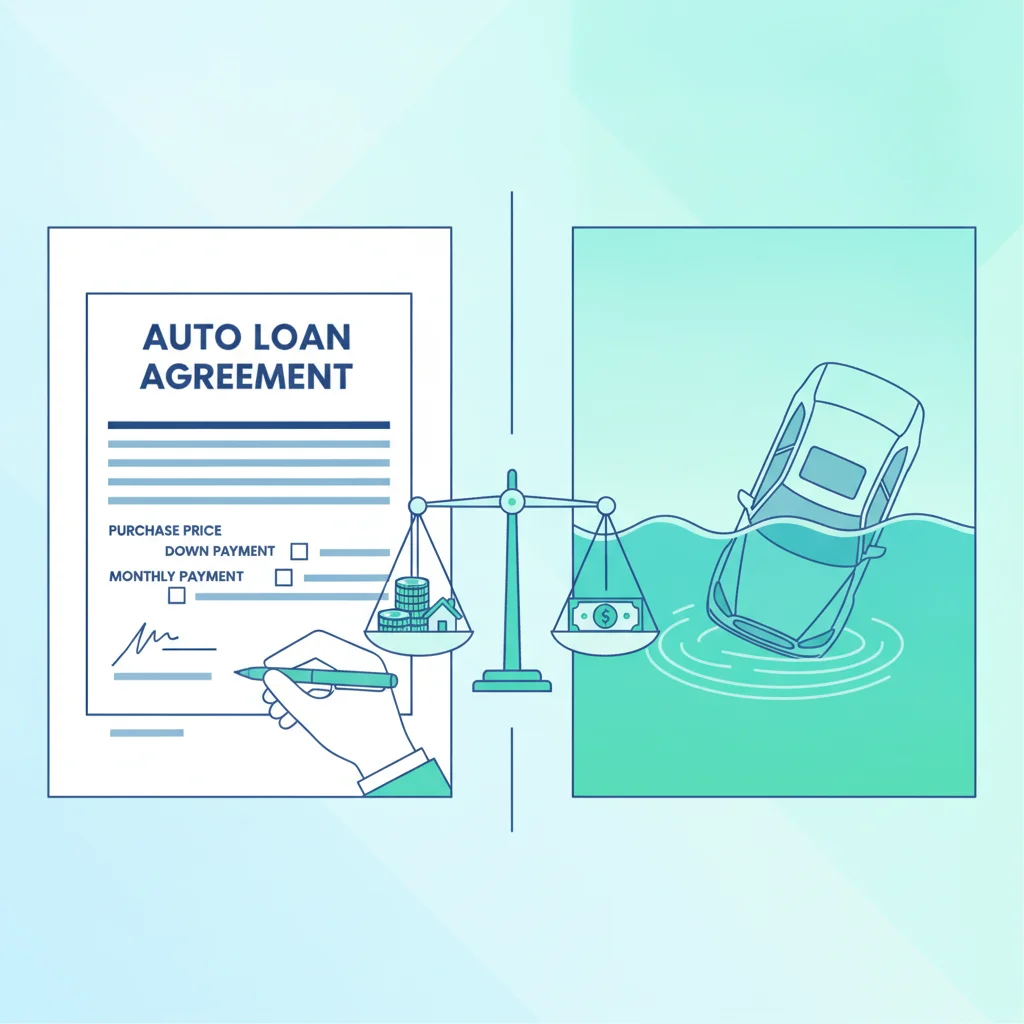
A down payment is the cash you put toward a car's purchase price upfront, which immediately reduces how much you owe. GAP (Guaranteed Asset Protection) insurance covers the difference between what your insurer pays if your car is totaled and what you still owe on your loan. The two are closely connected: the smaller your down payment, the more likely you are to owe more than the car is worth — which is exactly the situation GAP insurance is designed to protect against.
The 'gap' is formally defined as the delta between actual cash value (ACV) paid by your primary insurer and the outstanding loan balance at the time of a total loss or theft. A larger down payment reduces this delta from day one.
Why Your Down Payment Is a Risk Management Tool
Most buyers think of a down payment purely as a way to lower their monthly payment. That's true — but it misses the bigger picture. The amount you put down on day one determines how close your loan balance stays to your car's actual market value throughout the life of the loan. When those two numbers diverge significantly — when you owe more than the car is worth — you're carrying financial exposure that standard auto insurance won't cover.
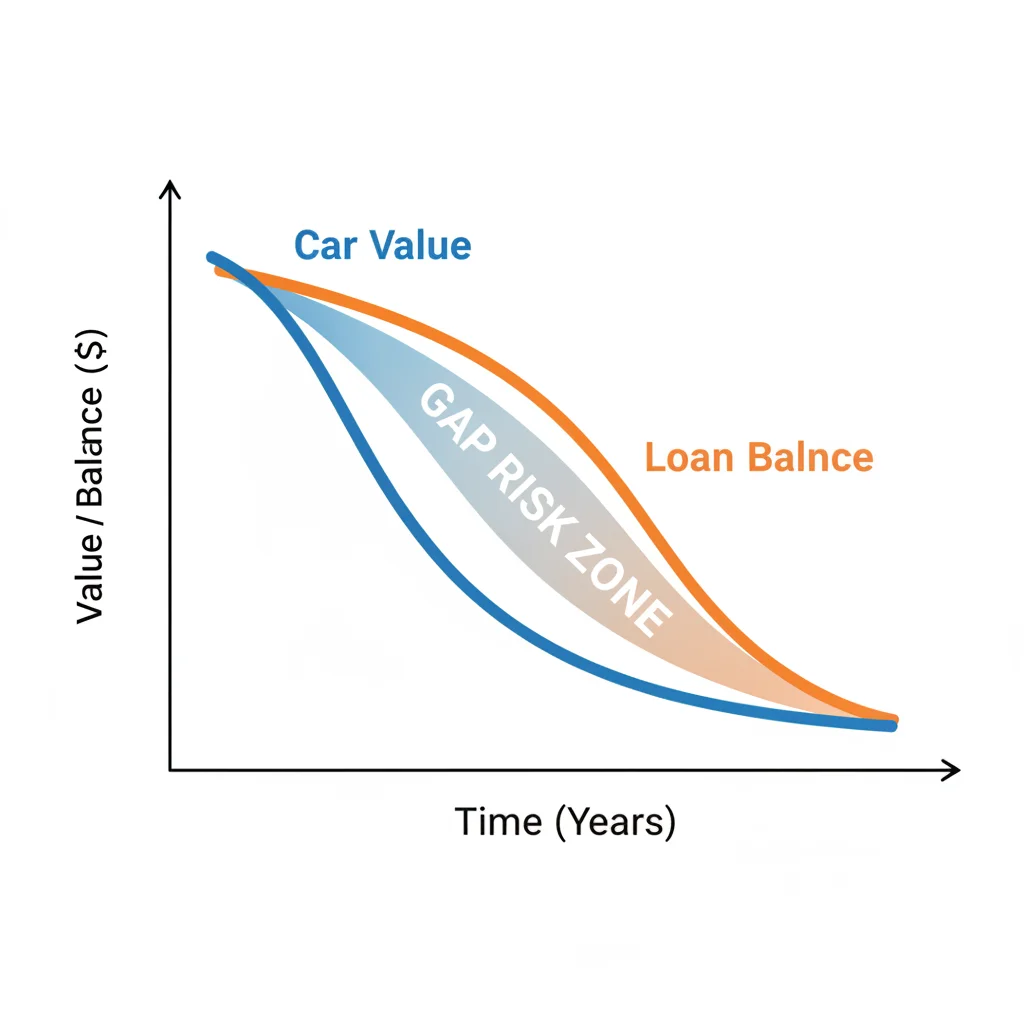
This divergence isn't a fringe scenario. It's the default outcome for buyers who finance a new vehicle with little or no money down on a long loan term. Cars depreciate; loan balances shrink slowly, especially in the early months when most of your payment goes to interest. The result is a window — sometimes lasting two to three years — where you're 'underwater' on your loan.
GAP insurance exists specifically to cover that window. Understanding how your down payment either creates or closes that window is the first step in making a smart decision about both financing and coverage.
GAP Doesn't Cover Every Shortfall
GAP insurance covers the difference between your loan payoff and your insurer's actual cash value payout — but it doesn't cover your deductible, missed payments, late fees, or any amounts rolled into your loan for extended warranties or other add-ons. Read the policy terms carefully to understand exactly what qualifies as a covered loss.
Used Cars and GAP: A Different Calculation
GAP is primarily designed for new vehicles, where early depreciation is steepest. Used cars have already absorbed the biggest depreciation hits, so the risk window is narrower. That said, if you're financing a used car with very little down on a long loan term, some gap exposure can still exist — especially on vehicles that depreciate unusually fast in their second or third year.
Dealership GAP Can Be Cancelled
If you already signed for dealer GAP and later decide you don't need it — or want to switch to a cheaper insurer-provided policy — you can typically cancel within the first 30 days for a full refund, or anytime after that for a prorated refund. Check your contract for the exact cancellation terms and contact the F&I department in writing.
The Depreciation Curve vs. the Loan Amortization Curve
To see why down payments and GAP interact the way they do, you need to understand two curves that move in opposite directions — but at very different speeds.
Depreciation: Fast at First, Then Slower
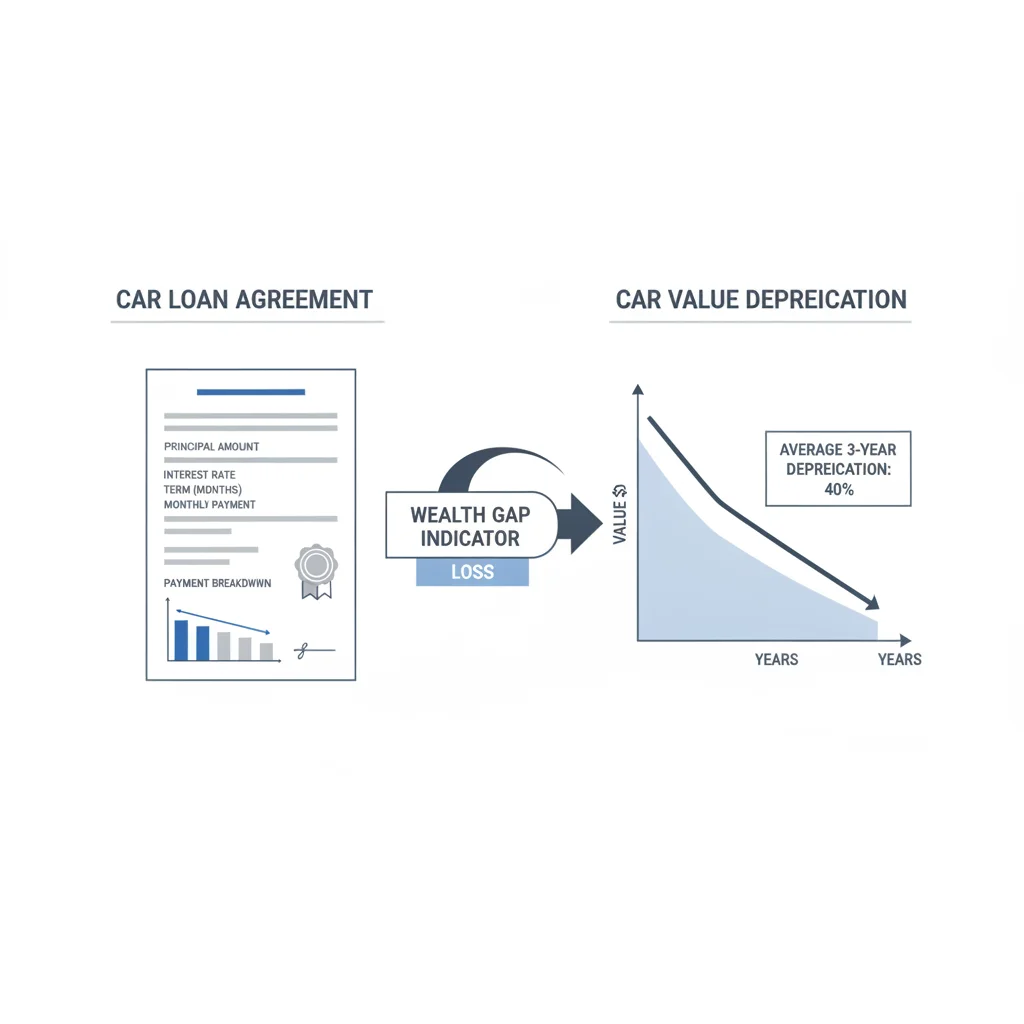
A new car loses roughly 15–25% of its value in its first 12 months. By year three, cumulative depreciation often reaches 40–50% of the original MSRP. After that, the pace slows considerably. This front-loaded loss is the core reason GAP risk is concentrated in the early years of a loan.
Loan Amortization: Slow at First, Then Faster
A standard auto loan is amortized so that early payments are heavily weighted toward interest. On a $35,000 loan at 7% interest over 60 months, you'll pay roughly $175 in principal and $204 in interest in your very first payment. It takes years before your principal paydown starts accelerating meaningfully.
20%
Average new-car value lost in year one
Edmunds and industry depreciation data consistently show new vehicles losing 15–25% of MSRP in the first 12 months of ownership.
44%
New-car buyers financing with little or no down payment
Experian's State of the Automotive Finance Market report shows a significant share of buyers financing 90–100% of vehicle purchase price.
$3,300
Median negative equity on trade-ins
According to Edmunds data, buyers trading in financed vehicles frequently carry thousands in negative equity rolled into the new loan.
84 months
Maximum common loan term offered today
Seven-year auto loans have become increasingly common, dramatically extending the window during which borrowers remain underwater.
3x
Typical dealer GAP markup over insurer GAP cost
Consumer advocacy research and F&I industry data indicate dealership GAP premiums are often 200–300% above the cost of equivalent insurer-provided coverage.
Put these two curves together and the problem becomes clear: in the first 12–24 months of a typical new-car loan, your car's value is falling faster than your loan balance is shrinking. That's the gap. A strong down payment is the most direct way to close that gap before it opens.
For a deeper look at how depreciation mechanics drive this risk, see GAP insurance and depreciation.
Running the Numbers: Small vs. Large Down Payment
Abstract curves are easier to understand with a concrete example. Let's use a $35,000 new vehicle financed over 60 months at 7% APR.
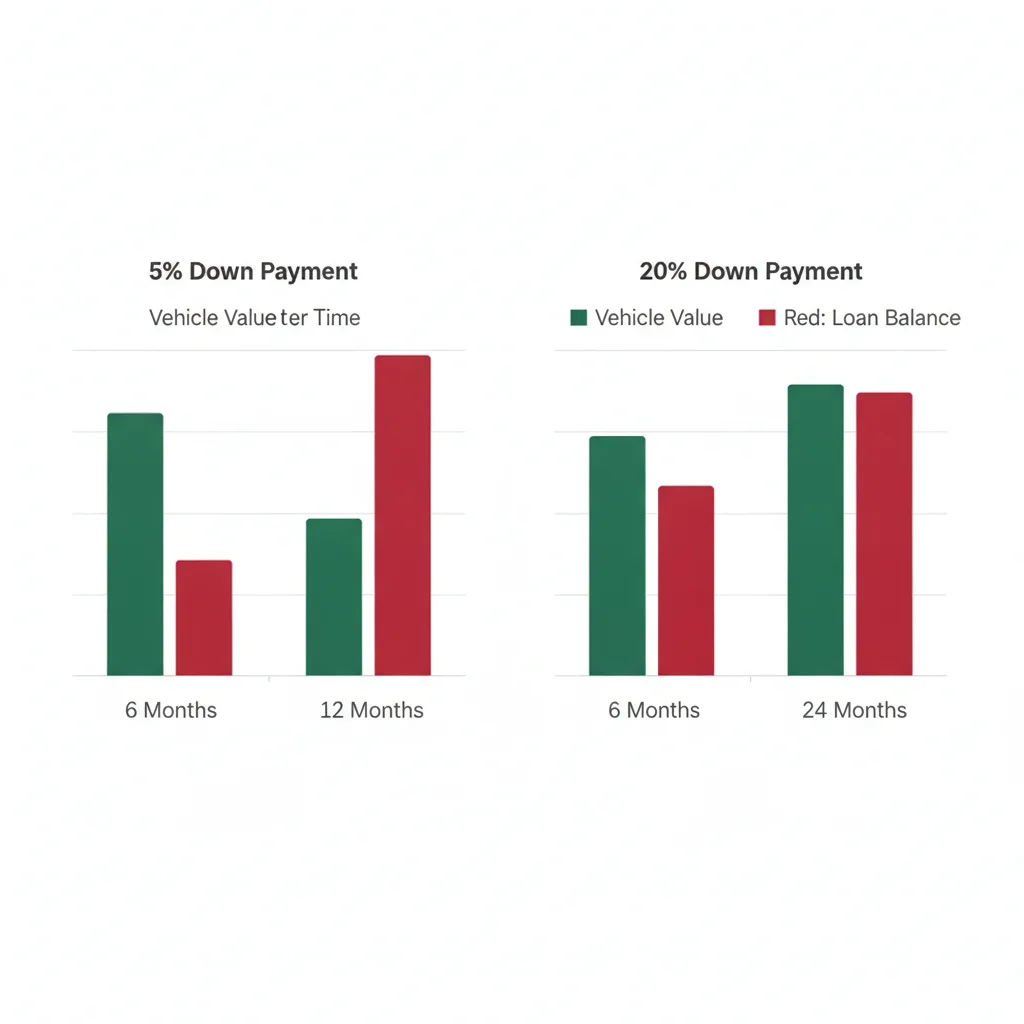
Scenario A: 5% Down ($1,750)
- Loan amount: $33,250
- After 12 months, loan balance: approximately $27,200
- Car's market value after 12 months (assuming 20% depreciation): approximately $28,000
- Equity position: +$800 — barely above water
- After 6 months, loan balance: approximately $30,100
- Car's value at 6 months (assuming 10% drop): approximately $31,500
- Equity position: +$1,400 — but a severe loss event early could still produce a gap
With only 5% down, you spend the first year walking a very thin line. One bad month of depreciation — or a vehicle that depreciates faster than average — pushes you underwater.
Scenario B: 20% Down ($7,000)
- Loan amount: $28,000
- After 12 months, loan balance: approximately $22,900
- Car's market value after 12 months: approximately $28,000
- Equity position: +$5,100 — comfortably above water
With 20% down, you absorb the first year of depreciation without ever going underwater. GAP insurance in this scenario provides little to no practical benefit.
“The down payment is the single most powerful lever a buyer controls at the time of purchase. It determines not just the monthly payment, but the entire risk profile of the loan for the next several years.”
— Greg McBride, Chief Financial Analyst, Bankrate
This is the core tradeoff: paying more upfront reduces your long-term risk and can eliminate the need for an ongoing insurance product. For a full breakdown of how loan term length compounds this effect, see how loan terms and down payments affect GAP necessity.
When GAP Insurance Is Worth the Cost
GAP coverage isn't always necessary, but there are financing situations where skipping it would be genuinely risky.
Situations That Create High GAP Exposure
- Less than 10% down on a new vehicle: You start the loan underwater almost immediately after driving off the lot.
- Loan terms of 72 or 84 months: Extended terms mean slower principal paydown, stretching the underwater window by 12–24 additional months.
- High-depreciation vehicles: Certain brands and segments — luxury cars, some domestic trucks, and EVs experiencing market corrections — depreciate faster than average.
- Rolled-in negative equity: If you traded in a car you owed more on than it was worth and rolled that balance into the new loan, your starting loan balance is already above the purchase price.
Check Your Loan Amortization Schedule Early
Ask your lender for a full amortization table before you sign. It shows exactly how much of each payment goes to principal versus interest and lets you project when your balance will fall below market value. Many buyers are surprised by how slowly equity builds in the first 12 months.
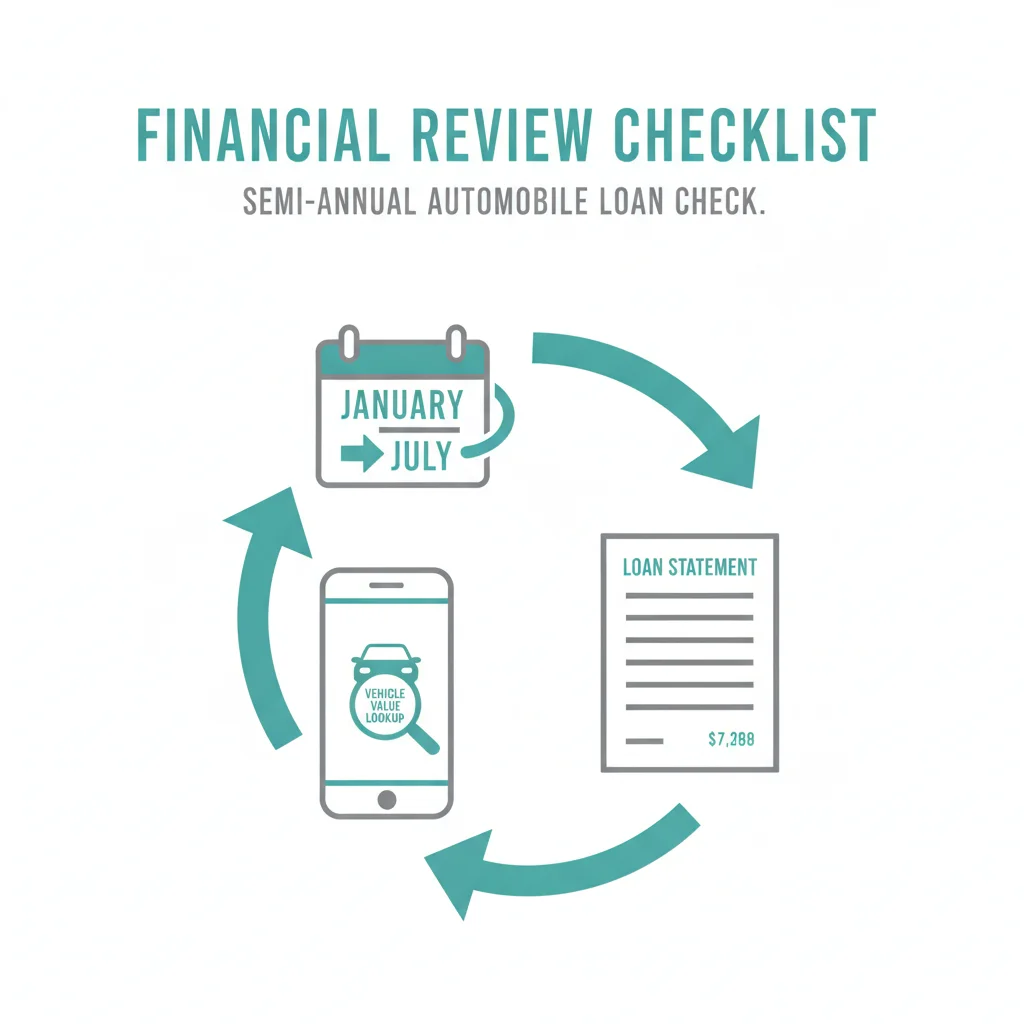
Set a Recurring Calendar Reminder
Put a reminder every six months to check your loan payoff quote against your car's current KBB or NADA value. The moment you have positive equity, GAP coverage is no longer serving you. Cancelling it promptly — especially a dealer policy with a prorated refund clause — puts money back in your pocket.
Situations Where GAP Is Less Critical
- You put 20% or more down on a vehicle with moderate depreciation.
- You're financing a used vehicle where depreciation has already occurred.
- Your loan term is 36–48 months and you're halfway through it.
- Your loan balance is already at or below the car's Kelley Blue Book or NADA value.
See when you actually need GAP insurance for a comprehensive breakdown of coverage triggers and exclusions.
The True Cost Calculation: Down Payment vs. GAP Premium
Buyers sometimes avoid a larger down payment to preserve cash, then end up spending money on GAP insurance for two or three years. It's worth doing the math on whether that tradeoff makes sense.
Cost of Carrying GAP for 24 Months
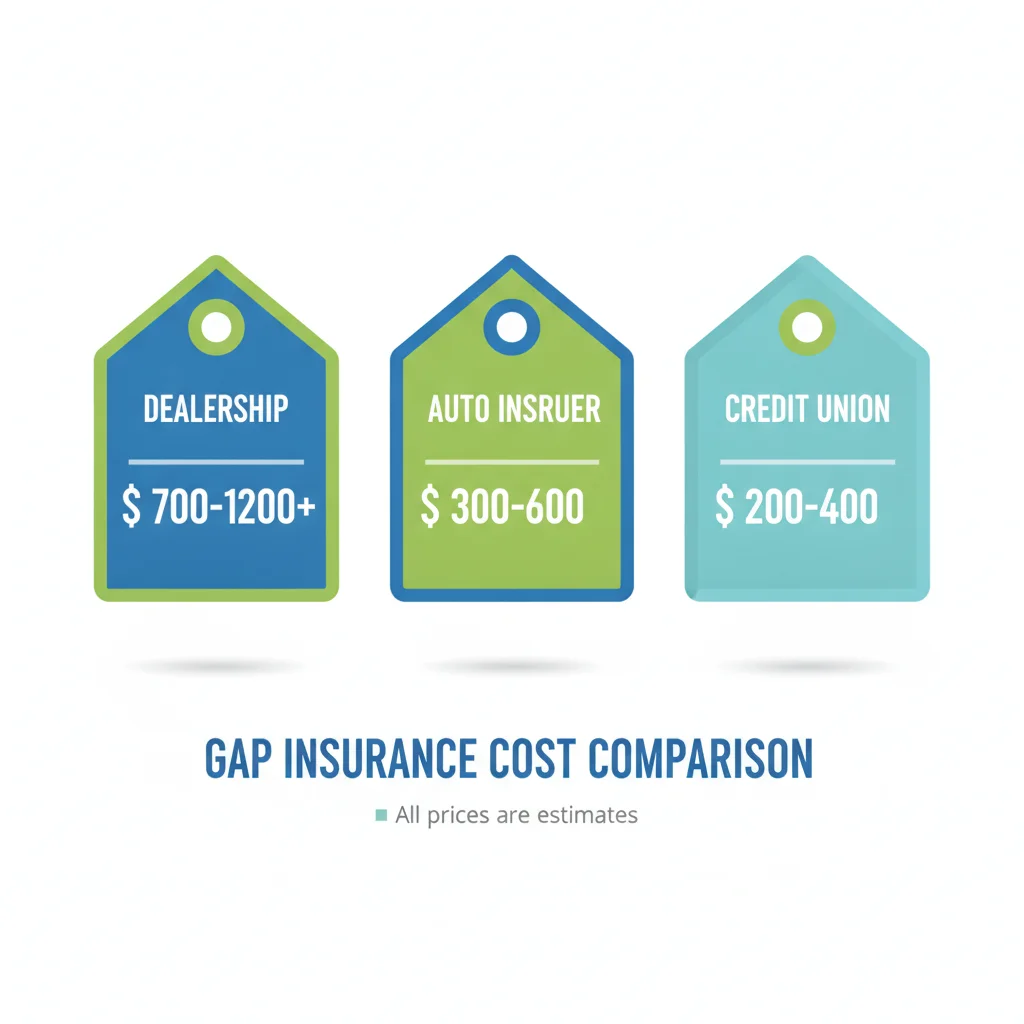
- Dealer-financed GAP: Typically $400–$900, rolled into the loan, meaning you pay interest on it. At 7% APR over 60 months, a $700 dealer GAP add-on costs you roughly $800 in total after interest.
- Insurer-added GAP: Roughly $20–$40/year added to your policy. Over 24 months, that's $40–$80 total — a significant difference.
What That Extra Down Payment Does for You
An extra $3,000 in down payment on a $35,000 vehicle at 7% APR over 60 months saves you approximately $350 in total interest over the life of the loan and eliminates the need for GAP coverage entirely. That's a combined benefit of $750–$1,150 depending on where you would have purchased GAP.
The math generally favors putting more money down — but only if doing so doesn't drain your emergency fund or leave you cash-poor. A strong down payment and no emergency savings is a different kind of financial risk.
If you're reviewing what you've already agreed to in a finance contract, see GAP insurance in the finance contract for details on what those terms actually mean and whether you can remove or renegotiate the coverage.
How to Monitor Your Gap Exposure Over Time
Even if you start out needing GAP coverage, you won't need it forever. Knowing when you've crossed from underwater to above water lets you cancel coverage you're no longer getting value from.
A Simple 6-Month Check
- Pull your current loan payoff quote from your lender (this is the exact amount needed to close out the loan today).
- Look up your car's current market value using Kelley Blue Book or NADA Guides. Use the 'private party' or 'trade-in' value — not the retail price.
- Subtract the loan payoff from the market value. If the result is positive, you have equity and no longer need GAP coverage.
- If it's negative, you're still underwater and GAP remains relevant.
Check Your Loan Amortization Schedule Early
Ask your lender for a full amortization table before you sign. It shows exactly how much of each payment goes to principal versus interest and lets you project when your balance will fall below market value. Many buyers are surprised by how slowly equity builds in the first 12 months.
Set a Recurring Calendar Reminder
Put a reminder every six months to check your loan payoff quote against your car's current KBB or NADA value. The moment you have positive equity, GAP coverage is no longer serving you. Cancelling it promptly — especially a dealer policy with a prorated refund clause — puts money back in your pocket.
Many buyers set a calendar reminder every six months to do this quick check. The crossover point — when equity turns positive — often happens around months 18–30 for buyers who put less than 10% down on a 60-month loan.
Also check whether your GAP policy has a cancellation provision. Dealer-sold GAP is almost always cancellable with a prorated refund. Insurer-added GAP can simply be removed from your policy at renewal or mid-term. Don't pay for protection you no longer need.
For guidance on how your collision and comprehensive policies interact with GAP at the time of a claim, see how GAP and physical damage coverage work together.
Buying GAP Smartly: Avoiding the Dealership Markup
If you've determined that GAP coverage makes sense given your down payment and loan structure, the next question is where to buy it. This matters because the price difference between sources is substantial.
Three Ways to Buy GAP
- 1. Through the dealership (F&I office)
- Convenient but expensive. Markup over cost is often 200–300%. The premium is typically rolled into your loan, meaning you pay interest on it. You may also be pressured to buy it whether or not you need it.
- 2. Through your auto insurer
- The most cost-effective option for most buyers. Typically added as a rider to your existing comprehensive coverage for $20–$40 annually. Requires that you carry both collision and comprehensive on the vehicle.
- 3. Through a credit union or bank
- Some lenders offer GAP as part of their loan package at a flat fee of $150–$300. This sits between the two extremes in cost and is worth asking about before you sign at the dealership.
For a full breakdown of the dealership pitch and how to evaluate it critically, see why dealers push GAP insurance. And if you're considering optional add-ons more broadly, the optional add-ons coverage hub is a useful reference point.
GAP Doesn't Cover Every Shortfall
GAP insurance covers the difference between your loan payoff and your insurer's actual cash value payout — but it doesn't cover your deductible, missed payments, late fees, or any amounts rolled into your loan for extended warranties or other add-ons. Read the policy terms carefully to understand exactly what qualifies as a covered loss.
Used Cars and GAP: A Different Calculation
GAP is primarily designed for new vehicles, where early depreciation is steepest. Used cars have already absorbed the biggest depreciation hits, so the risk window is narrower. That said, if you're financing a used car with very little down on a long loan term, some gap exposure can still exist — especially on vehicles that depreciate unusually fast in their second or third year.
Dealership GAP Can Be Cancelled
If you already signed for dealer GAP and later decide you don't need it — or want to switch to a cheaper insurer-provided policy — you can typically cancel within the first 30 days for a full refund, or anytime after that for a prorated refund. Check your contract for the exact cancellation terms and contact the F&I department in writing.

All claims are backed by peer-reviewed research. Sources on request.