Key Takeaways
Dealer Rate Markup
Dealer rate markup — also called the "dealer reserve" or "interest rate participation" — is the practice of a dealership raising the interest rate on your auto loan above the rate the lender actually approved you for. The dealer pockets the difference between what you pay and what the lender requires. You never see the lender's original rate, so the markup is invisible unless you know to look for it.
Lenders communicate the minimum acceptable rate (the "buy rate") to dealers via a rate sheet. Dealers are typically permitted to mark that rate up by 1–3 percentage points, though some lenders cap the spread; others do not.
How the Dealer Rate Markup Actually Works
When you finance a car through a dealership, the dealer doesn't lend you the money — a bank, credit union, or captive finance company (like Toyota Financial Services or Ford Motor Credit) does. The dealer submits your credit application to one or more of those lenders, who respond with an approval at a specific interest rate. That rate — the minimum the lender will accept — is called the buy rate.
Here's where the markup enters: the lender also tells the dealer the maximum rate they can charge you. Anything between the buy rate and that ceiling is the dealer's to keep. If the lender approves you at 5.9% and the dealer writes your contract at 7.9%, the extra 2% flows back to the dealer as compensation — called dealer reserve — typically paid out monthly as the loan is repaid.
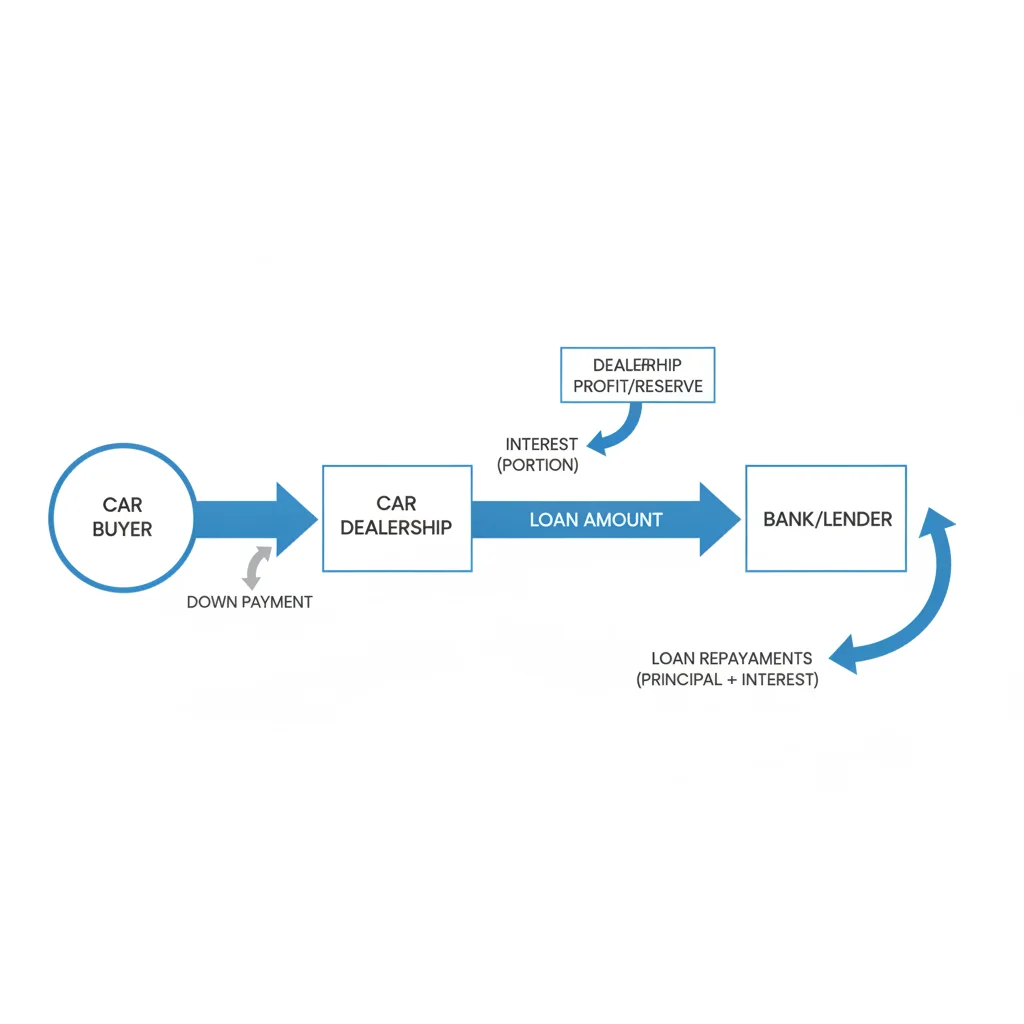
This arrangement exists because dealers function as loan originators. They do the paperwork, handle underwriting submissions, and take some risk if a deal falls apart. Lenders compensate them for that service. The problem is the structure creates a direct financial incentive for the finance manager to charge you the highest rate you'll accept, not the lowest rate you qualify for.
For a clear picture of how this fits into the broader deal structure, see how dealers structure a car deal. Rate is one of four levers they track — and it's the one most buyers focus on least.
Dealer Reserve Is Not the Same as Origination Fees
Dealer reserve is paid by the lender to the dealer out of the interest spread — it doesn't appear as a line item on your contract. Origination fees, by contrast, are explicit charges added to the loan balance or closing costs. Both can cost you money, but they work differently. Dealer reserve is invisible in the contract; your only clue is a rate higher than your credit profile warrants.
Fair-Lending Rules Still Apply
Even where rate markup is legal, the Equal Credit Opportunity Act prohibits lenders and dealers from charging different rates based on race, national origin, sex, or other protected characteristics. If you believe you were charged a higher rate than similarly qualified buyers due to a protected characteristic, you can file a complaint with the CFPB at consumerfinance.gov or contact your state attorney general's office.
The Real Cost in Dollars
Abstract percentages are easy to dismiss. Real numbers are not. Here's what a dealer markup actually costs on a typical loan:
| Loan Amount | Term | Buy Rate | Marked-Up Rate | Extra Interest Paid |
|---|---|---|---|---|
| $35,000 | 60 months | 5.9% | 7.9% | $1,847 |
| $35,000 | 72 months | 5.9% | 7.9% | $2,241 |
| $50,000 | 72 months | 6.5% | 8.5% | $3,720 |
That extra interest goes entirely to the dealership — not toward your vehicle, not toward GAP coverage, not toward anything of value to you. It's pure margin, collected invisibly over the life of the loan.
2.5%
Typical maximum dealer rate markup
Most major indirect auto lenders allow dealers to mark up the buy rate by up to 2–2.5 percentage points above the lender's approved rate.
$1,847
Extra interest on a 2-point markup
A 2 percentage point markup on a $35,000, 60-month loan at a base rate of 5.9% costs the borrower approximately $1,847 in additional interest over the loan term.
80%
New car buyers who use dealer financing
According to industry estimates, roughly 80% of new vehicle purchases involve some form of dealer-arranged financing, making rate markup exposure widespread.
The longer the loan term, the more damaging the markup. A 2-point spread on a 72-month loan costs nearly $400 more than the same spread on a 60-month loan. This is one reason finance managers often push extended terms — a longer loan amplifies the reserve income the dealer earns.
To understand how your credit score interacts with the rate you were quoted, read what's credit score vs. what's markup in your APR. Separating those two numbers is the key to knowing whether you're paying a fair rate.
“The single most powerful thing a car buyer can do before entering a dealership is walk in with a pre-approval letter. It changes the entire dynamic — you're no longer asking the dealer for financing, you're giving them a chance to beat what you already have.”
— Melinda Zabritski, Senior Director of Automotive Financial Solutions, Experian
How to Spot a Marked-Up Rate Before You Sign
You can't see the dealer's rate sheet — it's proprietary. But you don't need to. You need a reference point from outside the dealership. Here's how to build one:
Step 1: Get Pre-Approved Before You Shop
Contact your bank, credit union, or an online lender like LightStream or PenFed before you set foot in a dealership. Apply for a pre-approval at your actual loan amount and term. The rate they quote you is a real-world benchmark tied to your credit profile — it's close to what a lender would offer the dealer as a buy rate.
Step 2: Separate the Rate from the Monthly Payment
Finance managers are trained to anchor conversations around the monthly payment, not the rate. A 2-point markup on a $40,000 loan over 72 months raises your payment by roughly $40–$45 a month — easy to miss, easy to rationalize. Always ask: What is the APR on this contract? Get that number in writing before discussing terms further.

Step 3: Compare the Dealer's Rate to Your Pre-Approval
If the dealer's rate is within half a point of your pre-approval, dealer financing may be competitive or even better — especially if they're running a manufacturer incentive program. If the dealer's rate is a full point or more above your pre-approval, you're looking at a significant markup. Use your pre-approval as leverage: tell the finance manager you have outside financing at X% and ask them to beat it or match it.
Use Your Pre-Approval as a Floor
Hand the finance manager your pre-approval letter early in the conversation and ask them to beat it. You're not obligated to use it, but it reframes the negotiation — now they have to justify their rate rather than anchor the conversation at whatever number they choose to open with. Many dealers will match or beat a competitive pre-approval to keep the financing income in-house.
Negotiate Rate and Price Separately
Agree on the out-the-door vehicle price before you discuss financing. Once price is settled, move to the rate. Mixing the two lets the dealer shift profit between buckets — lowering the vehicle price while recouping it through a higher rate (or vice versa). Keeping them separate makes each negotiation cleaner and reduces hidden trade-offs.
Step 4: Watch for Rate Creep During F&I
The finance and insurance (F&I) office is where markups get buried. A finance manager may quote a higher rate as the baseline, then offer to "work on it" if you add products like GAP insurance or an extended warranty. The rate drop feels like a concession; it's often just returning margin they built in intentionally. Evaluate every add-on product on its own merits, independent of its effect on the rate.
When Dealer Financing Is Actually Worth It
Dealer rate markup isn't a reason to automatically reject dealership financing. In certain situations, the dealer's offer genuinely beats what you'd find at a bank.
Manufacturer subvented rates are the most obvious case. When an automaker offers 1.9% or 2.9% financing, that rate is subsidized — the manufacturer is buying down the rate to move inventory. The dealer typically earns a flat fee rather than a spread in these programs, and the rate is set. These offers are real and sometimes dramatically below market.
Captive finance arms — lenders owned by automakers — also occasionally have rate sheets that are more competitive than what regional banks offer, particularly for borrowers in the upper-middle credit tiers (scores in the 680–739 range) who might get penalized more at a traditional bank.
The full breakdown of when to choose dealer financing and when to stick with your own lender is covered in when dealer financing beats your bank. The short version: always have your own pre-approval ready, and let the two options compete.
Regulatory Context and Your Rights
Dealer rate markup operates in a complicated regulatory space. The CFPB examined the practice extensively around 2013 and issued guidance suggesting that discretionary markup policies — where dealers have uncapped latitude to raise rates — could produce fair-lending violations if protected classes were systematically charged higher markups than other borrowers. Several major lenders paid significant settlements as a result.
Some lenders responded by capping dealer spreads more tightly or switching to flat-fee dealer compensation. Others did not change their policies materially. The regulatory environment has shifted with changes in CFPB leadership, and active enforcement has varied.
What this means practically: you have no federally guaranteed right to see the buy rate. You do have the right to the full APR on your contract under the Truth in Lending Act (TILA), and that APR must be disclosed in writing before you sign. The gap between that disclosed APR and what you would have qualified for at a bank is where markup lives.
If you suspect you were charged a higher rate due to your race, national origin, or another protected characteristic, you can file a complaint with the CFPB or your state attorney general's office. The Equal Credit Opportunity Act (ECOA) applies to auto lending.
Dealer Reserve Is Not the Same as Origination Fees
Dealer reserve is paid by the lender to the dealer out of the interest spread — it doesn't appear as a line item on your contract. Origination fees, by contrast, are explicit charges added to the loan balance or closing costs. Both can cost you money, but they work differently. Dealer reserve is invisible in the contract; your only clue is a rate higher than your credit profile warrants.
Fair-Lending Rules Still Apply
Even where rate markup is legal, the Equal Credit Opportunity Act prohibits lenders and dealers from charging different rates based on race, national origin, sex, or other protected characteristics. If you believe you were charged a higher rate than similarly qualified buyers due to a protected characteristic, you can file a complaint with the CFPB at consumerfinance.gov or contact your state attorney general's office.
For a broader look at dealer profit mechanisms — including the ones that don't involve the interest rate at all — see dealer holdback and hidden profit margins. Rate markup is just one layer of a multi-layer deal.
The Bottom Line: How to Protect Yourself
The finance office is where significant money changes hands quietly. A 2-point markup on a five-year loan isn't a minor rounding error — it's $1,500 to $2,000 out of your pocket. The mechanics of that transfer are legal, common, and largely invisible unless you come prepared.
Here's the short list of what actually works:
- Get pre-approved before you visit any dealership. Your credit union is the best starting point — they typically offer competitive rates and have no incentive to mark them up.
- Know your credit score. Free scores from your card issuer or a monitoring service are close enough to ballpark what rate tier you're in.
- Always ask for the APR in writing before agreeing to any terms. Don't accept payment-only conversations.
- Treat rate and price as separate negotiations. Agree on vehicle price first, then move to financing. Bundling them makes markup easier to hide.
- Don't let F&I product pitches influence your rate decision. Evaluate GAP insurance, extended warranties, and other add-ons independently. On that note, read why dealers push GAP insurance before you're in that room.
Use Your Pre-Approval as a Floor
Hand the finance manager your pre-approval letter early in the conversation and ask them to beat it. You're not obligated to use it, but it reframes the negotiation — now they have to justify their rate rather than anchor the conversation at whatever number they choose to open with. Many dealers will match or beat a competitive pre-approval to keep the financing income in-house.
Negotiate Rate and Price Separately
Agree on the out-the-door vehicle price before you discuss financing. Once price is settled, move to the rate. Mixing the two lets the dealer shift profit between buckets — lowering the vehicle price while recouping it through a higher rate (or vice versa). Keeping them separate makes each negotiation cleaner and reduces hidden trade-offs.
One final point: if the dealer's rate is legitimately lower than your pre-approval — which does happen with manufacturer programs — take it. Pre-approval is a benchmark, not a commitment. Use it as a floor, and let the dealer beat it if they can. That's the system working in your favor.
For a deeper look at what advertised rates actually mean for subprime borrowers, see why the rate on the sticker isn't the rate you'll get.
All claims are backed by peer-reviewed research. Sources on request.