
| Most commonly purchased optional add-on | Roadside assistance (Insurance Information Institute, 2023) |
| Average annual cost of gap insurance (insurer) | $20–$40/year (NerdWallet Insurance Rate Analysis, 2024) |
| Average dealership gap insurance cost | $400–$900 (one-time) (Consumer Reports Auto Finance Guide, 2023) |
| Uninsured drivers on U.S. roads | ~12.6% (Insurance Research Council, 2022) |
| States where PIP is mandatory | 12 no-fault states (National Conference of State Legislatures, 2024) |
| Typical rental reimbursement daily limit | $30–$50/day (Industry standard policy range) |
| MBI availability restriction | Usually vehicles under 15,000 miles and less than 2 years old (GEICO MBI program terms, 2024) |
| Gap insurance recommended loan-to-value threshold | When you owe more than 80% of vehicle value (Consumer Financial Protection Bureau guidance) |
Why Optional Add-Ons Deserve a Closer Look
Standard auto insurance — liability, collision, and comprehensive — covers the basics. But between the dealership F&I office and your insurer's quote screen, you'll encounter a long list of optional coverages with names that sound either indispensable or redundant depending on who's selling them. The problem is that most drivers never get a plain-language explanation of what they're actually buying.
This glossary exists to fix that. Every major optional add-on is defined here in plain English, with a note on who benefits and who's paying for something they don't need. Use it as a reference before you sign anything — at the dealership, with your insurer, or when your renewal lands in your inbox.
If you want a side-by-side breakdown of costs and driver profiles, see our full optional coverage landscape guide. And if you're worried about add-ons buried in your purchase contract rather than your insurance policy, check out our guide on hidden add-ons in car contracts.
| Most commonly purchased optional add-on | Roadside assistance (Insurance Information Institute, 2023) |
| Average annual cost of gap insurance (insurer) | $20–$40/year (NerdWallet Insurance Rate Analysis, 2024) |
| Average dealership gap insurance cost | $400–$900 (one-time) (Consumer Reports Auto Finance Guide, 2023) |
| Uninsured drivers on U.S. roads | ~12.6% (Insurance Research Council, 2022) |
| States where PIP is mandatory | 12 no-fault states (National Conference of State Legislatures, 2024) |
| Typical rental reimbursement daily limit | $30–$50/day (Industry standard policy range) |
| MBI availability restriction | Usually vehicles under 15,000 miles and less than 2 years old (GEICO MBI program terms, 2024) |
| Gap insurance recommended loan-to-value threshold | When you owe more than 80% of vehicle value (Consumer Financial Protection Bureau guidance) |
Core Optional Coverage Glossary
These are the add-ons you're most likely to encounter — either offered by your insurer at purchase or pitched in the finance office when you're buying a vehicle.
Gap Insurance
Covers the difference between what you owe on your auto loan or lease and what your car is actually worth (its actual cash value) if the vehicle is totaled or stolen. Most relevant in the first few years of a loan when depreciation outpaces your payoff balance.
Mechanical Breakdown Insurance (MBI)
An optional endorsement that covers repair costs for mechanical failures not caused by an accident — similar to an extended warranty but issued by your insurer. Typically cheaper than dealership warranties and available for newer, lower-mileage vehicles.
Roadside Assistance
Covers services like towing, battery jump-starts, flat tire changes, lockout assistance, and fuel delivery when your vehicle breaks down. Often available through insurers, automakers, or membership clubs like AAA.
Rental Reimbursement
Pays for a rental car (up to a daily and total limit) while your vehicle is being repaired after a covered claim. Does not cover rentals for non-claim reasons such as routine maintenance.
Agreed Value Coverage
A policy structure where you and your insurer agree on the car's value upfront; that agreed amount is paid out in a total loss without depreciation adjustments. Most commonly used for classic cars, collectibles, or heavily modified vehicles.
Custom Parts and Equipment (CPE)
An endorsement that extends coverage to aftermarket modifications, accessories, or custom equipment not included in the vehicle's original factory specs. Standard policies typically cap or exclude these items entirely.
Accident Forgiveness
An endorsement that prevents your premium from increasing after your first at-fault accident. Eligibility requirements and availability vary by insurer; some offer it as a reward for a clean driving record.
New Car Replacement
If your new vehicle is totaled, this coverage pays for a brand-new equivalent model rather than the depreciated actual cash value. Most policies limit this benefit to the first one to two years of ownership.
Rideshare Insurance
An endorsement that fills the coverage gap that exists when a rideshare app is active but no ride has been accepted yet. Neither personal auto policies nor rideshare companies typically cover this window without this add-on.
Uninsured/Underinsured Motorist (UM/UIM)
Protects you when an at-fault driver has no insurance or insufficient coverage to pay your damages. Mandatory in some states; optional in others — and strongly recommended given how many uninsured drivers operate on U.S. roads.
Medical Payments Coverage (MedPay)
Pays medical expenses for you and your passengers after an accident regardless of who was at fault. It works alongside health insurance and can cover deductibles and co-pays that health plans don't immediately absorb.
Personal Injury Protection (PIP)
Covers medical bills, lost wages, and related expenses for you and passengers after an accident, regardless of fault. Required in no-fault states and broader in scope than MedPay, though the two serve similar functions.
A Quick Word on Deductibles and These Add-Ons
Many optional coverages come with their own deductible structures that are separate from your base collision or comprehensive deductible. Always ask specifically: "What is the deductible for this coverage, and does it stack with my existing deductible?" Some gap insurance products, for example, will cover your remaining loan balance minus whatever your primary insurer already pays — but won't cover your out-of-pocket deductible. That gap in the gap matters.
For a deeper look at how deductibles and endorsements interact across your full policy, see auto insurance policy terms drivers reference most often.
Gap Insurance: Dealer vs. Insurer — Price Difference Is Significant
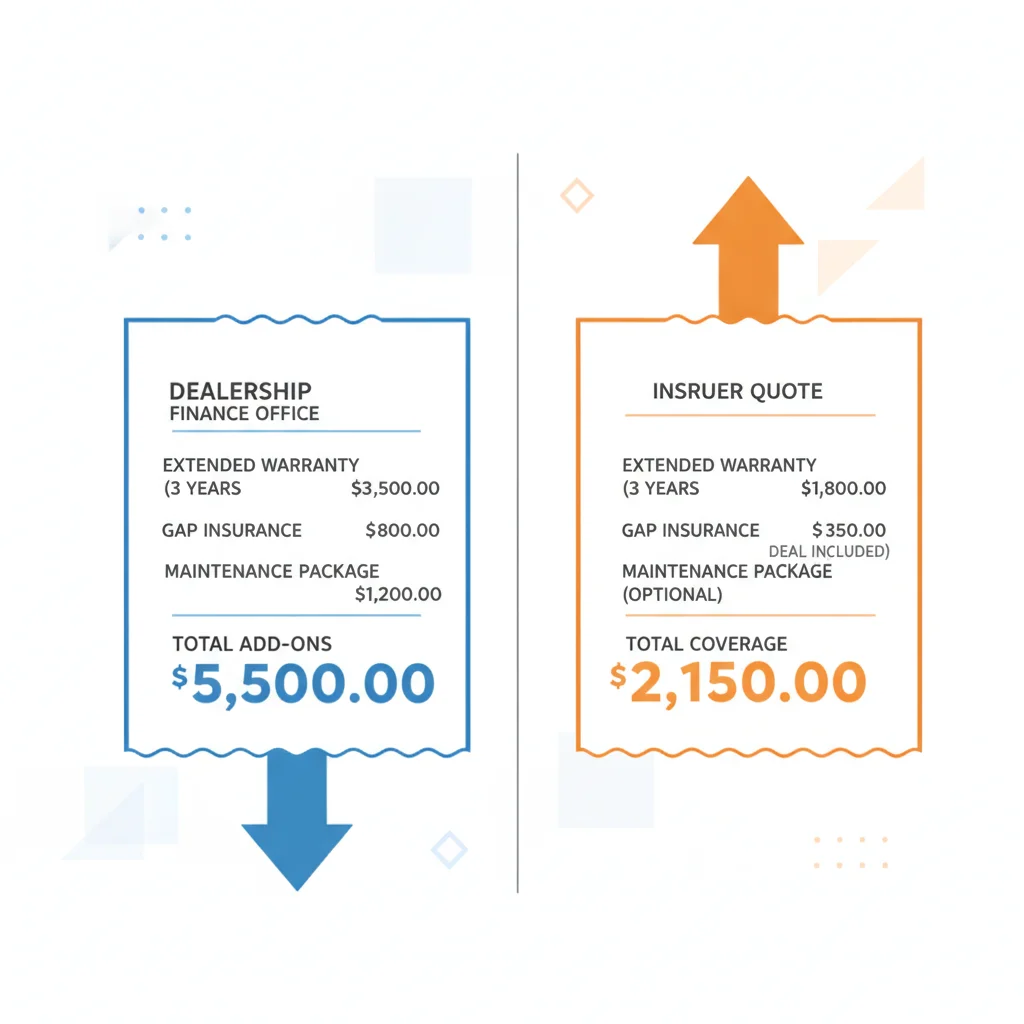
When a dealer's F&I office offers you gap insurance, the markup can be substantial — often $400 to $900 as a financed lump sum rolled into your loan. Your auto insurer typically offers the same protection for $20 to $40 per year, added directly to your policy. If you've already purchased gap through the dealer, check whether it's refundable — many are, prorated from the cancellation date.
Overlap With Health Insurance Is Real but Imperfect
MedPay and PIP both overlap with health insurance, which leads many drivers to skip them. However, health insurance typically doesn't cover lost wages, deductibles can be high, and billing coordination between your health plan and auto insurer can delay care. In a serious accident, having MedPay or PIP in place avoids that friction and pays out faster.
Timing Matters for New Car Replacement Coverage
New car replacement coverage typically only applies within the first one to two years of vehicle ownership and may require that you are the original owner. Check the specific terms — some policies limit it to the first 12 months, others to 24. After that window closes, the coverage either lapses or converts to a standard ACV payout, and you may be paying a premium for protection that no longer applies to your situation.
Stat Snapshot: How Drivers Actually Use Optional Coverage
Optional coverages aren't purchased equally. Some are near-universal for certain buyer profiles; others are marketed aggressively despite minimal claim rates. The numbers below put real context around the value conversation.
1 in 3
Drivers who filed a roadside assistance claim
According to a 2023 AAA survey, roughly one-third of U.S. drivers needed roadside assistance at least once in a 12-month period.
$3,300
Average gap between loan balance and ACV at total loss
Experian's 2023 State of the Automotive Finance Market report found average negative equity at total loss events exceeds $3,000 for newer-model vehicles.
42%
New car buyers who add gap insurance
A 2023 J.D. Power Finance Satisfaction Study found nearly half of financed new vehicle buyers purchased some form of gap protection.
$150–$300
Typical annual savings: insurer vs. dealer MBI
Independent rate comparisons consistently show mechanical breakdown insurance purchased through insurers costs significantly less than equivalent dealer-sold extended warranties.
68%
Rideshare drivers without proper coverage
A 2022 survey by The Zebra found the majority of gig drivers were unaware of the coverage gap during the app-on/no-ride-accepted window.
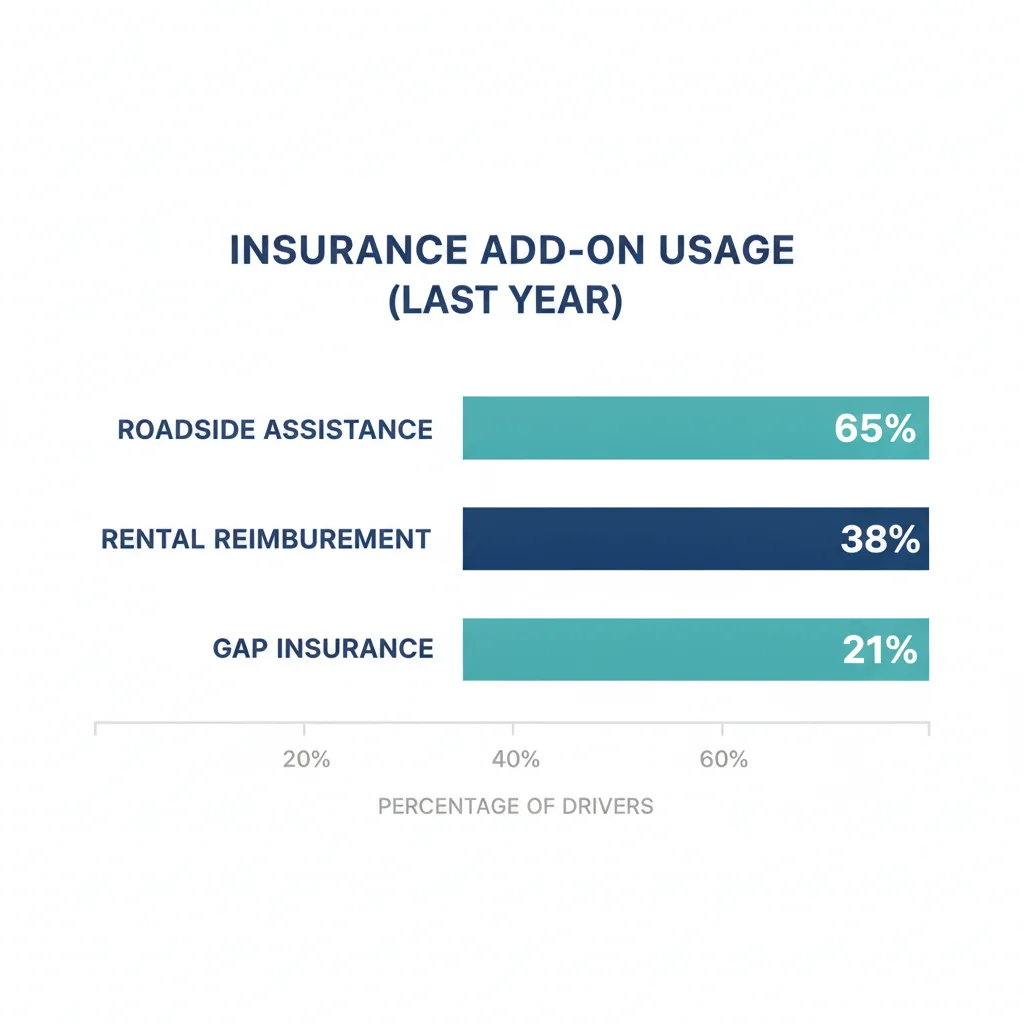
The roadside assistance and rental reimbursement numbers reveal an important truth: these coverages get used. They're not theoretical protection against a catastrophic event — they're practical tools that a significant portion of policyholders actually invoke. That's worth factoring in when your insurer offers them for $5–$15 per month.
On the other end of the spectrum, mechanical breakdown insurance and lease/loan gap coverage are worth scrutinizing carefully. The value depends almost entirely on your specific situation — vehicle age, loan-to-value ratio, and how long you plan to keep the car.
Less Common but Worth Knowing: Specialty Add-Ons
Agreed Value Coverage
Standard policies pay actual cash value (ACV) at the time of a loss — meaning depreciation is already baked in. Agreed value coverage locks in a specific dollar amount with your insurer upfront, and that's what you get paid if the car is totaled or stolen. This is most relevant for classic cars, collector vehicles, or modified builds where standard depreciation schedules bear no relationship to the vehicle's actual market value.
Custom Parts and Equipment (CPE) Coverage
If you've added aftermarket wheels, a custom sound system, a lift kit, or other non-factory modifications, your standard policy almost certainly won't cover them — or will cap the payout at a token amount. CPE coverage extends protection to those modifications up to a specified limit. Riders and enthusiasts who've invested in their vehicles often overlook this until they file a claim and discover the gap.
Rideshare Insurance
Driving for Uber or Lyft? Your personal auto policy doesn't cover you during the period when the app is on and you're waiting for a ride request — a coverage gap the rideshare companies' own policies also don't fully address. A rideshare endorsement fills that window. Without it, an at-fault accident while you're logged into the app could result in a denied claim on your personal policy.
Accident Forgiveness
This endorsement prevents your first at-fault accident from triggering a rate increase. It's not universal — not all insurers offer it, and many require you to be claim-free for a defined period before you're eligible. Whether it's worth paying for upfront depends on your driving record and how aggressively your insurer typically surcharges after a first incident. Run the math: if a first accident typically raises your premium by $400/year for three years, and accident forgiveness costs $80/year, the breakeven is obvious.
New Car Replacement
Related to gap insurance but distinct from it: instead of covering the difference between what you owe and what the car is worth, new car replacement pays for a brand-new equivalent vehicle if yours is totaled. This is most valuable in the first one to two years of ownership when depreciation is steepest. After that window, the cost-to-benefit ratio typically tilts against it.

For broader context on how these coverages interact with collision and comprehensive — the foundation they sit on — see our collision and comprehensive coverage hub.
Gap Insurance: Dealer vs. Insurer — Price Difference Is Significant
When a dealer's F&I office offers you gap insurance, the markup can be substantial — often $400 to $900 as a financed lump sum rolled into your loan. Your auto insurer typically offers the same protection for $20 to $40 per year, added directly to your policy. If you've already purchased gap through the dealer, check whether it's refundable — many are, prorated from the cancellation date.
Overlap With Health Insurance Is Real but Imperfect
MedPay and PIP both overlap with health insurance, which leads many drivers to skip them. However, health insurance typically doesn't cover lost wages, deductibles can be high, and billing coordination between your health plan and auto insurer can delay care. In a serious accident, having MedPay or PIP in place avoids that friction and pays out faster.
Timing Matters for New Car Replacement Coverage
New car replacement coverage typically only applies within the first one to two years of vehicle ownership and may require that you are the original owner. Check the specific terms — some policies limit it to the first 12 months, others to 24. After that window closes, the coverage either lapses or converts to a standard ACV payout, and you may be paying a premium for protection that no longer applies to your situation.
How to Decide Which Add-Ons Are Actually Worth It
The right set of optional coverages isn't the same for every driver. A person with a paid-off 12-year-old sedan has no business paying for gap insurance. A driver commuting 40 miles daily in a new financed vehicle probably should have roadside assistance and rental reimbursement. Here's a framework for the most common situations:
| Driver Situation | Add-Ons That Typically Make Sense | Add-Ons to Skip |
|---|---|---|
| New car, large loan balance | Gap insurance, new car replacement, roadside | Agreed value (not applicable to new cars) |
| Older paid-off vehicle | Roadside assistance, rental reimbursement | Gap, new car replacement, MBI |
| Leased vehicle | Gap (often required), lease-end protection | Custom parts/equipment (check lease terms first) |
| High-mileage daily driver | MBI (if newer), roadside assistance | Agreed value |
| Rideshare driver | Rideshare endorsement — non-negotiable | Accident forgiveness (high incident exposure) |
| Classic/collector car | Agreed value, CPE coverage | Standard ACV-based gap insurance |
One practical rule: if the annual premium for an add-on exceeds 10% of the benefit you'd receive in a likely claim scenario, reconsider it. That's not a hard cutoff, but it forces the mental exercise of estimating what you'd actually collect versus what you're paying in.
Before finalizing your coverage selections, it's also worth scanning available discounts — some bundle well with specific add-ons. Our insurance discounts hub covers options many drivers overlook.
And if you're still getting familiar with the core vocabulary that underpins all of these decisions, start with the auto insurance terms you need to know before comparing policies.

Optional Coverage Landscape Guide
A detailed breakdown of every major optional car insurance add-on — what it costs, what it covers, and which driver profiles benefit most. Pairs directly with this glossary.
Auto Insurance Claims Glossary
Definitions for every term you'll encounter when filing a claim, from adjuster and subrogation to proof of loss and salvage value. Essential reading before you need to use any coverage.
Liability Insurance Glossary
Plain-language definitions of liability coverage terms — indemnity, subrogation, split limits — that determine what your base policy actually protects against.
Insurance Discounts & Deals Hub
A curated look at the discounts most drivers overlook when purchasing auto insurance, including multi-policy, safe driver, and low-mileage options that can offset add-on costs.
Hidden Add-Ons in Car Contracts Guide
Learn to identify and remove dealership-side add-ons — paint protection, VIN etching, nitrogen fills — that appear quietly in purchase contracts before you sign.
Auto Insurance Policy Terms Reference
A quick-reference glossary of the most common terms found across auto insurance policies — from endorsements and exclusions to declarations pages and coverage limits.
Terms That Overlap With Liability Coverage
A few optional add-ons blur the line between liability coverage and supplemental protection. Understanding where liability ends and where these coverages pick up is essential to avoiding both gaps and redundancy in your policy.
Uninsured/Underinsured Motorist Coverage (UM/UIM)
Technically optional in many states (and mandatory in others), UM/UIM pays your expenses when the at-fault driver has no insurance or insufficient limits to cover your damages. It's one of the most undervalued coverages on this list — roughly 1 in 8 drivers on U.S. roads carries no insurance at all, and many others carry state-minimum limits that won't cover a serious injury.
Medical Payments Coverage (MedPay)
Covers medical expenses for you and your passengers regardless of fault — no liability determination required. In no-fault states, Personal Injury Protection (PIP) serves a similar function but usually comes with broader requirements. MedPay is optional in most states and is distinct from your health insurance, though the two can overlap. If your health insurance has a high deductible, MedPay can function as a useful buffer.
Personal Injury Protection (PIP)
Required in no-fault states, optional elsewhere. PIP covers medical bills, lost wages, and sometimes funeral expenses for you and your passengers after an accident, regardless of who caused it. The coverage limits vary significantly by state and policy. In states where it's optional, drivers with strong health insurance and disability coverage often find PIP redundant — but those without should evaluate it carefully.
For plain-language definitions of the liability-side terms that complement these coverages, see our liability insurance glossary. And if you want to understand how claims work once you've filed, the complete auto insurance claims glossary is a useful companion reference.

All claims are backed by peer-reviewed research. Sources on request.