
Key Takeaways
Why Add-Ons End Up in Your Contract Without a Conversation
You negotiated the price. You agreed on the trade-in value. You thought the hard part was over. Then you sit down in the finance office and a contract appears — already filled out — with a total that's several hundred dollars higher than expected.
This is one of the most common experiences car buyers report, and it has a straightforward explanation: dealership finance offices routinely pre-load contracts with optional add-ons before the buyer walks in the door. Some of these are disclosed verbally during the signing process. Many are not. The assumption, built into the workflow, is that a buyer who doesn't ask won't push back.
The finance manager's role at a dealership is to maximize back-end revenue — the profit generated after the vehicle sale. Add-ons are the primary tool for doing that. According to the National Automobile Dealers Association, finance and insurance products represent a significant share of dealership gross profit per vehicle. That's not inherently wrong, but it does mean the incentives in that office are not aligned with yours.
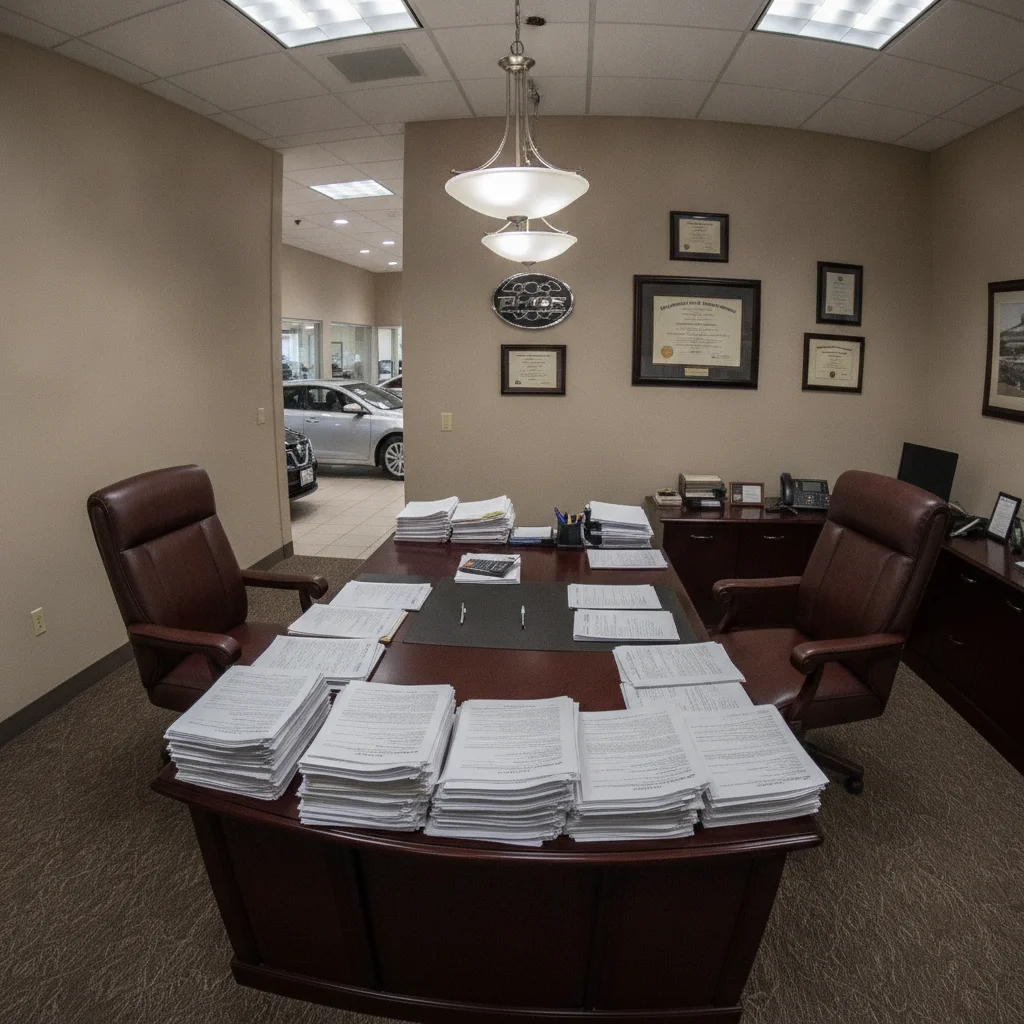
Understanding which add-ons appear most often, what they actually cost, and what language to look for in the contract puts you back in control of that transaction. The list below covers the items you're most likely to encounter — and what to do when you do.
Before you sign anything, it also helps to review this pre-purchase checklist for evaluating add-ons, which walks you through each category of optional coverage so you can decide what you actually need ahead of time.
Paint Protection Film or Sealant
This add-on goes by several names: paint protection film, clear bra, paint sealant, or ceramic coating. In a contract, you might see it listed as "PPF," "paint treatment," "exterior protection package," or simply "appearance package."
Dealerships typically charge between $200 and $1,500 for these products. The lower end usually refers to a spray-on sealant applied in the dealership's back lot — a product you could buy at an auto parts store for under $30. The higher end may involve a professionally installed film, which does have legitimate protective value, especially for high-gloss or darker paint colors.
How to spot it: Look for any line item referencing paint, exterior, appearance, or coating. If it wasn't discussed before you entered the finance office, it was added without your explicit consent.
What to do: Ask whether the product has already been applied to the vehicle. If it has, the dealer may not remove it, but you can often negotiate the charge down significantly or request documentation proving the work was done. If it hasn't been applied, request its removal from the contract outright.
For context on how this compares to similar upsells, this article on dealer add-ons that inflate your final bill walks through several of the same products with additional pricing context.
A spray-on paint sealant that costs dealers under $30 is routinely billed to buyers at $300 or more.
GAP Insurance
GAP stands for Guaranteed Asset Protection. It covers the difference between what you owe on your auto loan and what your car is actually worth if it's totaled or stolen. Because new cars depreciate quickly — sometimes by 15–20% the moment you drive off the lot — this gap can be significant in the first few years of ownership.
GAP insurance is a legitimate product. The problem is the price. Dealerships typically charge $400 to $900 for GAP coverage embedded in your financing contract. Your auto insurance provider or bank often offers the same protection for $20 to $40 per year, or as a one-time fee well under $100.
How to spot it: Watch for line items labeled "GAP," "debt cancellation," "loan/lease protection," or "guaranteed asset protection."
What to do: If you want GAP coverage — and for buyers financing more than 80% of a vehicle's value, it can make sense — decline it at the dealership and purchase it through your insurance carrier instead. Contact your insurer before your signing appointment so you already have a quote in hand.
[in_content_images:1]For a complete glossary of terms like GAP that appear across both auto loans and insurance products, see this plain-language glossary of optional car insurance add-ons.
GAP insurance sold at the dealership can cost ten times what the same coverage costs through your insurer.
Extended Warranty / Vehicle Service Contract
This is typically the highest-dollar add-on in any dealership contract. Extended warranties — more accurately called vehicle service contracts since they're not technically warranties under federal law — extend mechanical coverage beyond the manufacturer's included warranty period.
Prices range from $1,000 to $4,000 or more depending on the vehicle, coverage term, and deductible. They're almost always negotiable, and dealerships mark them up substantially from the cost they pay to the administrator who actually backs the contract.
How to spot it: Contract language includes terms like "VSC," "extended service agreement," "powertrain protection plan," "mechanical breakdown coverage," or the name of a third-party administrator (often a company you don't recognize).
What to do: First, check how long the manufacturer's warranty still has to run on the vehicle you're buying. For new cars, this can be three to five years with additional powertrain coverage — meaning you may not need extended coverage for years. If you do want a service contract, ask for the administrator's name, look up their reputation independently, and know that you can often purchase a contract later, before the factory warranty expires. Never let a finance manager imply the offer is only available at the time of purchase — that's a pressure tactic, not a policy.
Extended warranties are almost always negotiable — dealers mark them up significantly from actual cost.
VIN Etching
VIN etching involves engraving your vehicle's identification number onto the windows. The stated purpose is theft deterrence — the theory being that a thief will avoid a car whose parts are traceable. Some insurance companies offer a small discount for vehicles with VIN etching.
The product itself costs roughly $20 in materials and takes about 20 minutes to apply. Dealerships charge anywhere from $100 to $400 for it. In many cases, it's been pre-applied to the vehicle before you even take a test drive, meaning you're presented with a fait accompli during financing.
How to spot it: Look for "VIN etching," "window etching," "theft deterrent package," or "security engraving" in your contract line items.
What to do: If it's already on the vehicle, negotiate the charge. The cost should be well under $100 if you push back. If it hasn't been applied, remove it. You can purchase a DIY VIN etching kit for under $25 if you want the coverage — the process takes about half an hour and requires no special tools.
VIN etching kits cost under $25 at any auto parts store — the same service at a dealership runs up to $400.
Fabric and Interior Protection
Also sold as "Scotchgard," "interior protection package," "upholstery treatment," or "leather conditioning," this add-on claims to protect your seats, carpets, and interior surfaces against stains and wear. The application typically takes 15–30 minutes and involves spraying a commercial fabric protector throughout the cabin.
Dealer markup on this product is substantial. A $10 can of fabric protector becomes a $200–$500 line item. For leather interiors, the treatment may include a conditioner — still a $15–$30 product being billed at a significant premium.
How to spot it: Look for any line item referencing interior, fabric, upholstery, leather, or carpet protection.
What to do: Decline it. Apply a quality fabric protector yourself after purchase — products like Scotchgard or 303 Fabric Guard are widely available for under $20. If you're buying a vehicle with leather interior, a $15 bottle of leather conditioner applied twice a year does more long-term good than a single dealership treatment.
[in_content_images:2]Interior protection sprays that cost $10 retail are routinely bundled into contracts at $200 to $500.
Nitrogen-Filled Tires
You may have noticed some tire valve stems marked with green caps — that indicates nitrogen-filled tires. Nitrogen does maintain pressure slightly more consistently than regular air in extreme temperature fluctuations, which is why it's used in aircraft and racing. For everyday passenger vehicles on public roads, the practical difference is minimal.
Dealerships charge $50 to $200 for nitrogen fills at the time of purchase. The ongoing problem is that topping off nitrogen-filled tires requires a nitrogen source — which means you either return to the dealer for refills or you find a tire shop that offers the service. If you add regular air, you've negated most of the benefit anyway.
How to spot it: Look for "nitrogen fill," "N2 tire inflation," "tire protection," or "tire pressure maintenance" in the contract.
What to do: Decline it during negotiation. If it's already been done, it's not worth fighting over a $50–$100 charge — but it's a useful signal that the dealership is the type to pre-load contracts, which means you should scrutinize every other line item carefully.
Nitrogen-filled tires offer marginal benefits for everyday drivers and create an inconvenient dependency on nitrogen sources.
Roadside Assistance Programs
Roadside assistance is a genuinely useful service — but you may already have it through your auto insurance policy, your credit card, your cell phone carrier, or the vehicle manufacturer's included benefits. Paying for it a second time through a dealership contract means you're doubling up on coverage you don't need.
Dealer-branded roadside assistance programs typically cost $100 to $400 and are administered by third parties. Their coverage terms often aren't significantly better than what you already have.
How to spot it: Watch for "roadside assistance," "emergency road service," "towing protection," or third-party program names like "SafeGuard" or "DriveCare" in your contract.
What to do: Before your signing appointment, call your insurance carrier and ask whether roadside assistance is included in your current policy. Check your credit card benefits as well. If you're already covered, decline the dealer program entirely. If you're not covered and want it, purchasing through AAA or your insurer is typically more cost-effective. For details on how roadside assistance fits into the broader landscape of optional coverage, see the Optional Add-Ons hub.
Most buyers already have roadside assistance through insurance or a credit card — paying for it again is unnecessary.
Credit Insurance and Debt Protection Products
These products go by names like "credit life insurance," "credit disability insurance," "payment protection," or "involuntary unemployment protection." They're designed to make your loan payments if you die, become disabled, or lose your job.
On the surface, that sounds responsible. In practice, these products are notoriously expensive relative to their benefits, and their payout conditions are often more restrictive than they appear. A standard term life insurance policy typically provides far more coverage at a fraction of the cost. Credit disability products frequently contain waiting periods and exclusions that limit real-world usefulness.
How to spot it: Any line item referencing credit, payment protection, disability, life insurance, or unemployment coverage in the context of your loan.
What to do: Decline all of them. If your concern is what happens to your car payment in a financial emergency, that's a legitimate concern — but the answer is an emergency fund or a separate term life or disability policy, not a high-cost dealership product embedded in your loan. Also be aware: adding these products to your loan means you're paying interest on them for the life of the loan, which dramatically increases their actual cost.
[in_content_images:3]Credit insurance products embedded in loans accrue interest alongside your principal — their real cost is far higher than advertised.
Prepaid Maintenance Plans
A prepaid maintenance plan bundles future oil changes, tire rotations, and scheduled services into an upfront cost added to your contract. Dealerships present this as a convenience and a savings — but the math doesn't always work out in the buyer's favor.
Plans typically cost $500 to $1,500 and cover a set number of services over a specified period (often two to five years). The problem is that the services are priced at dealership rates, which are usually higher than independent shops. If you move, the plan may not transfer. If you sell the car early, the unused portion may or may not be refundable depending on the contract terms.
How to spot it: Look for "prepaid maintenance," "service plan," "maintenance agreement," "oil change package," or similar in the contract.
What to do: Calculate the math before accepting. Ask for a complete list of services included, how many times each is covered, and the per-service cost the plan is using in its pricing. Then compare to your actual dealership's service menu and to independent shop rates in your area. If the plan saves money only if you do every service at the dealership on their schedule, decide honestly whether that fits your habits. Many buyers find they don't use prepaid maintenance plans fully — which is exactly how dealers profit from them.
If you're also thinking about resale value and what maintenance investments actually pay off, see this guide to detailing and repair steps that deliver the best return.
Prepaid maintenance plans are only valuable if you use every included service — most buyers don't.
Dealer-Installed Accessories Listed at MSRP
This category is different from service products — it refers to physical items added to the vehicle that appear in the contract at retail pricing. Common examples include floor mats, cargo nets, wheel locks, door edge guards, splash guards, and window tint.
These items are often pre-installed before you see the car, which gives the finance manager a reason to say they can't be removed. That's sometimes true for permanently installed accessories, but the pricing is almost always negotiable.
How to spot it: Any physical accessory listed as a line item — often grouped under "dealer-installed accessories," "port-installed options," "dealer prep," or individual product names.
What to do: Ask for an itemized list of every accessory and its price. Cross-reference the price against what the same item costs from the manufacturer's online parts store or from a third-party supplier. Use any discrepancy as a negotiating point. If the item was installed at the port before the car reached the dealership — common for things like wheel locks and all-weather mats — ask whether the dealer can source the car without it, or whether they'll credit you toward a service appointment instead.
For a deeper look at which dealer extras are worth keeping and which to walk away from, this guide to dealer add-ons that sound essential but rarely are gives you a full breakdown by category.
Dealer-installed accessories are almost always priced at full retail — and that pricing is almost always negotiable.
How to Remove Add-Ons Before and After You Sign
Spotting an add-on is only half the job — you also need to know how to remove it without the process becoming an argument.
Before you sign
Ask the finance manager to print an itemized breakdown of every line item on the contract before you start reviewing. Compare that list against the agreed-upon selling price. Any line you didn't discuss during the sales negotiation is a candidate for removal. Simply say: "I'd like to remove from the contract." You don't need a reason. You're not required to accept any add-on as a condition of purchase — unless it's already physically installed on the vehicle, in which case ask whether the cost can be negotiated down.
Request the Contract in Advance
Many dealerships will email you a draft of the purchase contract before your signing appointment if you ask. Request it the day before and review every line item at home without time pressure. This single step eliminates most of the leverage the finance office relies on. If a dealer refuses to share a draft, that's useful information too.
Know Which Add-Ons Are Negotiable vs. Fixed
Physically installed items — like window tint or cargo liners — may be harder to remove from the contract but their price is still negotiable. Service products like extended warranties, GAP insurance, and maintenance plans are almost always negotiable on price and can typically be declined entirely. Don't let a finance manager frame any product as non-negotiable without pushing back.
After you sign
If you've already driven home and noticed unexpected charges on your paperwork, you may still have options. Many add-on products — particularly extended warranties, GAP insurance, and service contracts — can be canceled within a specified window (often 30 to 60 days) for a full or prorated refund. Check your contract for a cancellation clause, or call the product administrator directly. State lemon laws and consumer protection statutes in some states also provide additional recourse.
For a broader look at which of these products tend to deliver real value versus which are mostly dealer profit margin, see this honest breakdown of add-ons that pay off and ones that don't.
Cancellation Windows Vary by State and Product
If you've already signed a contract with add-ons you didn't want, check each product's cancellation terms immediately. Federal and state consumer protection laws in many jurisdictions provide buyers a right to cancel certain finance and insurance products within a defined window — often 30 days. The cancellation clause is usually buried in the product's addendum rather than the main contract. Call the product administrator directly rather than going through the dealership to avoid delays.
Some Add-Ons Are Required by the Lender — But Most Aren't
Dealers sometimes tell buyers that a specific add-on is required by the financing lender. This is rarely true. GAP insurance, extended warranties, and service contracts are almost never lender requirements. If a dealer claims otherwise, ask for written confirmation from the lender directly. The only product lenders genuinely require is comprehensive insurance on the vehicle itself — which is separate from anything sold in the finance office.
Financing Add-Ons Increases Their True Cost
When an add-on is rolled into your auto loan rather than paid upfront, you pay interest on that amount for the life of the loan. A $600 extended warranty financed at 7% over 60 months costs roughly $720 in total — before you've used a single dollar of coverage. This is one reason the actual cost of dealership add-ons is consistently higher than the sticker price suggests.
The goal isn't to reject every add-on automatically — it's to sign only for the ones you chose deliberately. That distinction is what separates a confident buyer from one who discovers a surprise charge on their first loan statement.

All claims are backed by peer-reviewed research. Sources on request.