
| Most common coverage types | Liability, Collision, Comprehensive, UM/UIM, PIP/MedPay (Insurance Information Institute, 2024) |
| Average annual auto premium (U.S.) | $2,150 (Bankrate, 2024) |
| States requiring uninsured motorist coverage | 22 states + D.C. (Insurance Information Institute, 2023) |
| Typical deductible range | $250 – $1,500 |
| Split limit format | Bodily injury per person / per accident / property damage |
| Endorsements commonly worth adding | Rental reimbursement, gap insurance, roadside assistance, new car replacement |
Why the Price Tag Is the Wrong Starting Point
Most drivers shop auto insurance the same way they shop for gas: find the lowest number and move on. That approach works fine for a commodity. Insurance isn't a commodity. Two quotes at the same monthly premium can deliver radically different protection depending on the limits, deductibles, exclusions, and endorsements buried in the policy language.
The goal of this guide is simple: give you the vocabulary to read a policy — not just a quote — so you can compare coverage quality, not sticker price. Every term defined here either directly controls how much money you'll receive after a claim or sets a condition that could result in a denial.
If you're about to switch carriers or buy your first policy, run through this reference before you sign. And when you're ready to act on it, the auto insurance comparison checklist walks you through applying these terms to a real side-by-side review.
| Most common coverage types | Liability, Collision, Comprehensive, UM/UIM, PIP/MedPay (Insurance Information Institute, 2024) |
| Average annual auto premium (U.S.) | $2,150 (Bankrate, 2024) |
| States requiring uninsured motorist coverage | 22 states + D.C. (Insurance Information Institute, 2023) |
| Typical deductible range | $250 – $1,500 |
| Split limit format | Bodily injury per person / per accident / property damage |
| Endorsements commonly worth adding | Rental reimbursement, gap insurance, roadside assistance, new car replacement |
The Core Coverage Types and What They Actually Cover
Before comparing limits and prices, you need a clear picture of what each coverage type does. They are not interchangeable, and most policies require you to select each one separately.
Liability Coverage
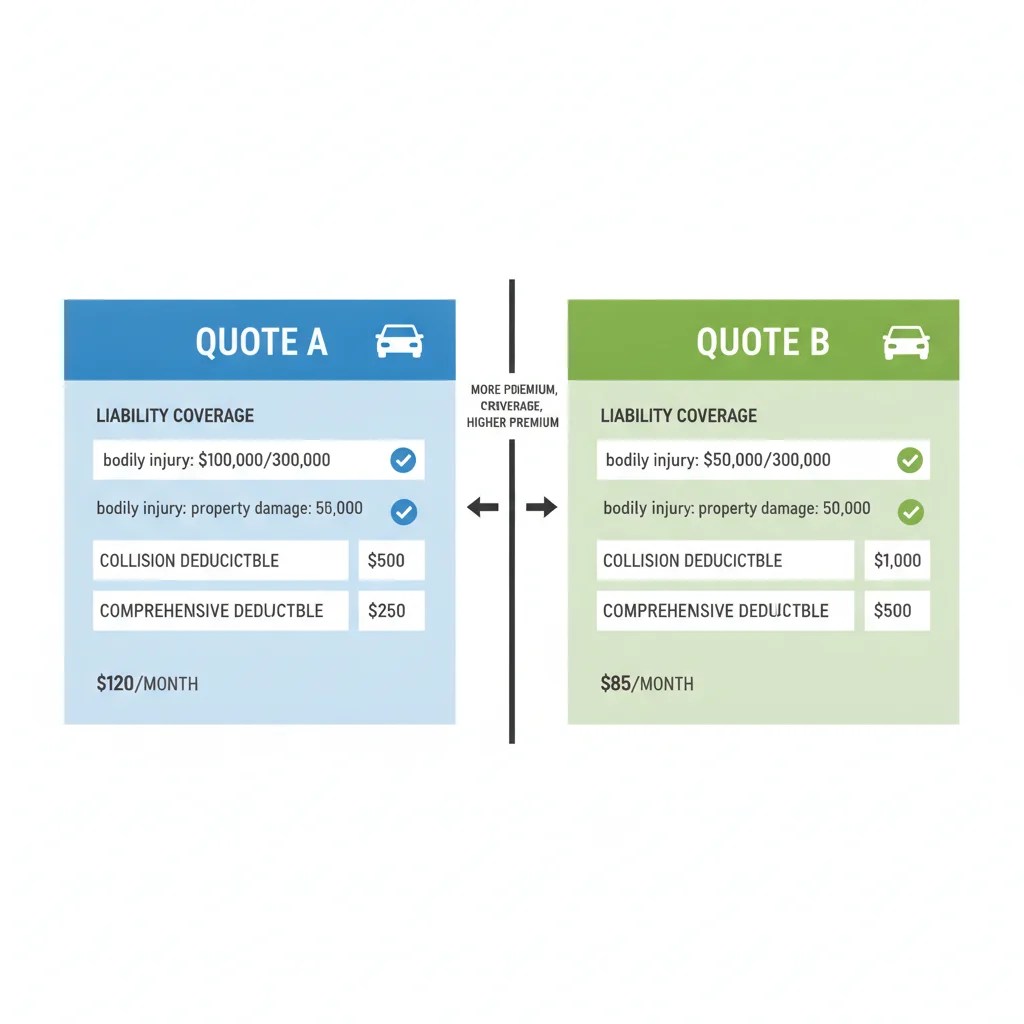
Liability is the foundation of virtually every auto policy and is legally required in almost every state. It pays for bodily injury and property damage you cause to other people. It does not pay for your injuries or your vehicle. You'll see it quoted in split limits — for example, 100/300/100 — which means $100,000 per injured person, $300,000 per accident total, and $100,000 for property damage. The liability insurance glossary breaks down split limits and related terms in full detail.
Collision and Comprehensive
Collision covers damage to your own vehicle from impact — hitting another car, a guardrail, or a pothole. Comprehensive covers everything else: theft, hail, fire, flooding, animal strikes. Both are optional on older vehicles but typically required by lenders if you're financing. Each carries its own deductible that you set when buying the policy.
Uninsured and Underinsured Motorist (UM/UIM)
With roughly one in eight drivers carrying no insurance, UM/UIM coverage is one of the most practically important coverages you can carry. If an uninsured driver hits you, this coverage steps in to pay your medical bills and sometimes vehicle damage — up to the limit you've selected. Underinsured coverage kicks in when the at-fault driver has insurance but not enough to cover your losses.
Personal Injury Protection (PIP) and Medical Payments (MedPay)
PIP covers your medical expenses and sometimes lost wages regardless of who caused the accident. It's mandatory in no-fault states. MedPay is a narrower version — medical bills only, no wage replacement — and is available in at-fault states as an optional add-on. Neither replaces health insurance, but both fill gaps when accident-related bills arrive fast.
State Minimums Are Rarely Enough
Every state sets a minimum required liability limit, but those floors were established decades ago and often don't reflect today's medical or repair costs. A serious accident can produce six-figure bills that blow past a 25/50/25 policy instantly. Treat minimums as a legal floor, not a coverage goal.
Bundling Discounts Don't Always Win
Bundling your auto and home policies with one insurer often unlocks a discount, but it isn't universally the cheapest route. Run standalone quotes and compare net costs before assuming bundling saves money. The <a href="/car-insurance/rates-and-savings/discounts-and-deals">discounts drivers overlook</a> aren't always the obvious ones.
Read the Exclusions Section First
Most drivers read the coverage summary and stop there. The exclusions section — typically buried in the middle of the policy — defines the boundaries of that coverage. Two policies can list identical coverage types but have meaningfully different exclusion language. Always read both.
Deductibles and Limits: The Two Numbers That Define Your Risk
Every covered claim is shaped by two numbers: your deductible and your coverage limit. Getting these wrong — either direction — is one of the most common and costly mistakes drivers make.

How Deductibles Work in Practice
Your deductible is the portion you absorb before the insurer pays. Choose a $500 deductible on collision, file a claim for $3,200 in damage, and you pay $500 while your insurer covers $2,700. The tradeoff: a higher deductible lowers your premium but increases what you owe after any loss. Before raising your deductible to save $20 a month, ask yourself whether you can comfortably cover that amount tomorrow if you need to.
Deductibles apply per claim — not per year. Two claims in a policy period mean you pay the deductible twice. Some policies offer a vanishing deductible endorsement that reduces your deductible incrementally for each claim-free year.
Coverage Limits and the Gap They Can Leave
A coverage limit is the ceiling on what your insurer will pay. If your bodily injury limit is $50,000 per person and you cause an accident that results in $180,000 in medical bills, you are personally liable for the remaining $130,000. That difference comes out of your pocket — or your assets. Carrying limits that match or exceed your net worth is the standard rule of thumb for liability coverage.
For comprehensive and collision, the limit is typically the actual cash value (ACV) of your vehicle — not the amount you paid for it or the balance of your loan. If you owe more than the ACV, gap insurance covers the difference. The optional add-ons glossary explains gap coverage and other endorsements in plain language.
1 in 8
Drivers on U.S. roads are uninsured
According to the Insurance Research Council's 2023 report on uninsured motorists.
40%
Of drivers don't understand their deductible
A 2023 J.D. Power auto insurance study found significant confusion around how deductibles apply at claim time.
$24,000+
Average bodily injury claim cost
Insurance Information Institute, 2023 — illustrating why minimum liability limits frequently fall short.
3x
More likely to be uninsured in certain zip codes
Urban and lower-income zip codes show significantly higher uninsured motorist rates, per the IRC 2023 data.
$900
Average savings from shopping policies annually
Drivers who compare quotes each renewal cycle save an average of $900 per year, per NerdWallet's 2024 analysis.
Exclusions and Endorsements: Where Policies Diverge
Two policies can list the same coverage types, carry the same limits, and still offer very different real-world protection. The difference lives in the exclusions and endorsements — the clauses that carve out or add to what the standard form covers.
What Exclusions Look Like and Why They Matter
An exclusion is a specific condition under which your insurer will not pay a claim, even for a covered event type. Common examples include:
- Damage occurring while using your personal vehicle for rideshare or delivery (without a rideshare endorsement)
- Mechanical failure or wear and tear — comprehensive does not cover a blown engine
- Intentional damage or fraud
- Racing or track use
- Using your vehicle outside of the covered territory (typically the U.S., Canada, and Mexico up to a certain distance)
Reading the exclusions section before buying is non-negotiable. For a thorough walkthrough, see what policy exclusions mean and how to spot them before you commit to any policy.
Endorsements That Are Often Worth Adding
An endorsement modifies your base policy. Some fill gaps created by exclusions; others add entirely new protections. The most commonly useful ones:
- Rideshare endorsement: Covers the gap between your personal policy and your rideshare company's commercial policy while you're logged into the app but haven't accepted a ride.
- Gap insurance: Pays the difference between what you owe on your loan and your vehicle's ACV if the car is totaled.
- New car replacement: Instead of ACV, your insurer replaces a totaled new vehicle with a comparable new one. Typically available for vehicles under two years old.
- Rental reimbursement: Covers a rental car while your vehicle is being repaired after a covered claim.
- Roadside assistance: Towing, flat tire, battery jump, lockout service — lower-cost than a standalone roadside plan for most drivers.
If you drive an EV, endorsements take on additional significance — battery replacement and OEM parts coverage are policy variables that don't exist for conventional vehicles. The EV insurance terms glossary covers those specifics.
Premium
The amount you pay — monthly, semi-annually, or annually — to keep your policy active. A lower premium doesn't automatically mean better value if coverage limits are also lower.
Deductible
The amount you pay out of pocket on a covered claim before your insurer pays the rest. A higher deductible typically lowers your premium but increases your financial exposure after an accident.
Coverage limit
The maximum dollar amount your insurer will pay for a covered loss. Limits are often expressed as split limits (e.g., 100/300/100) or a single combined single limit.
Exclusion
A specific situation, event, or type of damage that your policy explicitly does not cover. Exclusions are where many drivers are surprised at claim time.
Endorsement
An add-on or rider that modifies the standard policy — either expanding coverage, restricting it, or adjusting a term. Also called a 'rider' or 'floater' depending on the insurer.
Declarations Page
The summary sheet at the front of your policy that lists your name, vehicle, coverage types, limits, deductibles, and premium. It's the fastest way to compare two policies side by side.
Underwriting
The process an insurer uses to evaluate your risk profile and set your premium. Factors include driving history, credit score (in most states), vehicle type, and location.
Subrogation
Your insurer's legal right to pursue the at-fault party for reimbursement after paying your claim. This process typically happens behind the scenes and doesn't require action from you.
Liability Coverage
Coverage that pays for bodily injury and property damage you cause to others. It does not cover your own injuries or vehicle damage — that requires separate coverage types.
Comprehensive Coverage
Covers damage to your vehicle from non-collision events such as theft, fire, hail, flooding, or hitting an animal. Subject to your chosen deductible.
Collision Coverage
Covers damage to your vehicle resulting from a collision with another vehicle or object, regardless of who was at fault. Also subject to your deductible.
Uninsured Motorist Coverage
Pays for your injuries and sometimes property damage when you're hit by a driver who has no insurance or insufficient insurance to cover your losses.
Reading a Declarations Page in Under Five Minutes
The declarations page — often called the 'dec page' — is the single most useful document when comparing policies. It's the summary that sits at the front of your policy packet and lists every material fact about your coverage in one place.
What to Find on a Dec Page
| Section | What It Tells You |
|---|---|
| Named insured and vehicle | Confirms who and what is covered — check for accuracy |
| Policy period | The exact start and end dates of your coverage |
| Coverage summary | Lists each coverage type you've selected with its limit |
| Deductibles | Shows your elected deductible for collision and comprehensive |
| Premium breakdown | Line-item cost for each coverage type |
| Endorsements | Lists any add-ons attached to your policy |
| Discounts applied | Shows which discounts reduced your final premium |
When comparing two policies, put their dec pages side by side. Match each coverage type, then compare the limits and deductibles for each. A lower total premium that comes from lower limits or higher deductibles isn't a deal — it's a trade-off. You need to decide if that trade-off is intentional.
For a complete list of terms you'll encounter across standard policy documents, the auto insurance policy terms drivers reference most often is a useful companion reference. And once you've reviewed your dec page, the comparison checklist gives you the exact questions to ask before switching.
One more thing worth checking: the discounts column on the dec page. Many drivers carry policies with applicable discounts they never activated — safe driver, low mileage, bundling, good student. The discounts and deals hub covers the categories most commonly missed at purchase.
Auto Insurance Comparison Checklist
A structured checklist to audit coverage limits, exclusions, and claim service quality before switching insurers. Prevents costly coverage gaps.
Optional Car Insurance Add-Ons Glossary
Defines every major car insurance endorsement and add-on in plain language, from gap coverage to mechanical breakdown protection.
What Policy Exclusions Mean
A focused guide to spotting exclusions before you buy — the clauses that define where your coverage actually stops.
Liability Insurance Glossary
Decodes liability-specific terms like indemnity, subrogation, and split limits so you understand exactly what your liability section covers.
EV Insurance Terms Every Owner Should Know
EV policies carry unique language around battery endorsements, agreed value, and OEM parts clauses. This glossary covers what to watch for.
Putting It Together: A Smarter Comparison Framework
Shopping auto insurance intelligently comes down to four comparisons — run these for every quote you receive before making a decision.
- Match coverage types first. Make sure you're comparing the same categories: liability, collision, comprehensive, UM/UIM, PIP or MedPay. A quote missing one of these isn't cheaper — it's incomplete.
- Align limits exactly. Use the same liability split limits (or combined single limit) across all quotes. If one insurer defaults to 50/100/50 and another to 100/300/100, you're not comparing equivalent products.
- Set identical deductibles. Fix your collision and comprehensive deductibles at the same dollar amount across all quotes. This isolates pricing differences from coverage structure differences.
- Compare exclusion language. This step separates thorough shoppers from everyone else. Ask each insurer or read each policy for how rideshare use, custom equipment, or natural disaster events are handled. Small differences in exclusion language can have large consequences at claim time.
Once you've run that comparison, factor in the insurer's claim handling reputation. A policy that's $150 cheaper annually but backed by an insurer known for slow, contested claims is not necessarily the better value. Check AM Best financial strength ratings and state insurance department complaint ratios alongside your coverage comparison.
If you're purchasing alongside a car loan or lease, be aware that lenders typically require collision and comprehensive coverage — and sometimes set minimum deductible limits. The paperwork and contracts section covers how these requirements appear in financing documents.
The language in your auto insurance policy is the contract that governs what happens on your worst driving day. Understanding it before that day is the only leverage you have.

All claims are backed by peer-reviewed research. Sources on request.