
Why Liability Insurance Has Its Own Language
Liability insurance isn't complicated — but it does come with a vocabulary that can make a straightforward policy feel like a legal document. Terms like indemnity, subrogation, and tortfeasor appear routinely on policies and in claims conversations, yet they rarely come with a plain-English explanation attached.
This reference is designed to change that. Whether you're comparing quotes, reviewing your declarations page, or trying to make sense of a letter from an insurer, the definitions here will help you read with confidence rather than confusion. Think of it as the companion guide to your policy — the one your insurer probably should have given you.
If you're newer to auto insurance and want to understand how liability coverage fits into the bigger picture before diving into terminology, the complete introduction to liability coverage is a good place to start. For a broader look at policy language beyond liability — deductibles, exclusions, endorsements — this general auto insurance glossary covers the full picture.
The Building Blocks: Coverage Types and Limits
Every liability policy is built around two core coverage types. Understanding both — and how their limits are structured — is the foundation of reading any auto policy clearly.
Bodily Injury Liability (BI)
Bodily injury liability pays for physical harm you cause to another person in an at-fault accident. That includes their emergency care, ongoing medical treatment, lost income while they recover, and compensation for pain and suffering. If the injured party sues you, your BI coverage also funds your legal defense through the insurer's duty to defend.
Property Damage Liability (PD)
Property damage liability pays for damage you cause to someone else's property — most often their vehicle, but also structures like fences, walls, or storefronts. It does not cover your own car. For that, you'd need collision coverage.
Split Limits vs. Combined Single Limit
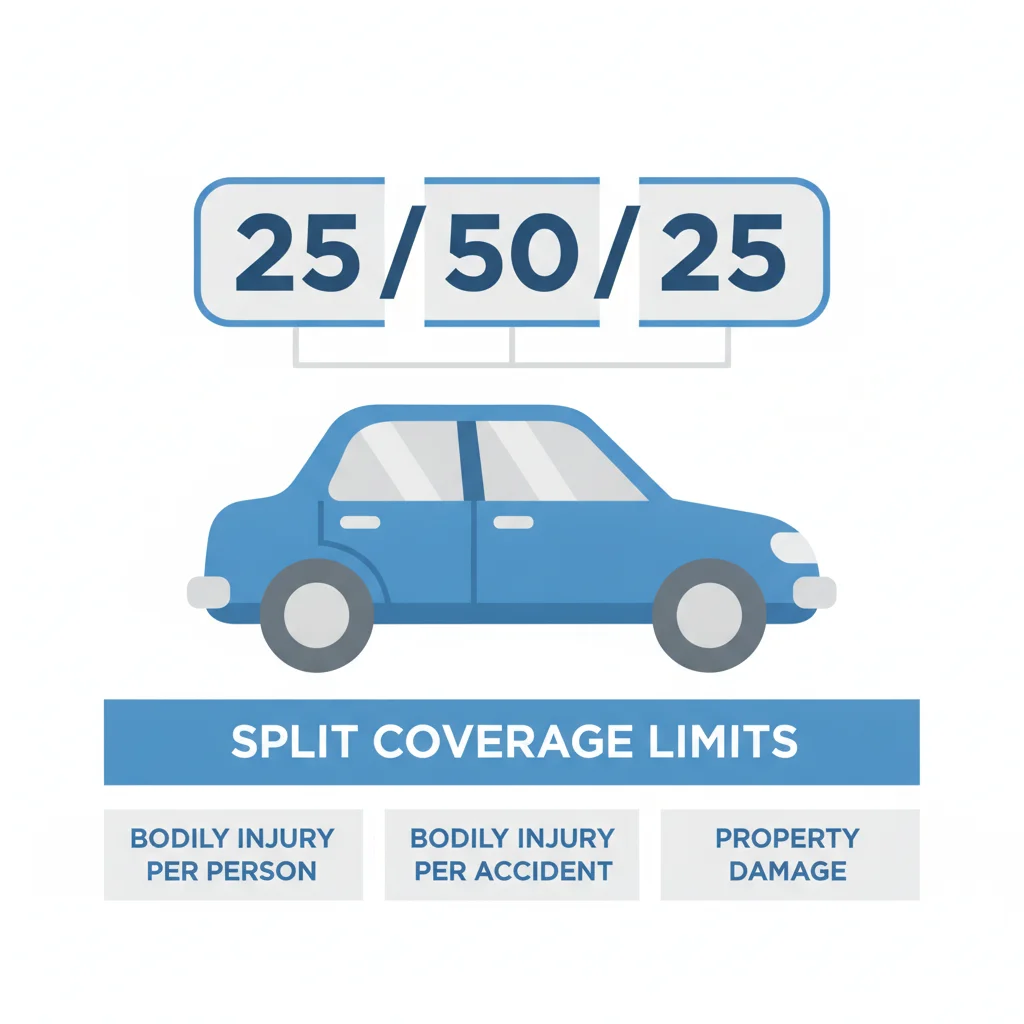
These terms describe how your coverage maximum is structured. With split limits, you have three separate caps: a per-person bodily injury limit, a per-accident bodily injury limit, and a per-accident property damage limit. A policy written as 100/300/100 means up to $100,000 per injured person, $300,000 total for all bodily injuries in one accident, and $100,000 for property damage.
A combined single limit (CSL) policy gives you one pooled amount — say, $500,000 — that can be applied across bodily injury and property damage in whatever proportion the accident requires. CSL policies are often used in commercial auto coverage but appear in personal policies as well.
State Minimums Are a Floor, Not a Recommendation
Every state sets minimum liability limits that drivers must carry, but these numbers are often far below what a single serious accident can cost. A bodily injury claim involving hospitalization, surgery, and lost wages can easily reach six figures. Choosing limits that reflect real-world costs — not just legal minimums — is one of the most important decisions you'll make when buying a policy.
Liability Coverage Protects Others, Not You
A common source of confusion is expecting liability insurance to pay for your own injuries or vehicle damage. It does not. Liability coverage is specifically designed to compensate the other party when you are at fault. For your own vehicle, you'd need <a href="/car-insurance/coverage-types/collision-and-comprehensive">collision and comprehensive coverage</a>. For your own injuries, medical payments or personal injury protection (PIP) coverage applies.
An Umbrella Policy Isn't Just for Wealthy Drivers
Many drivers assume umbrella policies are only for people with substantial assets. In reality, anyone with a driver's license and a car is exposed to liability risk that can exceed standard auto policy limits. An umbrella policy typically costs $150–$300 per year for $1 million in additional coverage — a modest expense compared to the protection it provides.
Core Legal and Insurance Principles
Several terms in liability insurance come directly from legal tradition. They sound formal, but each one describes something practical that affects how your coverage actually works.
Indemnity
Indemnity is the foundational idea behind all insurance: making someone financially whole after a loss — not enriching them, just restoring what was lost. When your insurer pays a liability claim, the goal is to put the injured party back in the position they were in before the accident. This principle also means coverage is capped at actual damages, not an arbitrary payout.
Negligence
Liability coverage activates when you are found negligent — meaning you failed to exercise the level of care a reasonable person would have in the same situation. In most accidents, negligence is the legal standard that determines who is at fault and therefore whose insurance responds first.
Tortfeasor
A tortfeasor is simply the at-fault party in a legal dispute. In an auto accident, the tortfeasor's liability insurer is responsible for compensating the injured party up to the policy's limits. You may encounter this term in demand letters or settlement correspondence.
Subrogation
Subrogation allows your insurer to step into your shoes and pursue reimbursement from the party responsible for your loss — or from that party's insurer. For example, if you were rear-ended and your insurer paid your collision claim quickly, they can later recover that payment from the at-fault driver's liability carrier. The complete claims glossary covers subrogation in more detail alongside other claims-specific terms.

Duty to Defend vs. Duty to Indemnify
These are two distinct obligations your insurer takes on when you have a liability claim. The duty to defend requires the insurer to provide or pay for legal representation if you're sued — even before any determination of fault is made. The duty to indemnify only kicks in if you are found liable: it's the obligation to actually pay the judgment or settlement up to your policy limits. Insurers can sometimes dispute the duty to indemnify while still fulfilling the duty to defend.
Limits, Gaps, and the Exposure Beyond Your Policy
One of the most important things to understand about liability insurance is where it ends. Every policy has a ceiling, and what happens above that ceiling is your personal financial responsibility.
Policy Limits
Your policy limit is the maximum dollar amount your insurer will pay for a covered claim. For split-limit policies, there are separate limits for each category. Once those limits are exhausted, any additional liability falls to you directly.
Excess Judgment
When a court awards a plaintiff more than your liability coverage allows, the difference is called an excess judgment. You are personally responsible for that amount — your insurer is not required to cover it. This is a serious financial risk, particularly in accidents involving severe injuries or fatalities where damages can run well into the hundreds of thousands of dollars.
Umbrella Policy
An umbrella policy is the most practical solution to excess judgment exposure. It sits on top of your auto and homeowners policies, activating once your underlying limits are exhausted. A $1 million umbrella typically costs between $150 and $300 annually — a relatively small premium for a substantial safety net.
Uninsured/Underinsured Motorist Coverage (UM/UIM)
While not technically a liability coverage, UM/UIM is closely related. If someone without insurance — or without enough insurance — causes an accident and injures you, your own UM/UIM coverage steps in to fill that gap. Given that roughly 13% of U.S. drivers are estimated to carry no insurance at all, this protection is worth understanding alongside liability.
For a deeper look at terms that appear across your full policy — not just the liability section — the policy terms drivers reference most often is a useful reference to keep on hand. And if you're exploring optional coverages beyond liability, the optional add-ons glossary defines every major add-on in plain language.
People and Parties: Who's Who on a Liability Policy
Liability claims often involve multiple parties, and each one has a specific role. Knowing the terminology helps you follow what's happening — and understand your rights — when a claim moves forward.
Named Insured
The person or persons listed on the policy as the primary policyholder. Named insureds have the broadest rights under the policy: they can add or remove vehicles, adjust coverage, or cancel the policy. If a spouse or partner is not listed, they may still be covered as a household member, but their rights are more limited.
Additional Insured
A person or entity added to your policy who receives liability protection under your coverage. Common in commercial contexts, but occasionally relevant in personal auto policies when, for example, a lienholder requires it.
Claimant
The party who files a claim for damages — either against your policy (a third-party claimant) or with their own insurer (a first-party claimant). In a liability context, the claimant is typically the person you injured or whose property you damaged.
Vicarious Liability
Vicarious liability assigns legal responsibility to one party for the negligent actions of another. The most common auto insurance example: a teenager causes an accident while driving the family car, and the parents — as vehicle owners — may share legal liability even though they weren't in the car.
Liability Release / Release of Claims
When a liability claim is settled, the claimant typically signs a release of claims — a legal document stating that in exchange for payment, they give up any further right to sue over the same incident. This protects you (and your insurer) from being revisited by the same claim in the future.
State Minimums Are a Floor, Not a Recommendation
Every state sets minimum liability limits that drivers must carry, but these numbers are often far below what a single serious accident can cost. A bodily injury claim involving hospitalization, surgery, and lost wages can easily reach six figures. Choosing limits that reflect real-world costs — not just legal minimums — is one of the most important decisions you'll make when buying a policy.
Liability Coverage Protects Others, Not You
A common source of confusion is expecting liability insurance to pay for your own injuries or vehicle damage. It does not. Liability coverage is specifically designed to compensate the other party when you are at fault. For your own vehicle, you'd need <a href="/car-insurance/coverage-types/collision-and-comprehensive">collision and comprehensive coverage</a>. For your own injuries, medical payments or personal injury protection (PIP) coverage applies.
An Umbrella Policy Isn't Just for Wealthy Drivers
Many drivers assume umbrella policies are only for people with substantial assets. In reality, anyone with a driver's license and a car is exposed to liability risk that can exceed standard auto policy limits. An umbrella policy typically costs $150–$300 per year for $1 million in additional coverage — a modest expense compared to the protection it provides.
Putting It All Together: Reading Your Declarations Page
The declarations page — sometimes called the dec page — is the summary sheet at the front of your policy. It lists your name, vehicle information, coverage types, and the specific limits attached to each. With the terminology in this glossary, you should now be able to read it clearly.
Look for your bodily injury liability limits expressed as a split (e.g., 100/300) or a combined single limit. Check your property damage limit separately. If you see an umbrella listed, it will typically show as a separate policy with its own limit and effective dates.
If something on your declarations page still doesn't match a term you've encountered here, the guide to policy terms drivers reference most often is a good next stop. For anything claims-specific — especially if you've already been in an accident — the complete auto insurance claims glossary will walk you through the terminology you'll encounter from the first call through final settlement.
State Minimums Are a Floor, Not a Recommendation
Every state sets minimum liability limits that drivers must carry, but these numbers are often far below what a single serious accident can cost. A bodily injury claim involving hospitalization, surgery, and lost wages can easily reach six figures. Choosing limits that reflect real-world costs — not just legal minimums — is one of the most important decisions you'll make when buying a policy.
Liability Coverage Protects Others, Not You
A common source of confusion is expecting liability insurance to pay for your own injuries or vehicle damage. It does not. Liability coverage is specifically designed to compensate the other party when you are at fault. For your own vehicle, you'd need <a href="/car-insurance/coverage-types/collision-and-comprehensive">collision and comprehensive coverage</a>. For your own injuries, medical payments or personal injury protection (PIP) coverage applies.
An Umbrella Policy Isn't Just for Wealthy Drivers
Many drivers assume umbrella policies are only for people with substantial assets. In reality, anyone with a driver's license and a car is exposed to liability risk that can exceed standard auto policy limits. An umbrella policy typically costs $150–$300 per year for $1 million in additional coverage — a modest expense compared to the protection it provides.
Liability insurance is, at its core, a promise: if you cause harm, there's a financial backstop in place so that neither you nor the person you injured is left completely without recourse. Understanding the language of that promise doesn't require a law degree — it just requires a reliable reference. Bookmark this page and come back to it whenever a term on your policy leaves you uncertain.

All claims are backed by peer-reviewed research. Sources on request.