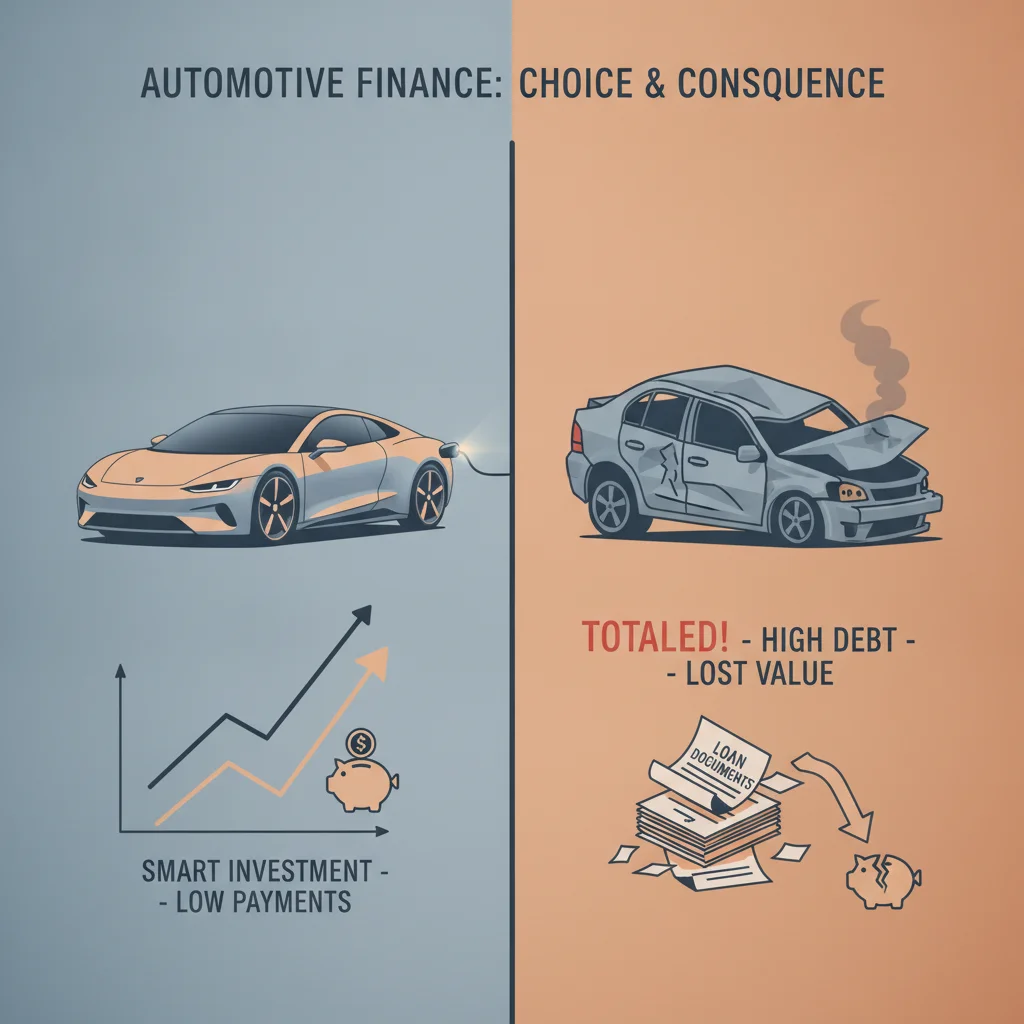
Key Takeaways
New Car Replacement Coverage
New car replacement coverage is an optional auto insurance add-on that pays to replace your totaled vehicle with a brand-new car of the same make and model — not just what the car was worth at the time of the loss. Standard insurance pays actual cash value, which is reduced by depreciation. This coverage eliminates that gap between what you're paid and what it actually costs to buy an equivalent new vehicle.
Insurers typically define 'new car replacement' as a vehicle in its first one to three model years and under a specified mileage threshold (commonly 15,000–25,000 miles). Coverage terms vary by carrier, so the exact eligibility window matters when comparing policies.
Why Standard Insurance Fails New Car Owners After a Total Loss
Here's the situation nobody explains when you're at the dealership signing papers: the moment you drive that new car off the lot, your insurance company's valuation of it drops — sometimes by thousands of dollars. If that car is totaled six months from now, your insurer owes you actual cash value (ACV), not what you paid. That means they subtract depreciation from the settlement, and you're left holding a check that won't buy you back into an equivalent vehicle.
Depreciation hits new cars immediately — often 10–15% in the first month alone, and up to 25% in the first year. On a $42,000 vehicle, that's a potential $10,500 shortfall between what insurance pays and what you need to replace it.
Standard collision and comprehensive coverage is built around ACV because that's the legally established measure of what you've lost — not what a new car costs today. Understanding how ACV differs from replacement cost is the first step to realizing why new car replacement coverage exists in the first place.
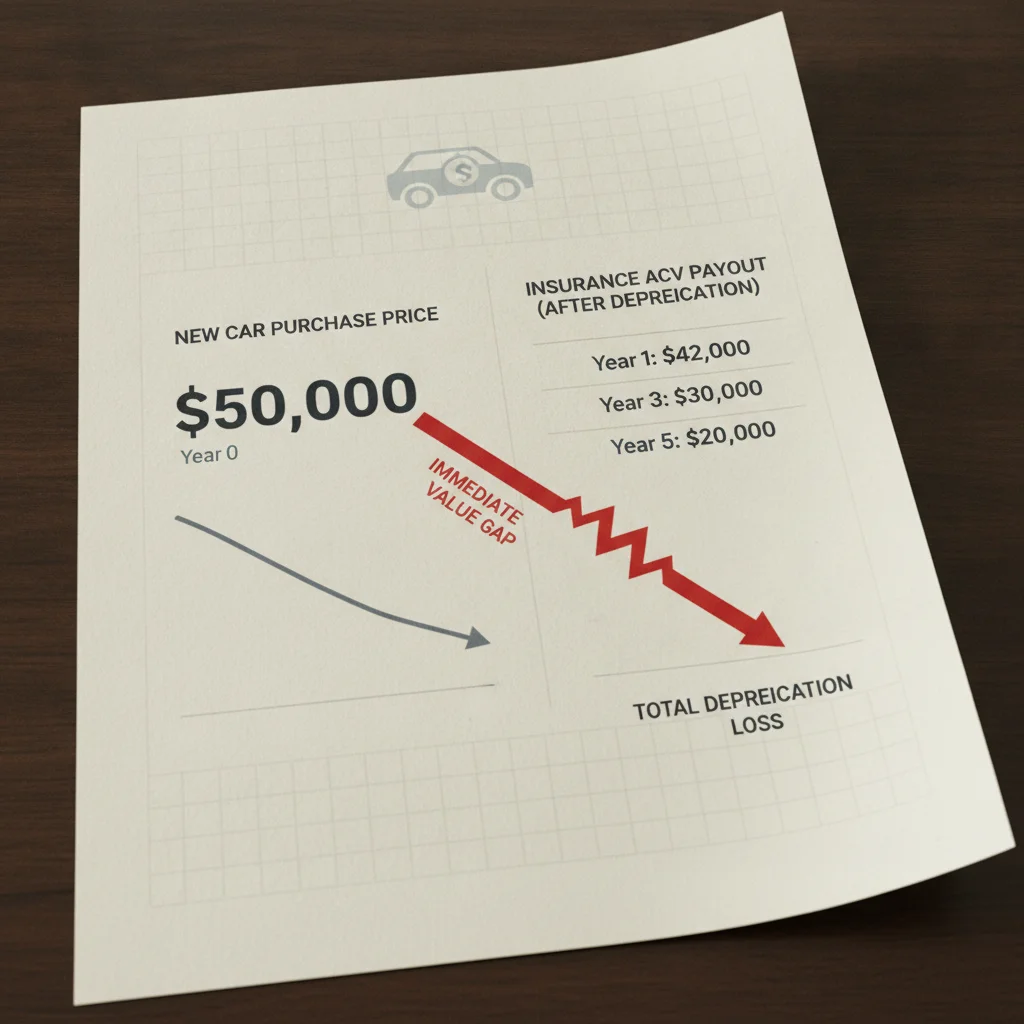
The math is simple and brutal. You pay $42,000 for a vehicle. You finance $38,000 after a small down payment. The car is totaled 14 months later. Your insurer values it at $31,000 — fair market ACV after depreciation. You still owe $34,500 on the loan. That's a $3,500 gap you're on the hook for before you've spent a single dollar on a replacement vehicle. New car replacement coverage eliminates this scenario entirely.
How New Car Replacement Coverage Actually Works
New car replacement coverage is an endorsement — an add-on to an existing policy — that changes the payout formula after a total loss. Instead of settling based on your car's depreciated market value, the insurer agrees to pay the cost of purchasing a comparable new vehicle of the same make, model, and trim at current retail prices.
20–25%
Average new car depreciation in year one
According to Carfax and multiple industry valuation sources, new vehicles typically lose 20–25% of their value within the first 12 months of ownership.
~11%
Value lost the moment you drive off the lot
Edmunds estimates new cars lose approximately 9–11% of their value the instant they leave the dealership, before a single payment is made.
72 months
Average new car loan term (2023)
Experian's State of the Automotive Finance Market report found the average new vehicle loan term reached 72 months, extending the window of negative equity exposure.
$10,000+
Typical ACV shortfall on a totaled new car
For a $42,000 new vehicle financed with minimal down payment and totaled at 12–18 months, the gap between ACV payout and loan balance can easily exceed $10,000.
~$30–$50/yr
Estimated annual cost of new car replacement add-on
Insurer pricing varies widely, but industry estimates suggest the endorsement typically adds $30–$50 per year to a comprehensive policy — far less than typical payout differences.
The mechanics vary slightly by carrier, but the core promise is consistent: depreciation is taken off the table. If your 2024 vehicle is totaled and the same 2025 model now retails for $44,500, that's what you receive — not $31,000, not $38,000.
Not All New Car Replacement Policies Are Equal
Some insurers require you to purchase — not just receive cash for — a replacement vehicle in order to access the new car replacement payout. Others cap the replacement value at the original purchase price rather than the current retail cost of the same model. Read the endorsement language carefully, because 'new car replacement' is a marketing term, not a standardized policy construct. Ask your insurer specifically: does the payout reflect today's MSRP for the equivalent vehicle, or your original purchase price?
There are real-world constraints worth knowing. Most insurers apply a model-year window — typically one to three years old — and a mileage cap, often in the 15,000 to 25,000 mile range. Some policies require you to actually purchase or finance a replacement vehicle rather than simply issuing a cash check. And like all physical damage coverage, it only applies if you're also carrying comprehensive and collision — this is not a standalone product.
One nuance that catches buyers off guard: some policies offer better car replacement — a variant that steps you up to the next model year rather than the same model year. That's worth asking about specifically, because a same-model-year replacement may no longer be available depending on when the loss occurs in the calendar year.
Buy the Coverage at Policy Inception
Most insurers will not allow you to add new car replacement coverage after a claim has occurred or if the vehicle is already outside the eligibility window. Add it when you first insure the vehicle — before you need it — or you may find it unavailable exactly when it matters most. If you're switching insurers, confirm the new carrier will extend the endorsement before canceling your existing policy.
Compare Endorsement Terms, Not Just Premiums
When shopping policies, ask each insurer three specific questions: What is the model-year cutoff? What is the mileage cap? Does the payout reflect current MSRP or original purchase price? A policy with a lower premium but a 12-month eligibility window is less valuable than one priced slightly higher with a 36-month window.
New Car Replacement vs. Gap Insurance: Different Problems, Different Tools
These two coverages are frequently confused, and dealers often pitch gap insurance as if it solves everything. It doesn't. Understanding the distinction is essential before you decide what to buy.
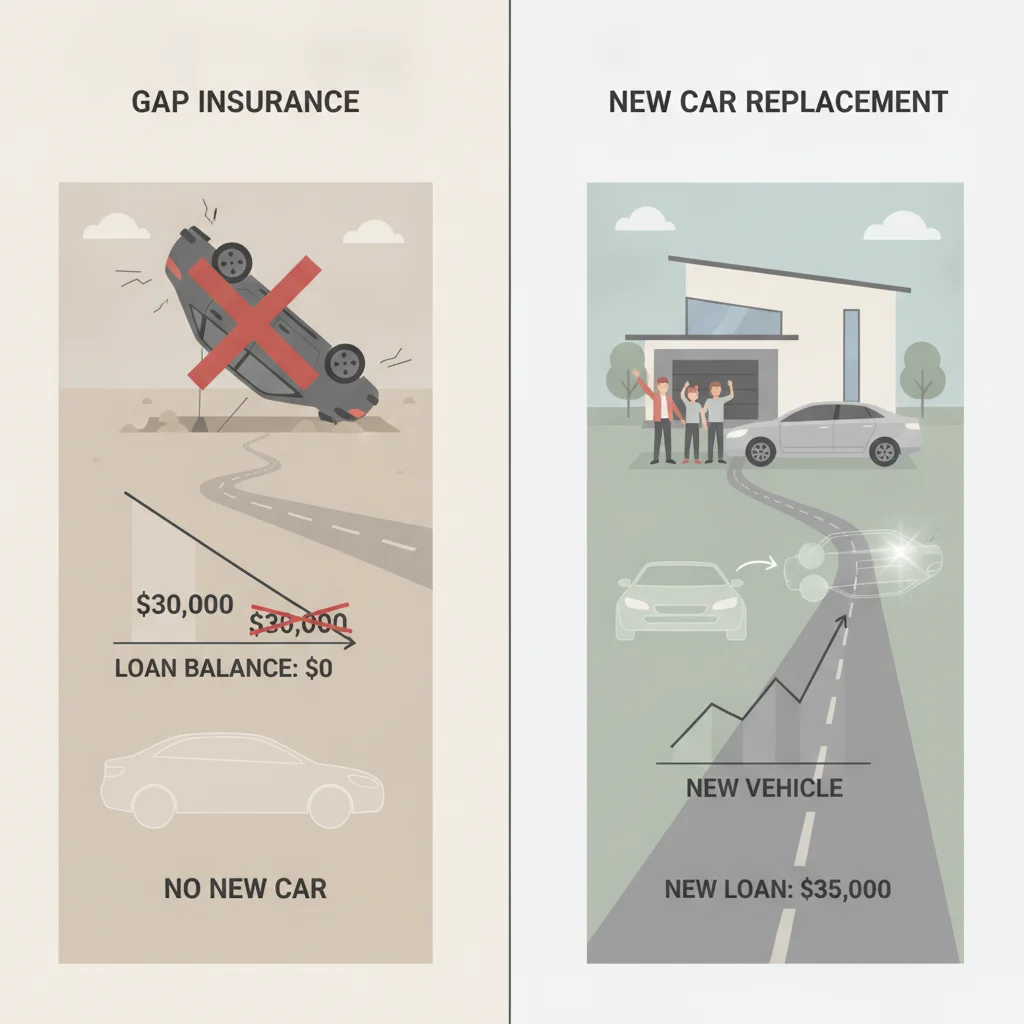
Gap insurance (Guaranteed Asset Protection) covers the difference between what you owe on your loan and what insurance pays in ACV. It protects your lender, functionally — it ensures you don't walk away still owing money on a car you no longer have. What it does not do is put you in a new car. If you owe $34,500 and your ACV settlement is $31,000, gap pays the $3,500 balance. You're debt-free, but you're also carless.
New car replacement coverage solves a different problem. It funds the purchase of a new vehicle. If your replacement car costs $44,500 and your ACV was $31,000, the coverage bridges that $13,500 gap — not just your loan payoff. This is categorically more protective if you intend to replace your vehicle with another new one.
Comparing new car replacement and gap insurance side by side reveals that the right choice depends on your loan situation, your down payment, and what you plan to do after a total loss. If your primary concern is avoiding a loan deficiency, gap insurance is cheaper and sufficient. If you want to actually replace your car with a new one without coming out of pocket, new car replacement coverage is the right tool.
Also worth noting: gap insurance becomes less useful as your loan balance drops relative to ACV. In the first 12 months, both coverages offer meaningful protection. After 24–36 months, gap exposure shrinks significantly — but new car replacement coverage may have already aged out by then too.
Who Should Seriously Consider This Coverage
Not every new car buyer needs new car replacement coverage, but there are specific buyer profiles where it's a near-automatic yes.
- Low or no down payment buyers: If you put less than 10–15% down, you're underwater from day one. Depreciation outpaces your early loan paydown, and ACV coverage will leave you short for months or years.
- Long-term loan borrowers: 72- and 84-month loans have become common. The slower you pay down principal, the longer you carry negative equity. New car replacement coverage is a direct hedge against this.
- Buyers of high-depreciation vehicles: Some brands and body styles depreciate far faster than average — certain luxury sedans, domestic trucks in off-peak seasons, and vehicles with heavy incentive history. If you're weighing a new car against a CPO alternative, factoring in first-year depreciation exposure is part of the math.
- High-mileage commuters: If you drive 20,000+ miles per year, your ACV drops fast. A total loss in month 18 on a high-mileage vehicle produces a particularly low ACV payout — but only if you're still within the coverage's mileage eligibility window.
Conversely, if you paid cash, made a large down payment, or are buying a vehicle with a strong residual value track record, the coverage adds less marginal value. Weigh the annual premium against the realistic payout difference in a total-loss scenario.
“Depreciation is the largest single cost of owning a new vehicle — larger than fuel, maintenance, and insurance premiums combined in the first year. Yet most buyers never think about it until they're staring at a total-loss settlement check that won't cover their loan payoff.”
— Philip Reed, Senior Consumer Advice Editor, Edmunds
What Happens When the Coverage Expires — and What to Do Next
New car replacement coverage has a shelf life. Once your vehicle crosses the model-year or mileage threshold set by your insurer, the endorsement is no longer valid and your policy reverts to standard ACV. This transition typically happens somewhere between 12 and 36 months into ownership — exactly the period when many drivers forget to reassess their coverage.
When new car replacement ages out, you have several decisions to make:
- Evaluate gap insurance if you're still carrying negative equity. It's cheaper than new car replacement and specifically addresses the loan-ACV gap. The case for gap insurance gets stronger the longer you're upside-down on the loan.
- Reassess your deductible. As ACV falls, a higher deductible makes more financial sense — you're self-insuring a smaller vehicle value regardless.
- Consider whether full coverage is still justified. As your car ages, full coverage premiums may exceed the vehicle's value. The standard rule: if your annual premium for collision and comprehensive exceeds 10% of the car's ACV, the coverage is economically hard to justify.

The key is not to let coverage decisions go on autopilot. Insurers won't automatically adjust your policy as your car ages — that's your job. Set a calendar reminder for your vehicle's two-year anniversary and run the numbers on what your current ACV settlement would actually cover before deciding whether to drop, reduce, or replace your coverage.
The bottom line: new car replacement coverage solves a real, quantifiable problem during a specific window of vulnerability. Buy it if you're in that window. Replace it with the right tool when you're not.

All claims are backed by peer-reviewed research. Sources on request.