Key Takeaways
New Car Depreciation
Depreciation is the loss in a vehicle's market value over time. For new cars, this process begins the instant the vehicle is registered in your name and driven off the dealer's property — before you've even reached the first stoplight. The car transitions from "new" to "used" the moment you take ownership, and that label change alone triggers an immediate value drop.
Depreciation is not a theoretical accounting entry for car buyers — it's the difference between what you paid and what a dealer or private buyer will offer you a week later. That gap is real money, and it compounds over time.
The "Drive-Off-Lot" Drop: What Actually Happens
The phrase "your car loses value the moment you drive it off the lot" gets repeated so often it has become background noise. Most buyers nod, assume it means something small, and sign the paperwork anyway. The reality is more specific — and more consequential — than the cliché suggests.
The instant your new car is registered in your name, it becomes a used vehicle in the eyes of every buyer, dealer, and insurance company on the planet. That status change is permanent and immediate. A private buyer looking at a 3-day-old car with 47 miles on it will not pay MSRP — they know they can buy the same model new. So what are they willing to pay? Typically 9–11% less than what you paid.
On a $45,000 purchase, that's $4,050–$4,950 gone before you've made a single monthly payment.
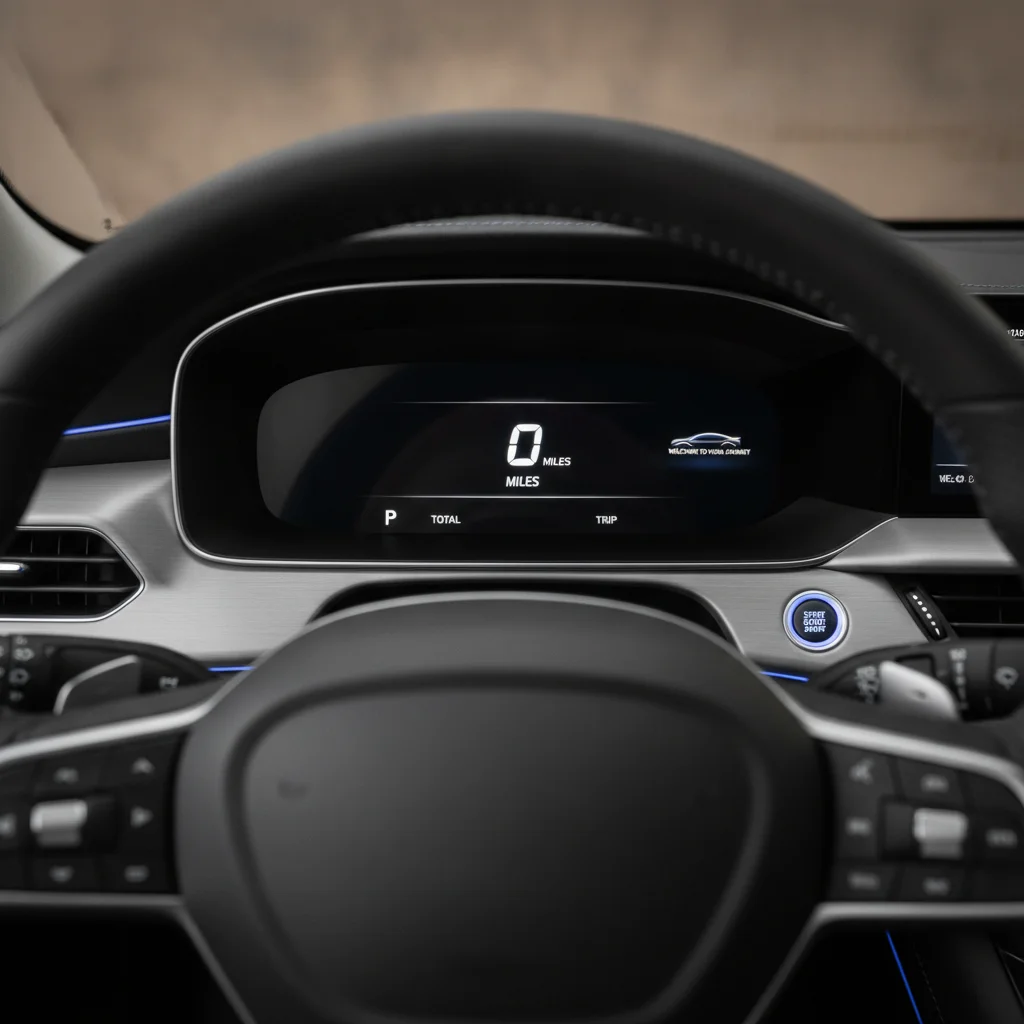
This isn't a market flaw — it's the market working exactly as designed. The premium you paid was for the experience of being the first owner: the plastic still on the seats, the factory warranty at full strength, the odometer reading zero. Once that's consumed, the car is priced on a different scale.
The practical impact depends on how you bought the car. If you paid cash, this is a paper loss until you sell — uncomfortable, but manageable. If you financed with a small down payment, you may already owe more than the car is worth, which creates a real financial exposure. See our full breakdown of how depreciation affects your net worth as an owner for the longer picture.
Why the "New" Label Commands Such a High Premium
To understand why that first depreciation hit is so large, you have to understand what you're actually paying for when you buy new. Part of the MSRP covers the vehicle itself, but another part covers intangibles: a full factory warranty, no unknown history, no previous owner's habits, and the psychological satisfaction of first ownership.
The moment you transfer those intangibles to yourself, they cannot be resold at the same value. The next buyer does not get to be the first owner. The warranty clock has started. A month of depreciation has occurred. Even if the car is spotless, these facts lower what a rational buyer will pay.
“Depreciation is the largest single cost of owning a vehicle — more than fuel, more than insurance, more than maintenance — yet it's the one cost almost no buyer calculates before signing.”
— Philip Reed, Senior consumer advice editor, Edmunds
There's also a supply dynamic at work. Dealers can order new cars. Used car supply is finite. When a buyer can walk into a showroom and order the exact configuration they want — new — paying a significant premium for a slightly used version of the same car makes less sense unless the price gap is meaningful.
This is why the drive-off-lot depreciation hit is larger for common, readily available models. A Toyota Camry in a dealership-standard color configuration drops faster off the lot than a Jeep Wrangler in a sought-after trim, because Wrangler supply is tighter relative to demand. Supply and demand dynamics are one of several factors that separate slow depreciators from fast ones.
Depreciation Affects Private Sale and Trade-In Differently
When you trade in a vehicle at a dealership, the dealer's offer will typically be lower than private-party sale value — they need room to recondition and profit on resale. This means the depreciation hit you feel at trade-in is often steeper than what the open market would offer. If you have the time and patience, selling privately almost always yields more money than a dealer trade-in at any point in the depreciation curve.
High-Demand Periods Can Temporarily Slow Depreciation
During supply chain disruptions — most visibly during 2021–2022 — used car values actually rose in some segments, temporarily reversing normal depreciation patterns. Some buyers who purchased new in late 2019 found their vehicles worth more two years later than when they bought them. These conditions are exceptional and should not be counted on as a buying strategy — normal depreciation dynamics reassert themselves once supply normalizes.
Mileage Is the Second-Biggest Depreciation Driver
After time, annual mileage is the single largest factor affecting a vehicle's market value. A car driven 20,000 miles per year will depreciate significantly faster than the same model driven 10,000 miles per year. Most residual value estimates assume 12,000–15,000 miles annually — if your commute or lifestyle runs well above that, factor in additional depreciation when calculating your true ownership cost.
The First Year: When Depreciation Hits Hardest
The drive-off-lot drop is the opening act. Year one is where most of the financial damage accumulates for new car buyers.
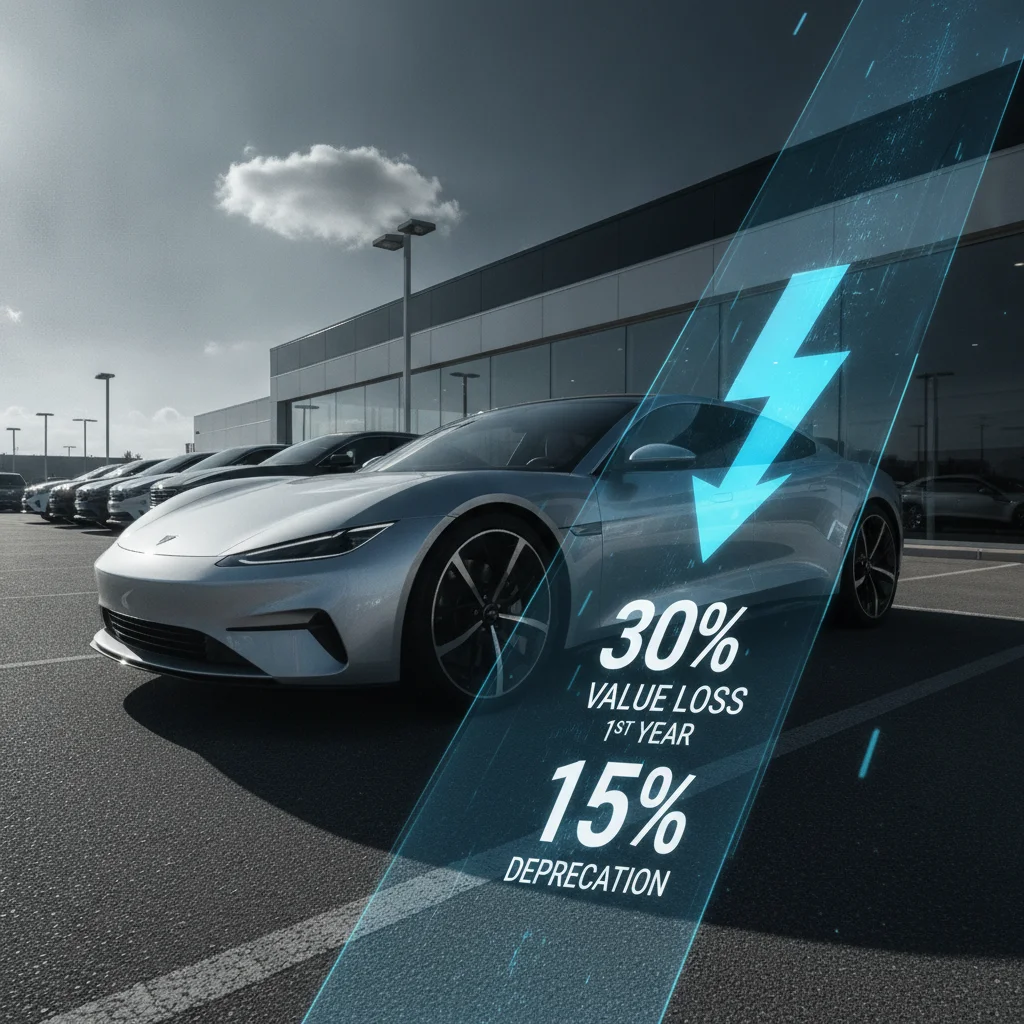
By the time a car hits its first birthday — typically around 12,000–15,000 miles — the average new vehicle has lost 15–25% of its original purchase price. That's on top of the initial off-the-lot drop, not instead of it.
9–11%
Value lost driving off the lot
Industry estimates from Edmunds and Kelley Blue Book indicate new cars lose 9–11% of their value the moment they are registered as used vehicles.
20%
Average first-year depreciation
According to Carfax and Edmunds data, the average new vehicle loses approximately 20% of its original purchase price within the first 12 months of ownership.
49%
Average 5-year value loss
Edmunds analysis shows the average new car retains roughly 51% of its original value after five years, meaning nearly half the purchase price evaporates through depreciation.
30–40%
5-year loss for top-retaining trucks
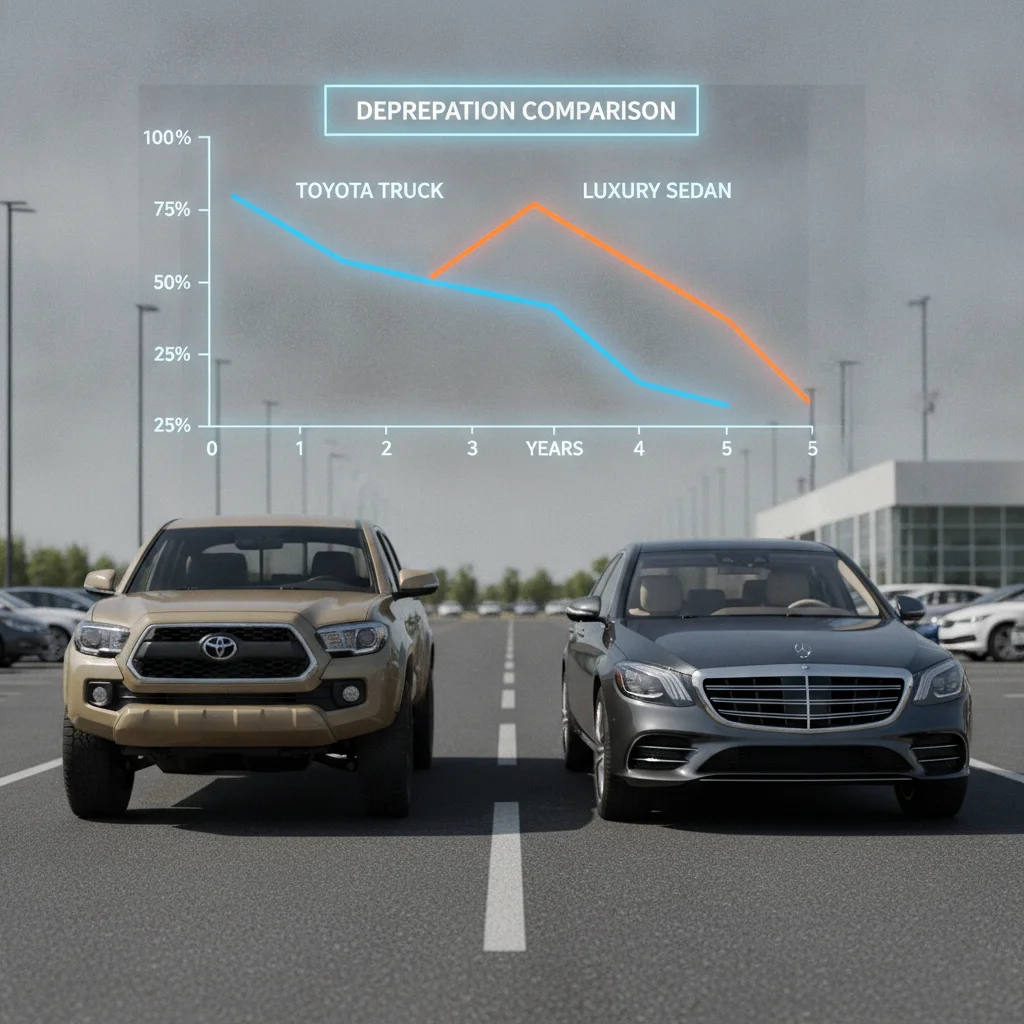
Models like the Toyota Tacoma and Jeep Wrangler consistently rank among the lowest depreciators, losing only 30–40% of value over five years according to iSeeCars annual studies.
60%+
5-year loss for fastest depreciators
Certain luxury sedans and high-supply domestic models can shed 60% or more of their original value within five years, per iSeeCars and Kelley Blue Book residual value data.
The math on a $40,000 car is stark: after 12 months, you might be looking at a vehicle worth $30,000–$34,000, depending on the model. If you put 10% down and financed the rest, your loan balance at the one-year mark (depending on your term and interest rate) might still be $33,000–$35,000. That's a negative equity position — you owe more than the car is worth — and it's the normal outcome of buying new with a standard down payment.
The steepness of year-one depreciation is partly structural. Manufacturers and dealers know that the first buyer subsidizes the used market. They build this into pricing. For more on that specific dynamic, our article on first-year depreciation and why the drop is steepest in year one walks through the mechanics in detail.
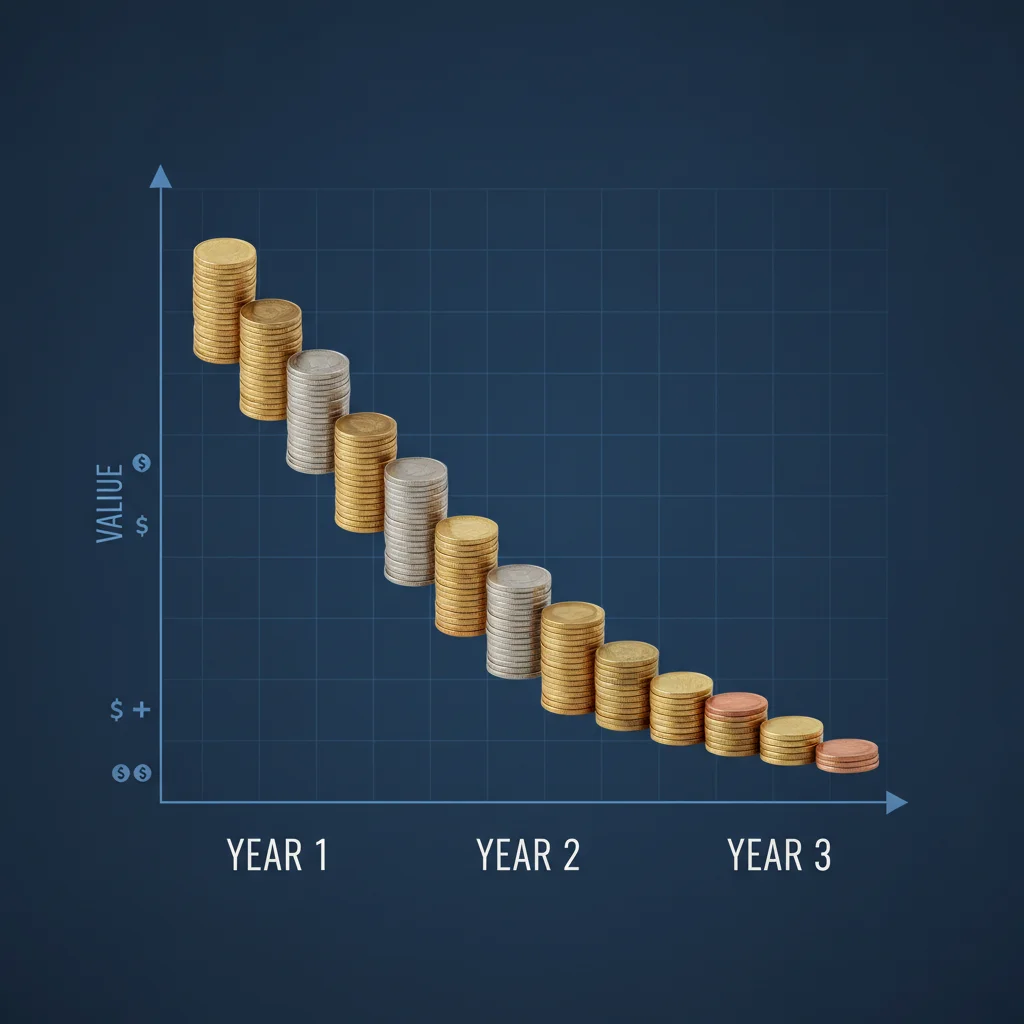
Year two and three are also significant — most vehicles lose another 10–15% per year during this window — but the rate begins to flatten. By years four and five, annual depreciation has often moderated to 6–12% per year. The full five-year depreciation curve shows exactly how this trajectory plays out and what it costs owners at each stage.
Check Residual Value Before You Fall in Love
Before you commit to a specific make and model, look up its projected 3-year and 5-year residual value on Edmunds or Kelley Blue Book. Compare it to two or three alternatives in the same segment. A difference of 10 percentage points in residual value on a $40,000 car is $4,000 of real money — often more than any dealer discount you'll negotiate.
GAP Insurance Is Not Optional If You Finance New
If you're putting less than 20% down on a new car purchase, seriously consider GAP (Guaranteed Asset Protection) insurance. It covers the difference between what you owe and what the car is worth if the vehicle is totaled or stolen. Dealer-offered GAP is almost always overpriced — buy it through your own insurer or credit union instead for a fraction of the cost.
Shorter Loan Terms Reduce Underwater Risk
A 48- or 60-month loan builds equity faster than a 72- or 84-month loan, which means you cross the break-even point — where your loan balance equals the car's value — sooner. Yes, the monthly payment is higher. But you spend far less time in a position where selling or totaling the car would leave you with a gap to cover.
Which Cars Depreciate Fastest — and Why It Matters
Depreciation is not uniform across the market. Two cars with identical sticker prices can have dramatically different five-year value retention, and that gap directly affects your total cost of ownership.
Here's how different segments and brands generally stack up:
| Vehicle Type | Typical 5-Year Depreciation | Notable Examples |
|---|---|---|
| Midsize pickup trucks | 30–40% | Toyota Tacoma, Ford F-150 |
| Japanese compact SUVs | 35–45% | Toyota RAV4, Honda CR-V |
| German luxury sedans | 50–65% | BMW 5 Series, Mercedes E-Class |
| Domestic large sedans | 50–60% | Chrysler 300, Dodge Charger |
| Electric vehicles (varies widely) | 45–65% | Chevrolet Bolt, early Nissan Leaf |
The forces behind these differences include brand reliability reputation, supply and demand for used units, cost of ownership (insurance and fuel), and how quickly the technology in the segment evolves. Luxury vehicles present a particularly sharp case: they depreciate faster partly because their higher maintenance costs and ownership complexity shrink the pool of buyers willing to purchase them used. Why luxury cars depreciate faster than economy models explains the counterintuitive economics behind this pattern.
Electric vehicles add a newer wrinkle: battery technology and software are advancing quickly enough that a 3-year-old EV can feel significantly outdated, compressing used values. This is one reason EV depreciation has run steeper than comparable gas vehicles for much of the past decade, though that gap is narrowing as EV adoption broadens.
For a comprehensive look at what drives these differences — including color, mileage, and reliability ratings — see what makes a car depreciate faster.
How Depreciation Interacts With Your Auto Loan
Most buyers focus on monthly payment when financing a new car. Few think about how the loan balance compares to the car's actual market value at any given point in the loan. That relationship — equity position — is where depreciation can turn from an abstract concept into a concrete financial problem.
Standard new car loans today run 60, 72, or even 84 months. The longer the term, the slower you build equity. Meanwhile, depreciation doesn't care about your payment schedule — it follows market forces. On a 72-month loan with a standard down payment, many buyers are underwater (owing more than the car is worth) for the first 24–36 months of the loan.
The danger materializes in two common scenarios:
- Total loss accident: Your insurer pays the current market value of the vehicle, not what you owe on the loan. If you owe $28,000 and the car is worth $22,000, you still owe your lender $6,000 after the insurance check clears — unless you carry GAP insurance, which covers that difference.
- Need to sell or trade early: Life changes — job loss, growing family, relocation. If you need to exit the car before the loan is paid down, you'll either roll negative equity into a new loan (compounding the problem) or pay the difference out of pocket.
The fix is not complicated, but it requires intention: put more money down, choose a shorter loan term, or buy a model known to hold its value. Any of these strategies reduces the window during which you're underwater. For a broader look at how depreciation shapes what you actually own versus what you owe, see the depreciation basics hub.
Depreciation Affects Private Sale and Trade-In Differently
When you trade in a vehicle at a dealership, the dealer's offer will typically be lower than private-party sale value — they need room to recondition and profit on resale. This means the depreciation hit you feel at trade-in is often steeper than what the open market would offer. If you have the time and patience, selling privately almost always yields more money than a dealer trade-in at any point in the depreciation curve.
High-Demand Periods Can Temporarily Slow Depreciation
During supply chain disruptions — most visibly during 2021–2022 — used car values actually rose in some segments, temporarily reversing normal depreciation patterns. Some buyers who purchased new in late 2019 found their vehicles worth more two years later than when they bought them. These conditions are exceptional and should not be counted on as a buying strategy — normal depreciation dynamics reassert themselves once supply normalizes.
Mileage Is the Second-Biggest Depreciation Driver
After time, annual mileage is the single largest factor affecting a vehicle's market value. A car driven 20,000 miles per year will depreciate significantly faster than the same model driven 10,000 miles per year. Most residual value estimates assume 12,000–15,000 miles annually — if your commute or lifestyle runs well above that, factor in additional depreciation when calculating your true ownership cost.
Strategies to Protect Yourself From Steep Depreciation
You cannot eliminate depreciation — every vehicle loses value over time. But you can make decisions that minimize how much of your money it consumes.
Buy a slower depreciator deliberately
Before you fall in love with a specific car, look up its projected 3- and 5-year residual value. Resources like Kelley Blue Book, Edmunds, and J.D. Power publish depreciation data by model. Choosing a vehicle in the top quartile for value retention versus a comparable competitor can save you $5,000–$10,000 in lost value over five years on a mid-priced vehicle.
Consider a 1–3 year old certified pre-owned vehicle
A manufacturer-certified pre-owned (CPO) vehicle with 15,000–25,000 miles absorbs the steepest portion of the depreciation curve before it reaches you. You typically still get an extended warranty and access to financing. The trade-off is that you're not the first owner — but if that matters less to you than the financial outcome, CPO is one of the most effective strategies available.
Put a meaningful down payment on new purchases
A 15–20% down payment on a new car purchase gets your equity position close to the vehicle's market value faster, reducing the underwater period. It won't stop depreciation, but it prevents your loan balance from running so far ahead of the vehicle's value that you lose flexibility.
Choose popular colors and avoid excessive options
White, silver, gray, and black vehicles have consistently broader resale appeal than unusual or polarizing colors. And while it's tempting to load up on factory options, not all of them add equivalent resale value — some are priced by the manufacturer at a premium that the used market won't replicate.
Check Residual Value Before You Fall in Love
Before you commit to a specific make and model, look up its projected 3-year and 5-year residual value on Edmunds or Kelley Blue Book. Compare it to two or three alternatives in the same segment. A difference of 10 percentage points in residual value on a $40,000 car is $4,000 of real money — often more than any dealer discount you'll negotiate.
GAP Insurance Is Not Optional If You Finance New
If you're putting less than 20% down on a new car purchase, seriously consider GAP (Guaranteed Asset Protection) insurance. It covers the difference between what you owe and what the car is worth if the vehicle is totaled or stolen. Dealer-offered GAP is almost always overpriced — buy it through your own insurer or credit union instead for a fraction of the cost.
Shorter Loan Terms Reduce Underwater Risk
A 48- or 60-month loan builds equity faster than a 72- or 84-month loan, which means you cross the break-even point — where your loan balance equals the car's value — sooner. Yes, the monthly payment is higher. But you spend far less time in a position where selling or totaling the car would leave you with a gap to cover.

For a deeper look at how brand, segment, and reliability ratings shape depreciation trajectories, slow depreciators vs. fast depreciators breaks down the key differentiators. If you want to understand the mathematical models behind how depreciation is calculated, straight-line vs. accelerated depreciation models gives you the tools to evaluate any specific vehicle's trajectory more precisely.
What This Means for the Actual Decision in Front of You
Depreciation is a cost of ownership, just like fuel, insurance, and maintenance. The difference is that most buyers never see it as a line item — it's silent, accumulating in the background while you focus on monthly payments and interest rates.
When you're evaluating a new car purchase, run this quick mental calculation: take the expected 5-year depreciation percentage for the model you're considering (available from Edmunds or KBB), apply it to the purchase price, and divide by 60 months. That's your monthly depreciation cost. Add it to your monthly payment, insurance, and fuel, and you have a realistic picture of what that car is actually costing you.
A $45,000 car that depreciates 50% over five years costs you $375 per month in depreciation alone — before interest, before insurance, before gas. A $42,000 truck that retains 65% of its value costs you $245 per month in depreciation. That $130-per-month difference adds up to $7,800 over the loan term, and it's entirely invisible if you're only looking at payment and rate.
The goal isn't to make you afraid of buying new. Plenty of buyers have excellent reasons to buy new — warranty coverage, specific configurations, technology features, or simply personal preference. The goal is to make sure you go in with clear numbers, not comfortable myths. Understanding how depreciation works across the full ownership timeline puts you in a far stronger position — whether you're buying, selling, or deciding when to do either.
Buyers who understand depreciation make different choices at the dealer. They negotiate differently, finance differently, and know exactly when it makes sense to hold versus sell. That knowledge is worth more than any single negotiating tactic.
All claims are backed by peer-reviewed research. Sources on request.