
Key Takeaways
Liability Premium
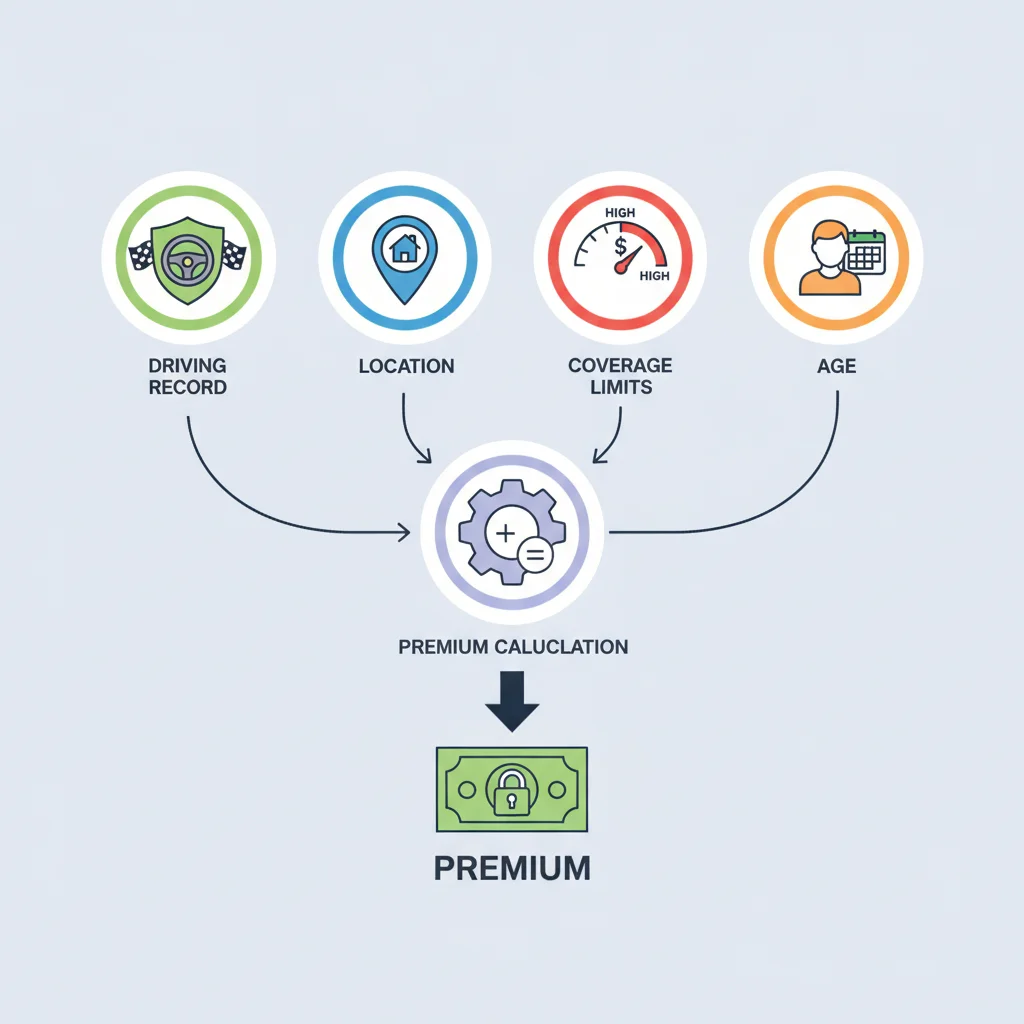
A liability premium is the amount you pay — usually monthly or every six months — for the portion of your car insurance that covers injuries and property damage you cause to others in an at-fault accident. It does not cover your own car or your own medical bills. Insurers set this price by analyzing dozens of variables that predict how likely you are to cause an accident and how costly that accident might be.
Actuaries use statistical models — often incorporating generalized linear models (GLMs) — to assign rate factors to each variable, then multiply those factors together to arrive at a final premium.
Why Liability Pricing Works Differently From Other Coverage
When people are confused about their car insurance bill, they often focus on the total number without realizing that different coverages within the same policy are priced using completely different logic. Collision and comprehensive rates are heavily tied to your vehicle's value and where you park it. Liability pricing is almost entirely about you — your behavior, your history, your location, and the limits you choose.
This distinction matters because it changes what you can actually do to influence your rate. You can't easily change your driving history, but you can understand which levers insurers pull so you know exactly what you're paying for — and where there's room to improve over time.
For a broader look at how physical damage coverage is priced, see how insurers calculate collision and comprehensive premiums. But for now, let's focus on the liability side of your policy.
Your Driving Record: The Heaviest Weight on the Scale
If there's one factor that matters more than all others in liability pricing, it's your driving record. Insurers look at this first because it's the most statistically reliable predictor of whether you'll file a liability claim in the future.
Here's what underwriters typically examine:
- At-fault accidents: The most significant negative mark. An at-fault accident tells an insurer that you have already demonstrated the behavior they're pricing against. Most insurers look back three to five years.
- Moving violations: Speeding tickets, running red lights, reckless driving — each violation adds a surcharge. Minor violations carry smaller penalties; major violations like reckless driving or street racing can dramatically increase your rate.
- DUI or DWI convictions: These trigger the largest surcharges and can remain on your insurance record for five to ten years in many states. Some insurers will non-renew a policy after a DUI.
- License suspensions: A suspended license signals elevated risk even if it's since been reinstated.
Drivers with completely clean records receive what's known as a preferred or standard rate. Each negative item introduces a rate factor — a multiplier — that compounds your base premium upward.
“Insurance pricing isn't punitive — it's probabilistic. Every surcharge on a policy reflects a statistical pattern observed across millions of drivers. The good news is that most of those patterns are reversible over time.”
— J. Robert Hunter, Former Insurance Commissioner and Director of Insurance, Consumer Federation of America
Coverage Limits: You're Buying More Protection, So You Pay More
The limits you choose directly determine how much your insurer could potentially pay out on your behalf. Higher limits mean greater insurer exposure, so they cost more. But the relationship is not linear — doubling your limits does not double your premium.
Most states require minimum liability limits, but those minimums are often dangerously low in a serious accident. Understanding what those numbers mean is a prerequisite for making a smart coverage decision. If you haven't already, it's worth reviewing what split-limit liability numbers actually mean before you adjust your limits.
30–50%
Average premium increase after one at-fault accident
Industry data from multiple insurers consistently shows a single at-fault accident can raise liability premiums by 30–50% at renewal, with some high-risk carriers going higher.
$15–$30/mo
Typical cost to upgrade from minimum to 100/300/100 limits
For a driver with a clean record and average risk profile, the monthly difference between state minimums and robust limits is often far smaller than drivers assume.
Up to 67%
Premium difference between best and worst credit tiers
The Consumer Federation of America has found that drivers with poor credit can pay up to 67% more than those with excellent credit for the same liability coverage in states that allow credit scoring.
3–5 years
Lookback window for driving record violations
Most insurers review your motor vehicle record going back three to five years, meaning older incidents age off and stop affecting your rate.
12.6%
Share of U.S. drivers who are uninsured
According to the Insurance Research Council, roughly 1 in 8 drivers on American roads carries no insurance — a statistic that shapes liability risk modeling in many states.
A practical note: moving from state minimum limits to substantially higher limits — say, 100/300/100 — often costs far less per month than drivers assume. The actuarial reason is that your base premium already reflects most of your personal risk; higher limits add exposure at the upper tail of potential losses, which is statistically rare. The incremental cost is usually modest relative to the added protection.
If you're unsure what limits make sense for your financial situation, this practical framework for setting liability limits can help you calibrate.
Upgrading Limits Costs Less Than You Think
Before renewing at your current limits, ask your insurer for a quote at 100/300/100. For most drivers with clean records, the monthly difference is small enough that the upgrade pays for itself the moment you're in a serious at-fault accident. It's one of the highest-value changes you can make to a liability policy.
Disclose Your Annual Mileage Accurately
Underestimating how much you drive can seem like it saves money upfront, but it creates a coverage risk. If you file a claim and your insurer finds a significant mileage discrepancy, they may dispute the claim or adjust your payout. Give an honest estimate — and update it if your commute or lifestyle changes.
Where You Live: Geographic Risk and Why It Prices Into Liability
Your address is a powerful rate signal. Insurers analyze claim data at remarkably granular levels — sometimes down to the ZIP code or even census tract — to understand what the liability environment looks like where you drive most.
Key geographic factors include:
- Traffic density: Urban areas with more vehicles per road mile have statistically higher collision frequency. More collisions mean more liability claims.
- Litigation climate: Some states and cities have legal environments where injury claims are more frequently litigated and settlements run higher. Insurers price for the cost of defending and settling claims in your jurisdiction.
- Uninsured motorist rates: High concentrations of uninsured drivers in an area can affect how insurers model local claim costs.
- Weather patterns: Regions prone to ice, heavy rain, or other adverse conditions see higher accident frequencies.
The impact of location on your premium is explored in depth in what your ZIP code tells your insurer and why it costs you. The short version: two drivers with identical profiles can pay meaningfully different liability rates just by living on opposite sides of a city boundary.

State Laws Shape What Insurers Can Use
Not every rating factor is legal in every state. California bans the use of credit scores, gender, and education level in auto insurance pricing. Michigan and Hawaii also restrict certain variables. Before assuming a factor applies to your rate, it's worth checking your state's insurance department website for permitted rating criteria.
Liability Pricing Is Reviewed at Every Renewal
Your premium isn't locked in forever. At each renewal — typically every six or twelve months — your insurer re-runs your risk profile. A violation that just aged off your record, a credit score that's improved, or a move to a lower-risk ZIP code can all produce a lower rate at the next renewal cycle. It's worth reviewing your profile proactively rather than waiting for your insurer to notify you.
Driver Demographics: Age, Experience, and Household Composition
Actuarial data consistently shows that certain demographic groups have higher accident rates, and insurers are permitted to use age and driving experience as rating factors in most states.
How this typically plays out:
- Teen and young adult drivers (16–25): Face the highest liability surcharges due to statistically elevated accident rates. Adding a 17-year-old to a policy can raise the liability portion substantially.
- Drivers over 70: May see modest rate increases as reaction time and accident frequency begin to rise again in older age brackets.
- New license holders at any age: Someone who gets their license at 40 will still be rated as inexperienced for a period, though not as severely as a teenager.
Household composition also matters. If anyone listed on your policy — or anyone who regularly drives your vehicles — has a poor driving record, that risk bleeds into your premium. Insurers typically require you to list all licensed household members, and they'll rate accordingly.
Credit-Based Insurance Scores: The Factor Many Drivers Don't Expect
In most states, insurers use a credit-based insurance score as a rating factor. This is not identical to the credit score a lender uses to approve a car loan, but it draws from similar underlying data — payment history, outstanding balances, length of credit history, and credit mix.
The insurance industry's rationale is that credit-based insurance scores have been statistically correlated with claim frequency across very large datasets. Drivers with lower scores tend to file more claims on average, so insurers charge them more. The practice is controversial, and states like California, Hawaii, and Massachusetts prohibit it entirely.
If you're in a state that allows credit scoring and your credit history has had rough patches, improving your credit over time can eventually translate into lower liability premiums. This is a slower path than cleaning up your driving record, but it's a real lever.
For more on how credit affects your auto-related finances broadly, the credit score impact on auto loans section covers the lending side of that equation.
Your Vehicle's Role in Liability Pricing
Liability coverage pays for damage you cause to others, so you might expect your vehicle to be largely irrelevant. It's not entirely irrelevant, but it does play a smaller role here than it does in collision or comprehensive pricing.
Insurers may consider:
- Vehicle size and weight: Heavier vehicles can cause more damage to smaller vehicles in a collision. This can push liability rates slightly higher for large trucks and SUVs in some rating models.
- Engine power and performance: High-horsepower vehicles are statistically associated with higher-severity accidents. Some insurers apply a modest surcharge for sports cars or performance trims.
- Vehicle use: Using your vehicle for business purposes, ridesharing, or high annual mileage increases your exposure and can raise your liability rate. A car driven 25,000 miles per year is on the road far more than one driven 8,000 miles — and is therefore more likely to be involved in an accident.
None of these vehicle factors approach the weight of your driving record or location, but they're worth understanding if you're comparing rates across different vehicles you're considering purchasing.

Upgrading Limits Costs Less Than You Think
Before renewing at your current limits, ask your insurer for a quote at 100/300/100. For most drivers with clean records, the monthly difference is small enough that the upgrade pays for itself the moment you're in a serious at-fault accident. It's one of the highest-value changes you can make to a liability policy.
Disclose Your Annual Mileage Accurately
Underestimating how much you drive can seem like it saves money upfront, but it creates a coverage risk. If you file a claim and your insurer finds a significant mileage discrepancy, they may dispute the claim or adjust your payout. Give an honest estimate — and update it if your commute or lifestyle changes.
How All the Factors Come Together — and What You Can Do
Insurers don't simply add up these risk factors — they multiply them. A driver with two negative factors doesn't pay double; they often pay considerably more because each rate factor is applied on top of the last. This is why a combination of a poor driving record, a young age, and a challenging ZIP code can produce a premium that feels startling.
The full universe of variables that shape your auto insurance rate goes even deeper than what we've covered here. The complete list of variables insurers feed into your auto insurance quote covers additional data points — from policy tenure to homeownership status — that influence your final number. And the rate factors hub is a good home base for understanding how each category interacts.
What you can control:
- Drive carefully and consistently. A clean record is the most durable path to a lower liability premium. Violations and claims age off over three to five years.
- Shop multiple insurers. Because each company weights variables differently, you may qualify for a meaningfully lower rate at a competitor even with identical coverage.
- Review your limits annually. Your financial situation changes. Make sure your limits still reflect what you actually need to protect — especially as your assets grow.
- Ask about discounts. Bundling home and auto, completing a defensive driving course, paying in full, or going paperless can all reduce your final premium.
Understanding how your liability premium is built is the first step toward having an informed conversation with your insurer or agent. Once you know which variables are working against you, you can build a realistic plan to improve your rate over time — and make sure the coverage you're paying for is actually the coverage you need.
If you want to understand what happens when that coverage is actually triggered, how liability insurance responds after an at-fault accident walks through the full claims sequence step by step.
State Laws Shape What Insurers Can Use
Not every rating factor is legal in every state. California bans the use of credit scores, gender, and education level in auto insurance pricing. Michigan and Hawaii also restrict certain variables. Before assuming a factor applies to your rate, it's worth checking your state's insurance department website for permitted rating criteria.
Liability Pricing Is Reviewed at Every Renewal
Your premium isn't locked in forever. At each renewal — typically every six or twelve months — your insurer re-runs your risk profile. A violation that just aged off your record, a credit score that's improved, or a move to a lower-risk ZIP code can all produce a lower rate at the next renewal cycle. It's worth reviewing your profile proactively rather than waiting for your insurer to notify you.

All claims are backed by peer-reviewed research. Sources on request.