

| Coverage Type | Split-Limit Liability |
| First Number (25) | $25,000 per injured person (bodily injury) |
| Second Number (50) | $50,000 per accident, all injured persons combined |
| Third Number (25) | $25,000 per accident for property damage |
| Covers Your Own Injuries? | No — liability covers others only |
| Common State Minimum | 25/50/25 or lower in many U.S. states (Insurance Information Institute) |
| Recommended Starting Point | 100/300/100 for drivers with assets to protect (Insurance industry general guidance) |
| Alternative Format | Combined Single Limit (CSL) — one pooled dollar amount |
The Three Numbers You Need to Know
When you open your auto insurance declarations page, you'll likely see a string of numbers that looks something like 25/50/25. It's easy to gloss over it — it almost looks like a fraction or a date — but these three figures define the outer boundaries of your financial protection if you cause an accident. Understanding them isn't just useful; it's essential.
This format is called a split-limit liability policy, and it's by far the most common way liability coverage is expressed in the United States. Each number represents a separate cap, measured in thousands of dollars, and each cap governs a different slice of what your insurer will pay out on your behalf.
| Coverage Type | Split-Limit Liability |
| First Number (25) | $25,000 per injured person (bodily injury) |
| Second Number (50) | $50,000 per accident, all injured persons combined |
| Third Number (25) | $25,000 per accident for property damage |
| Covers Your Own Injuries? | No — liability covers others only |
| Common State Minimum | 25/50/25 or lower in many U.S. states (Insurance Information Institute) |
| Recommended Starting Point | 100/300/100 for drivers with assets to protect (Insurance industry general guidance) |
| Alternative Format | Combined Single Limit (CSL) — one pooled dollar amount |
Here's the short version before we go deeper: the first number covers any one injured person, the second covers all injured people combined in a single accident, and the third covers property damage you cause. They are not interchangeable — money allocated to one category cannot be redirected to another, even if one bucket is empty and another is overflowing.
If you've ever wondered why a friend's medical bills weren't fully paid after an accident even though the at-fault driver had insurance, limits like these are often the reason. Let's walk through each number carefully.
Decoding Each Number in 25/50/25
The First Number: Per-Person Bodily Injury Limit
The first 25 in 25/50/25 means your insurer will pay up to $25,000 in bodily injury costs for any single person injured in an accident you caused. This includes emergency treatment, hospitalization, surgery, rehabilitation, and sometimes lost wages or pain and suffering, depending on your state's tort rules.
That $25,000 cap applies individually. If one passenger in the other car sustains injuries totaling $40,000 in medical bills, your policy pays $25,000 — and that person could pursue you personally for the remaining $15,000.
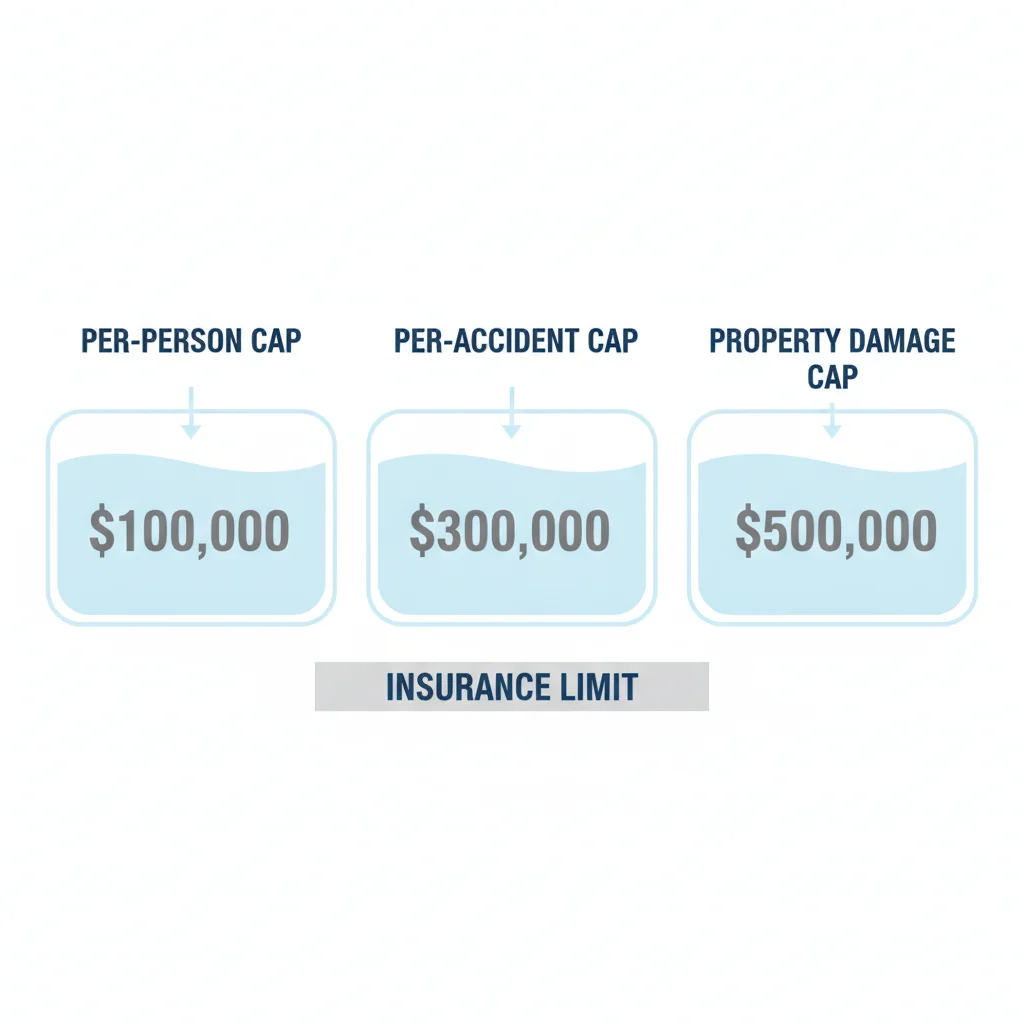
The Second Number: Per-Accident Bodily Injury Limit
The second number — 50, representing $50,000 — is the total your insurer will pay for bodily injury claims across all people injured in a single accident. This is sometimes called the per-occurrence or aggregate limit.
Here's where the math gets important: even if three people are each injured and each submits a claim, your policy will never pay more than $50,000 total, no matter how many people were hurt. And remember, no single person can receive more than the $25,000 per-person cap either — so both limits are always in play simultaneously.
Think of it as a two-gate system. Every claimant must pass through the per-person gate first ($25,000 maximum), and together they cannot collect more than the per-accident gate allows ($50,000 maximum). For a deeper look at what happens when multiple people are injured at once, see how liability limits behave in multi-vehicle collisions.
The Third Number: Property Damage Limit
The final 25 — another $25,000 — is your property damage liability limit. This pays for damage you cause to someone else's vehicle, fence, building, or other property. It does not cover damage to your own car; that's what collision and comprehensive coverage is for.
Property damage claims can escalate quickly. A newer luxury vehicle can easily cost $30,000–$60,000 to repair or replace, and if you collide with a commercial vehicle or damage a storefront, costs climb even faster. A $25,000 property damage limit can feel adequate until it isn't.
Split-Limit Liability
A liability coverage structure that sets three separate dollar caps: one per injured person, one per accident for all bodily injuries combined, and one for property damage. Funds cannot be transferred between categories.
Per-Person Limit
The maximum your insurer will pay toward any single individual's bodily injury claims resulting from one accident you caused. In 25/50/25, this is $25,000.
Per-Accident Limit
The total ceiling your insurer will pay across all bodily injury claims arising from a single accident, regardless of how many people were injured. In 25/50/25, this is $50,000.
Property Damage Liability
The portion of your liability policy that pays for physical damage you cause to someone else's vehicle or other property. It does not cover damage to your own car.
Declarations Page
A one- or two-page summary document issued by your insurer that lists all your coverage types, limits, deductibles, covered vehicles, and premium for the policy term.
Combined Single Limit (CSL)
An alternative liability structure that replaces the three-number split format with a single pooled dollar amount covering both bodily injury and property damage. Offers more flexibility but can be harder to compare.
State Minimum Coverage
The lowest liability limits a driver is legally permitted to carry in a given state. These minimums vary by state and are often considered insufficient to protect drivers with significant assets.
Judgment Gap
The difference between what a court awards an injured party and what your insurance policy will actually pay. You are personally responsible for amounts that exceed your policy limits.
A Real-World Scenario: Where Limits Collide With Reality
Suppose you run a red light and T-bone another car. The other car has two occupants. Here's how the numbers play out under a 25/50/25 policy:
| Claimant / Item | Actual Cost | Your Policy Pays | Gap You Owe |
|---|---|---|---|
| Driver (other car) — bodily injury | $35,000 | $25,000 | $10,000 |
| Passenger (other car) — bodily injury | $20,000 | $20,000 | $0 |
| Other vehicle — property damage | $28,000 | $25,000 | $3,000 |
| Total | $83,000 | $70,000 | $13,000 |
In this scenario, your insurer pays the $25,000 per-person cap for the driver (even though the bills are $35,000), and the full $20,000 for the passenger — together that's $45,000, comfortably under the $50,000 per-accident aggregate. The property damage claim of $28,000 exceeds your $25,000 cap by $3,000. Total out-of-pocket exposure: $13,000.
That's a realistic example with relatively modest damage. Serious accidents involving significant injuries or newer vehicles can produce gaps that are two or three times larger.
$24,000+
Average cost of a bodily injury liability claim
According to the Insurance Research Council, the average bodily injury claim has risen steadily, frequently exceeding common minimum per-person limits.
1 in 8
Drivers on U.S. roads without insurance
Insurance Research Council estimates roughly 12.6% of motorists are uninsured, increasing the financial stakes when you are the at-fault driver.
$4,700+
Average property damage liability claim
Insurance Information Institute data shows property damage claims climbing year over year as newer vehicles become more expensive to repair.
~$150–$200
Typical annual premium increase: 25/50/25 → 100/300/100
Industry estimates suggest that tripling liability limits often costs far less than drivers expect — sometimes less than a dollar a day more.
State Minimums vs. Adequate Coverage
Most states require drivers to carry at least a minimum level of liability coverage. In many states, that minimum looks like 25/50/25 or even lower — for example, some states allow 15/30/10. These minimums were established decades ago and haven't kept pace with medical costs or vehicle values.
Minimum Coverage Is a Legal Floor, Not a Recommendation
State minimum liability requirements exist to protect other drivers on the road — not to protect your personal finances. Many minimums were set decades ago and have never been adjusted for inflation or the rising cost of medical care and vehicle repairs. Carrying only the state minimum is legal, but it leaves a real gap between what an accident could cost and what your insurer will pay. Review your limits with your actual assets in mind, not just what the law requires.
Liability Limits Don't Follow the Money Across Categories
One of the most common misconceptions about split-limit policies is that unused funds in one category can help pay claims in another. They cannot. If your per-accident bodily injury limit is exhausted but your property damage limit still has room, that property damage money cannot be redirected to cover additional injury claims. Each bucket is sealed. This is one key reason some drivers prefer a combined single limit (CSL) policy, which offers more flexibility in how the total is applied.
Just because 25/50/25 meets your state's legal requirement doesn't mean it's enough to protect your finances. If your total assets — savings, home equity, retirement accounts — exceed what your policy would pay in a worst-case accident, you're carrying personal risk that insurance isn't covering.
Many insurance professionals recommend starting with at least 100/300/100 for drivers who have meaningful assets to protect. That's $100,000 per person, $300,000 per accident, and $100,000 in property damage. The premium difference between minimum coverage and stronger limits is often smaller than people expect. For guidance on setting the right limits for your situation, see how much liability coverage you actually need.
It's also worth knowing that split-limit policies like 25/50/25 are not the only way liability coverage is structured. Some policies use a combined single limit (CSL), which pools bodily injury and property damage into one total. Each format has tradeoffs — comparing split limits versus combined single limit policies can help you decide which structure fits your needs better.
Reading the Numbers on Your Declarations Page
Your declarations page — sometimes called a "dec page" — is the summary document your insurer provides at the start of each policy term. It lists your coverages, limits, deductibles, vehicles, and premium in one place. Finding your liability limits there is straightforward once you know what to look for.

Look for a section labeled Liability Coverage, Bodily Injury / Property Damage, or simply BI/PD. You'll see the limits expressed as either:
- Split limits — three numbers separated by slashes (e.g., 25/50/25 or 100/300/100)
- Combined single limit — a single dollar amount (e.g., $300,000 CSL)
If you see numbers like $25,000 / $50,000 / $25,000 written out in full, that's the same as 25/50/25 — just formatted differently. Some insurers write the thousands in full; others abbreviate. Either way, you're reading the same three-number structure.
For a complete walkthrough of everything your dec page contains and how to compare it against a competitor's offer, understanding what a declarations page contains is a practical next step.
One important note: your liability limits are the amounts your insurer pays to others on your behalf. They do not compensate you or your passengers for injuries or vehicle damage in an accident you cause. For that, you'd need separate coverages like medical payments, personal injury protection, or collision coverage.
Split Limits vs. Combined Single Limit: Full Comparison
Not all liability policies use the three-number split format. This guide compares split-limit and combined single limit (CSL) structures so you can see which offers more flexible protection for your situation.
How Much Liability Coverage Do You Actually Need?
A practical framework for choosing liability limits based on your assets, income, and driving habits — not just the state minimum requirement.
What a Declarations Page Contains
Learn how to read every section of your dec page accurately, including how to spot liability limits, deductibles, and exclusions when comparing policies.
State Minimum Auto Insurance Requirements Lookup
Look up the legally required minimum liability limits for your state and see how they compare to recommended coverage levels for adequate financial protection.
When to Revisit Your Liability Limits
Your liability limits shouldn't be something you set once and forget. A few life changes are reliable signals that it's time to review what you're carrying:
- You bought a home — home equity is an asset a judgment creditor could potentially target. Higher limits protect it.
- Your income increased significantly — higher earners have more to lose in a lawsuit.
- You added a teen driver to your policy — statistically higher accident risk warrants a hard look at limits.
- You started driving more — more miles means more exposure. Remote workers who return to commuting sometimes overlook this.
- Vehicle values in your area have risen — property damage claims are larger when the average car on the road costs more.
Even if none of those apply, it's reasonable to review your limits annually when your policy renews. Premiums change, your financial picture changes, and what felt like adequate coverage two years ago may look thin today.
If you're weighing whether to upgrade from liability-only to a fuller policy, comparing liability limits versus full coverage lays out the decision clearly. And if the number format on your policy still feels confusing, how liability coverage limits are expressed walks through alternate formats you might encounter.
The bottom line: 25/50/25 is a starting point for many drivers, not a destination. Knowing what those numbers mean — and where they stop — puts you in a far better position to decide whether they're enough.

All claims are backed by peer-reviewed research. Sources on request.