Key Takeaways
ZIP Code Rating Territory
A ZIP code rating territory is the geographic zone your insurer assigns your vehicle to based on your home address. Insurers use that territory to assess the collective risk of drivers in your area — including local accident rates, weather patterns, crime statistics, and claims history. The territory directly influences how much you pay for coverage, independent of your personal driving record.
Insurers file territory-level rating factors with state regulators as part of their approved rate schedules. A single ZIP code change can move a policyholder into a dramatically different rating band, even if no other underwriting variable changes.
Your Address Is an Underwriting Variable
Before an insurer looks at your driving record, your age, or the car you drive, it places you on a map. Your home ZIP code — specifically, the rating territory it falls into — establishes a risk baseline that every other variable in your quote is built on top of.
That might feel impersonal, even arbitrary. But from an actuarial standpoint, geography is one of the most statistically reliable predictors of future claims. A driver with a clean record living in a dense urban core will often pay more than a driver with a minor violation living in a low-risk rural county. The math reflects reality: cities generate more collisions, more theft, and more comprehensive claims than sparse suburbs, regardless of any individual driver's behavior.
Understanding exactly what your ZIP code signals to an underwriter — and why — gives you meaningful leverage as a consumer. It won't eliminate territorial pricing, but it will help you ask better questions, compare quotes more accurately, and identify the offsets available to you. See the full picture in our guide to the variables insurers feed into your auto insurance quote.
The Local Data Behind Your Premium
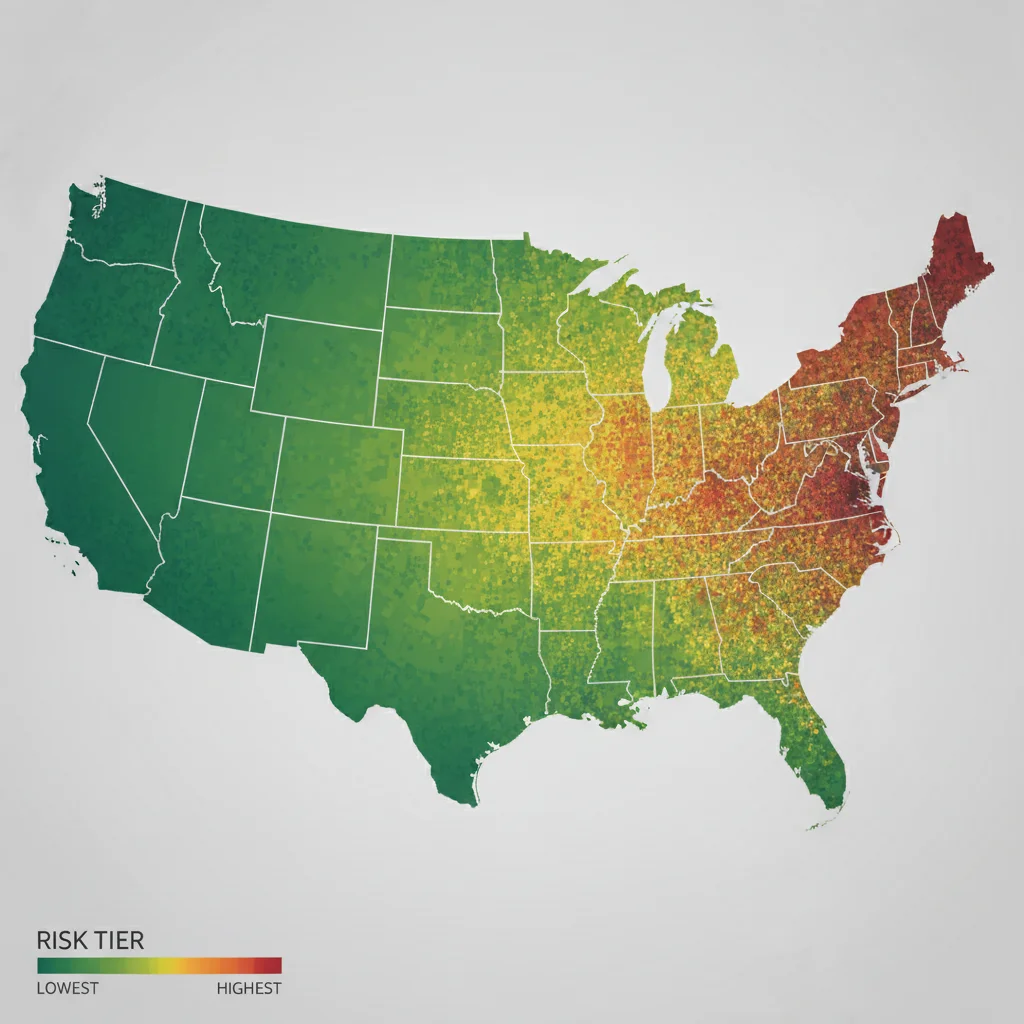
When insurers assign a rating territory to your ZIP code, they're drawing on several distinct data streams. Each one adds a layer to the risk profile they build for your address.
91%
Of U.S. insurers using geographic rating
According to the Consumer Federation of America, the vast majority of major U.S. auto insurers use ZIP code or territory-level data as a primary rating variable.
2–3×
Premium gap within the same metro area
ProPublica analysis of minimum liability premiums found that the most expensive ZIP codes within a metro area often cost two to three times more than the cheapest, for drivers with identical profiles.
$947
Average annual premium difference, urban vs. rural
The National Association of Insurance Commissioners reported that average urban auto insurance premiums in 2022 exceeded rural premiums by roughly $947 per year across comparable coverage levels.
5–30%
Potential savings through telematics programs
Insurer-reported data from major carriers including Progressive and Allstate show telematics program discounts ranging from 5% to 30% for qualifying low-risk drivers.
Top 3
Rate factors in most states: record, vehicle, territory
Industry actuarial filings reviewed by state regulators consistently place driving record, vehicle type, and rating territory among the top three variables in auto insurance pricing models.
Accident and Claims Frequency
The most direct input is how many collision and liability claims get filed per insured vehicle in your area. Insurers track this data internally across their own book of business and supplement it with industry-wide data from organizations like the Insurance Institute for Highway Safety (IIHS) and state motor vehicle departments. A ZIP code with a high claims frequency — even if your specific street is quiet — raises everyone's base rate.
Vehicle Theft Rates
The National Insurance Crime Bureau (NICB) publishes annual vehicle theft data by metro area, and insurers build their own granular theft models down to the ZIP code level. If your area is a hot spot for catalytic converter theft, carjackings, or specific model targeting, your comprehensive coverage will reflect that. This is particularly relevant for owners of high-theft vehicles. Your vehicle's own theft profile compounds the territory factor — a popular theft target parked in a high-theft ZIP code is a double risk signal.
Weather and Natural Disaster Exposure
Comprehensive coverage pays for non-collision damage: hail, floods, falling trees, wildfires. Insurers map catastrophe exposure at granular geographic levels using historical storm data, FEMA flood zone designations, and proprietary catastrophe models. If you live in hail corridor states like Texas, Colorado, or Kansas — or in wildfire-exposed areas of California or Colorado — your comprehensive rates carry that exposure even if your car has never been damaged.
Traffic Density and Road Infrastructure
More cars on the road means more opportunities for accidents. Insurers factor in traffic congestion metrics, average commute times, road quality scores, and intersection accident histories. This is one reason dense urban cores carry higher liability rates than suburban or rural areas with equivalent driver profiles. It's also why some insurers offer low-mileage or usage-based discounts — fewer miles driven in congested areas meaningfully reduces expected loss.
Local Litigation Climate
This factor surprises most consumers. In states or counties with higher rates of bodily injury lawsuits, larger average jury verdicts, and more aggressive plaintiff bar activity, insurers price liability coverage higher to account for elevated claim payouts. Florida and Louisiana, for example, carry notoriously high liability rates partly due to their legal environments. This is separate from driving risk entirely — it's a systemic cost of operating in a particular jurisdiction. Our explainer on how insurers calculate your liability premium covers this dynamic in detail.
What Counts as Your 'Garaging Address'
Insurers rate your vehicle based on where it is primarily kept overnight — not your work address or where you drive most often. If you live in one city but your car is garaged at a second home or a relative's address, the garaging location is what drives your territorial rating. Failing to accurately report this is a form of misrepresentation that can void coverage at claim time.
Territory Maps Are Not Public by Default
While rate filings are technically available through state insurance department records, the territory maps insurers use are rarely published in consumer-friendly formats. If you want to know which territory your address falls into under a specific carrier's system, you generally have to request a quote or ask the insurer directly. Some state regulators maintain rate comparison tools that show territory-adjusted quotes.
Moving? Notify Your Insurer Promptly
Most policies require you to report a change of garaging address within 30 days of moving. Failing to do so can create a coverage gap or give the insurer grounds to deny a claim if the new address carries different risk characteristics than the rated address. Always update your address with your insurer before your move date when possible.
How Rating Territories Actually Work
A common misconception is that insurers rate you at the ZIP code level individually. In practice, insurers file territory maps with state regulators that group ZIP codes into larger rating zones. These territories are drawn based on shared risk characteristics — geographic clusters of similar loss experience — not simply political boundaries.
This means two ZIP codes on opposite sides of a city boundary might be in the same territory, while two adjacent ZIP codes separated by a major highway might be in different ones. The territory designations are proprietary to each insurer, which is one reason why the same driver can receive dramatically different quotes from different carriers for the same coverage — their territory maps don't match.
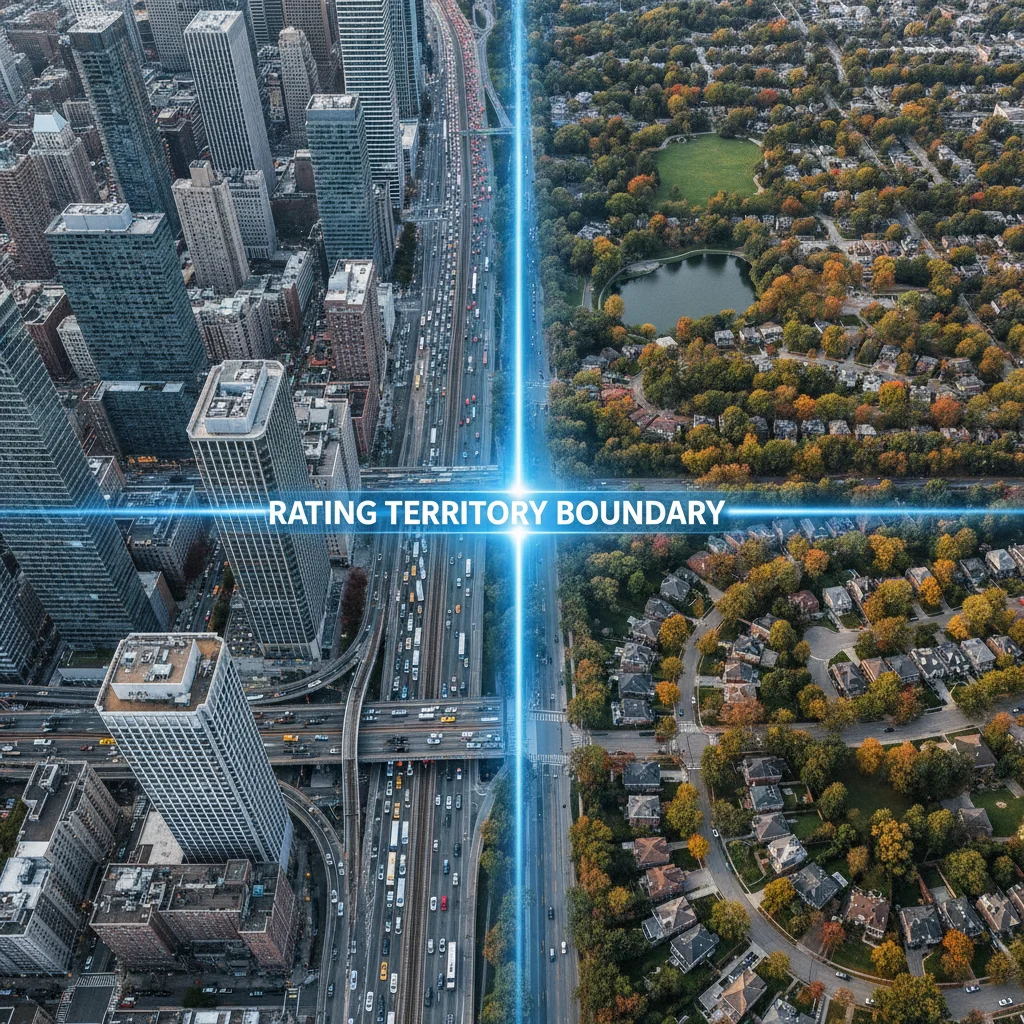
Each territory carries a rating factor — a multiplier applied to the insurer's statewide base rate. A territory factor of 1.0 means your rate is at the baseline. A factor of 1.35 means the territory adds a 35% surcharge on top of every other rating element. That multiplier compounds with your vehicle rating, your driver rating, and your coverage selection.
“Territorial rating is legal and actuarially based, but consumers deserve to understand that the address they register their car at is doing as much work in their premium calculation as their driving record — sometimes more.”
— J. Robert Hunter, Former Insurance Commissioner; Director of Insurance, Consumer Federation of America
Rating territories are submitted to and approved by state insurance commissioners as part of the rate filing process. Regulators review whether the territories are actuarially justified — meaning the loss data supports the rate differential — but they generally do not require that territories perfectly follow ZIP code lines or that they be disclosed in consumer-friendly formats. That opacity is a persistent consumer complaint.
The Premium Gap Is Real — and Wide
Researchers and consumer advocates have repeatedly documented the price swings that accompany ZIP code changes. The Consumer Federation of America and ProPublica have both published analyses showing that minimum liability premiums in the most expensive ZIP codes within a metro area can be two to three times higher than in the cheapest ZIP codes — for a driver with an identical profile.
These gaps exist within the same city, sometimes within the same neighborhood, when an insurer's territory line bisects it. And because insurers don't advertise their territory maps, consumers rarely discover the gap until they're already committed to an address.
For EV owners, the dynamics can be even more pronounced. Higher repair costs, specialized technician requirements, and the elevated cost of battery replacement mean EV insurance pricing already runs higher than comparable gas vehicles — and a high-risk territory compounds that further.
This is also why your renewal rate isn't static, even with a clean record. If claims frequency in your territory rises — say, a bad hail season or a spike in local theft — your renewal rate will reflect it, even if you filed no claims yourself.
Compare Quotes Before You Sign a Lease
If you're choosing between two apartments or neighborhoods, pull insurance quotes for each address before you commit. The premium difference may factor meaningfully into your total cost of living comparison. This is especially important in cities like Miami, New Orleans, or Detroit, where intra-city premium variation is extreme.
Ask About Telematics Before Dismissing It
If you live in a high-rating territory but consider yourself a careful driver, a telematics program is worth evaluating. Most major carriers offer a trial period with no downside penalty if your score comes in below expectations. Programs like Progressive's Snapshot, Allstate's Drivewise, and State Farm's Drive Safe & Save are worth comparing directly.
What You Can — and Can't — Do About It
Territorial pricing is largely outside your direct control. You can't negotiate your ZIP code out of your quote, and misrepresenting your garaging address constitutes fraud. But there are legitimate strategies that can reduce the impact of a high-territory designation.
Shop Across Multiple Carriers
Because each insurer files its own territory maps and factors, the same address can produce meaningfully different results across companies. One insurer may have a territory factor of 1.2 for your ZIP code; a competitor may have 1.45. Shopping three to five quotes for the same coverage is the single most effective tool available. Overlapping discounts can also tip the balance — a carrier with a higher territory factor might still come out cheaper after applying bundling, good driver, or telematics discounts.
Explore Telematics Programs
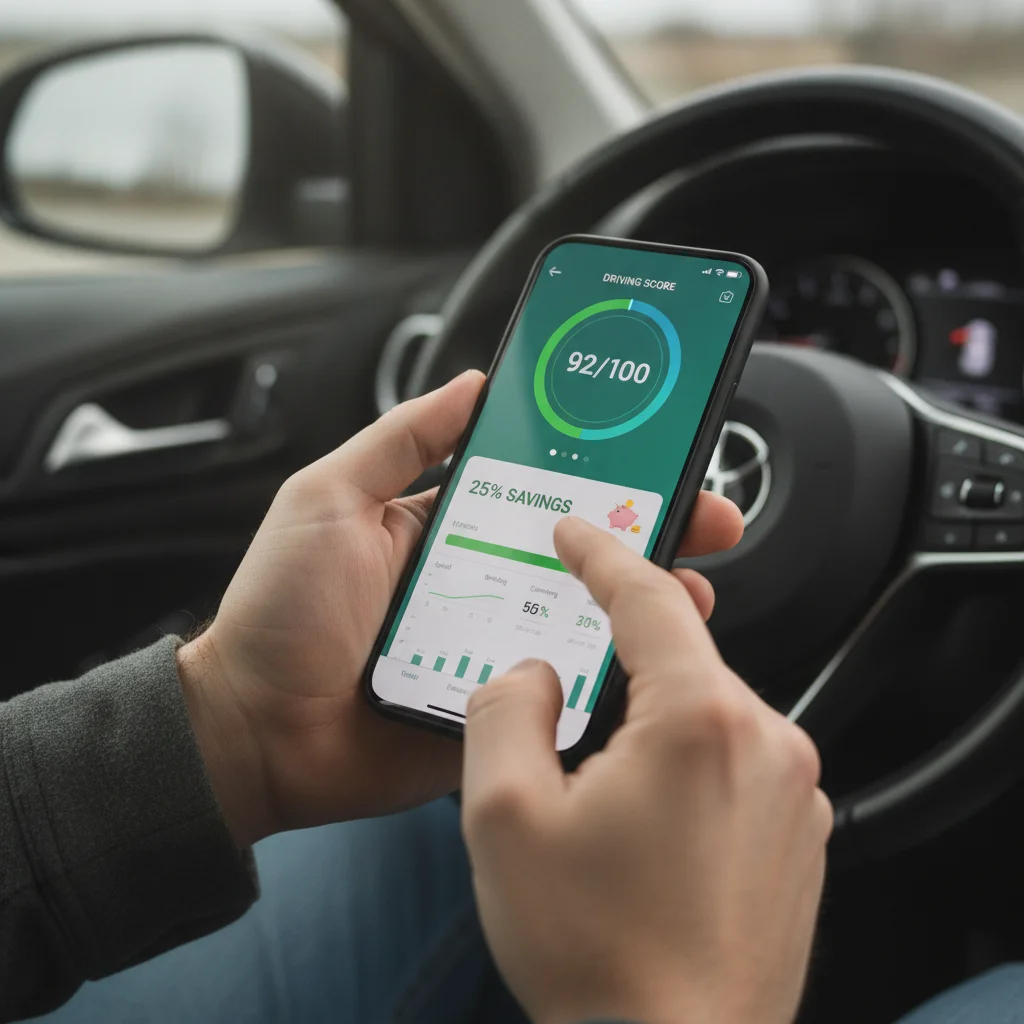
Usage-based insurance programs track your actual driving behavior — speed, braking, time of day, mileage. For a careful driver in a high-risk ZIP code, these programs can partially offset the territory surcharge by demonstrating that your personal risk profile is lower than the average for your area. The savings can range from 5% to 30% depending on the program and insurer.
Document Your Garaging Situation
If your car spends nights in a secured garage rather than on the street, tell your insurer explicitly. Some carriers differentiate between garaged and street-parked vehicles, and the distinction may qualify you for a reduced comprehensive or theft rate even within a high-risk territory.
Revisit Coverage Limits and Deductibles
If your territory factor is inflating your comprehensive and collision premiums substantially, raising your deductible can restore affordability without reducing your core liability protection. Just ensure your emergency fund can cover the higher deductible before making that adjustment.
What Counts as Your 'Garaging Address'
Insurers rate your vehicle based on where it is primarily kept overnight — not your work address or where you drive most often. If you live in one city but your car is garaged at a second home or a relative's address, the garaging location is what drives your territorial rating. Failing to accurately report this is a form of misrepresentation that can void coverage at claim time.
Territory Maps Are Not Public by Default
While rate filings are technically available through state insurance department records, the territory maps insurers use are rarely published in consumer-friendly formats. If you want to know which territory your address falls into under a specific carrier's system, you generally have to request a quote or ask the insurer directly. Some state regulators maintain rate comparison tools that show territory-adjusted quotes.
Moving? Notify Your Insurer Promptly
Most policies require you to report a change of garaging address within 30 days of moving. Failing to do so can create a coverage gap or give the insurer grounds to deny a claim if the new address carries different risk characteristics than the rated address. Always update your address with your insurer before your move date when possible.
The Regulatory Debate Around ZIP Code Pricing
Territorial rating has faced sustained scrutiny from consumer advocates and civil rights organizations who argue that the practice produces racially disparate outcomes, because ZIP code demographics correlate with race in many U.S. cities. The contention is that even if territory pricing is actuarially defensible, it can function as a proxy for protected characteristics.
California regulators took the most aggressive stance, requiring under Proposition 103 that territory be subordinated to driving-safety factors in the rate calculation. The result is that California premiums are more driven by your personal record and mileage than your neighborhood. Most other states allow insurers substantial discretion in how much weight territory receives.
The National Association of Insurance Commissioners (NAIC) has acknowledged the issue and encouraged states to examine their rating factor frameworks, but federal regulation of insurance pricing remains limited under the McCarran-Ferguson Act, which reserves insurance regulation for states.
The practical implication for consumers: where you live determines not just your premium but also which regulatory protections apply to how that premium is set. Shopping across carriers remains the most universally available consumer remedy — and comparing quotes with the same coverage structure across three or more insurers is the closest thing to a built-in check on territorial overcharging.
Compare Quotes Before You Sign a Lease
If you're choosing between two apartments or neighborhoods, pull insurance quotes for each address before you commit. The premium difference may factor meaningfully into your total cost of living comparison. This is especially important in cities like Miami, New Orleans, or Detroit, where intra-city premium variation is extreme.
Ask About Telematics Before Dismissing It
If you live in a high-rating territory but consider yourself a careful driver, a telematics program is worth evaluating. Most major carriers offer a trial period with no downside penalty if your score comes in below expectations. Programs like Progressive's Snapshot, Allstate's Drivewise, and State Farm's Drive Safe & Save are worth comparing directly.

All claims are backed by peer-reviewed research. Sources on request.