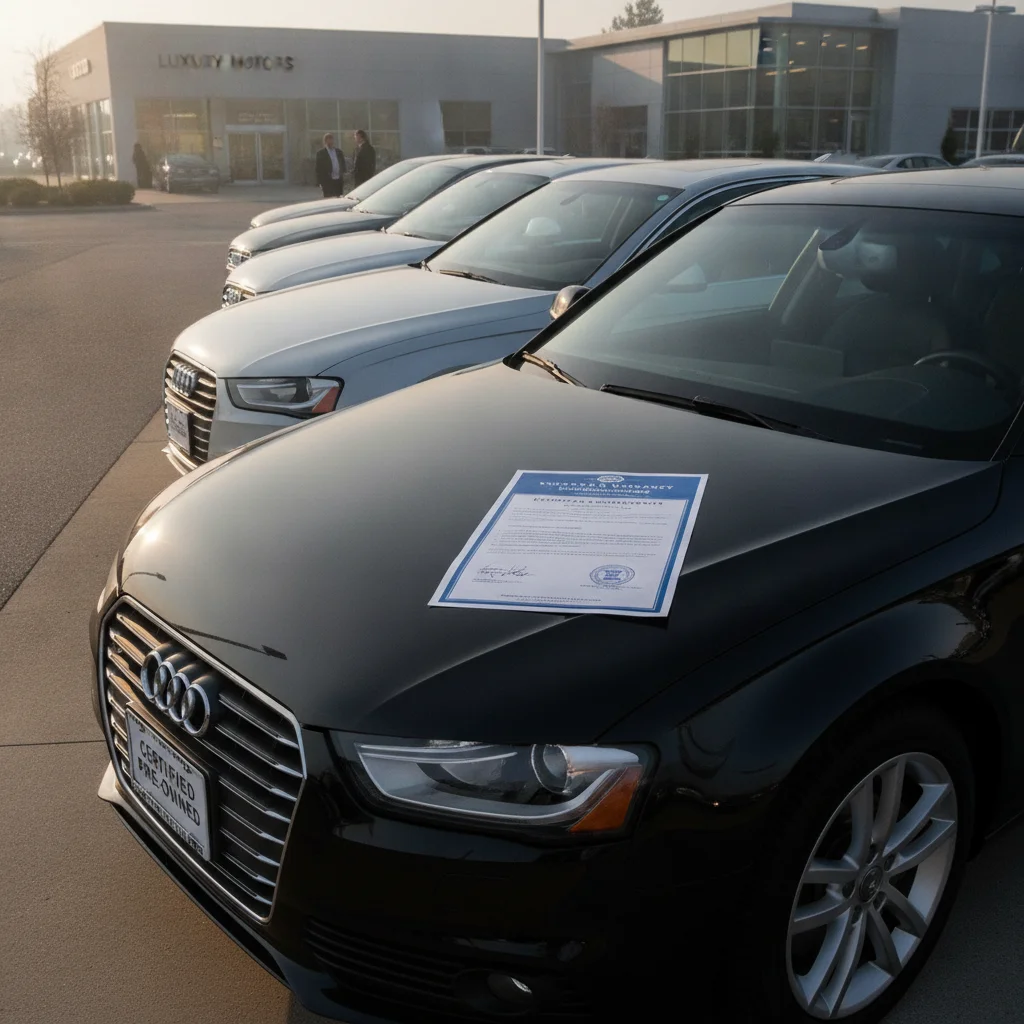
Key Takeaways
Option A
CPO Warranty
The manufacturer-backed safety net built into a certified purchase.
Best for: Buyers who want factory-level coverage immediately after purchase with no extra paperwork or cost beyond the CPO premium.
Option B
Extended Warranty (Service Contract)
The customizable, add-on protection that picks up where CPO leaves off.
Best for: Buyers who plan to keep a CPO vehicle well beyond the certified coverage period or who want to fill specific gaps in CPO exclusions.
If you plan to sell or trade in within three to four years
CPO Warranty
You'll likely still be inside the CPO coverage window, making an extended warranty an unnecessary added expense that you won't have time to use.
If you plan to keep the car for six or more years
Extended Warranty (Service Contract)
CPO coverage will expire well before your ownership ends, and an extended warranty bridges the gap — especially for high-cost components like transmission or electronics.
If you're buying a CPO vehicle from a brand with a history of expensive repairs
Extended Warranty (Service Contract)
Brands with higher-than-average repair costs make extended warranties statistically more valuable; the contract cost is more likely to pay off.
If you want maximum resale flexibility
CPO Warranty
Many CPO warranties transfer to the next buyer at no cost, which adds measurable value when you list the car — something most extended warranties do not offer.
If your CPO warranty excludes a system you're worried about
Extended Warranty (Service Contract)
A targeted service contract can cover specific exclusions — such as electrical systems or advanced driver-assistance tech — that CPO programs often omit.
What Each Warranty Actually Covers
Before comparing the two, it's worth being precise about what each product actually is — because the term "warranty" gets used loosely in car dealerships, and that looseness costs buyers money.
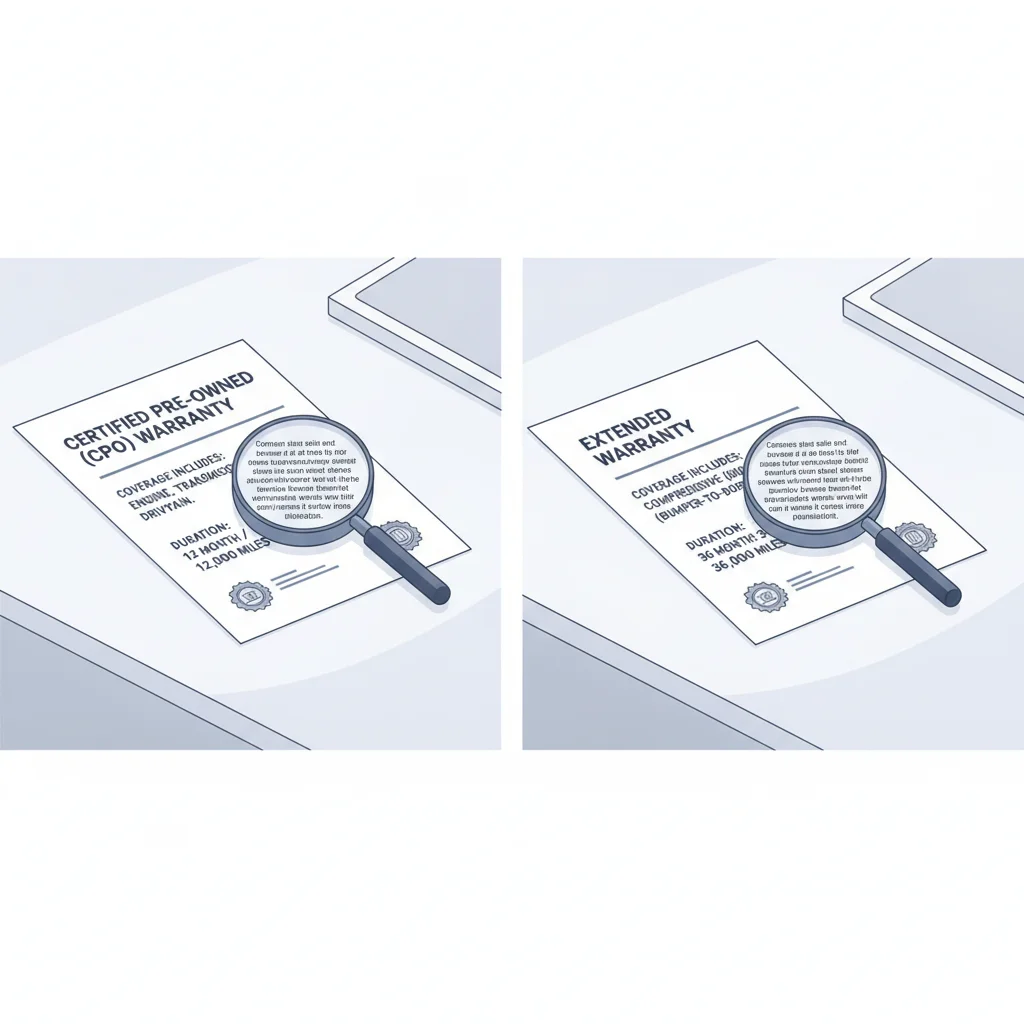
A CPO warranty is a manufacturer-backed guarantee that comes attached to a certified pre-owned vehicle. When an automaker certifies a used car, it's essentially re-underwriting the vehicle's reliability. The CPO warranty is a real warranty under the Magnuson-Moss Warranty Act, which means the manufacturer is legally obligated to honor it. Coverage typically splits into two layers:
- Bumper-to-bumper (comprehensive) coverage: Covers most mechanical and electrical components. This portion usually lasts the shortest — for example, Toyota's CPO program offers a 12-month/12,000-mile comprehensive warranty, while BMW's offers two years with no mileage cap.
- Powertrain coverage: Covers the engine, transmission, and drivetrain. This runs longer — many programs extend it to 7 years or 100,000 miles from the original sale date, not from when you bought it used.
That last point is critical. If you buy a CPO vehicle that is already four years old with 45,000 miles, and the powertrain coverage runs to 7 years/100,000 miles from the original sale, you may only have three years or 55,000 miles of powertrain coverage left — not seven years of fresh coverage.
An extended warranty — more accurately called a vehicle service contract — is a separate product, usually sold by the dealer at closing or by third-party administrators. It is not a warranty in the legal sense. It's a contract promising to pay for specific repairs, subject to terms, exclusions, deductibles, and the financial solvency of whoever backs it.
Extended warranty coverage on used cars varies enormously. Some contracts are nearly bumper-to-bumper in scope; others cover only the powertrain with a long list of exclusions for wear items, sensors, and infotainment components. Reading the actual contract — not just the sales pitch — is the only way to know what you're buying.

The practical upshot: a CPO warranty is factory-grade protection you can trust; an extended warranty is only as good as its contract terms and the company behind it. That distinction shapes every comparison that follows.
Head-to-Head: CPO vs. Extended Warranty
Let's put the two side by side across the dimensions that matter most when you're deciding whether to add an extended warranty on top of a CPO vehicle — or skip it entirely.
| Criterion | CPO Warranty | Extended Warranty (Service Contract) |
|---|---|---|
| Backed by | Vehicle manufacturer | Third-party admin or dealer |
| Legal classification | True warranty (Magnuson-Moss) | Service contract (not a warranty) |
| Cost to buyer | Included in CPO premium (~$1,000–$3,500) | Add-on cost (~$1,500–$3,000) |
| Coverage start | Immediately at CPO purchase | Often after 30-day/1,000-mile wait |
| Coverage scope | Bumper-to-bumper + powertrain (two tiers) | Varies widely; powertrain to near-comprehensive |
| Exclusions | Wear items, accident damage, modifications | Pre-existing conditions, ADAS, infotainment (often) |
| Repair location | Franchised dealer only | Varies; some allow independent shops |
| Transferability | Usually free to next private buyer | Often non-transferable or fee required |
| Duration | Fixed from original sale date | Negotiable; can extend beyond CPO period |
| Negotiability | Not negotiable (manufacturer sets terms) | Price and terms often negotiable |
A few of these rows deserve more explanation:
Transferability
Many manufacturer CPO warranties transfer to a subsequent private-party buyer automatically and at no charge. That's a real selling point when you list the car. How CPO warranty transferability works is worth understanding before you decide whether to pay for an extended contract that may not carry the same benefit.
What's excluded
CPO warranties almost universally exclude wear items — brake pads, tires, filters, wiper blades — as well as damage from accidents, floods, or modifications. Extended warranties add their own exclusions: pre-existing conditions (anything wrong at purchase), maintenance-related failures, and often entire subsystems like infotainment or advanced driver-assistance systems (ADAS). If your primary concern is the radar sensors behind the grille, confirm they're actually listed in the service contract before signing.
Repair location
CPO repairs must be performed at a franchised dealership for that brand. Extended warranties from third-party administrators may allow independent shops, but reimbursement processes vary — some require pre-authorization for every claim, others require you to pay out of pocket and submit for reimbursement. Check the process before you need it.
Original Sale Date vs. CPO Purchase Date
This is the most common misunderstanding in CPO warranty math. When a manufacturer says coverage runs '7 years/100,000 miles,' that clock starts at the vehicle's original retail sale — not when you buy it as a CPO vehicle. A four-year-old CPO car may have only three years of powertrain coverage remaining, even if it was just certified. Always ask the dealer for the original in-service date and cross-reference it with the specific CPO program's term limits before assuming how much coverage you're actually getting.
The Math: Does Layering Both Make Financial Sense?
Here's the core question most buyers face: you've already paid a CPO premium (typically $1,000–$3,500 more than a comparable non-certified used vehicle), and now the dealer is offering an extended warranty for another $1,500–$3,000. Should you add it?
The answer depends on two variables: how long you'll own the car and what the CPO coverage leaves uncovered.
Scenario 1: You'll sell within three to four years
If you buy a three-year-old CPO vehicle with 35,000 miles, and you plan to sell or trade in after another three years, you'll be at roughly six years and somewhere around 70,000–80,000 miles. Many powertrain CPO warranties cover to 7 years/100,000 miles from original sale — meaning you'll likely still be inside CPO coverage when you sell. An extended warranty purchased now would cost $1,500–$2,500 and you'd use little or none of it before selling. That's a poor return.
Scenario 2: You'll keep the car for six-plus years
Same starting point — three-year-old CPO, 35,000 miles — but you plan to keep it for eight years. By year six of your ownership, the car is nine years old and may have 110,000+ miles. The CPO powertrain warranty has likely expired. Now you're exposed to full repair costs on a nearly decade-old vehicle at peak wear. An extended warranty that kicks in at CPO expiration makes a genuine financial case here, particularly for luxury or European vehicles where a transmission repair can run $4,000–$7,000.
$3,800
Average major engine or transmission repair cost
According to RepairPal data, drivetrain repairs are the most common claims on vehicle service contracts and frequently exceed $3,500.
55%
Extended warranty buyers who never file a claim
Consumer Reports analysis found that the majority of extended warranty purchasers never use the contract for a covered repair.
$2,100
Average dealer markup on extended warranty contracts
Industry estimates suggest dealers mark up third-party service contracts by $1,000–$2,500 above administrator cost.
7 yrs / 100K mi
Typical maximum CPO powertrain coverage
Most major manufacturer CPO programs cap powertrain coverage at 7 years or 100,000 miles from the original in-service date, not from CPO purchase.
Running the expected-value calculation
Actuarially, most extended warranty contracts are priced so the provider profits — meaning on average, buyers pay more in contract fees than they receive in repairs. That's not necessarily a reason to decline. Insurance works the same way: you pay more in premiums on average than you collect in claims, but the protection against catastrophic cost is worth the premium to most people.
The question is risk tolerance. If a $5,000 transmission repair would seriously strain your budget, the extended warranty functions as insurance against that outcome, even if the expected value is slightly negative. If you have a repair fund that could absorb a major repair, you may be better off self-insuring.
When extended warranties make sense vs. when to decline explores this expected-value framework in more depth for new cars, but the logic transfers directly to CPO scenarios.

Reading the Fine Print Before You Layer Coverage
If you decide an extended warranty makes sense on top of your CPO vehicle, the contract details determine whether you're actually protected — or just paying for a document that's full of escape clauses.
Key contract terms to verify
- Waiting period
- Many third-party service contracts impose a 30-day or 1,000-mile waiting period before coverage begins. If you buy at closing and something fails on day 15, you may not be covered. CPO warranties, by contrast, begin immediately.
- Deductible structure
- Some contracts charge a per-visit deductible (say, $100 per repair visit), others charge per-component. A single visit for two unrelated repairs could trigger two deductibles under per-component terms. Understand which structure applies.
- Overlap with CPO
- If your CPO warranty is still active, the extended warranty typically functions as secondary coverage — the CPO pays first. This is fine, but confirm neither contract requires you to exhaust one before the other kicks in.
- Exclusion lists
- Read every exclusion. Common ones: consequential damage (if a failed sensor damages the engine, the engine damage may be excluded), pre-existing conditions, and non-OEM modifications. If you've added aftermarket accessories, flag this upfront.
- Administrator vs. insurer
- Some dealer-sold service contracts are backed by the dealer itself — meaning if the dealer goes out of business, your contract is worthless. Prefer contracts backed by a rated insurance carrier or the manufacturer's financial arm.
What extended warranty service agreements actually say vs. what buyers expect walks through contract language in detail — worth reading before you sign anything at the F&I desk.
Also review the extra CPO paperwork that comes with certified purchases to understand exactly what your CPO warranty already commits the manufacturer to covering, so you don't pay for redundant extended coverage.

CPO Insurance Considerations When You Add an Extended Warranty
Warranty coverage and insurance are separate products, but they interact in ways CPO buyers often miss.
If you financed your CPO vehicle, your lender likely requires comprehensive and collision coverage. CPO status doesn't change that requirement. What it does change is your risk exposure during the loan period — and that affects how you should think about gap insurance and deductible levels.
With a CPO warranty covering mechanical failures, the primary financial risk during the CPO period is accidental damage, theft, and total loss — all insurance territory, not warranty territory. An extended warranty doesn't reduce your insurance exposure; it only addresses mechanical breakdown. These are genuinely complementary products, not alternatives.
How CPO status affects insurance decisions covers what to discuss with your insurer before purchase — particularly around gap coverage, which becomes especially relevant when a CPO vehicle's higher purchase price means a larger loan balance relative to depreciated value.
One practical note: if your extended warranty covers rental car costs during repairs, check whether your auto insurance already provides rental reimbursement. Many comprehensive policies do. Paying twice for rental coverage is a common and avoidable overlap.
Finally, think about long-term resale strategy. A vehicle with both a remaining CPO warranty and a transferable extended warranty is a compelling listing. But most extended warranties are not easily transferable — or charge a transfer fee — so factor that into your calculation. Maximizing the value of a CPO purchase over time includes strategies for using warranty coverage proactively to protect resale value throughout ownership.
When You Actually Need Both — and When You Don't
Let's be direct. Most CPO buyers don't need an extended warranty at the time of purchase. Here's a simple decision framework:
You likely don't need an extended warranty if:
- You'll sell or trade in within three to four years of purchase
- You're buying a CPO vehicle with a long powertrain warranty that runs past your expected ownership period
- The vehicle is a brand with strong long-term reliability ratings and relatively affordable repair costs
- You have $5,000+ in accessible savings that could absorb a major repair
You likely do need an extended warranty if:
- You plan to own the vehicle for six or more years, past the likely CPO expiration
- You're buying a luxury or European CPO vehicle where out-of-warranty repairs are expensive — a water pump on an inline-6 BMW costs three times what it does on a Toyota
- You're financing and a large unexpected repair bill could disrupt your loan payments
- The CPO program for your brand is notably limited (some manufacturer CPO programs are stronger than others — compare before you buy)
A word on timing
You don't have to buy an extended warranty at closing. In fact, doing so is often the most expensive option, because the dealer marks it up. Third-party administrators and some manufacturers sell service contracts directly, and you can often purchase one up until the original factory warranty expires. If you're not sure whether you'll keep the car long enough to justify the cost, wait and revisit the decision 12 months before your CPO coverage ends. You'll know more about your ownership plans — and you can shop for better contract pricing outside the dealership.
The paperwork and contracts hub is a useful resource if you want to understand all the documents involved in a CPO purchase before you sit down at the F&I desk — including how extended warranty contracts are presented and what negotiating room exists.

All claims are backed by peer-reviewed research. Sources on request.