Key Takeaways
Start here
What Does 'Certified Pre-Owned' Actually Mean?
Get oriented
CPO vs. Regular Used vs. New: How to Place CPO on the Spectrum
Dig deeper
What a CPO Inspection Really Covers
Understand protection
Understanding CPO Warranties and What They Protect
Run the numbers
The CPO Price Premium: Is It Worth It?
Before you commit
Red Flags and Questions to Ask Before You Sign
What Does 'Certified Pre-Owned' Actually Mean?
The phrase "certified pre-owned" sounds official — and when it comes from a manufacturer, it genuinely is. But the term is used loosely enough in car sales that first-time buyers need to understand exactly what they're being sold before they attach any value to the label.
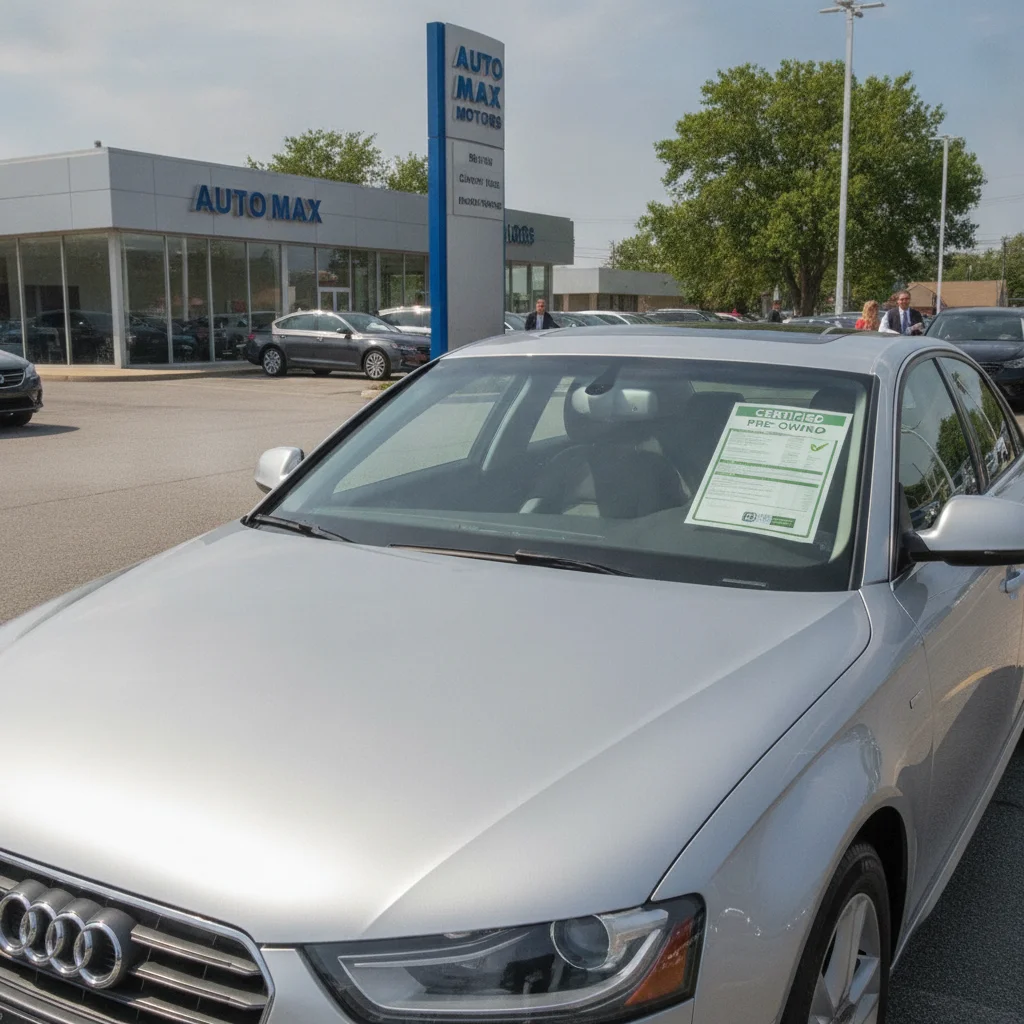
At its core, a certified pre-owned (CPO) vehicle is a used car that has passed a multi-point inspection and meets a defined set of eligibility criteria set by whoever is certifying it. The critical distinction is who is doing the certifying:
- Manufacturer CPO programs — run by the automaker (Toyota, Honda, BMW, Ford, etc.). These are the programs worth paying for. They have standardized inspection checklists, eligibility rules set by the brand, and most importantly, warranty coverage backed by the manufacturer — not just the dealer.
- Dealer-certified programs — created by an individual dealership with no manufacturer involvement. The dealer sets its own inspection standards, issues its own warranty, and carries all the risk. Quality varies wildly.
When most people say "CPO," they mean a manufacturer program. That's the version this guide focuses on, because that's the one that offers meaningful, enforceable protection for a first-time buyer.
Manufacturer CPO program
A certification program run by the automaker itself — not the dealer — that sets standardized inspection requirements and provides a warranty backed by the manufacturer.
Powertrain warranty
A warranty that covers the engine, transmission, and drivetrain components only. It does not cover electronics, air conditioning, or most other systems.
Bumper-to-bumper warranty
A broad warranty covering almost all vehicle components between the front and rear bumpers, with specific exclusions for wear items and damage.
In-service date
The date a vehicle was first sold new to its original buyer. CPO warranty terms are often calculated from this date, not from when you buy the CPO car.
CPO price premium
The additional cost of a CPO vehicle compared to an equivalent non-certified used car. It typically ranges from $1,000 to $3,500 depending on brand and market.
Captive finance arm
The lending company owned by an automaker — such as Toyota Financial Services or Ford Motor Credit — that offers financing directly through the manufacturer's dealerships.
Gap insurance
Coverage that pays the difference between what you owe on a car loan and what the car is actually worth if it's totaled or stolen, preventing you from owing money on a car you no longer have.
Multi-point inspection
A structured checklist of vehicle components a technician inspects before certifying a vehicle. The number of points varies by manufacturer and does not directly indicate inspection quality.
For a complete walkthrough from research through paperwork, see The Complete Roadmap to Buying a Certified Pre-Owned Car. This guide focuses specifically on the concepts you need to evaluate before you start shopping.
CPO vs. Regular Used vs. New: How to Place CPO on the Spectrum
Think of your options as a spectrum from least to most expensive, with trade-offs at every point:
| Vehicle Type | Typical Price | Warranty | Condition Certainty | Best For |
|---|---|---|---|---|
| Regular used (private sale) | Lowest | None | Low — buyer beware | Budget buyers with mechanical knowledge |
| Regular used (dealer) | Low–moderate | None or limited as-is | Moderate | Budget buyers willing to take some risk |
| Manufacturer CPO | Moderate | Manufacturer-backed | High | First-time buyers who want protection |
| New | Highest | Full factory warranty | Highest | Buyers who want zero prior ownership history |
The key insight here: CPO splits the difference between used and new in both cost and peace of mind. You avoid the steepest part of new-car depreciation — a new car loses roughly 15–20% of its value in the first year — while still getting meaningful warranty coverage.
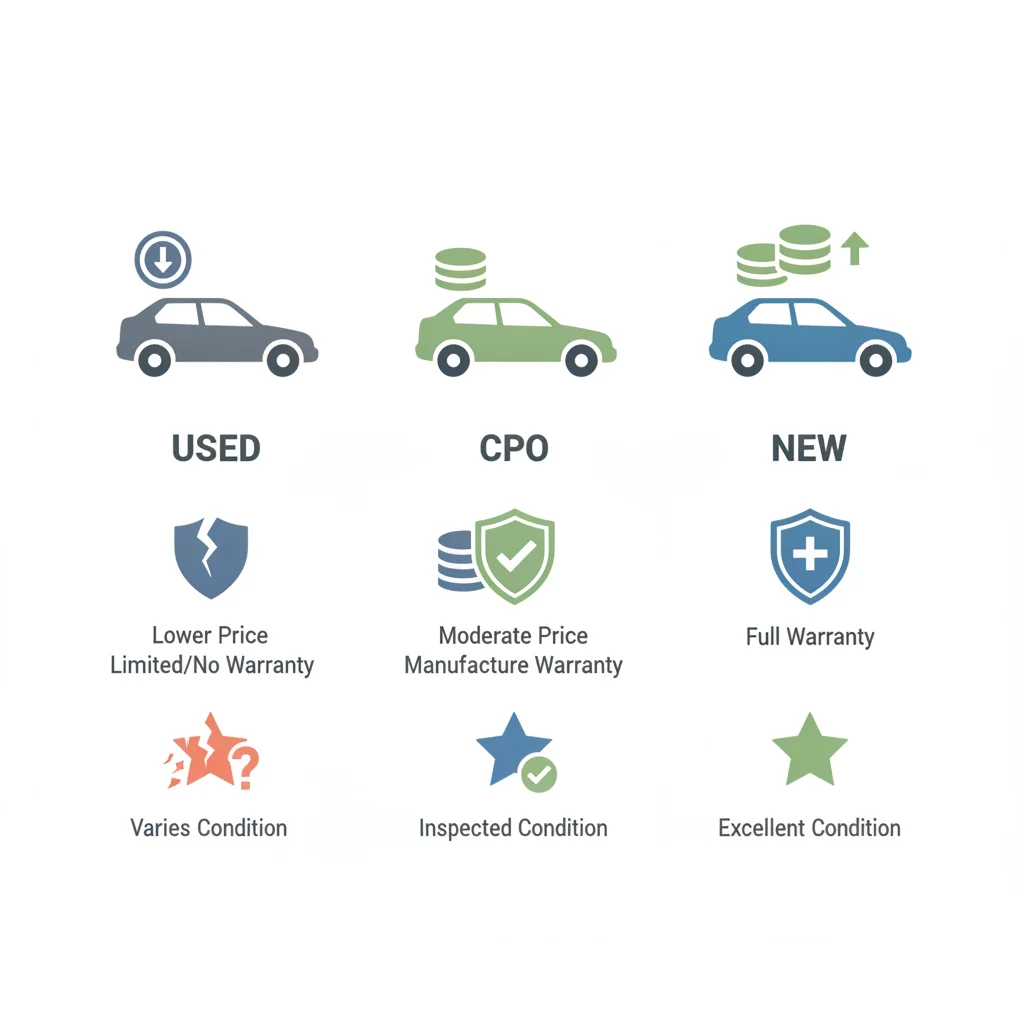
For example, a 2022 Toyota Camry XSE that sold new for $32,000 might be priced at $26,500 as a Toyota Certified Used Vehicle two years later. A similar non-certified Camry at a different dealer might list for $24,800. That roughly $1,700 difference is the CPO premium. Whether it's worth it depends on what the warranty covers and how much you'd pay out of pocket for repairs without it.
Compare this to buying new: buying a brand-new car gives you a full factory warranty from day one, but you absorb that first-year depreciation hit the moment you drive off the lot.
First-Year Depreciation Works in Your Favor
When you buy a CPO car that's 1–2 years old, someone else has already absorbed the steepest depreciation. The original owner took the 15–20% first-year value hit; you're stepping in at a point on the curve where the car loses value more gradually. This is one of the core financial arguments for CPO over new.
Ask for the Inspection Report in Writing
Any reputable dealership selling a manufacturer-certified vehicle should have a completed, signed inspection report on file. Ask for a printed copy — not just a summary brochure. Scan it for items that were repaired and make note of any components flagged as marginal. This document is your evidence if a dispute arises later.
What a CPO Inspection Really Covers
Manufacturers advertise their inspection checklists with impressive point counts — 150-point, 172-point, 203-point. What do those numbers actually mean?
Each "point" on the checklist is one item a technician is supposed to inspect, test, or verify. A 160-point inspection doesn't mean 160 separate mechanical components; it means 160 individual checks, which can include things like:
- Checking that the windshield washer fluid reservoir cap is present
- Verifying that the spare tire has adequate pressure
- Testing each window switch
- Inspecting brake pad thickness
- Scanning for stored diagnostic codes
Some of those checks are genuinely important. Others are trivial. A high point count doesn't necessarily mean a more thorough inspection — it can just mean the manufacturer counts more granular items.
What matters more than the number is what categories are covered. Any credible manufacturer CPO inspection should include:
- Engine and transmission — compression tests, fluid condition, transmission behavior under load
- Brakes and suspension — pad and rotor measurements, shock absorber condition, steering play
- Electrical systems — battery health, all lights, infotainment, HVAC
- Exterior and glass — paint condition, rust, glass chips or cracks
- Interior — seat condition, airbag system, all controls
- Vehicle history verification — title check, odometer accuracy, prior accidents

When you visit a dealership, you can and should ask to see the actual completed inspection report — not just a brochure about the program. The report should show which items passed, which were repaired, and which were noted as acceptable wear. If a dealer won't produce it, treat that as a red flag.
Inspection Reports Are Not Standardized Across Brands
A Toyota 160-point inspection and a Nissan 167-point inspection are not the same document or the same process. Each manufacturer defines its own checklist and pass/fail thresholds. When comparing CPO cars across brands, compare the actual program terms — not the point count marketing number.
CPO Status Doesn't Eliminate the Need for a Test Drive
No inspection report can replace what you learn by driving the car. Take a thorough test drive that includes highway speeds, hard braking, and sharp turns. Listen for rattles, note how the transmission shifts, and test every electrical feature. The inspection confirmed the car met a threshold at a point in time — your test drive confirms it meets your needs today.
Understanding CPO Warranties and What They Protect
The warranty is the single most valuable component of any CPO purchase. It's also the most misunderstood. Here's how to read it correctly.
The Two Types of CPO Warranty Coverage
Most manufacturer CPO programs offer two layers of warranty:
- 1. Remaining factory warranty
- If the car is still within its original new-car warranty period (typically 3 years/36,000 miles bumper-to-bumper and 5 years/60,000 miles powertrain for most brands), that coverage transfers to you as the new owner. You inherit whatever time and mileage is left on those original terms.
- 2. CPO extension warranty
- This is the coverage the manufacturer adds on top of — or in lieu of — the remaining factory warranty. It kicks in after the original warranty expires and extends protection for an additional period. The scope varies dramatically by brand.
Powertrain-Only vs. Bumper-to-Bumper Coverage
This is where many first-time buyers get confused. Powertrain coverage protects the engine, transmission, and drivetrain — the most expensive components, but not the only ones that break. Bumper-to-bumper coverage (also called comprehensive or limited comprehensive) protects almost everything else: electronics, air conditioning, steering, suspension, and more.
Example comparison:
| Brand | CPO Extension | Coverage Type | Deductible |
|---|---|---|---|
| Toyota | +1 yr/12k miles bumper-to-bumper, then to 7yr/100k powertrain | Comprehensive + Powertrain | $0 |
| Honda | To 7yr/100k powertrain from original sale date | Powertrain | $0 |
| BMW | 1 yr unlimited miles bumper-to-bumper | Comprehensive | $50 |
| Ford | To 7yr/100k powertrain from original sale date | Powertrain | $100 |
Notice how differently these programs are structured. A Toyota CPO and a Ford CPO are not interchangeable products — the coverage depth, deductible, and term all differ. Always read the actual program documents.
For a plain-English glossary of all the terms you'll encounter in CPO program agreements, see The CPO Glossary: Terms Every Buyer Should Know.
What's Usually Not Covered
Even bumper-to-bumper CPO warranties exclude certain items. Typical exclusions include:
- Wear items: brake pads, tires, wiper blades, filters
- Damage from accidents, flooding, or misuse
- Cosmetic issues: paint chips, upholstery tears
- Aftermarket modifications
Don't Confuse 'Certified' with 'Covered'
A CPO warranty covers defects and mechanical failures — not everything that can go wrong. Wear items like tires, brakes, and wiper blades are almost always excluded. Read the exclusions list carefully before assuming the warranty gives you blanket protection.
Aftermarket Modifications Can Void Coverage
If the previous owner installed aftermarket parts — performance chips, suspension lifts, non-OEM audio systems — those modifications can complicate or void your CPO warranty claims. Always review the vehicle history and ask directly whether any modifications are present before you close the deal.
Many CPO programs also bundle perks beyond mechanical coverage — things like roadside assistance, trip interruption reimbursement, and loaner car programs. See CPO Roadside Assistance and Perks: What Most Buyers Overlook for a full breakdown of what's typically included and how to use it.
The CPO Price Premium: Is It Worth It?
Let's run concrete numbers. Suppose you're looking at a 2021 Honda CR-V EX with 35,000 miles. You find two listings:
- Option A: Honda Certified Pre-Owned — asking $27,900
- Option B: Non-certified, same trim and mileage at a different dealer — asking $26,200
The CPO premium here is $1,700. Is that a good deal? The answer depends on four factors:
- Remaining factory warranty. If the original 3yr/36,000-mile bumper-to-bumper warranty has already expired (which it has, since the car is over 3 years old from original sale), the CPO extension is the only coverage you're getting. On a Honda, that's powertrain coverage to 7 years/100,000 miles from the original sale date — meaning you might have 2–3 years of powertrain protection remaining.
- Your repair fund. If a transmission replacement costs $3,500–$5,000 and you don't have an emergency fund to cover that, the $1,700 premium looks cheap by comparison.
- The car's reliability history. The CR-V has an excellent reliability record, which lowers the probability you'll need the warranty at all. For a brand with a spottier reliability track record, the warranty has more expected value.
- How long you plan to keep the car. If you're keeping it for 4+ years, more warranty coverage has more time to pay off. If you're planning to sell in 2 years, you're paying for protection you may never use.
For many first-time buyers with limited savings, paying $1,700 to avoid potential four-figure repair surprises is a rational trade. But it's not universally right — model the decision against your own financial situation.
Edmunds CPO Car Search
Filter used car listings by CPO status, brand, mileage, and price to compare certified options in your market. Includes True Market Value pricing to help you evaluate the CPO premium.
Kelley Blue Book CPO Values
Check fair purchase prices for CPO vehicles by make, model, trim, mileage, and ZIP code so you can negotiate from an informed starting point rather than the sticker price.
Carfax Vehicle History Report
Verify a CPO vehicle's ownership history, accident records, service history, and title status before committing. Most manufacturer CPO programs provide this — but you can also run your own check using the VIN.
Auto Loan Calculator
Model the total interest cost of different loan terms and rates on a CPO purchase. Use it to compare a 60-month vs. 72-month loan or a manufacturer rate vs. your credit union's offer.
To understand how CPO vehicles hold their value over time, and which brands offer the best combination of reliability and resale, see Why Some CPO Cars Are a Better Long-Term Investment Than Others.
How CPO Financing Differs from Standard Used-Car Loans
One of the least-discussed advantages of manufacturer CPO programs is that they often come with access to special financing rates through the manufacturer's captive finance arm — the same lender that handles new-car loans.
Here's why that matters: banks and credit unions treat standard used cars as higher-risk collateral than new cars, which means they charge higher interest rates. A buyer with good credit might get 5.5% on a regular used-car loan but 4.9% on a CPO loan from the manufacturer's lender. On a $25,000 loan over 60 months, that 0.6% difference saves about $400 in total interest — not enough to cover the price premium on its own, but it partially offsets it.
During promotional periods, manufacturer lenders sometimes offer CPO financing rates as low as 1.9%–2.9% APR, which can be significantly better than any third-party lender.
CPO Financing Tips for First-Time Buyers
- Get pre-approved before visiting the dealer. Contact your bank or credit union first so you know your baseline rate. Use it as leverage when the dealer presents their financing offer.
- Don't assume the manufacturer's rate is automatically better. Compare it directly to your pre-approval. Sometimes a local credit union beats the promotional rate.
- Watch out for term stretching. Dealers may offer a low rate but extend the loan to 72 or 84 months to make the payment look affordable. A longer term means more total interest paid, even at a low rate.
- Understand gap coverage needs. Because CPO cars cost more than standard used cars, there's a higher risk of being underwater on the loan if the car is totaled early in the loan term. Gap insurance is worth considering — see Insuring a CPO Car: What Changes Compared to a Standard Used Vehicle for a detailed look at how CPO status affects your insurance decisions.
Red Flags and Questions to Ask Before You Sign
Even with a manufacturer-backed program, you're still negotiating with a dealership — and the F&I (finance and insurance) office is where deals can go sideways. Here's what to watch for and ask about.
Questions to Ask the Salesperson
- "Can I see the completed inspection report?" — If they can't produce one, walk away.
- "What is the original in-service date on this vehicle?" — This determines how much factory warranty remains and when the CPO extension clock started ticking.
- "Is the CPO warranty transferable if I sell the car?" — Some programs are; this adds resale value.
- "What is the deductible on the CPO warranty?" — Deductibles range from $0 to $200+ depending on the brand.
- "Has this car had any warranty claims under the factory warranty?" — This tells you what has already broken.
Red Flags to Watch For
- Dealer-certified vs. manufacturer-certified confusion. If the dealer says "certified" but can't name the specific manufacturer program (e.g., "Toyota Certified Used Vehicles"), it's likely dealer-certified only.
- Missing or unavailable vehicle history report. Any credible CPO car should come with a Carfax or AutoCheck report. If the dealer resists, that's a problem.
- Mileage close to the program cap. A car with 74,000 miles certified under a program that caps at 80,000 gives you very little warranty runway. Calculate what you're actually buying.
- Add-on products pushed in the F&I office. Extended service contracts, paint protection, and similar add-ons sold at the desk are often overpriced. A manufacturer CPO warranty already provides substantial coverage — evaluate each add-on independently against its price.
Before you sit down to sign, run through a structured pre-purchase checklist. Before You Sign: A CPO Buyer's Pre-Purchase Checklist covers exactly what to verify on warranty terms, inspection records, and title history so nothing gets missed in the excitement of the moment.
Once you've confirmed the CPO details, you'll still need to navigate the paperwork side of the deal. Understanding what you're signing is just as important as understanding what you're buying — see our overview of Paperwork & Contracts to know what to expect at the desk.
Inspection Reports Are Not Standardized Across Brands
A Toyota 160-point inspection and a Nissan 167-point inspection are not the same document or the same process. Each manufacturer defines its own checklist and pass/fail thresholds. When comparing CPO cars across brands, compare the actual program terms — not the point count marketing number.
CPO Status Doesn't Eliminate the Need for a Test Drive
No inspection report can replace what you learn by driving the car. Take a thorough test drive that includes highway speeds, hard braking, and sharp turns. Listen for rattles, note how the transmission shifts, and test every electrical feature. The inspection confirmed the car met a threshold at a point in time — your test drive confirms it meets your needs today.

All claims are backed by peer-reviewed research. Sources on request.