Key Takeaways
Summary
28 items · 45–90 minutes
Why CPO Isn't a Substitute for Your Own Due Diligence
The phrase "certified pre-owned" carries a lot of marketing weight. Dealers lean on it to justify higher sticker prices, and manufacturers use it to extend their brand relationship beyond the original sale. But certification is not a guarantee — it's a program with terms, exclusions, and variability that most buyers never read closely enough.
Consider the basics: two vehicles can both carry a CPO badge and be priced $3,000 apart, yet offer wildly different coverage windows, deductibles, and eligible repair networks. A Honda CPO warranty works differently from a Toyota CPO, which works differently from a BMW CPO. None of that nuance shows up in the sales pitch.
This checklist exists to close that gap. Whether you're buying from a franchised dealership or evaluating a manufacturer-certified listing online, these 28 items walk you through the warranty terms, inspection documentation, title history, and contract details you need to evaluate before any money changes hands. See our complete roadmap to buying a certified pre-owned car for the broader strategic picture; this checklist zooms in on the pre-signing moment itself.
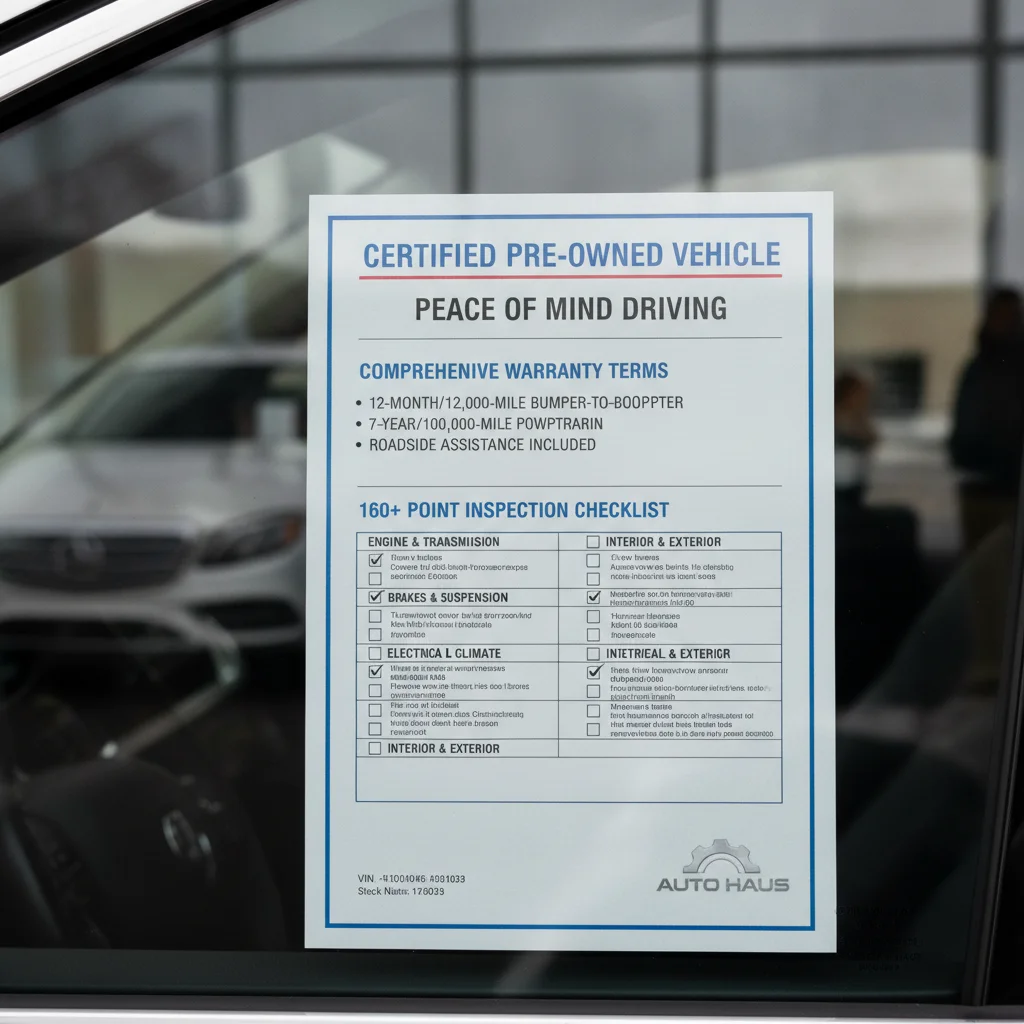
If you're comparing CPO buying to purchasing a non-certified used vehicle entirely online, the pre-purchase checklist for buying a car online offers a useful contrast. The verification steps overlap in some areas but diverge significantly when warranty documents enter the picture.
What You'll Need Before You Start
Running this checklist efficiently requires gathering a few documents and resources ahead of your dealership visit or before finalizing any online purchase. Having these ready means you won't be scrambling mid-negotiation.
Carfax or AutoCheck Vehicle History Report
Pull the full title, accident, and ownership history using the VIN before visiting the dealership.
NHTSA Recall Database (nhtsa.gov)
Check for open or incomplete safety recalls on the specific vehicle using its VIN — free and takes under two minutes.
Manufacturer's Official CPO Warranty Document
The primary document to verify coverage terms, exclusions, deductible, and transferability — request this in writing before signing.
Edmunds True Market Value or KBB Fair Purchase Price
Benchmark the CPO asking price against current market data to quantify the certification premium.
Independent Pre-Purchase Inspector (PPI)
A trusted mechanic or inspection service who can evaluate the vehicle's physical condition outside the dealership's own report.
Personal Bank or Credit Union Financing Pre-Approval
Having a competing loan offer in hand gives you leverage when evaluating the dealer's CPO-subsidized financing rate.
Tread Depth Gauge
A $5 tool that measures exact tire tread depth in 32nds of an inch — more reliable than the penny test for evaluating CPO tire condition claims.
One practical tip: request the inspection report and warranty documents via email before your in-person visit. Dealers who are confident in their CPO vehicles won't hesitate. Those who stall or claim documents are "only available at signing" are sending you a signal worth paying attention to.
The Complete CPO Pre-Purchase Checklist
Work through each group below in order. The warranty and documentation sections are the most consequential — don't skip to the vehicle condition items before you've confirmed the certification itself holds up.
Warranty Verification
Inspection Documentation
Title & History
Vehicle Condition Walk-Around
Financing & Pricing
Verbal Assurances Are Not Coverage
Whatever a salesperson tells you about CPO coverage in conversation carries zero legal weight. The only thing that matters is what appears in the signed warranty document. Before you commit to any CPO vehicle, insist on reviewing the actual warranty paperwork — not a marketing summary, not a printed brochure, and not a verbal walkthrough. If the dealer won't produce the document before signing, that is a serious red flag.
Recalls Must Be Resolved Before You Take Delivery
An open safety recall is the seller's responsibility to remediate, not yours to accept. Check the NHTSA database at nhtsa.gov using the exact VIN of the vehicle you are considering. If any open recalls appear, require written confirmation that all recall work has been completed — with repair order documentation — before signing the purchase agreement. Driving away in a vehicle with an unresolved safety recall shifts all risk to you.
After you've run through the checklist, the paperwork you'll encounter at closing takes on a different character. CPO deals include manufacturer-backed warranty documents layered on top of standard purchase contracts. Our guide to what extra paperwork CPO adds to the deal walks you through each form so nothing surprises you at the table.
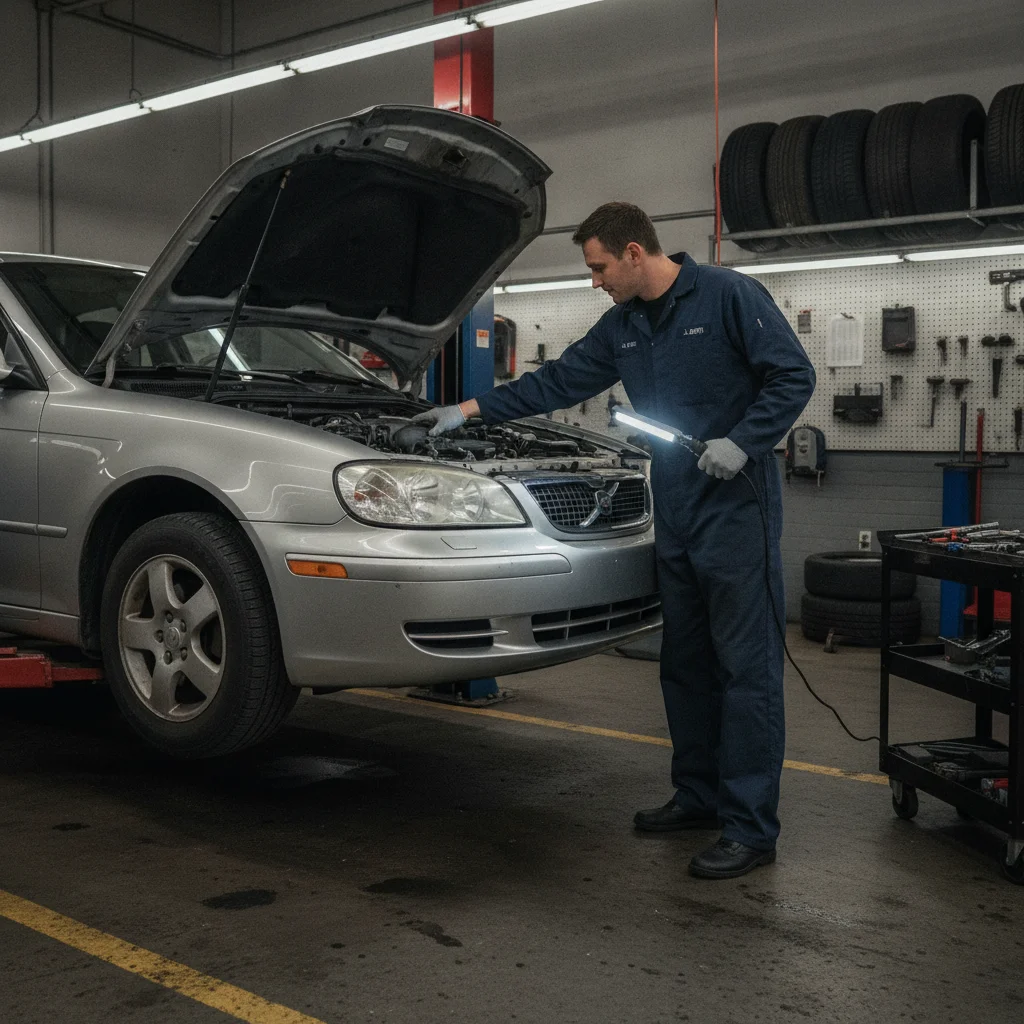
For a deeper dive into physical condition verification — covering undercarriage, engine bay, and body panels point by point — the complete pre-purchase vehicle inspection checklist is an excellent companion resource to bring to the lot.
Dealer-Administered CPO Is Not Manufacturer CPO
Some dealerships offer their own "certified" programs that are not affiliated with the vehicle's manufacturer. These programs are typically backed by a third-party warranty administrator and carry significantly less financial strength than a factory warranty. Always ask: "Is this certification backed by the vehicle's manufacturer?" If the answer is anything other than a clear yes, treat it as a standard used car with an aftermarket extended warranty — and price it accordingly.
High-Mileage CPO Vehicles Carry More Risk
Most manufacturer CPO programs cap eligibility at 80,000–100,000 miles and 5–7 model years. A vehicle certified at 78,000 miles may carry only 12 months or 12,000 miles of remaining powertrain coverage. Know exactly how much coverage remains at the mileage you'll be driving — not at the mileage on the odometer today.
Finance Office Add-Ons Can Erase CPO Value
Dealers frequently present extended service contracts, GAP insurance, and paint/fabric protection during the finance office visit. If you already have a factory-backed CPO warranty, some of these products are redundant. Adding a $1,500 extended service contract on top of a CPO vehicle with three years of factory coverage remaining is almost certainly unnecessary — review your warranty first, then evaluate each add-on against what you actually need.
Evaluating the CPO Premium: Is It Worth the Extra Cost?
Once you've verified that the CPO certification is legitimate and the vehicle checks out, the final question is whether you're paying a fair premium for it. CPO vehicles typically cost $1,500–$3,500 more than comparable non-certified used vehicles with similar mileage and condition. Whether that markup is justified depends on a straightforward cost-benefit analysis.
Start with the warranty coverage gap. Ask yourself: if I bought this vehicle without CPO status, how much would an extended warranty from a reputable third-party provider cost for equivalent coverage? If the answer is $1,200 and the CPO premium is $2,800, the math doesn't favor the CPO — unless the manufacturer's factory coverage offers something the aftermarket can't replicate, such as roadside assistance bundled in or zero-deductible repair terms.
Next, factor in financing. Manufacturer-certified programs frequently offer subsidized APR rates — sometimes 1–2 percentage points below standard used car rates — available exclusively on CPO inventory. On a $28,000 loan over 60 months, a 2% rate difference saves roughly $1,500 in total interest. That's real money that can offset part of the sticker premium.
| Factor | CPO Advantage | Estimated Dollar Value |
|---|---|---|
| Extended warranty coverage | Factory-backed, often bumper-to-bumper | $800–$2,500 vs. aftermarket equivalent |
| Subsidized financing APR | 1–2% below standard used-car rates | $1,000–$1,800 over loan term |
| Multi-point inspection assurance | Documented pass/fail record | Reduces risk of immediate repair costs |
| Roadside assistance | Included in most manufacturer CPO programs | $100–$300/year replacement value |
The bottom line: if the total value of warranty coverage, financing savings, and risk reduction exceeds the CPO price premium, the certification is earning its cost. If it doesn't, you're paying for the badge more than the benefits. Use this checklist to confirm the benefits are real — then make the call with your eyes open.
For a full breakdown of purchase contract terms that apply to any car deal — CPO or otherwise — the pre-signing checklist for car purchase contracts covers price, rate, term, and add-ons before your pen touches paper. And for a broader understanding of the documentation landscape, the Paperwork & Contracts hub is a useful reference throughout the buying process.

Buying CPO is one path within the larger used-car universe. The buying used cars hub covers the full spectrum — from private-party purchases to auction vehicles — so you can benchmark the CPO experience against every alternative before committing.

All claims are backed by peer-reviewed research. Sources on request.