


Key Takeaways
Why Unpreparedness Costs You More Than You Think
Most car buyers spend more time researching a $500 television than a $40,000 vehicle. That imbalance is exactly what dealership finance offices are built around. I spent years on the other side of that desk, and I can tell you with certainty: the buyers who paid the most were almost always the ones who walked in without a plan.
The new car buying process has more moving parts than most people realize — the vehicle price, the financing terms, the trade-in value, the add-ons, the fees. Each one is a separate negotiation, and dealers are practiced at blending them together so you lose track of where the money is going. When you show up unprepared, you're handing the dealer a significant structural advantage.
This isn't about distrust — most salespeople are doing their job. But their job is to maximize gross profit, and your job is to minimize unnecessary spending. That tension only resolves in your favor when you've done the work ahead of time. The good news: the research required isn't complicated. It just requires doing it before you go, not after.

If you're starting from zero, the new car buying cycle guide for first-timers walks through every phase from budgeting to signing. Read that alongside this article and you'll have a complete picture.
The Most Costly Mistakes — and How to Avoid Them
Below are the mistakes I saw most frequently from buyers who paid too much, got buried in a bad loan, or drove home with a car that didn't fit their life. Every one of them is preventable with a few hours of preparation.
Focusing on monthly payment instead of the total purchase price.
Why it happens: Monthly payments feel manageable and easy to compare, so buyers anchor to them rather than the actual cost of the vehicle. Dealers exploit this by stretching loan terms to make high prices look affordable.
Walking in without a pre-approved auto loan.
Why it happens: Many buyers assume the dealership will find them the best rate, or they don't realize they can get pre-approved independently before visiting. This hands the dealer complete control over the financing conversation.
Not checking your credit score and report before applying for financing.
Why it happens: Buyers often assume their credit is "fine" without verifying, or they don't know their credit tier and therefore can't evaluate whether the rate they're offered is fair.
Negotiating the trade-in and new car price simultaneously.
Why it happens: Dealers present the transaction as a single deal to simplify the conversation — but the real effect is that trade-in value and purchase price become levers that can be manipulated against each other without the buyer noticing.
Skipping research on the vehicle's actual market value.
Why it happens: MSRP is printed on the window sticker, so buyers treat it as the target price rather than a starting point. Few buyers check Edmunds, KBB, or TrueCar to understand what others are actually paying in their market.
Agreeing to F&I add-ons under showroom pressure without prior research.
Why it happens: After hours of negotiation, buyers are mentally fatigued when they reach the finance office. The F&I products are presented quickly, priced in small monthly increments, and the buyer just wants to be done.
Buying more car than your budget can realistically support.
Why it happens: The showroom environment is designed to feel aspirational. A salesperson who senses you're drawn to a higher trim will focus your attention there, and monthly payment framing makes upgrades seem affordable when they aren't.
63%
Buyers who didn't negotiate vehicle price
According to a 2023 Cox Automotive Car Buyer Journey study, nearly two-thirds of car buyers accepted the listed price without attempting to negotiate.
2.1%
Average rate advantage of credit union financing
The National Credit Union Administration reported that in 2023, credit union auto loan rates averaged roughly 2 percentage points below those offered by banks and dealer-arranged financing.
$1,000+
Average F&I profit per vehicle
Industry data from the National Automobile Dealers Association (NADA) shows F&I departments consistently generate over $1,000 in gross profit per retail unit sold.
14 hours
Average time spent researching a new car purchase
Cox Automotive's Car Buyer Journey data shows buyers spend an average of 14 hours on research — but much of that happens after the dealership visit rather than before it.
A critical piece of that preparation is understanding your credit before the dealer pulls it. The credit readiness checklist covers how to review your score, dispute errors, and know your tier so there are no surprises at the finance desk.
Don't Let the Dealer Be the First to Pull Your Credit
When you haven't checked your own credit ahead of time, the dealer's credit pull is your first look at your actual rate eligibility — and by then you're already in the chair. Multiple hard inquiries within a short window are generally treated as one inquiry for rate-shopping purposes, but only if you complete all pulls within a 14–45 day window depending on the scoring model. Pull your own report first using AnnualCreditReport.com (this is a soft pull that doesn't affect your score), then get pre-approved before visiting any dealership.
Verbal Promises Don't Survive the Finance Office
If a salesperson promises a specific price, a free accessory, or a certain trade-in value verbally, assume it doesn't exist until it appears in writing. Deals are restructured frequently between the sales floor and the finance office, and verbal commitments are routinely forgotten or denied. Get every agreed term written down before you sign anything.
What to Do Before You Set Foot in a Dealership
Preparation isn't just about knowing the MSRP. It's about arriving with your entire position locked in so you're reacting to their terms from a position of knowledge, not curiosity.
Step 1: Know your real budget — including total cost of ownership
Calculate what you can genuinely afford monthly, then work backwards to a purchase price. Factor in insurance (get quotes before you buy), fuel costs, expected maintenance, and registration fees. A $450/month payment on a vehicle with $200/month in insurance and premium fuel needs is a very different financial picture than the same payment on an efficient sedan.
Step 2: Research the vehicle's actual market value
MSRP is a starting point, not a target. Check Edmunds True Market Value, KBB Fair Purchase Price, and TrueCar to understand what people in your zip code are actually paying. For high-demand vehicles, you may pay over MSRP — but you should know that going in, not be surprised by it at the desk.
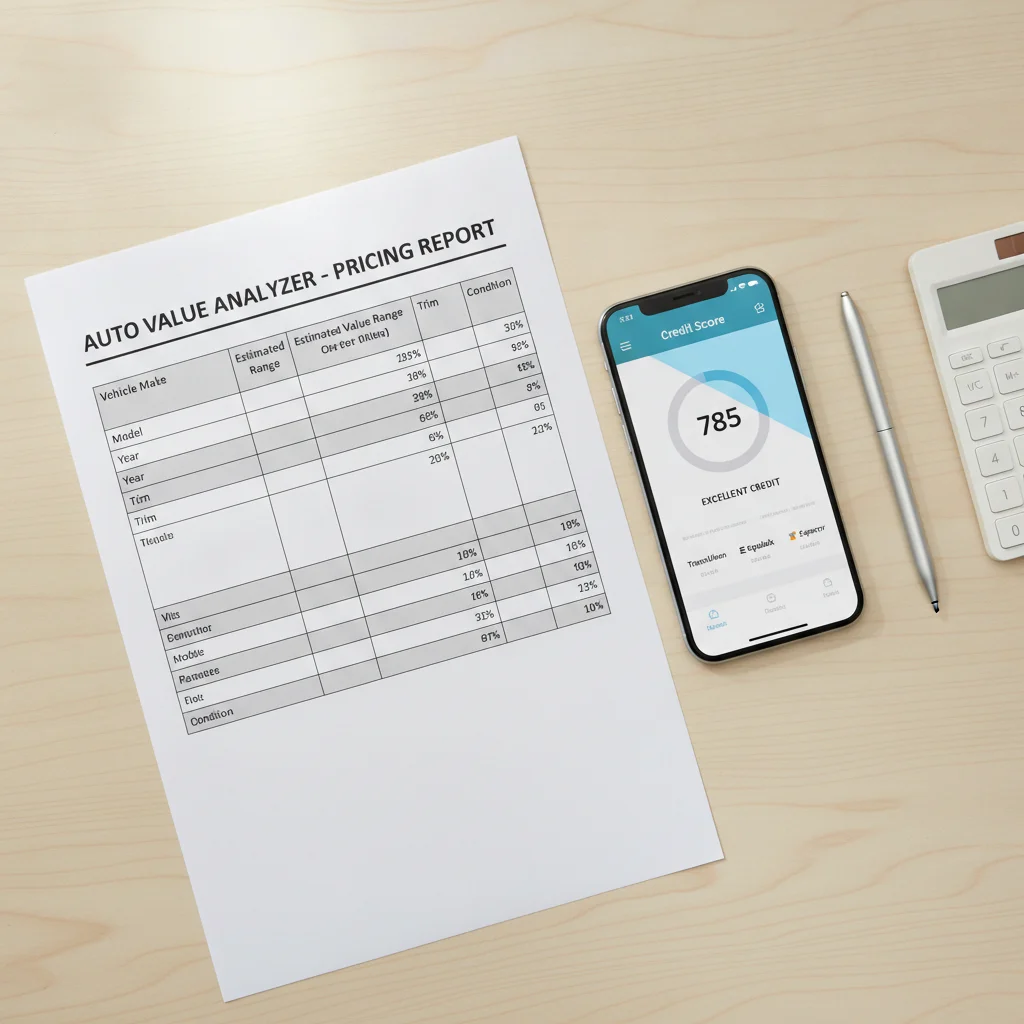
Step 3: Get pre-approved financing before you go
Walk into the dealership with a pre-approval letter from your bank or credit union. This gives you a real rate benchmark and removes the dealer's ability to control the financing conversation. If the dealer's rate beats yours, great — use it. If it doesn't, you already have your fallback.
Step 4: Get your trade-in value independently
Use CarMax, Carvana, or a local independent dealer to get a written offer on your trade-in before you negotiate your new car. This gives you a floor — a real number you can walk away with regardless of what the dealer offers.
Step 5: Build your complete pre-visit checklist
The dealership preparation checklist consolidates all of this into a structured format you can work through in an afternoon. If you prefer to handle as much as possible remotely, the online car buying hub covers tools and platforms that let you lock in pricing and financing before any in-person interaction.
Never Sign a Contract Without Reading Every Line
The finance office operates under time pressure — the manager will move quickly through paperwork and expect you to sign promptly. Slow down. Read every document. Check that the purchase price, interest rate, loan term, and monthly payment match exactly what you agreed to. Spot-check for add-ons you didn't approve. Errors — intentional or not — are common and expensive. If anything doesn't match, stop and ask before signing.
Negotiation Fundamentals That Protect Your Bottom Line
Even well-researched buyers sometimes unravel in the showroom because negotiation pressure is real and salespeople are skilled at applying it. A few rules will keep you on track.
Always negotiate the out-the-door price, not the monthly payment
The out-the-door price is the total you'll pay: vehicle price + taxes + fees + any add-ons. This is the only number that matters when comparing offers. Monthly payment is a derivative of that number plus your loan term — a dealer can make any payment look affordable by stretching the loan to 84 months.
Separate every negotiation
New car price. Trade-in. Financing. F&I add-ons. These are four distinct transactions. Dealers prefer to blend them — "What if we give you more for your trade if you take our financing?" — because blending obscures where the profit is. Insist on negotiating each one independently.
Use competing dealer quotes as leverage
Email the internet sales department at three or four dealers with the exact same vehicle configuration and ask for their best out-the-door price. You don't have to be adversarial — just let them know you're getting multiple quotes. This alone can move the price several hundred dollars.

Be willing to walk away — and mean it
The single most powerful negotiating position is genuine willingness to leave. If a dealer knows you need to drive home in a car today, they'll hold firm on margin. If you've done your research and have competing quotes, walking away is a real option and they know it. Dealerships have monthly quotas — a buyer who walks often gets a callback with a better number within 24 hours.
For a deeper playbook on pre-negotiation positioning, see the pre-negotiation checklist — it covers pricing research, financing benchmarks, and trade-in positioning in a single structured guide.
The Finance Office: Where Unprepared Buyers Lose the Most
If the sales floor is the first arena, the finance and insurance (F&I) office is the second — and it's where the real money is made on unprepared buyers. After you've negotiated a good vehicle price, you're handed off to a finance manager whose job is to load profit back in through financing, extended warranties, paint protection, gap insurance, and a menu of other products.
Some of these products have genuine value. Gap insurance, for example, makes real sense if you're putting less than 20% down — it covers the difference between what you owe and what the car is worth if it's totaled. An extended warranty can be worthwhile on certain vehicles with higher long-term repair costs. But many F&I products are priced at extreme margins, and the finance manager is trained to present them as monthly payment increases that feel trivial.

The rules here are simple: decide in advance which products you'd consider and what you'd pay for them. Don't make any F&I decisions under showroom pressure. You can research extended warranty pricing online and often buy from a third party for less. And remember — almost everything in the F&I menu is negotiable, including the price of the warranty itself.
Buyers who've already secured pre-approved financing enter this room with a significant advantage. They know their rate, they have a fallback, and they're harder to control through financing manipulation. That's exactly why pre-approval is non-negotiable preparation, not optional homework.
If you're also weighing a used vehicle purchase, the dealer-side strategies for used car buyers covers the same dynamics in the pre-owned context — many of the F&I tactics are identical.
You Control More of This Process Than You Think
The dealership experience feels high-pressure because it's designed to feel that way — time pressure, social pressure, the sense that you need to decide now or lose the deal. Almost none of that is real. The car will be there tomorrow. A competing dealer has the same or similar inventory. A better-prepared buyer is almost always a better-outcome buyer.
The buyers I saw walk out genuinely happy — paying a fair price, with financing that made sense, in a vehicle that fit their life — were the ones who showed up knowing their number, knowing their credit, and knowing what the car was actually worth. They weren't aggressive or difficult. They were just informed, and that was enough.
That's the entire point of the research phase: not to "beat" the dealer, but to walk in as an equal participant in the transaction. You're spending tens of thousands of dollars. You've earned the right to understand exactly where each dollar is going. A few hours of preparation is the cheapest investment you'll make in the entire car buying process.
Start with the full pre-dealership checklist and work through it methodically. By the time you walk through those showroom doors, the power dynamic will already have shifted.
All claims are backed by peer-reviewed research. Sources on request.