
Key Takeaways
True Cost of Car Ownership
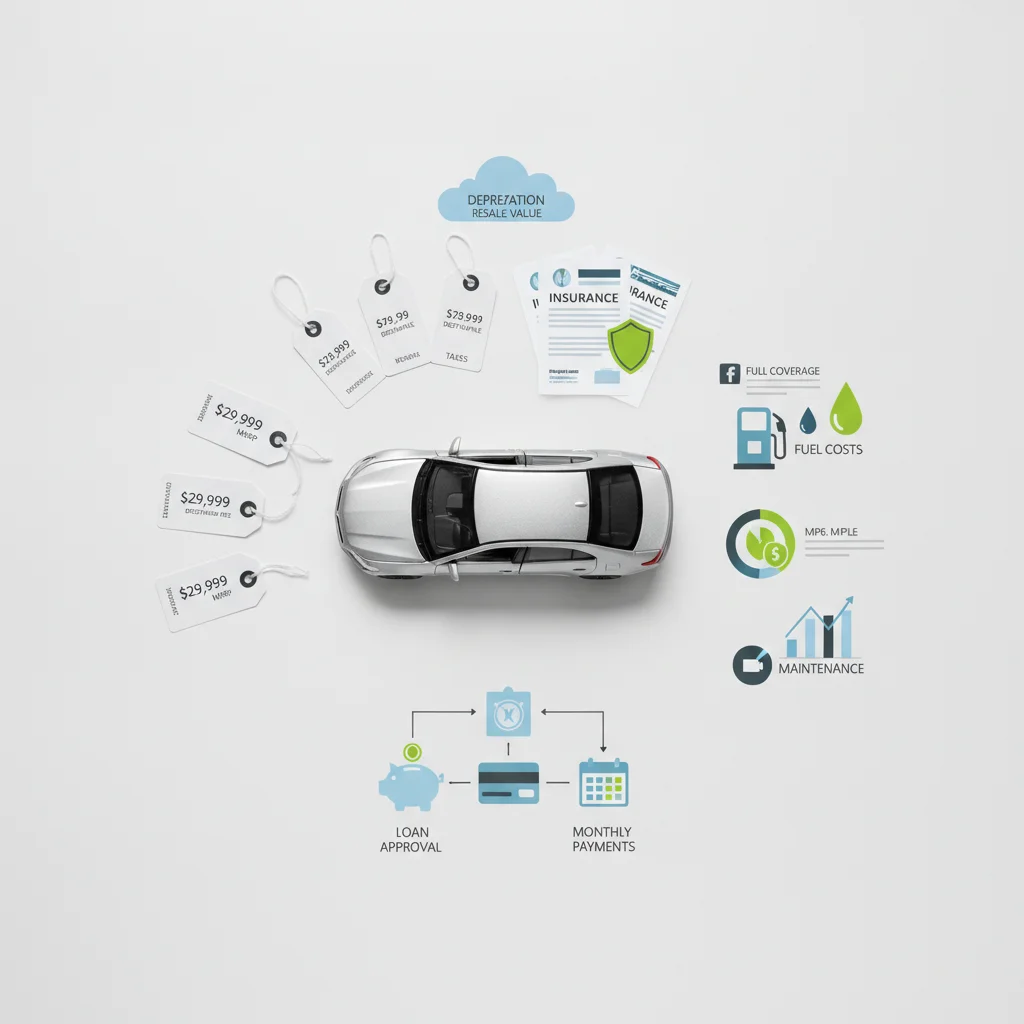
The true cost of owning a new car goes far beyond what you paid at the dealership. It includes every dollar you spend to legally operate, insure, fuel, and maintain that vehicle — plus the value the car loses the moment you drive it off the lot. In year one specifically, several of these costs hit their highest peak and never return to that level again.
Economists and auto analysts often calculate total cost of ownership (TCO) on a per-mile basis, factoring depreciation, financing interest, insurance premiums, fuel, maintenance, registration, and taxes into a single annualized figure.
Why Year One Is the Most Expensive Year You'll Ever Own That Car
Most buyers focus almost entirely on the monthly payment. That number is visible, concrete, and easy to budget around. But the monthly payment is a narrow window into what new car ownership actually costs. In year one, you're absorbing a convergence of one-time and recurring expenses that will never stack up this high again.
Here's the straightforward version: when you buy a new car, you're paying peak prices across virtually every cost category at the same time. The car's value is at its highest — which means your insurance premiums, your registration fees, and your financing balance are all calculated from that elevated starting point. You also typically pay sales tax on the full purchase price, dealer documentation fees, and destination charges before you even make a single monthly payment.
Add the steepest depreciation curve of the car's life, and year one becomes a financial event that deserves far more planning than most buyers give it.

This article breaks down every major cost category you'll encounter in the first 12 months, gives you real numbers to benchmark against, and shows you where the leverage points are — the decisions you can make before signing that actually change the outcome.
The Out-the-Door Price: More Than the Sticker
Before we even get to ongoing costs, the purchase transaction itself costs more than the vehicle's advertised price. Understanding what drives that gap is step one.
Sales Tax
In most states, you'll pay sales tax on the full purchase price of the vehicle. At a 7% rate — close to the national average — a $35,000 car generates $2,450 in tax alone. Some states allow you to reduce the taxable amount by your trade-in value; others don't. Know your state's rules before you negotiate.
Dealer Fees
Documentation fees, dealer preparation fees, advertising fees — these go by many names and vary wildly. Some states cap doc fees (California limits them to $85); others let dealers charge $800 or more. Always ask for an itemized out-the-door quote, and challenge any fee that isn't government-required.
Destination Charges
Every new vehicle carries a manufacturer destination charge — typically $900–$1,500 depending on the model and shipping distance. Unlike most dealer fees, this one is non-negotiable; every dealer pays it and passes it through.
$2,450
Average sales tax on a $35,000 new car at 7%
Sales tax is calculated on the full purchase price in most states before any rebates are applied at the dealer level.
15–20%
Average value lost in year one on a new vehicle
According to Edmunds and CarFax depreciation data, most new vehicles lose between 15 and 20 percent of their value within the first 12 months of ownership.
$1,900
Average annual full coverage insurance premium, new car
The Insurance Information Institute estimates average full coverage premiums at roughly $1,700–$2,200 annually for new vehicles, varying by state, driver profile, and vehicle type.
$2,100
Interest paid in year one on a typical new car loan
On a $33,000 loan at 7% APR over 60 months, approximately one-third of total loan interest is paid in the first 12 months due to front-loaded amortization.
~$14,000
Total year-one ownership cost, $35K vehicle
Combining depreciation, interest, insurance, registration, fuel, and maintenance, a mid-range new car typically generates $12,000–$16,000 in total first-year ownership costs beyond principal repayment.
Extended Warranties and Add-Ons
The finance office is where dealers make significant profit on add-ons: extended warranties, paint protection, GAP insurance, tire-and-wheel coverage. Some of these have genuine value; many are overpriced for what they deliver. GAP insurance, for instance, is worth considering if you're financing more than 80% of the vehicle's value — but you can often buy it through your own insurer for a fraction of the dealer price.
The upshot: on a $35,000 vehicle, your real out-the-door cost before you make a single payment commonly runs $37,500–$40,000 once taxes and fees are included.
Depreciation: The Largest Cost Nobody Puts in the Budget
This one deserves its own conversation because it's simultaneously the biggest expense and the most ignored. The moment a new car leaves the dealership lot, it begins losing value — and in year one, that decline is steeper than at any other point in the vehicle's life.
On average, a new car loses 15–20% of its value in the first 12 months. On a $35,000 purchase, that's $5,250–$7,000 gone — not to a payment, not to fuel, not to maintenance. Just gone, absorbed into the gap between what you paid and what the car is now worth.
“Depreciation is the elephant in the room of car ownership. Buyers obsess over the interest rate and forget that the biggest cost — the loss in the car's value — never shows up on their loan statement.”
— Philip Reed, Senior Consumer Advice Editor, Edmunds
Why does this matter practically? Because depreciation is a real cost whether you plan to sell the car or not. If you keep it, you've permanently lost that equity. If you sell or trade it in, you'll see that loss reflected directly in what you're offered. And if you're financing the vehicle, rapid first-year depreciation creates the risk of being upside down — owing more on your loan than the car is worth — which limits your options if your situation changes.
See our detailed breakdown of first-year depreciation to understand exactly why the drop is so steep and how it varies by vehicle segment. And if you want the full picture beyond year one, the five-year depreciation curve shows how costs evolve over time.
Not all vehicles depreciate equally. Trucks and SUVs with strong demand often hold value better than sedans. Luxury vehicles typically depreciate faster. Checking resale value projections before you buy — using tools covered in our valuation tools guide — is one of the smartest pre-purchase moves you can make.
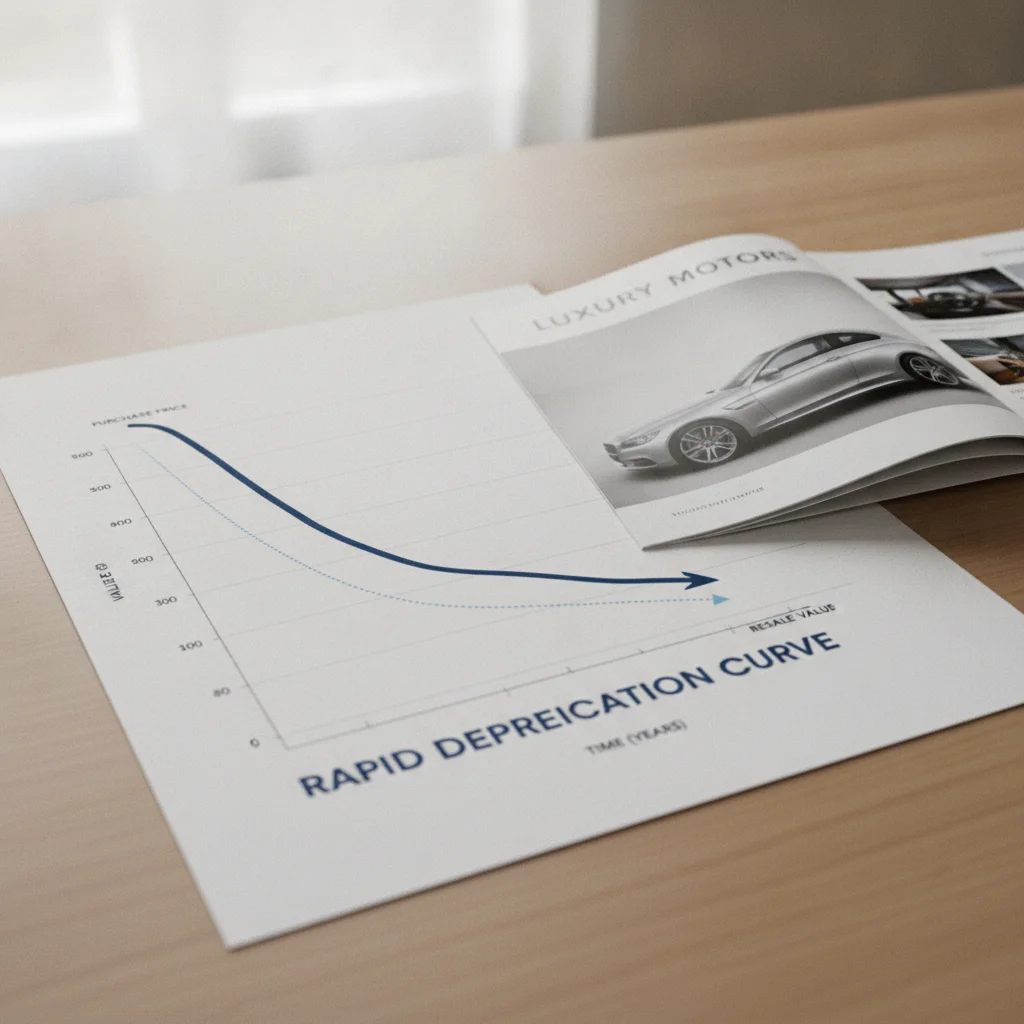
If you want the full picture of depreciation as an ownership cost, including why it rarely shows up in monthly payment calculators, our companion piece covers exactly that.
Auto Insurance: Why New Car Premiums Hit Hardest in Year One
Insuring a new car costs more than insuring a comparable used vehicle for two reasons: the car's replacement value is higher, and your lender legally requires you to carry full coverage (comprehensive and collision) as a condition of the loan.
The national average for full coverage auto insurance on a new vehicle runs roughly $1,700–$2,200 per year, though this varies significantly by state, driving record, credit score, and the specific vehicle. Sports cars, luxury models, and vehicles with high theft rates all carry premium surcharges.
Shop Insurance Before You Sign the Deal
Get quotes on the exact year, make, model, and trim you're considering before you finalize your purchase. Insurance premiums vary significantly between vehicles at similar price points — sometimes by $400 or more per year. A 10-minute call to your insurer could change which car makes financial sense.
Use Total Cost, Not Payment, to Compare Vehicles
When comparing two vehicles, add up depreciation exposure (check resale value ratings), insurance quotes, and fuel costs alongside the payment. Two cars with identical monthly payments can have year-one total costs that differ by $2,000–$3,000 or more. Make the decision on the full number, not the monthly slice.
A few things that genuinely move the needle on your premium in year one:
- Your deductible choice: Raising your collision deductible from $500 to $1,000 typically reduces your premium by 10–15%. On a $2,000 annual premium, that's $200–$300 back in your pocket per year.
- Bundling: Combining auto and home (or renters) insurance with the same carrier commonly generates discounts of 10–20%.
- Shopping before you buy: Get insurance quotes on the specific make and model you're considering before you finalize the purchase. The difference in annual premium between two similarly priced vehicles can easily exceed $400.
- Your credit score: In most states, insurers use credit-based insurance scores heavily in rate calculations. A strong credit score is worth real money on your premium.
When comparing new versus used, remember that on a used car that's paid off, you have the option to drop collision coverage entirely — a cost lever that simply doesn't exist when you're financing a new vehicle.
Registration, Taxes, and Government Fees
Registration fees vary so dramatically by state that generalizing is almost meaningless — but the directional truth is consistent: new cars cost more to register, and the first year is the most expensive.
States use one of two basic approaches:
- Flat fee states
- Charge a set amount regardless of vehicle value — often $50–$200. Your new car pays the same as a 10-year-old economy car.
- Value-based states
- Calculate registration fees as a percentage of the vehicle's value. California, Virginia, Minnesota, and others use this model. On a $35,000 new vehicle in a state charging 1.5% of value, you're looking at $525 in year one — dropping each year as the car depreciates.
Beyond registration, several states impose a separate personal property tax on vehicles (Virginia, Missouri, and others), assessed annually based on the car's current market value. In Virginia, this can run 4% of the vehicle's value — meaning a $35,000 car generates a $1,400 personal property tax bill in year one.
Our registration and taxes hub has state-by-state breakdowns if you want to look up your specific situation. For a direct comparison of how registration costs stack up on new versus used vehicles over time, see registration fees over a full ownership period.
State Registration Fees Vary Enormously
If you're near a state border or considering relocating, registration costs alone can swing by hundreds of dollars annually. Flat-fee states like Montana and Arizona charge nominal amounts; value-based states like California and Virginia charge fees that scale directly with what your car is worth. Check your specific state's DMV fee schedule before finalizing your budget.
These Numbers Are Averages — Yours Will Vary
The year-one cost estimate in this table assumes a mid-range vehicle, a midtier insurance profile, average fuel prices, and a value-based registration state. Your actual costs will depend on your credit score, location, driving habits, the specific vehicle, and the terms you negotiate. Use these numbers as a calibration framework, not a precise prediction. The structure of the costs — depreciation, interest, insurance, registration, fuel, maintenance — applies universally even when the dollar amounts shift.
Financing Costs: The Real Price of Your Loan
Unless you're paying cash, the loan is a direct cost of ownership — and in year one, you're paying the most interest you'll ever pay on that loan. That's because loan interest is front-loaded: your early payments are weighted toward interest, with only a small portion reducing your principal balance.
On a $33,000 loan (after a $5,000 down payment on a $38,000 out-the-door purchase) at 7% APR over 60 months, your total interest paid over the life of the loan is approximately $6,200. But in year one alone, you'll pay roughly $2,100 in interest — more than a third of the total, for payments that don't reduce your loan balance much at all.
APR matters enormously. The difference between a 5% and 9% rate on that same $33,000 loan over 60 months is about $3,700 in total interest — enough to cover more than a year of fuel costs. That's why securing pre-approval through a bank or credit union before you walk into the dealership is one of the most financially impactful steps a buyer can take. The dealer's financing arm may offer competitive rates — or they may not — but you can only know if you have a competing offer in hand.
Also worth noting: if you're financing more than 80–90% of the vehicle's value, GAP insurance (Guaranteed Asset Protection) is worth serious consideration. It covers the difference between your loan balance and the car's actual cash value if the car is totaled or stolen — a real exposure in year one when depreciation can outpace your principal paydown.
Fuel and Maintenance: Ongoing Costs That Start Immediately
These categories are more predictable than depreciation or insurance, but they're real money and worth quantifying.
Fuel
The average American drives about 15,000 miles per year. At $3.50 per gallon and 30 MPG combined (a reasonable mid-range assumption for many new sedans and crossovers), that's approximately $1,750 per year in fuel. A truck or SUV getting 20 MPG runs about $2,625 annually. A hybrid getting 45 MPG drops to around $1,167.
Fuel economy isn't just an environmental consideration — it's a $500–$1,400 annual cost difference that compounds over every year you own the car.
Maintenance in Year One
New cars come with a manufacturer warranty, so year one is usually the lightest maintenance year you'll have. Most of your expenses will be routine oil changes (typically $50–$100 each, 2–3 times per year), tire rotations, and possibly a cabin air filter. Budget around $300–$500 for maintenance in year one on most new vehicles.
Many manufacturers now offer complimentary maintenance for the first two to three years — BMW, Mercedes, Hyundai, and others. If the vehicle you're considering offers this, it's a genuine value worth factoring into your comparison.

For buyers weighing new versus used, this is where the comparison tilts back toward new in year one specifically: used cars carry more maintenance uncertainty and don't come with full factory warranty coverage. That said, the lower purchase price, lower depreciation impact, and lower insurance cost on a used vehicle typically more than offset the maintenance advantage of new. See our breakdown of used car ownership costs for a direct comparison.
Putting It All Together: A Year-One Cost Summary
Here's what year one actually looks like on a $35,000 new vehicle financed with $5,000 down at 7% APR over 60 months, driven 15,000 miles per year in a value-based fee state:
| Cost Category | Estimated Year-One Cost |
|---|---|
| Depreciation (18% of purchase price) | $6,300 |
| Loan interest (year one) | $2,100 |
| Insurance (full coverage, midrange rate) | $1,900 |
| Registration and fees | $650 |
| Fuel (15,000 miles at 28 MPG, $3.50/gal) | $1,875 |
| Maintenance | $400 |
| Sales tax and dealer fees (one-time, amortized) | $750 |
Estimated Year-One Total: ~$13,975
That's on top of your principal payments — money that does reduce your loan balance but comes from your cash flow all the same. The monthly payment alone on this loan would be around $653/month ($7,836 annually). Add the $13,975 in ownership costs and the real annual outlay is closer to $21,800 in year one — or about $1,817 per month when you include everything.
State Registration Fees Vary Enormously
If you're near a state border or considering relocating, registration costs alone can swing by hundreds of dollars annually. Flat-fee states like Montana and Arizona charge nominal amounts; value-based states like California and Virginia charge fees that scale directly with what your car is worth. Check your specific state's DMV fee schedule before finalizing your budget.
These Numbers Are Averages — Yours Will Vary
The year-one cost estimate in this table assumes a mid-range vehicle, a midtier insurance profile, average fuel prices, and a value-based registration state. Your actual costs will depend on your credit score, location, driving habits, the specific vehicle, and the terms you negotiate. Use these numbers as a calibration framework, not a precise prediction. The structure of the costs — depreciation, interest, insurance, registration, fuel, maintenance — applies universally even when the dollar amounts shift.
This isn't meant to scare you away from buying new. It's meant to give you a realistic baseline so you can budget honestly, compare vehicles on total cost rather than just payment, and make choices that hold up over time. The buyers who get into financial trouble with car ownership are almost always the ones who only planned for the monthly payment.
If you want to see how these numbers compare across vehicles with better cost profiles, new cars with the lowest five-year ownership cost is worth your time before you commit.
Shop Insurance Before You Sign the Deal
Get quotes on the exact year, make, model, and trim you're considering before you finalize your purchase. Insurance premiums vary significantly between vehicles at similar price points — sometimes by $400 or more per year. A 10-minute call to your insurer could change which car makes financial sense.
Use Total Cost, Not Payment, to Compare Vehicles
When comparing two vehicles, add up depreciation exposure (check resale value ratings), insurance quotes, and fuel costs alongside the payment. Two cars with identical monthly payments can have year-one total costs that differ by $2,000–$3,000 or more. Make the decision on the full number, not the monthly slice.
All claims are backed by peer-reviewed research. Sources on request.