Why Transmission Behavior Deserves Its Own Checklist
Most buyers focus on acceleration, braking, and cabin noise during a test drive. The transmission gets a pass — until something goes wrong at 87,000 miles and the repair quote hits $3,500. That's the scenario you're trying to avoid.
Transmission problems are among the most expensive repairs in any vehicle. A rebuilt automatic can run $2,500–$5,000. A replacement dual-clutch unit on a European vehicle can exceed $8,000 installed. The frustrating part: most of these problems announce themselves well before failure if you know how to listen and what to feel for.
This guide gives you a transmission-specific evaluation checklist for both automatic and manual gearboxes, organized by what you'll experience during a standard test drive. See our complete test drive tactics guide for the full sensory checklist beyond the transmission.
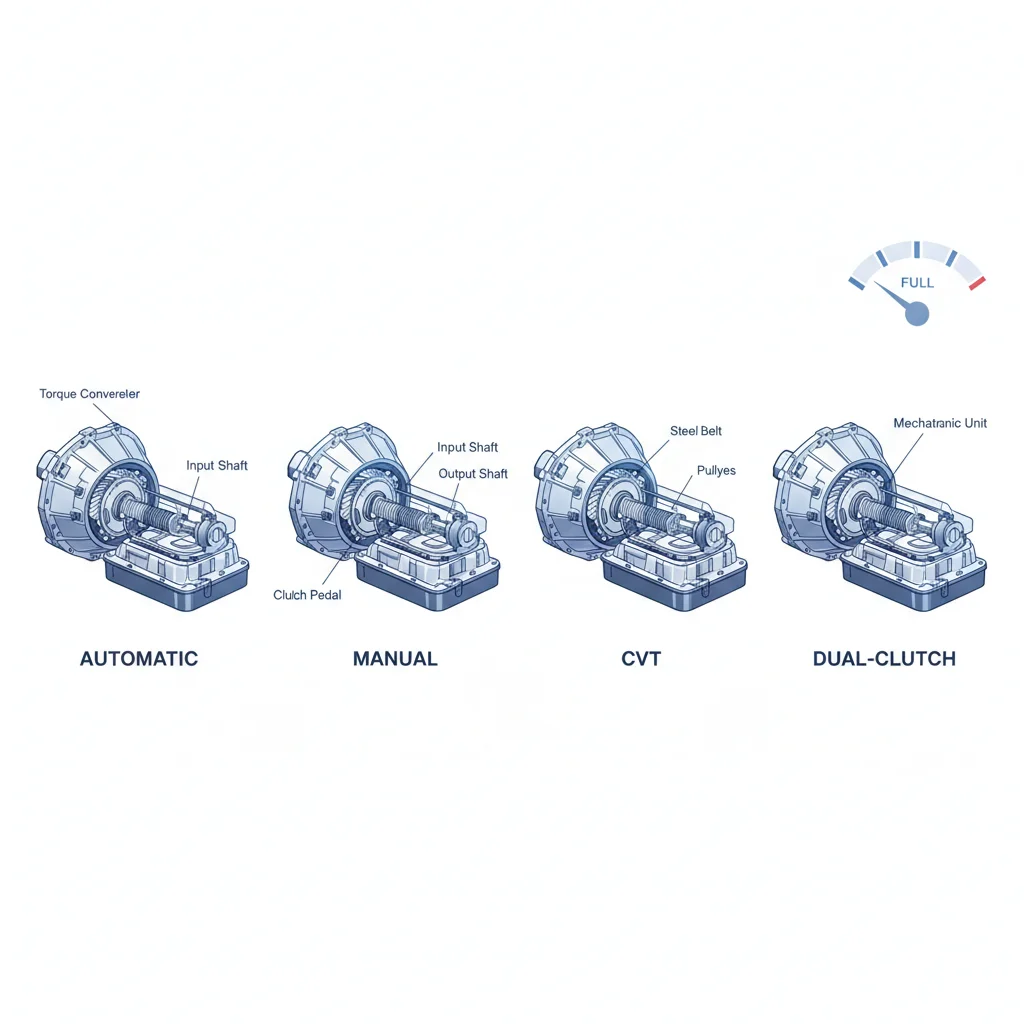
Before diving into symptoms, understand that transmissions vary significantly by type. An automatic, a manual, a continuously variable transmission (CVT), and a dual-clutch transmission (DCT) each have distinct normal behaviors — and distinct failure signatures.
Automatic Transmission: Normal vs. Problem Behavior
Automatics are the most forgiving transmissions to evaluate because their behavior is highly predictable. Any deviation from smooth, almost-invisible shifts is worth noting.
What's Normal
- Smooth, sequential upshifts as you accelerate from a stop through highway speed. You may feel a subtle mechanical nudge at each shift — that's normal. What you should not feel is a jolt, clunk, or delay.
- Slight hesitation before engaging from Park or Neutral — about half a second is acceptable in most automatics, especially cold. Longer than one second warrants attention.
- Downshifting firmness during hard braking or when climbing a steep grade. The transmission hunting between gears on a gentle slope is not normal.
- Torque converter lockup — at highway cruising speed (typically 45–65 mph), modern automatics lock the torque converter for efficiency. You may feel a very subtle engagement, almost like a slight RPM drop. This is normal.
Red Flags to Log During the Drive
- Harsh or banging shifts: A noticeable bang or shudder between gears, especially 1–2 or 2–3, indicates worn clutch packs or low/degraded transmission fluid.
- Slipping: RPMs climb but the car doesn't accelerate proportionally. The engine revs freely while forward motion lags. This is a major warning sign.
- Shuddering at highway speed: A rhythmic vibration at 45–65 mph that disappears above or below that range often points to torque converter shudder — a known failure mode in many GM, Ford, and Honda automatics.
- Delayed engagement: Shifting into Drive and waiting more than 1.5 seconds for the car to move. Worse if accompanied by a clunk when it finally catches.
- Transmission slipping into neutral under load: Feels like the engine briefly disconnects from the drivetrain under acceleration — one of the clearest signs of clutch pack wear.
If you notice shuddering between 45 and 65 mph, cross-reference with our guide to diagnosing vehicle shaking — some vibrations originate in the drivetrain or tires, not the transmission itself.
Manual Transmission: What Good and Bad Feel Like
Manual gearboxes are more tactile by design, which makes them easier to diagnose — but also easier to misread. Some behaviors that feel odd to an inexperienced driver are completely normal in a performance-tuned manual.
What's Normal
- Clutch engagement point variation by model: Some manuals engage high in the pedal travel, others low. Neither is inherently a problem — what matters is that the bite point is consistent and the clutch doesn't slip after engagement.
- Stiff or precise short-throw shifter feel: Performance vehicles often have deliberate mechanical resistance in the shifter. That's not damage — it's tuning.
- Slight gear whine in reverse: Many manual transmissions produce a low whine in reverse because reverse gears are typically straight-cut (not helical). Normal.
- Synchro resistance when shifting cold: First and second gear may feel notchy when the gearbox is cold. This should clear up within the first few minutes of driving.
Red Flags to Log During the Drive
- Clutch slipping under load: In third or fourth gear, accelerate hard from 35–40 mph. RPMs should rise and fall in sync with vehicle speed. If RPMs spike ahead of acceleration, the clutch disc is worn and slipping.
- Difficulty engaging reverse: Hard to find, grinds, or requires two attempts. Indicates worn reverse gear or shift fork issues.
- Grinding on 2–3 or 3–4 shifts: Classic synchro wear. A skilled driver can sometimes mask this by double-clutching, so try the shift yourself, deliberately and cleanly.
- Clutch chatter on takeoff: A vibrating, chattering sensation when releasing the clutch from a stop suggests a glazed or oil-contaminated clutch disc.
- Jumping out of gear: If a gear pops back to neutral under light throttle load, the shift forks or gear engagement teeth are worn. This is a safety and mechanical issue.
Note that a worn clutch on a manual may not be obvious at low speeds. The load test in 3rd gear described above is the most reliable field check you can do without a lift.
CVT and Dual-Clutch Transmissions: Specific Things to Check
CVTs and DCTs have expanded dramatically in the market — and each has its own set of normal quirks that buyers frequently misinterpret, as well as its own failure signatures.
CVT (Continuously Variable Transmission)
CVTs are designed to keep the engine in its most efficient RPM band by varying the effective gear ratio continuously. This creates a driving experience that feels unlike a traditional automatic.
- Normal: Engine RPM holds steady during acceleration while speed increases — this is called the "rubber band" effect and is intentional. The engine sounds like it's revving high without a corresponding surge in speed. That's the CVT doing its job.
- Normal: Slight hesitation at very low speeds in some Toyota or Subaru CVTs before the belt engages under load.
- Problem: Loud whining, slipping, or shuddering under acceleration. CVT belts and pulleys wear progressively and degrade quietly until they fail catastrophically. High-mileage CVTs (above 100,000 miles) with no documented fluid service are a significant risk.
- Problem: Jerky low-speed behavior that never smooths out after warming up suggests degraded CVT fluid or early pulley wear.
Dual-Clutch Transmission (DCT)
DCTs use two separate clutch packs to pre-select the next gear, enabling faster shifts than a traditional automatic. The trade-off: notoriously poor low-speed manners, especially in traffic.
- Normal: Noticeable hesitation, shuddering, or judder when moving slowly from a stop — especially in stop-and-go conditions. This is a known characteristic of dry-clutch DCTs (common in Ford's PowerShift and Volkswagen's DSG entry variants). It's annoying, but it's not necessarily a defect on its own.
- Problem: The same shudder persists after the car warms up fully and is worse after 20+ minutes of city driving. Suggests clutch pack wear beyond normal operating parameters.
- Problem: Hesitation followed by a lurch during a smooth, moderate acceleration from 5–15 mph. This indicates the software or mechatronics unit is struggling — common in high-mileage Ford PowerShift and early VW/Audi DSG units.
- Problem: Slipping in any gear above 3rd under moderate throttle. Unlike the low-speed quirks, this is a mechanical failure sign.
For a broader look at how these transmission types compare at the pump, see how transmission type affects real-world fuel economy.
The Five-Stage Test Drive Protocol for Transmission Evaluation
A 10-minute loop around the block will not reveal most transmission problems. You need to run the car through specific conditions deliberately. Here's why short test drives can fool you — and what a proper route looks like.
Here's the five-stage transmission test sequence:
- Cold start engagement (Stage 1): Before the engine warms up, shift through Park → Reverse → Neutral → Drive. Feel for delayed engagement, hard catches, or unusual sounds. Note how long it takes to engage Drive from a cold start.
- Low-speed maneuvering (Stage 2): In a parking lot, practice slow-speed creep. For automatics and CVTs, ease off the brake at idle and let the car inch forward — it should be smooth and predictable. For DCTs, observe whether shudder is present and consistent or erratic and worsening.
- City acceleration (Stage 3): From a traffic stop, accelerate moderately to 40 mph. Feel each shift in an automatic — count them, feel their firmness, listen for any clunks. In a manual, run 1–2–3–4 shifts deliberately. No grinding, no reluctance.
- Highway load test (Stage 4): Merge onto a highway or find a stretch where you can reach 60–70 mph. In an automatic, perform a half-throttle passing acceleration from 55 mph — the transmission should downshift promptly and re-engage cleanly. In a manual, do the RPM slip test in 3rd gear. With a CVT, listen for belt whine above 60 mph.
- Deceleration and downshifting (Stage 5): Lift off the throttle at highway speed and let the car engine-brake down. An automatic should step down through gears smoothly. A manual should allow clean heel-toe or sequential downshifts. Any shuddering, hunting, or reluctance to downshift is a flag.
Document anything that feels off. Even if you can't diagnose it yourself, your notes help a pre-purchase inspector target the right areas. Transmission warning signs every driver should recognize provides a broader reference to take with you.
After the Drive: Making Sense of What You Found
Not every unusual sensation means walk away. Context matters — and so does the seller's response when you bring it up.
Low-Risk Findings
- Cold-start shift roughness that disappears after 5 minutes of driving
- CVT rubber-band effect at highway on-ramps
- Slight notchiness in a manual's 1st-to-2nd shift when cold
- DCT hesitation below 10 mph in a car with known DCT characteristics (Ford Focus/Fiesta PowerShift, VW DSG entry models)
Medium-Risk Findings — Price or Walk
- Consistent harsh 1–2 shift in an automatic (fluid service may fix it; if not, clutch pack replacement)
- Clutch slip in a manual under hard load (clutch replacement: $500–$1,200 on most vehicles, $1,800+ on performance models or AWD platforms)
- CVT shudder at highway speed with no documented fluid service history
High-Risk Findings — Walk Away or Get a Specialist Inspection First
- Slipping in any gear in an automatic or DCT
- Grinding during normal upshifts in a manual (synchro replacement requires transmission removal)
- Gear popping out of engagement in a manual
- Torque converter shudder combined with evidence of fluid leaks under the vehicle
- Delayed engagement over 2 seconds combined with a clunk
If a seller pushes back on any of these findings or refuses to allow a pre-purchase inspection by a third-party mechanic, that itself is a red flag. Any legitimate private seller or dealer will accommodate a 45–60 minute shop inspection — it typically costs $100–$175 and can save you thousands.
Transmission issues rarely exist in isolation. Hesitation under acceleration might be the transmission — or it might be the engine. See engine hesitation and stutter symptoms decoded to distinguish between the two before committing to a diagnosis. And for post-purchase maintenance clarity, automatic vs. manual transmission service differences lays out what each type needs and when.

All claims are backed by peer-reviewed research. Sources on request.