Key Takeaways
Refinancing After Bankruptcy
Refinancing after bankruptcy means replacing your current auto loan with a new one — typically at a lower interest rate or better terms — after having gone through a Chapter 7 or Chapter 13 bankruptcy proceeding. It's possible, but lenders apply stricter scrutiny than they would for borrowers with clean credit histories. The key variables are how much time has passed since your discharge, how your credit has recovered, and which lenders you approach.
Chapter 7 bankruptcies remain on your credit report for 10 years; Chapter 13 stays for 7 years. However, most lenders shift their evaluation focus from the bankruptcy itself to your post-discharge payment behavior after 12–24 months.
Why Refinancing After Bankruptcy Is Harder — But Not Impossible
Bankruptcy carries a heavy stigma in lending circles, but it's worth understanding what lenders actually fear: the risk that you won't repay. A bankruptcy on your record signals that you've had serious repayment difficulty in the past. What lenders are really watching for, especially after the first year, is evidence that your financial behavior has changed.
That's why refinancing after bankruptcy isn't a door that's permanently shut — it's a door with a timeline attached to it. The further you get from your discharge date, the more weight your recent payment history carries relative to the bankruptcy itself.
Here's what makes post-bankruptcy refinancing different from a typical application:
- Lower credit scores mean fewer lenders will compete for your business, reducing your negotiating leverage.
- Higher perceived risk means lenders who do offer terms will price that risk into the rate.
- Stricter loan-to-value requirements mean some lenders want more equity in the vehicle before they'll approve a refinance.
- Shorter loan terms may be offered to limit their exposure.
None of these are permanent conditions. They're constraints that ease as your credit profile rebuilds. Understanding them helps you set realistic expectations and approach lenders strategically rather than hoping for the best.
If you're still early in your post-bankruptcy recovery, it's also worth reading our guide on bad credit auto loan options to understand the broader financing landscape you're working within.
The Timeline: When Lenders Start Taking You Seriously
Timing is the single most important variable in post-bankruptcy refinancing. Applying too early almost guarantees rejection — or terms so poor that refinancing doesn't actually help you. Here's how the timeline typically plays out:
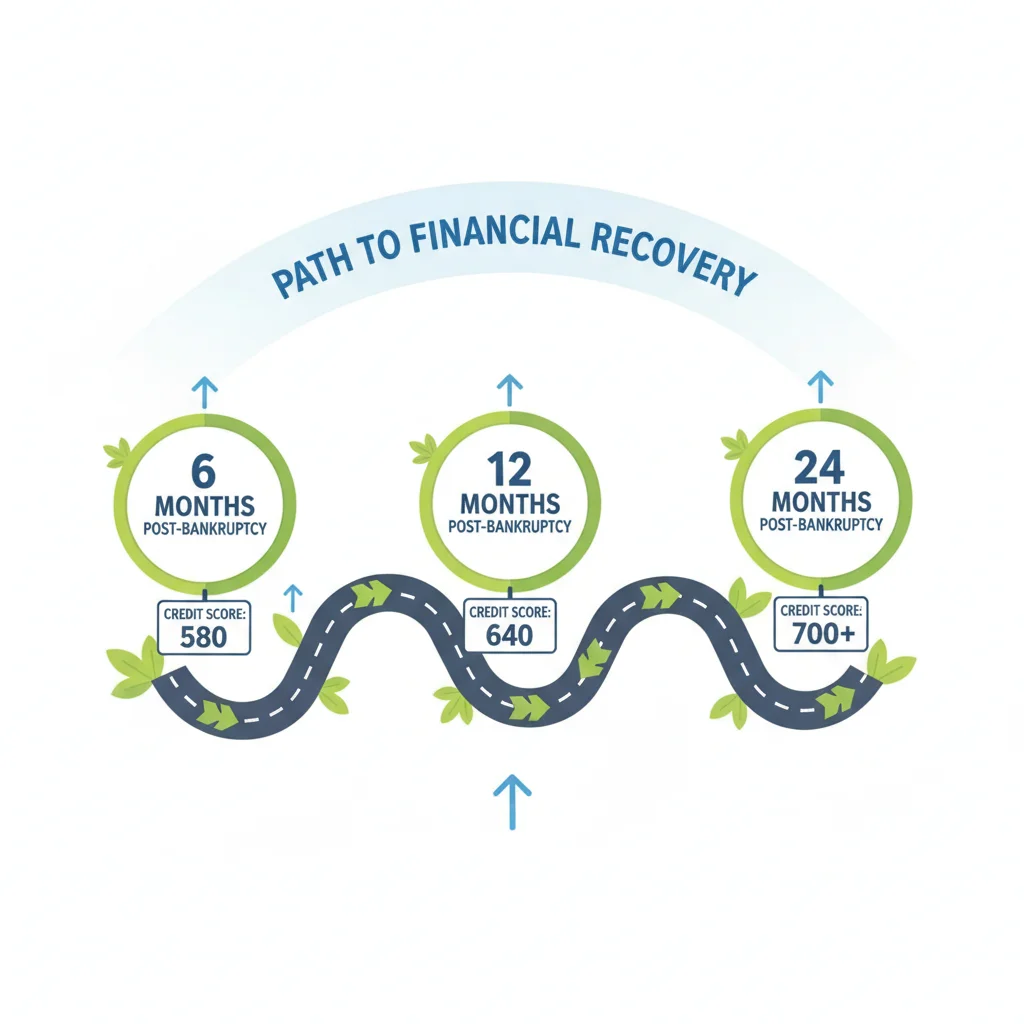
0–6 Months Post-Discharge
This is the hardest window. Your credit score has likely taken its largest hit, and lenders who see a very recent bankruptcy discharge treat you as an extremely high-risk borrower. Refinancing in this window is rarely worth pursuing unless you're in a predatory loan with an interest rate above 25% and have no other options. Even then, your choices will be very limited.
6–12 Months Post-Discharge
Some subprime and specialty lenders will consider applications here, particularly if you have a stable income, a vehicle with positive equity, and a few months of on-time payments already on record. Rates will still be high — expect 15–25% APR in many cases — but if your original loan was secured at a 28–30% rate through a buy-here-pay-here dealer, even this can represent meaningful savings.
12–24 Months Post-Discharge
This is where the refinancing landscape meaningfully opens up. With 12+ months of clean payment history, your credit score has likely started recovering. More lenders will consider your application, and the rates they offer begin to reflect your rebuilt behavior rather than just your bankruptcy history. Credit unions in particular often become viable options in this window.
24+ Months Post-Discharge
After two years, the bankruptcy is still on your report but begins to function more like a historical note than an active red flag. If you've been diligent — paying every bill on time, keeping credit utilization low, avoiding new derogatory marks — your score may have recovered into the 620–680 range or higher. At this point, you can often access near-prime rates and a broader pool of lenders.
12–24 months
Typical wait before lenders reconsider post-bankruptcy borrowers
Based on common underwriting guidelines across credit unions and subprime auto lenders.
10 years
How long Chapter 7 bankruptcy stays on a credit report
Per the Fair Credit Reporting Act; Chapter 13 stays for 7 years from filing date.
50–200 pts
Typical credit score drop immediately after bankruptcy filing
FICO research indicates the impact varies based on the borrower's pre-bankruptcy score.
~$1,500
Estimated interest savings on a $12,000 balance refinanced from 22% to 14% APR
Calculated over a 36-month remaining loan term using a standard amortization formula.
For context on what lenders specifically examine beyond just your bankruptcy status, see our detailed breakdown of what lenders look at before approving an auto refinance.
Chapter 7 vs. Chapter 13: How the Type of Bankruptcy Shapes Lender Response
Not all bankruptcies are treated the same by lenders, and understanding the difference helps you anticipate what you're up against.
Chapter 7: Full Discharge, Longer Credit Impact
Chapter 7 is often called a "liquidation" bankruptcy. Most unsecured debts are discharged — wiped clean — relatively quickly, usually within 3–6 months of filing. The tradeoff is that it stays on your credit report for 10 years from the filing date, and lenders tend to view it as a more severe credit event because debts were discharged without repayment.
For auto loan refinancing purposes, Chapter 7 borrowers typically face the strictest initial scrutiny. However, once you're 12–24 months past discharge with a clean payment record, many lenders treat you comparably to a Chapter 13 filer at a similar stage.
Chapter 13: Repayment Plan, Shorter Credit Impact
Chapter 13 is a restructuring bankruptcy — you agree to a 3–5 year repayment plan under court supervision. It stays on your credit report for 7 years from the filing date and is sometimes viewed slightly more favorably by lenders because it shows an intention to repay.
The complexity with Chapter 13 is that you may still be in your repayment plan when you want to refinance your car. In that case, you need court and trustee approval before taking on new debt. This is legally possible but administratively complex — most financial advisors recommend waiting for discharge unless your current auto loan terms are genuinely unmanageable.
Refinancing During Active Chapter 13 Requires Court Approval
If your Chapter 13 case is still open, you cannot take on new debt — including a refinanced auto loan — without permission from your bankruptcy trustee and court. This process can take weeks and isn't guaranteed. In most cases, waiting until your plan is complete and you receive a discharge is the more practical path. Consult your bankruptcy attorney before pursuing any new credit during an active case.
Your Post-Bankruptcy Score May Recover Faster Than You Think
Many borrowers expect their credit score to remain depressed for the entire 7–10 years a bankruptcy appears on their report. In practice, FICO scores can recover significantly within 2–3 years of discharge if you're actively building positive credit history. The bankruptcy entry doesn't reset to zero each year — its impact diminishes over time as positive behavior accumulates in your report.
If your situation involves a life change that intersects with your bankruptcy — a divorce, job loss, or income shift — the considerations become more layered. Our article on refinancing after a major life change addresses those situations in more depth.
What Rates Should You Realistically Expect?
Rates after bankruptcy exist on a wide spectrum, and where you land depends on the interplay of several factors: time since discharge, current credit score, vehicle age and equity, income stability, and the lender type you approach.

Here's a rough framework for what to expect at different stages of recovery:
| Time Since Discharge | Approximate Credit Score Range | Typical APR Range |
|---|---|---|
| 6–12 months | 520–570 | 18%–28% |
| 12–24 months | 560–620 | 12%–20% |
| 24–36 months | 600–660 | 8%–16% |
| 36+ months | 640–700+ | 6%–12% |
Note: These ranges are approximations. Individual rates vary based on lender, vehicle, income, and loan-to-value ratio.
Even if you're looking at a 14% rate, that might represent real savings if your current loan — perhaps obtained through a subprime dealer shortly after bankruptcy — is sitting at 22% or higher. The math matters: on a $12,000 remaining balance, dropping from 22% to 14% APR over 36 months saves roughly $1,500 in interest.
“After bankruptcy, lenders aren't looking for a perfect borrower — they're looking for a changed borrower. Twelve to twenty-four months of clean payment history can do more for your rate than any letter of explanation.”
— Gerri Detweiler, Credit expert and author on consumer credit and lending
The right question isn't "is this rate good in absolute terms?" It's "is this rate better than what I have now, and does the refinance make financial sense given any fees and remaining loan life?"
Rate-Shop Within a Short Window
When you're ready to apply, submit all your refinancing applications within a 14-day window. FICO scoring models treat multiple auto loan inquiries within a short period as a single inquiry, minimizing the credit score impact. This lets you compare real offers from multiple lenders without paying a scoring penalty for each application.
Calculate Total Cost, Not Just Monthly Payment
Always compare the total amount you'll pay over the life of the loan — not just the monthly payment. A lower monthly payment achieved by extending your term can cost you more in total interest than your current loan. Ask each lender for the total interest paid over the full term before making your decision.
Which Lenders Are Most Open to Post-Bankruptcy Borrowers?
Knowing where to look is half the battle. Not all lenders treat post-bankruptcy borrowers the same way, and targeting the right type of institution can save you significant time and unnecessary credit inquiries.
Credit Unions
Credit unions are consistently among the most borrower-friendly institutions for people rebuilding after bankruptcy. They tend to have more flexible underwriting criteria than commercial banks, lower rates than subprime finance companies, and loan officers who can actually evaluate your full financial picture rather than just running an automated decision. If you're not already a member of a credit union, joining one before you need to refinance is a smart first step — membership eligibility is usually based on your employer, location, or community affiliation.
Community Banks
Smaller community banks often have similar advantages to credit unions — local decision-making, relationship-based lending, and more nuanced underwriting. If you have an existing banking relationship with a community bank, that history can work in your favor.
Specialized Subprime Auto Lenders
Lenders like Capital One Auto Finance, Westlake Financial, and similar subprime-focused institutions explicitly market to borrowers with damaged credit. They will typically offer terms, but rates can be high. Use them strategically — as a benchmark or a fallback if credit union options don't come through — rather than a first-choice destination.
Online Lenders and Marketplaces
Several online platforms specialize in connecting subprime borrowers with lenders. The advantage is speed and the ability to compare multiple offers with a single application. Be cautious about which platforms you use and read the fine print carefully, as some online lenders charge origination fees that offset the rate savings.
What to Avoid
Be cautious about high-volume buy-here-pay-here dealers offering "refinancing" — these are often high-rate dealer financing dressed up as refinancing, not true refinancing with an independent lender. Also avoid lenders promising guaranteed approval regardless of credit history, as these often come with exploitative terms.
Building Your Credit Profile to Unlock Better Refinancing Terms
The most powerful thing you can do between your discharge date and your refinancing application is build a deliberate, documented track record of responsible credit use. Lenders aren't looking for perfection — they're looking for evidence that your financial behavior has changed.
Pay Every Bill On Time, Every Month
Payment history is the single largest factor in your credit score, accounting for about 35% of your FICO score. One late payment during your post-bankruptcy rebuild can set your recovery back significantly. Set up automatic payments for every account to eliminate the risk of accidental missed payments.
Get a Secured Credit Card and Use It Lightly
A secured credit card requires a cash deposit (typically $200–$500) that becomes your credit limit. Use it for small, regular purchases — a monthly subscription, gas — and pay the balance in full each month. This demonstrates responsible revolving credit use without carrying debt.
Keep Credit Utilization Below 30%
Utilization — the percentage of your available credit you're using — accounts for about 30% of your credit score. Even on a secured card with a $300 limit, try to keep the balance below $90 at statement time.
Monitor Your Credit Report for Errors
Errors on credit reports are more common than most people realize, and post-bankruptcy reports can be especially messy — accounts that were discharged may still show active balances or incorrect statuses. Check your reports from all three bureaus (Experian, Equifax, TransUnion) through AnnualCreditReport.com and dispute any inaccuracies promptly.
Don't Open Too Many Accounts at Once
Each new credit application triggers a hard inquiry that temporarily dips your score. Be selective. Focus on a secured card and your existing accounts rather than accumulating new credit lines quickly.
Refinancing During Active Chapter 13 Requires Court Approval
If your Chapter 13 case is still open, you cannot take on new debt — including a refinanced auto loan — without permission from your bankruptcy trustee and court. This process can take weeks and isn't guaranteed. In most cases, waiting until your plan is complete and you receive a discharge is the more practical path. Consult your bankruptcy attorney before pursuing any new credit during an active case.
Your Post-Bankruptcy Score May Recover Faster Than You Think
Many borrowers expect their credit score to remain depressed for the entire 7–10 years a bankruptcy appears on their report. In practice, FICO scores can recover significantly within 2–3 years of discharge if you're actively building positive credit history. The bankruptcy entry doesn't reset to zero each year — its impact diminishes over time as positive behavior accumulates in your report.
When you're ready to apply for refinancing, it's worth getting preapproved before visiting lenders — this gives you a real rate to compare against your current loan without committing to anything.
For a complete walkthrough of what happens once you're ready to apply, see our full refinancing process guide.
How to Evaluate Whether Refinancing Actually Makes Sense for You
Refinancing isn't automatically the right move just because you can qualify. It needs to make financial sense given your specific loan and situation. Here's how to evaluate it honestly.
Calculate Your Break-Even Point
If refinancing involves fees — origination fees, prepayment penalties on your existing loan, title transfer costs — you need to make sure the monthly savings justify those upfront costs. Divide the total fees by your monthly savings to find how many months it takes to break even. If you're breaking even at month 18 but you only have 20 months left on your loan, refinancing probably isn't worth it.
Consider the Remaining Loan Life
Refinancing saves the most when you have a significant portion of the loan remaining. If you're in month 48 of a 60-month loan, the interest savings from refinancing are minimal regardless of rate — most of the interest was paid in the early months due to how amortization works.
Watch Out for Term Extension Traps
A lender might offer to lower your monthly payment by extending your loan term from 36 months to 60 months. Your payment goes down, but your total interest paid goes up substantially. Always compare total cost of the loan, not just monthly payment.
Evaluate Your Vehicle's Position
If your vehicle is significantly underwater — meaning you owe more than it's worth — refinancing becomes harder to execute and riskier financially. Most lenders won't refinance a loan where the loan-to-value (LTV) ratio exceeds 110–120%. If your car has depreciated sharply, you may need to pay down some principal first.
Rate-Shop Within a Short Window
When you're ready to apply, submit all your refinancing applications within a 14-day window. FICO scoring models treat multiple auto loan inquiries within a short period as a single inquiry, minimizing the credit score impact. This lets you compare real offers from multiple lenders without paying a scoring penalty for each application.
Calculate Total Cost, Not Just Monthly Payment
Always compare the total amount you'll pay over the life of the loan — not just the monthly payment. A lower monthly payment achieved by extending your term can cost you more in total interest than your current loan. Ask each lender for the total interest paid over the full term before making your decision.
For first-time refinancers who are also navigating post-bankruptcy complexity, our guide auto loan refinancing for first-timers covers the mechanics of the process in plain language.
Similarly, if your credit challenges stem from a repossession or missed payments rather than (or in addition to) bankruptcy, rebuilding credit after a repossession offers a parallel recovery roadmap.

All claims are backed by peer-reviewed research. Sources on request.