Key Takeaways
Why Life Changes Disrupt Your Auto Loan
When you signed your original auto loan, the terms reflected your financial life at that moment — your income, your credit score, your household structure, and your debt obligations. A major life change rewrites all of those variables at once. The loan doesn't adjust with you. That mismatch is exactly why refinancing becomes a practical tool rather than just a nice-to-have option.
Divorce is the most common trigger. A loan that made sense on two incomes may be crushing on one. More specifically, if your ex-spouse was the co-borrower and their income was the stronger of the two, you may now face a payment structure built around a financial profile that no longer exists. The reverse is also true: if you're keeping the car and the debt, you may need to remove your ex's name from the loan entirely — something that typically requires a full refinance, not just a name change.
Job loss, career changes, and income reductions create similar pressure. Even a temporary dip in income — a layoff between positions, a switch from salaried to freelance work, or a reduction in hours — can make a previously manageable payment feel impossible. On the flip side, a significant income increase may position you to qualify for a dramatically better interest rate than you received when you first financed the vehicle.

The key insight is this: refinancing isn't just about chasing lower rates. It's a mechanism for realigning your loan with your current financial reality. Understanding what refinancing actually involves — including how lenders evaluate applications and what changes when you replace an existing loan — is the foundation for making this decision intelligently.
Divorce-Specific Refinancing: What You Need to Know
Divorce creates two distinct refinancing challenges that don't apply in most other situations: removing a co-borrower and qualifying on a single income. These aren't minor administrative tasks — they're full underwriting events that lenders treat like any new loan application.
Removing a Co-Borrower
If your auto loan lists both you and your ex-spouse as borrowers, both of you remain legally responsible for the debt until the loan is paid off or refinanced. A divorce decree does not change your lender's position. Even if the court assigns the car to you, your ex's credit is still tied to that loan, and your lender can still pursue them for missed payments.
The only way to remove a co-borrower from an auto loan is to refinance into a new loan solely in your name. This means you must qualify independently — your income, your credit score, your debt-to-income ratio — without relying on your former spouse's financial profile. If you were the secondary borrower during the original application, this can be a significant hurdle.
A Divorce Decree Doesn't Remove Your Ex from the Loan
Many divorcing borrowers mistakenly believe that a court order assigning the car to one party automatically removes the other from the loan. It does not. Your lender is not a party to your divorce agreement. Until the loan is refinanced into one person's name, both borrowers remain legally liable for the debt. Missed payments will damage both credit profiles regardless of what the divorce decree states.
Extending Your Term Has a Real Cost
Stretching a 36-month remaining term to 60 or 72 months to lower your monthly payment may provide immediate cash flow relief, but it increases the total interest you'll pay — sometimes significantly. On a $15,000 balance at 8% APR, extending from 36 to 60 months saves roughly $130 per month but costs approximately $1,200 more in total interest. Make sure you understand this trade-off before choosing the longer term.
Qualifying on a Single Income
Lenders typically want your total monthly debt payments (including the new car payment) to stay below 40–45% of your gross monthly income. If your household income just dropped by 30–50%, you may need to restructure the loan — extending the term to reduce the monthly payment — in order to fit within that threshold.
Income changes affect how lenders evaluate your application in ways that go beyond just your salary figure. Alimony and child support payments you receive can typically be counted as income if you can document at least six months of receipt and demonstrate that the payments will continue. Payments you make, however, count against your debt load.
Timing Your Refinance After Divorce
Avoid refinancing in the middle of active divorce proceedings if possible. Lenders will require documentation of your financial picture, and if your income, expenses, or obligations are still being negotiated legally, that uncertainty can complicate the application. Waiting until the divorce is finalized — and you have a court-issued settlement agreement to reference — gives you cleaner documentation and a clearer financial baseline.
Timing Your Refinance After Divorce
Waiting until the divorce is legally finalized gives you cleaner documentation and a clearer financial baseline for lenders. Once you have a court-issued settlement agreement, you can point to specific income, liability, and asset figures — which dramatically reduces underwriting uncertainty. If your divorce involved joint accounts that are now closed or reassigned, allow 30–60 days for those changes to reflect on your credit report before applying.
Use the 14-Day Shopping Window
FICO's auto loan scoring model clusters multiple hard inquiries within a 14-day period and counts them as a single inquiry. Submit all your refinance applications within that window to protect your credit score while still comparing competitive offers from multiple lenders. Some scoring models extend this window to 45 days — but 14 days is the safe conservative benchmark.
Job Loss, Career Change, and Income Shifts
A job loss doesn't automatically mean you can't refinance — but it does mean the timing and strategy matter considerably more. Lenders extend credit based on the expectation of future income. If your income is currently zero or unstable, most traditional lenders will decline your application or offer terms that don't meaningfully help.
If you've recently lost your job and are concerned about making your current payment, contact your lender first about hardship options — deferment, forbearance, or a temporary payment reduction. These don't solve the underlying problem, but they protect your credit score and buy time until you're in a stronger position to refinance.
Once you've secured new employment, the general rule is to wait at least two to three months before applying to refinance. Lenders want to see consistency — a recent start date combined with a solid credit profile is more convincing than a long employment history that just ended. If you've moved from salaried employment to self-employment or contract work, expect lenders to ask for additional documentation, including profit-and-loss statements or tax returns, to verify income stability.

A significant income increase deserves equal attention. If your salary has grown substantially since you first financed your vehicle, or if a second income has joined your household, your debt-to-income ratio has likely improved — sometimes dramatically. That improvement may entitle you to a lower interest rate than you currently carry. When you refinance within your loan's life cycle also affects how much you actually save, so it's worth running the numbers before assuming the timing is right.
The central question with any income change is whether your current loan terms are still appropriate for your financial profile — or whether a new set of terms would create measurably more stability. That's not a judgment call based on feelings. It's a calculation you can make with concrete numbers.
AnnualCreditReport.com
Pull your free credit reports from all three bureaus to check for errors and assess your credit profile before applying.
Kelley Blue Book (kbb.com)
Estimate your vehicle's current market value to determine whether you have positive equity before refinancing.
Edmunds
Cross-reference your vehicle's market value with a second source to get a more accurate equity estimate.
Loan Amortization Calculator
Calculate total interest paid under your current loan versus each refinance offer to identify your true break-even point.
myFICO.com
Purchase the specific FICO score version most lenders use for auto loans, giving you a precise read on your creditworthiness.
Your Divorce Settlement Agreement
Provides documentation of how the vehicle and loan obligation are legally assigned, which lenders may require during underwriting.
How to Refinance Your Auto Loan After a Major Life Change
The process itself is straightforward, but the preparation is where most people stumble — especially when life circumstances have created documentation gaps or credit complications. Work through these steps in order to maximize your chances of approval and ensure you're refinancing into genuinely better terms.
What you will need
Pull Your Current Loan Details
Contact your current lender or log into your account to retrieve: your current interest rate, remaining loan balance, monthly payment amount, remaining term in months, and whether there are any prepayment penalties. This is your baseline. Every refinancing decision you make will be measured against these numbers.
Also note whether your ex-spouse or anyone else is currently listed as a co-borrower. If so, the new loan must be structured to exclude them — which means you'll need to qualify entirely on your own financial profile.
Check Your Credit Score and Report
Pull your credit report from all three major bureaus — Equifax, Experian, and TransUnion — through AnnualCreditReport.com. Look specifically for any accounts that may have been affected by your life change: joint accounts that are past due, accounts you didn't know existed, or errors introduced during the transition.
Dispute any inaccuracies in writing before you apply. Even a modest credit score improvement — moving from the low 600s to the mid 600s, for example — can shift you into a better rate tier with most lenders and produce meaningful savings over the life of the loan.
Determine Your Vehicle's Current Market Value
Use at least two sources — Kelley Blue Book (kbb.com) and Edmunds — to estimate your vehicle's current market value. Compare that figure to your loan payoff amount. If your payoff is less than the vehicle's value, you have positive equity, which makes you a stronger refinancing candidate. If your payoff exceeds the vehicle's value, you're underwater, and many lenders will decline a standard refinance.
Gather Documentation of Your Current Financial Situation
Collect the documents lenders will ask for. Standard requirements include:
- Government-issued photo ID
- Proof of current address (utility bill, bank statement)
- Recent pay stubs or proof of income (last 30 days)
- If self-employed or recently changed jobs: last two years of tax returns and/or profit-and-loss statements
- Documentation of alimony or child support income you receive (court order plus bank statements showing receipt)
- Your current loan account number and lender contact information
- Vehicle information: VIN, make, model, year, mileage
If your financial situation has changed recently, a brief written explanation to accompany the application can help underwriters evaluate your file with full context — especially at credit unions and smaller community lenders.
Shop Multiple Lenders Within a 14-Day Window
Apply to at least three lenders — ideally a credit union, an online lender, and your current bank or credit union — within a 14-day period. FICO's scoring model treats multiple auto loan inquiries within this window as a single inquiry, so shopping aggressively has minimal credit score impact.
Compare offers using the total cost of the loan, not just the monthly payment. A lower payment achieved by extending the term from 36 months to 72 months may cost you thousands more in interest over the life of the loan. Calculate the total amount you'll repay under each offer before deciding.
Evaluate Each Offer Against Your Current Loan
For each offer you receive, calculate:
- Monthly payment difference: How much does the new payment reduce or increase your monthly obligation?
- Total interest paid: Multiply the new monthly payment by the number of months in the new term, subtract the loan balance, and compare that figure to the total remaining interest on your current loan.
- Break-even point: If there are any fees to refinance (origination fees, title transfer costs), divide those costs by your monthly savings to find how many months until you've recovered them.
The right offer isn't always the lowest rate — it's the offer that solves the specific problem your life change created, whether that's removing a co-borrower, reducing monthly cash flow pressure, or reducing total interest cost.
Accept the Best Offer and Close the New Loan
Once you've selected an offer, the new lender will handle paying off your existing loan directly. Confirm the payoff amount with your current lender the day you close — it changes daily as interest accrues. Continue making your current payment until you receive written confirmation from your original lender that the loan is paid off. Do not assume the process is complete until you have that confirmation in writing.
After closing, update your records with the new lender's payment portal, confirm the first payment due date, and set up automatic payments if you qualify for a rate discount by doing so (many lenders offer 0.25% APR reduction for autopay enrollment).
Once you've completed the process, take a moment to assess whether the new terms actually solve the problem you started with. A lower monthly payment through term extension may reduce immediate pressure while costing you more overall — that trade-off is worth understanding clearly. Running through key questions before submitting a refinance application is a useful exercise before you finalize anything.
When Refinancing Isn't the Right Move Yet
Refinancing after a major life change is sometimes the right tool — and sometimes it makes the situation worse. Understanding the difference can save you from locking in a bad rate or damaging your credit with a rejected application.
Your Credit Score Took a Hit
Divorce, job loss, and financial stress often lead to missed or late payments, which damage your credit score. Applying for refinancing immediately after those events may result in a higher interest rate than your current loan — the opposite of what you're trying to achieve. If your score has dropped significantly, exploring options designed for borrowers with poor credit histories may be more appropriate than a standard refinance application.
In most cases, a six-to-twelve month period of on-time payments after a credit disruption is enough to begin rebuilding a score to the point where refinancing makes financial sense. If the financial pressure is immediate, contact your current lender directly — they may offer temporary accommodations that protect your credit while you stabilize.
You're Deep Into the Loan
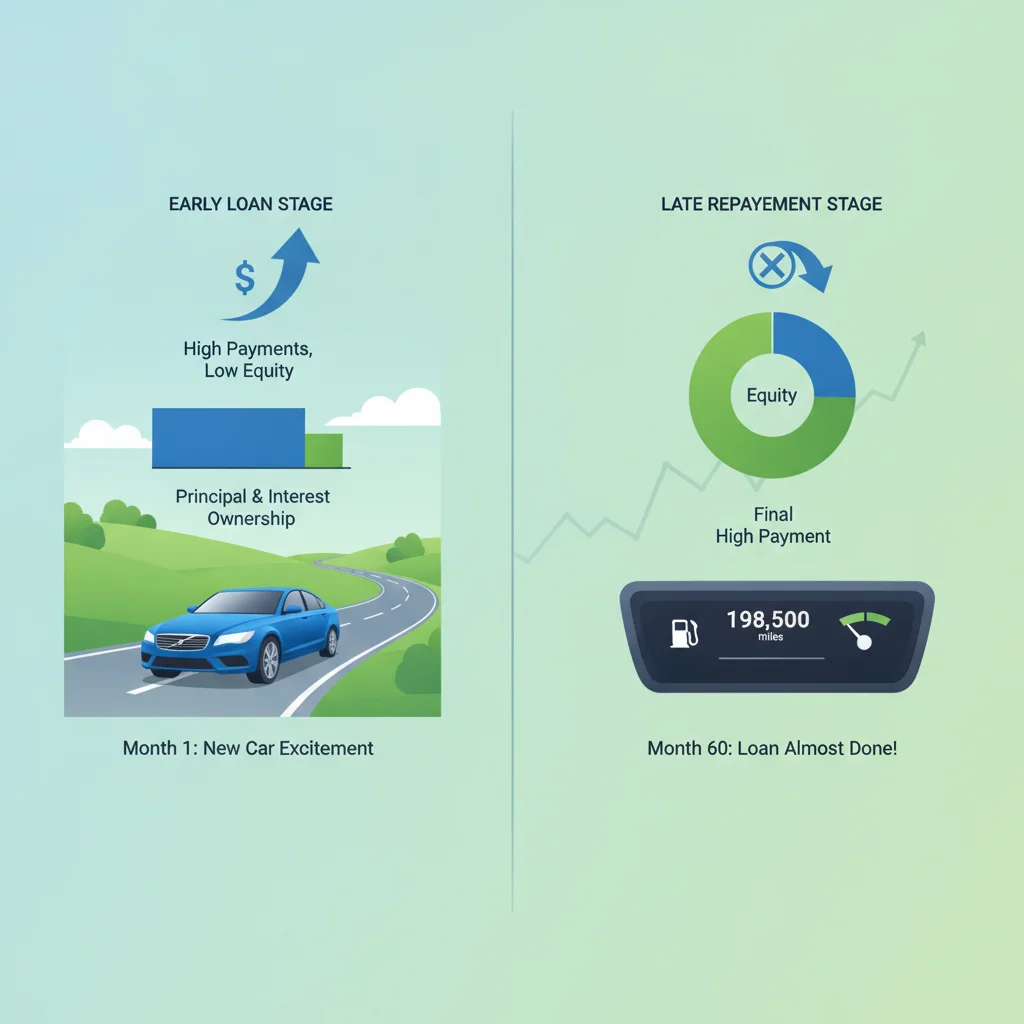
If you're in the final 12–18 months of your loan, refinancing may not produce meaningful savings even if you qualify for a lower rate. The interest on an amortizing auto loan is front-loaded — you pay more interest in the early months and more principal toward the end. Refinancing deep into repayment restarts that structure. The math often doesn't favor it unless you're extending the term to reduce an unmanageable payment, which has its own trade-offs.
You're Underwater on the Vehicle
If you owe more on the car than it's currently worth, most lenders will decline a standard refinance — or require you to pay the difference upfront. This situation, called negative equity, is common when vehicles depreciate faster than loan principal is paid down. Check your payoff balance against your vehicle's current market value before applying. If the gap is significant, you may need to wait until your equity position improves.
Refinancing While Underwater Can Backfire
If your loan payoff amount exceeds your vehicle's current market value, a standard refinance is unlikely to be approved — and attempting one prematurely can result in hard inquiries that lower your credit score without producing any benefit. If you're in this position, focus first on making extra principal payments to close the equity gap, or wait for the loan balance to naturally decrease below the vehicle's value. Applying only when your equity position is positive increases your approval odds and access to competitive rates.
The bottom line is that refinancing is a tool with specific use cases. It works best when your credit profile has improved, when your income has changed in ways that alter your qualifying rate, or when you need to restructure a loan to reflect a new household financial reality — like removing a co-borrower. When those conditions aren't met, patience is usually the better strategy. For context on what happens when a major financial event like bankruptcy is in the picture, understanding the timelines and lender expectations after bankruptcy provides a useful comparison point.
Preparing for the Lender Conversation
Lenders don't know your life story — they know your application. After a major life change, there's often a gap between your actual financial stability and what shows up on paper. Closing that gap with thorough documentation is the most effective thing you can do before applying.
If your income has changed, gather proof of the new income source before you apply: recent pay stubs, an employment offer letter with a start date, bank statements showing consistent deposits, or documentation of alimony and child support payments. If your credit score has dropped and then begun recovering, a brief written explanation of the circumstances — what happened and what steps you've taken since — can accompany applications at many credit unions and community banks, which tend to evaluate applications more holistically than large national lenders.
Getting preapproved by multiple lenders before committing to any one offer is one of the most valuable steps you can take. Understanding what preapproval means and how it strengthens your negotiating position is particularly relevant here — multiple preapproval applications within a 14-day window are typically treated as a single credit inquiry by scoring models, so shopping around doesn't have to hurt your score.

Finally, approach the lender conversation with specific numbers rather than general requests. Know your current loan balance, your current rate, the remaining term, and your vehicle's approximate market value. Know what monthly payment you can realistically sustain. When you walk in — or apply online — with that level of preparation, you're not just a borrower. You're a borrower who understands the terms being discussed, and that changes how lenders respond to you.

All claims are backed by peer-reviewed research. Sources on request.