

Key Takeaways
Start here
What Refinancing Actually Does to Your Loan
Build vocabulary
The Jargon Decoded: Terms You'll See on Every Offer
Check the market
When Market Conditions Make Refinancing Worth It
Check yourself
When Your Personal Situation Makes It Worth It
Do the math
How to Know If Refinancing Will Actually Save You Money
Take action
Your Next Steps: Getting Ready to Refinance
What Refinancing Actually Does to Your Loan
When you refinance an auto loan, you're not modifying your existing contract. You're replacing it entirely. A new lender — or sometimes the same one — pays off your current loan balance and issues you a brand-new loan with its own interest rate, term length, and monthly payment. From that point forward, you make payments to the new lender.
That single fact explains most of the confusion first-timers run into. Refinancing isn't a negotiation with your current lender. It's a new lending transaction, which means you'll go through a full application and approval process, just like when you first financed the car.
To understand how refinancing reshapes your loan, it helps to know what your current loan is actually made of. For a deeper look at how interest and APR interact, see our guide to auto loan interest and APR.
The two levers refinancing gives you are:
- Your interest rate — A lower rate means less of each payment goes to the lender and more goes toward paying off the principal balance.
- Your loan term — You can shorten or lengthen how long you have to pay. Shorter terms cost less in total interest. Longer terms reduce your monthly payment but increase what you pay overall.
Sometimes borrowers pull both levers at once: lowering the rate and adjusting the term. That's where refinancing can genuinely change your financial situation — not just shuffle the numbers around.
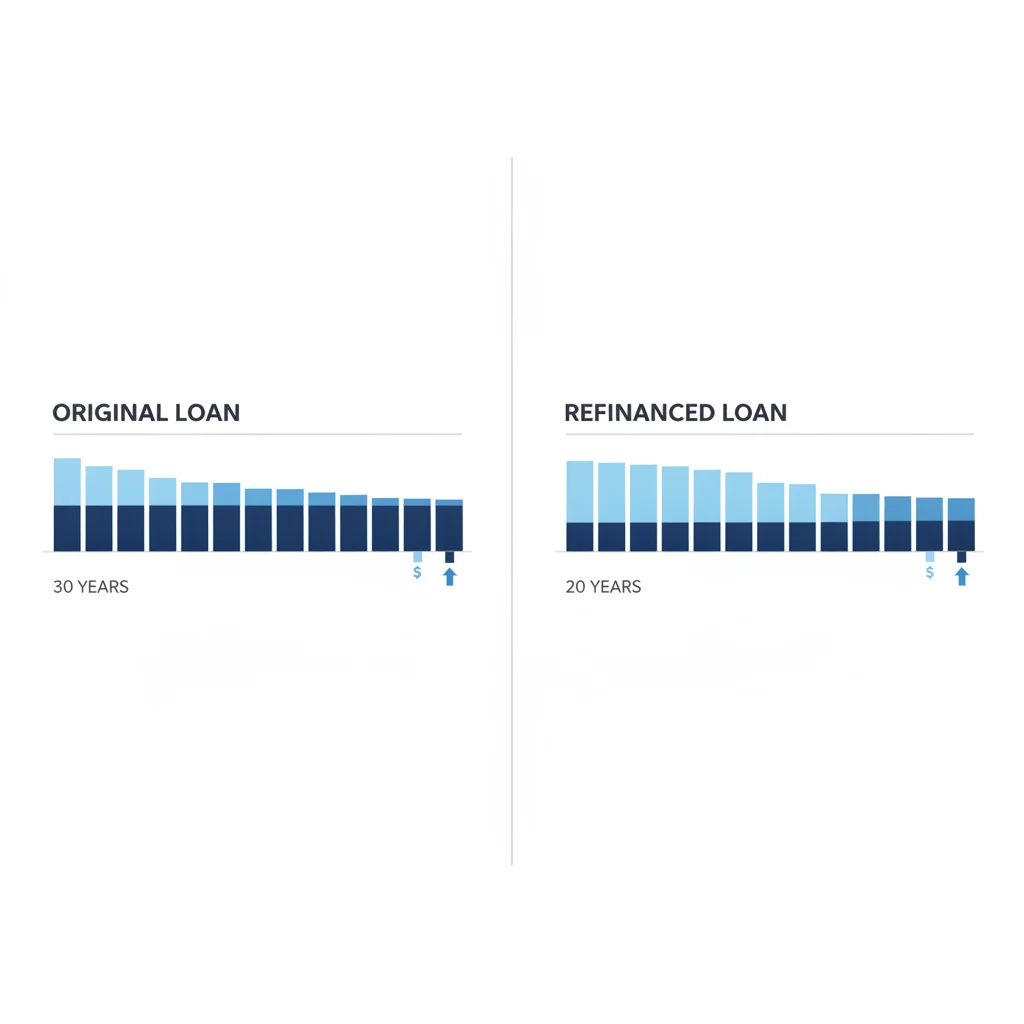
One important caveat: refinancing works differently at different stages of your loan. In the early months, most of your payment is interest. By the final year, you're mostly paying principal. Refinancing late in a loan often saves very little because the interest has already been paid — and a new loan resets that front-loaded interest schedule.
The Jargon Decoded: Terms You'll See on Every Offer
Refinance offers come loaded with terminology that lenders treat as obvious but first-timers have never been taught. Here's what the key terms actually mean before you evaluate any offer.
APR (Annual Percentage Rate)
The true yearly cost of your loan, expressed as a percentage. It includes the interest rate plus any lender fees, so it's a more accurate comparison tool than the interest rate alone.
Principal
The original amount you borrowed — or the remaining balance you still owe — not counting interest. Lowering your rate means more of each payment goes toward reducing the principal.
Loan term
The length of time you have to repay the loan, usually expressed in months (e.g., 36, 48, or 60 months). Shorter terms mean higher monthly payments but less total interest paid.
Loan-to-value ratio (LTV)
A percentage comparing what you owe on the loan to what your car is currently worth. If you owe $12,000 and the car is worth $15,000, your LTV is 80%.
Prepayment penalty
A fee some lenders charge if you pay off your loan before the scheduled end date. Refinancing pays off your current loan early, so this fee can apply.
Break-even point
The number of months it takes for your monthly savings from refinancing to offset the costs of refinancing. You don't truly save money until you pass this point.
Hard credit inquiry
A formal review of your credit report by a lender when you apply for a loan. It typically lowers your credit score by a few points temporarily.
Lienholder
The lender whose name is on your vehicle title because you borrowed money to buy the car. When you refinance, the new lender becomes the lienholder.
One term worth extra attention is loan-to-value ratio (LTV). This compares what you owe on the loan to what your car is currently worth. If you owe $14,000 and the car is worth $18,000, your LTV is about 78%. Lenders use LTV to assess their risk: the higher your LTV, the more exposed they are if you stop paying and they have to repossess and sell the vehicle. Most lenders prefer an LTV under 125% — some cap it at 100%.
For a broader look at how loan terms affect your total cost, the Loan Terms Explained hub walks through the relationship between term length, monthly payments, and what you ultimately pay.
Same Lender, New Loan
Some borrowers refinance with the same lender that holds their current loan. This is perfectly valid — and sometimes the existing lender will offer competitive terms to keep your business. However, don't assume loyalty earns you the best rate. Always get at least one or two quotes from outside lenders before accepting any offer, even from your current lender.
Understanding these terms before you sit down with a lender puts you in a much stronger position. You won't be making decisions under pressure while decoding unfamiliar language — you'll be comparing numbers you actually understand.
When Market Conditions Make Refinancing Worth It
The interest rate on your auto loan isn't just about you — it's also shaped by what's happening in the broader economy at the moment you borrowed. If you financed your car when rates were high and market rates have since dropped, there may be a real opportunity to refinance into a lower rate even if nothing about your personal finances has changed.
Here's the mechanism: auto loan rates are influenced by the federal funds rate set by the Federal Reserve, which in turn reflects inflation and economic conditions. When the Fed raises rates to cool inflation, auto loan rates climb. When it cuts rates, lenders typically follow. Watching that cycle isn't something most car buyers do — but it should be part of how you evaluate whether refinancing makes sense.
Signs that market conditions favor refinancing
- The Federal Reserve has cut its benchmark rate since you took out your loan
- Current advertised auto loan rates are at least 1 to 2 percentage points lower than your existing rate
- You're seeing promotional refinance rates from credit unions or online lenders that are meaningfully below your current APR
Rate-Shop Within a Short Window
When you apply to multiple lenders to compare refinance rates, do it within a 14-to-45-day period. Most credit scoring models treat all auto loan inquiries made within that window as a single inquiry, minimizing the impact on your score. Spreading applications out over several months causes multiple independent hits.
Always Compare Total Cost, Not Monthly Payment
A lower monthly payment sounds good, but if it comes from extending your loan term rather than lowering your rate, you could end up paying more overall. Always look at the total amount you'll pay over the life of the loan — principal plus all interest — and compare that number across your current loan and any refinance offer.
Even a 1.5 percentage point rate reduction can save hundreds or even thousands of dollars over the remaining life of your loan. On a $20,000 balance at 7% over 48 months, dropping to 5.5% saves roughly $650 in total interest — without changing anything else about your loan structure.
Market conditions alone don't guarantee a better rate for you, though. Lenders price rates based on both the market environment and your individual credit profile. The market sets the floor; your creditworthiness determines where above that floor you land.
When Your Personal Situation Makes It Worth It
Even when market rates haven't moved, changes in your own financial profile can make refinancing worthwhile. The most common personal trigger is a meaningful credit score improvement since you took out your original loan.
Here's why that matters so much: lenders assign interest rates based on risk tiers. A borrower with a 620 credit score is considered riskier than one with a 720, so the lender charges more to compensate. If you were in a lower tier when you first financed and you've since moved into a better tier, a new lender will evaluate you at your current score — not the one you had when you signed your original contract.
Personal situations that often justify refinancing
- Your credit score has risen 40+ points since you first financed. A jump that size can move you into a lower rate tier.
- You financed through a dealership at the point of sale. Dealer-arranged financing often carries a markup built in. Refinancing with a bank or credit union frequently cuts that out.
- Your income has become more stable. If you were between jobs or had irregular income when you first applied, a more stable financial picture now may qualify you for better terms.
- You need to reduce your monthly payment. If your budget has tightened, refinancing into a longer term can lower the payment — though you'll pay more total interest, so weigh that carefully.

If your original loan was taken out with bad credit, the opportunity to refinance into a significantly lower rate after rebuilding is one of the most powerful financial moves available to you. Our guide Auto Loans for Bad Credit covers how bad-credit financing works, which helps you understand what you were likely paying — and why refinancing after improvement can save so much.
Don't Refinance Just to Free Up Cash Flow
Extending your loan term to lower your monthly payment can feel like a relief, but it almost always increases the total interest you'll pay. If your goal is purely to reduce what you pay each month — not to lower your rate — exhaust other options first, like adjusting your budget. Refinancing into a longer term should be a deliberate trade-off, not a reflex.
Don't Skip the Prepayment Penalty Check
Before you invest time in comparing refinance offers, look at your original loan agreement for a prepayment penalty clause. Some lenders — especially dealer-arranged or subprime lenders — include fees that trigger when the loan is paid off early. If that fee is significant, it changes your break-even math entirely and may make refinancing not worthwhile at your current stage.
The Hidden Costs Most First-Timers Miss
Refinancing isn't free, and the costs involved are the part no one walks you through at the beginning. If you don't account for them, you might calculate that refinancing saves you money — and then discover the fees eat up most of that savings.
Prepayment penalties
Some auto loans — particularly from smaller lenders or buy-here-pay-here dealerships — include a prepayment penalty clause. This charges you a fee if you pay off the loan early, which is exactly what refinancing does. Check your current loan contract for this clause before you do anything else. If it exists, calculate the penalty amount and subtract it from your projected savings.
Title transfer fees
When you refinance, the new lender becomes the lienholder on your vehicle title. That change requires paperwork filed with your state's DMV, and those fees vary by state — typically $15 to $75, but can be higher. It's a small number, but it's real money out of your pocket.
Loan origination fees
Some lenders charge an origination fee — a percentage of the loan amount — for processing your new loan. Not all lenders charge this, but if yours does, it needs to factor into your break-even calculation.
Extended term interest
This isn't a fee, but it's a hidden cost many first-timers overlook. If you refinance and extend your term to lower your monthly payment, you'll pay interest for longer. Even at a lower rate, a much longer term can mean paying more in total interest than you would have under your original loan. Always compare total cost — not just monthly payment.
For a comprehensive look at common errors that turn a smart refinance into a losing one, read our article on common mistakes that undercut a good refinancing decision.
Refinancing Your Auto Loan: A Full Walkthrough from Application to Closing
Once you've decided refinancing makes sense, this step-by-step guide covers everything from pulling your credit report to signing with your new lender — so you know exactly what to expect at each stage.
Auto Loan Interest and APR: A Complete Guide for First-Time Car Buyers
If APR, interest rate, and total loan cost still feel fuzzy, this guide untangles every concept you need to compare refinance offers confidently and avoid overpaying.
Loan Terms Explained
A focused resource on how loan length, monthly payments, and total cost interact — essential reading before you decide whether to shorten or extend your term when refinancing.
Common Mistakes That Undercut an Otherwise Good Refinancing Decision
A practical rundown of the errors that turn smart refinancing decisions into money-losing ones, from ignoring fees to miscalculating break-even timing.
How to Know If Refinancing Will Actually Save You Money
Before you apply anywhere, run the break-even calculation. This tells you exactly when you'll start saving money — and how much you'll save over the life of the loan. Without it, you're guessing.
The break-even calculation
Here's how it works, step by step:
- Find your current monthly payment and the number of payments remaining on your current loan.
- Get a refinance quote — ideally from two or three lenders — with the proposed rate, term, and monthly payment.
- Calculate your monthly savings: Subtract the new payment from your current payment.
- Add up all refinancing costs (fees, penalties, title transfer).
- Divide total costs by monthly savings. The result is your break-even point in months.
Example: If your costs are $300 and you save $60 per month, you break even in 5 months. Every month after that is genuine savings. But if you plan to sell the car or pay off the loan in 4 months, the refinance actually costs you money.
Total interest comparison
Go one step further and compare the total interest you'd pay under each scenario. Multiply your monthly payment by the number of remaining months, then subtract the remaining principal. Do the same for the new loan. The difference is the true dollar-for-dollar comparison.
| Scenario | Monthly Payment | Months Remaining | Total Remaining Cost |
|---|---|---|---|
| Current loan (7% APR) | $425 | 36 | $15,300 |
| Refinanced loan (5.2% APR) | $405 | 36 | $14,580 |
| Savings | $20/mo | — | $720 total |
After subtracting $200 in fees, net savings would be $520. That's a clear win — but only because we did the math first.
Rate-Shop Within a Short Window
When you apply to multiple lenders to compare refinance rates, do it within a 14-to-45-day period. Most credit scoring models treat all auto loan inquiries made within that window as a single inquiry, minimizing the impact on your score. Spreading applications out over several months causes multiple independent hits.
Always Compare Total Cost, Not Monthly Payment
A lower monthly payment sounds good, but if it comes from extending your loan term rather than lowering your rate, you could end up paying more overall. Always look at the total amount you'll pay over the life of the loan — principal plus all interest — and compare that number across your current loan and any refinance offer.
What Lenders Look at When You Apply
Refinancing is an application process, and lenders make approval decisions using a specific set of criteria. Knowing what they're evaluating helps you anticipate your options — and understand why some lenders may offer you better rates than others.
Credit score
This is the single largest factor. Lenders use your score to categorize your risk tier and set your rate accordingly. Generally speaking, scores above 740 get the best rates. Scores between 660 and 739 get competitive but not top-tier rates. Below 660, options narrow and rates climb — though refinancing can still make sense if your score has risen since your original loan. You can learn more about preapproval and how lenders use your credit profile in our Loan Preapproval hub.
Loan-to-value ratio (LTV)
Lenders compare what you still owe against the current market value of your vehicle. If you owe close to — or more than — the car is worth, that raises their risk and may limit your options. Cars depreciate, so the longer you've had your vehicle, the more the balance and value may have diverged.
Payment history on the current loan
Lenders want to see that you've been making payments on time. A history of late payments on the loan you're trying to refinance is a red flag. Most lenders want to see at least six months of clean payment history before they'll consider your application.
Income and debt-to-income ratio
Lenders verify that your income is sufficient to cover the new loan payment alongside your other debts. Your debt-to-income ratio (monthly debt payments divided by gross monthly income) should ideally be below 40% — though requirements vary by lender.
Vehicle age and mileage
Lenders are financing a depreciating asset, so older vehicles and high-mileage vehicles represent more risk. Many lenders won't refinance vehicles older than 7 to 10 years or with more than 100,000 to 125,000 miles. Check lender eligibility requirements before applying.
For a more complete explanation of how lenders evaluate refinance applications, see our foundational article on what auto loan refinancing actually means and how it works.
Your Next Steps: Getting Ready to Refinance
If you've worked through this guide and think refinancing makes sense for your situation, here's how to move from understanding to action without rushing into a bad decision.
Step 1: Pull your current loan details
Find your most recent statement. Note your current balance, interest rate, monthly payment, and how many payments remain. Also look for any prepayment penalty clause in your original loan agreement.
Step 2: Check your credit score
Get your current score from a free source — many credit cards and banks offer this. Compare it to where you were when you first financed. A 40-point or greater improvement is a meaningful signal that refinancing could yield a better rate.
Step 3: Look up your car's current value
Use a source like Kelley Blue Book or Edmunds to estimate your car's current market value. Compare it to your remaining loan balance to calculate your LTV. This tells you whether you're in a position lenders will view favorably.
Step 4: Get quotes from multiple lenders
Start with credit unions and online lenders — they often offer more competitive rates than traditional banks or dealer finance arms. Apply to two to four lenders within a short window (14 to 45 days) so the multiple hard inquiries count as one for credit score purposes. Compare the APR, term, total cost, and any fees from each offer — not just the monthly payment.
Step 5: Run the break-even math
Use the calculation from the previous section to confirm the refinance actually saves you money after fees. If it does and you plan to keep the car long enough to hit break-even, you have a clear case to move forward.
When you're ready to apply in earnest, our step-by-step walkthrough Refinancing Your Auto Loan: A Full Walkthrough from Application to Closing covers the entire process from submitting documents to signing the new loan agreement.
Don't Refinance Just to Free Up Cash Flow
Extending your loan term to lower your monthly payment can feel like a relief, but it almost always increases the total interest you'll pay. If your goal is purely to reduce what you pay each month — not to lower your rate — exhaust other options first, like adjusting your budget. Refinancing into a longer term should be a deliberate trade-off, not a reflex.
Don't Skip the Prepayment Penalty Check
Before you invest time in comparing refinance offers, look at your original loan agreement for a prepayment penalty clause. Some lenders — especially dealer-arranged or subprime lenders — include fees that trigger when the loan is paid off early. If that fee is significant, it changes your break-even math entirely and may make refinancing not worthwhile at your current stage.
Refinancing is one of the few financial moves where preparation genuinely determines the outcome. The borrowers who do best aren't the ones with the highest incomes — they're the ones who showed up knowing their numbers, understood what they were signing, and didn't let an unclear term or an unexpected fee catch them off guard.

All claims are backed by peer-reviewed research. Sources on request.