


Key Takeaways
What Repossession and Missed Payments Actually Do to Your Credit
Let's be direct about the damage so you can plan around it accurately. A single 30-day late payment on an auto loan can drop a 700-range score by 60–110 points. A repossession — which is typically reported as both a series of late payments and a separate "repossession" tradeline — can crater a mid-range score into the 500s or below. That's not fearmongering; that's the math lenders use every day.
Here's what the timeline looks like on your credit report:
- 30-day late payment: Reported to bureaus and stays for 7 years from the original delinquency date.
- 60- and 90-day lates: Each reported as separate negative items, compounding the damage.
- Repossession entry: A distinct derogatory mark that lenders can see clearly — voluntary or involuntary, both appear.
- Deficiency balance: If the lender sold your car for less than you owed, the remaining balance may be sent to collections, adding yet another negative tradeline.
The good news is that credit scoring models are forward-looking. FICO and VantageScore both weight recent payment behavior far more heavily than older derogatory marks. A repossession from three years ago with two years of clean payments behind it looks meaningfully different to an algorithm than a repossession from six months ago with no recovery activity. Time and consistent behavior are your primary tools — but there are several concrete steps you can take to accelerate the process.
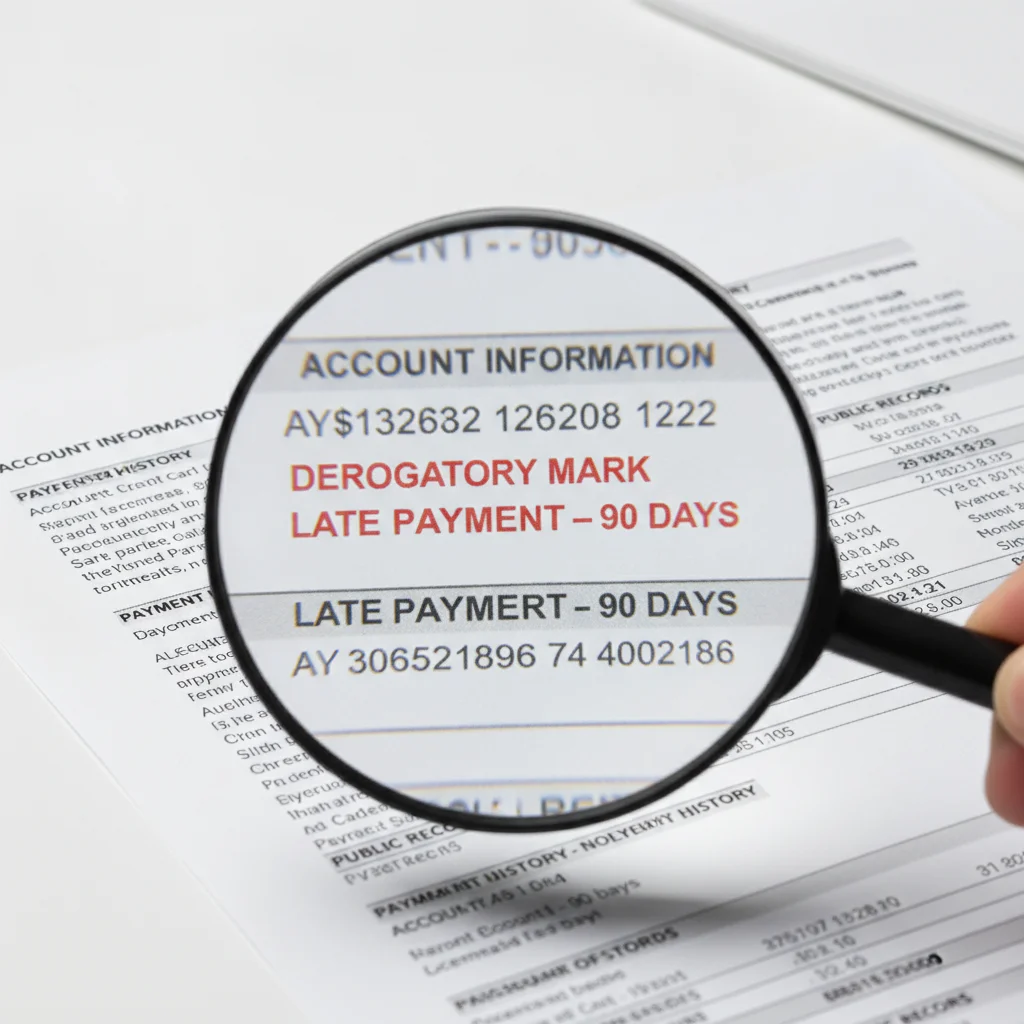
Before you even think about applying for a new auto loan, you need a clear picture of where you stand. Pull your credit reports from all three bureaus at AnnualCreditReport.com — free, weekly access is currently available. Verify that any repossession entry is accurate: confirm the date, the balance reported, and whether a deficiency balance appears twice (once as the loan and once as a collection). Errors happen, and disputing inaccurate information is one of the few ways to remove a negative item before its seven-year clock expires.
For a detailed look at what the late-payment and repossession timeline looks like from the lender's side, see what happens when you miss a payment on a subprime auto loan.
The Credit Score Ranges That Determine Your Loan Rate
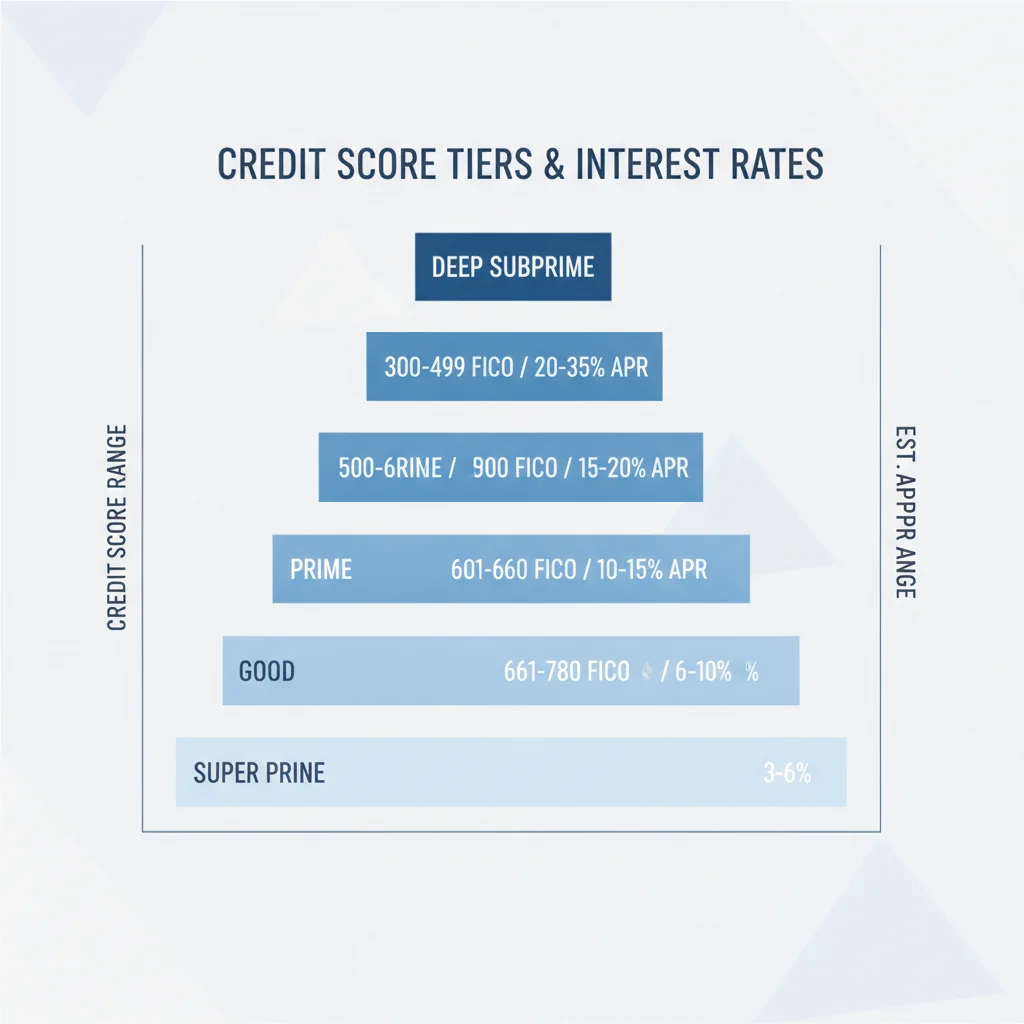
Lenders don't see your credit story — they see a tier. Every auto lender buckets applicants into risk tiers that correspond directly to APR ranges. Knowing these tiers tells you exactly what you're shopping for and when it makes sense to wait versus act now.
| Credit Score Range | Tier Label | Typical New Car APR | Typical Used Car APR |
|---|---|---|---|
| 781–850 | Super Prime | 5%–7% | 6%–8% |
| 661–780 | Prime | 7%–10% | 9%–13% |
| 601–660 | Near Prime | 11%–15% | 14%–18% |
| 501–600 | Subprime | 16%–22% | 19%–26% |
| 300–500 | Deep Subprime | 22%–29%+ | 25%–29%+ |
These numbers are approximations — lenders set their own tiers — but they track closely with what I saw written into hundreds of contracts at the dealership. The difference between a 580 score and a 640 score on a $20,000 used car loan at 60 months is roughly $3,000 in total interest paid. That gap motivates real action.
If your score currently sits in the deep subprime or subprime range, this guide focuses on two parallel tracks: rebuilding your score as quickly as practically possible and knowing when and how to apply for a car loan despite imperfect credit. Both tracks are worth running simultaneously, because sometimes you need a car now.
Financing options for borrowers with poor credit histories cover the full landscape — the steps below focus on the specific sequence that moves you from damaged credit to fundable loan application.
Before You Apply: What You Need and What to Expect
Preparation is the difference between a loan approval at 19% APR and one at 24% APR — a gap that adds up to real money over 48–60 months. Before you walk into a lender's process, get these items in order.
What you will need
On the documentation side, lenders doing subprime approval will scrutinize income verification more tightly than a prime lender would. Proof of stable employment for at least six months at your current job is a meaningful positive signal. Recent bank statements showing consistent deposits matter. If you're self-employed, two years of tax returns are typically required — W-2 history alone won't satisfy most subprime lenders.
AnnualCreditReport.com
Pull official credit reports from all three bureaus to identify inaccuracies, confirm derogatory item details, and track recovery progress.
Credit score monitoring service (Credit Karma, Experian free tier, or your bank's app)
Track your score in real time so you can see the impact of each credit action and time your loan application strategically.
Secured credit card
Adds a new positive revolving tradeline to your credit file, which helps rebuild score when kept below 30% utilization and paid in full monthly.
Credit-builder loan (typically from a credit union or online lender)
Adds an installment account to your credit mix and builds payment history simultaneously, often with very low monthly amounts.
Loan preapproval from a credit union or online lender
Establishes a concrete rate benchmark before visiting dealers, giving you negotiating leverage and protecting against rate markups.
Auto loan calculator (free online tool)
Models total cost scenarios at different APRs and terms so you understand the real dollar impact of rate differences before signing.
One thing worth flagging: if you still have an outstanding deficiency balance from a previous repossession with the same lender or affiliated lender group, they will almost certainly decline your application. Settle or establish a payment plan on that balance before applying anywhere. Some lenders will also flag an open collection from any auto lender as a disqualifying factor until it's resolved.
Unresolved Deficiency Balances Will Block Most Lenders
If your repossession left a deficiency balance that went to collections, many lenders — especially credit unions and prime lenders — will decline your application automatically regardless of your current score. Some lenders in the subprime space will still approve you, but they'll price the risk into a higher rate. Resolving the deficiency balance before applying expands your lender pool considerably and can drop your rate offer by 2–4 percentage points.
Avoid Long Loan Terms on High-Rate Loans
A 72- or 84-month term at 20%+ APR isn't just expensive — it keeps you underwater on your vehicle for years, which blocks refinancing and leaves you exposed if the car is totaled or stolen. Stick to 48 or 60 months maximum in the subprime tier, even if it means buying a less expensive vehicle to keep the payment manageable.
Step-by-Step: From Damaged Credit to Approved Auto Loan
This process isn't a sprint. The realistic timeline from active damage to prime-adjacent loan terms is 18–36 months of consistent effort. But many of the steps below have impact within 3–6 months, and getting a car loan — even at subprime rates — can itself become part of the recovery strategy if managed correctly.
Audit your credit reports and dispute any errors
Pull reports from all three bureaus and go line by line through every derogatory item related to your auto history. Verify the original delinquency date (this sets the seven-year removal clock), the balance reported, and whether a deficiency balance is appearing as both a charged-off loan and a separate collection account — a common duplication that can be disputed. File disputes directly with the bureau reporting the error using their online dispute portals. Disputes are resolved within 30 days in most cases.
Also check for any accounts that aren't yours — mixed credit files (where another person's data appears in your report) are more common than most people realize and can suppress your score significantly.
Resolve any outstanding deficiency balance
If the lender who repossessed your vehicle sold it for less than you owed, the deficiency balance is likely sitting in collections. This is a hard block with many lenders — particularly if the collection belongs to the same lender group you're now applying to. Contact the collection agency or original lender and negotiate a settlement. Many will accept 40%–60% of the balance, especially on older deficiencies. Get any settlement agreement in writing before paying. After settlement, the account should be updated to "settled" or "paid" status, which won't erase the entry but removes it as an active blocking factor for most lenders.
Open a secured credit card and use it strategically
A secured credit card requires a cash deposit — typically $200–$500 — that becomes your credit limit. Use it for one small recurring purchase per month (a streaming subscription, a gas fill-up) and pay the balance in full before the due date. This adds a positive revolving tradeline to your file that all three bureaus see. Keeping the balance below 10% of the credit limit at statement time has the strongest positive effect on utilization scoring. After 12–18 months of on-time payments, many issuers will upgrade you to an unsecured card and return your deposit.
Add positive payment history through a credit-builder loan
Credit-builder loans from credit unions or online lenders like Self or local community development financial institutions (CDFIs) work differently from regular loans: the lender holds the funds in a savings account while you make monthly payments. Once you've paid it off, you receive the funds plus interest earned. The value is entirely in the payment history it adds to your credit report — typically 12–24 months of positive installment account activity. Payments are usually $25–$50/month. Combined with a secured card, this gives you both revolving and installment positive accounts, which scoring models reward.
Get preapproved before setting foot in a dealership
Once your score has moved — even into the 580–620 range — start the preapproval process with credit unions and online lenders that specialize in subprime auto lending. Credit unions are your first call: they tend to price risk more charitably than banks and are often more willing to look at your full financial picture rather than just the score. Apply to three to five lenders within a 14-day window so all inquiries count as a single hard pull under FICO's rate-shopping rules.
Your preapproval letter gives you a concrete rate and loan amount to walk into a dealership with. The dealer's finance office will try to beat it — sometimes they can, sometimes they can't. Either way, you're negotiating from a position of information rather than desperation. See how loan preapproval works and why it matters for a full breakdown of the preapproval process.
Choose a realistic vehicle and negotiate the right numbers
In the subprime tier, lenders often restrict loan amounts, loan-to-value ratios, and vehicle age (many won't finance a car more than 8–10 years old or with more than 100,000 miles). Target a vehicle priced between $10,000 and $18,000 that's 3–6 years old with documented service history. Avoid rolling any add-ons — extended warranties, GAP insurance, paint protection — into the loan. These push your LTV above 100% and narrow your lender options. Budget for them separately or skip them entirely until you refinance at better terms.
Negotiate the vehicle price first, completely separately from the financing conversation. A dealer who knows you need their financing has leverage. When you negotiate price first, you remove that leverage.
Make every payment on time and plan your 12-month refinance review
The loan you sign today is not the loan you're stuck with forever. Once you have 12 months of on-time payments on your new auto loan — and assuming your score has continued improving — you may qualify for a refinance at meaningfully better terms. Set a calendar reminder for month 10 to pull your credit again and run the numbers. At a 640+ score with 12 months of perfect payment history on the new loan, a refinance from 22% to 14% APR on a $15,000 balance saves you roughly $2,400 over the remaining term. That's the payoff for the rebuild work you did upfront.
Once you've secured a loan, the work isn't over. A bad credit auto loan can actually rebuild your score when managed carefully — but most borrowers underestimate how easy it is to slip back. Set up autopay on day one. Never pay late. And revisit your credit profile in 12 months to see if you qualify for a refinance at better terms.
Use a 12-Month Refinance as Your Finishing Move
The subprime loan you take today is a bridge, not a destination. Once you've built 12 months of on-time payments and your score has recovered into the 620–660 range, actively seek a refinance. Even dropping from 21% to 13% APR on a $14,000 remaining balance over 48 months saves roughly $2,800 in interest. Schedule that review in your calendar now so you don't forget.
Rate-Shop Within a 14-Day Window
Under FICO 8 scoring rules, multiple auto loan inquiries within a 14-day period are treated as a single hard pull. This means you can apply to five lenders and compare real offers without compounding the score damage from multiple inquiries. Don't apply one at a time over several weeks — batch your applications and use the competition to your advantage.
What Lenders Look at Beyond Your Score
Your credit score is the front door, but lenders walk through the whole house. After a repossession or serious delinquency, underwriters look at several additional factors that can either help or hurt your application independent of the score itself.
Loan-to-Value Ratio (LTV)
The LTV compares the loan amount to the car's actual market value. Subprime lenders are far more willing to approve a loan at 90% LTV than at 120% LTV. If you're buying a used car worth $15,000 and financing $18,000 (which happens when taxes, fees, and add-ons are rolled in), you're immediately underwater — and a lender knows the risk of that combination with a damaged-credit borrower. This is why down payments matter so much in this tier. A $2,000 down payment on a $15,000 car doesn't just lower your monthly payment; it changes the lender's risk calculation entirely.
Debt-to-Income Ratio (DTI)
Most subprime lenders cap acceptable DTI at 45%–50%. That means all your monthly debt payments — rent or mortgage, any existing loans, credit cards — plus the proposed car payment should not exceed roughly half your gross monthly income. At $3,500/month gross income, that's a cap of around $1,575 in total monthly obligations. If your rent is $1,200 and the car payment would be $450, you're already at $1,650 — over the limit. Paying down or closing small debts before applying can shift this ratio meaningfully.
Payment-to-Income Ratio (PTI)
Some auto-specific lenders also use a PTI threshold — typically 15%–20% of gross monthly income for just the car payment. At $3,500/month gross, that puts the comfortable payment cap at $525–$700. If the car you're looking at pushes beyond that, even with an acceptable DTI, some lenders will decline. Choosing a less expensive vehicle isn't a defeat; it's a strategic decision that expands your lender pool.

Time Since Derogatory Event
Lenders who specialize in subprime auto lending often have explicit rules about recency. A repossession within the last 12 months is a near-automatic decline at many lenders, regardless of any positive activity since. At 12–24 months, you'll find a small set of willing lenders. At 24–36 months with positive accounts added, the pool of willing lenders expands significantly. Understanding this calendar helps you decide whether to wait six more months or push forward now.
If you've already been turned down by multiple lenders, paths forward when every lender has said no walks through the alternatives — including buy-here-pay-here, co-signers, and secured borrowing strategies.
Same-Lender Applications After a Repo Will Likely Fail
If you're applying to the same lender — or a lender within the same institutional group — that repossessed your previous vehicle, expect a denial. Most lenders flag prior repossession customers in their system and will not extend new credit until the deficiency is fully resolved and a significant amount of time has passed (often three or more years). Target lenders with no prior relationship to your repossession first.
Buy-Here-Pay-Here Lots Often Don't Report to Credit Bureaus
Buy-here-pay-here dealerships are sometimes positioned as a credit-rebuilding tool, but most do not report payment history to the major credit bureaus. That means two years of on-time payments with a BHPH dealer may do nothing for your score. Before financing through any BHPH lot, ask directly and in writing whether they report to Equifax, Experian, and TransUnion. If they don't, you're paying high rates with zero credit-building benefit.
Troubleshooting: When Things Don't Go as Planned
Even with preparation, the path to approval after a repossession doesn't always run straight. Here are the most common friction points and what to do about them.
You're approved, but the rate is worse than expected
This happens when lenders reprice risk upward based on what they see in the full credit file — not just the score, but the specific nature of the derogatory items. If the offered rate is significantly above what you modeled, ask the lender directly what would improve it. Some will tell you. Common answers: larger down payment, shorter loan term, or a co-signer with stronger credit. A shorter term (36 or 48 months vs. 72 months) reduces the lender's exposure and can sometimes drop the rate by 1–2 points. That shorter term also means less total interest paid even before the rate change.
You keep getting declined despite improving credit
Check whether you have an unresolved deficiency balance or an open auto collection account. These are invisible blockers that don't always surface until an underwriter reviews the full file. Request a free copy of your specialty consumer reports — specifically your ChexSystems and CLUE reports — in addition to the standard bureau reports. Some lenders also use alternative data sources that may contain errors. If a specific lender declines you, ask for the adverse action notice, which is legally required and will list the specific reasons for denial.
The dealer is pushing a much higher rate than your preapproval
This is the oldest play in the book. If you walked in with a credit union preapproval at 18% APR and the dealer's finance office is quoting 24%, the dealer is marking up the rate — which is legal and common. Your preapproval is your floor. Tell them you'll finance through your credit union unless they can beat it. Many times, they can and will. The dealer earns a cut of the finance income, so they're motivated to match or undercut a legitimate external offer. Don't sign a contract until you've compared the total amount financed, not just the monthly payment.
For readers who want a realistic overview of the full experience financing a car with damaged credit, what to realistically expect when getting a car loan with bad credit covers the complete picture — from application to dealership negotiation.
And if your situation eventually includes a prior bankruptcy rather than just late payments or a repo, the refinancing pathway diverges — refinancing after bankruptcy covers the specific timelines and lender expectations for that scenario.
All claims are backed by peer-reviewed research. Sources on request.