
Key Takeaways
Don't wait for a 'perfect' moment to refinance — run the numbers whenever your credit score crosses a tier boundary (e.g., from 659 to 660) or when benchmark rates drop by more than a full percentage point.
Rate tiers work like tax brackets — crossing a threshold can unlock a meaningfully lower rate class, and the savings compound over the remaining loan term.
Call your current lender for the exact 10-day payoff figure, not just your current balance. Payoff amounts include interest accrued through the payoff date and can be $200–$500 higher than your statement balance.
Applying with the wrong balance figure can cause a mismatch with the new loan amount, creating delays at closing or an unexpected out-of-pocket difference.
When comparing lenders, ask specifically whether any extra principal payments are applied immediately to the principal balance or deferred to future scheduled payments.
Some lenders automatically apply overpayments to advance your next due date rather than reducing your principal — which eliminates the interest-saving benefit of paying ahead.
If a lender pre-qualifies you with a soft pull before a full application, use it — this lets you gauge the rate you'll likely receive without any credit impact.
Soft inquiries don't affect your FICO score, so pre-qualification is essentially free information that helps you decide whether a full application is worth pursuing.
Keep making your old loan payment on time throughout the refinancing process, even if you've already signed new loan documents.
Until the payoff clears — which can take 5–10 business days — your old account remains open. A missed payment during this gap will appear as a delinquency on your credit report.
What Auto Loan Refinancing Actually Means
Auto loan refinancing is straightforward in concept: a new lender pays off your existing loan and issues you a replacement loan with different terms. From that point forward, you make payments to the new lender instead of the old one. The car title transfers to reflect the change, and your original loan is closed.
What changes with refinancing depends entirely on what you negotiate. Most borrowers refinance to secure a lower annual percentage rate (APR) — the true cost of borrowing that includes both the interest rate and any lender fees. Others refinance to extend the loan term and reduce the monthly payment, or to shorten the term and pay less total interest over time. In some cases, borrowers do both: lower the rate and adjust the term.
It's worth being clear about what refinancing is not. It is not a modification of your current loan — your original lender typically has no role in the process. It is also not a cash-out transaction in most cases, though some lenders do offer cash-out auto refinancing if your vehicle is worth more than you owe. And it is not a guarantee of savings — the math has to work in your favor, and we'll walk through exactly how to verify that.
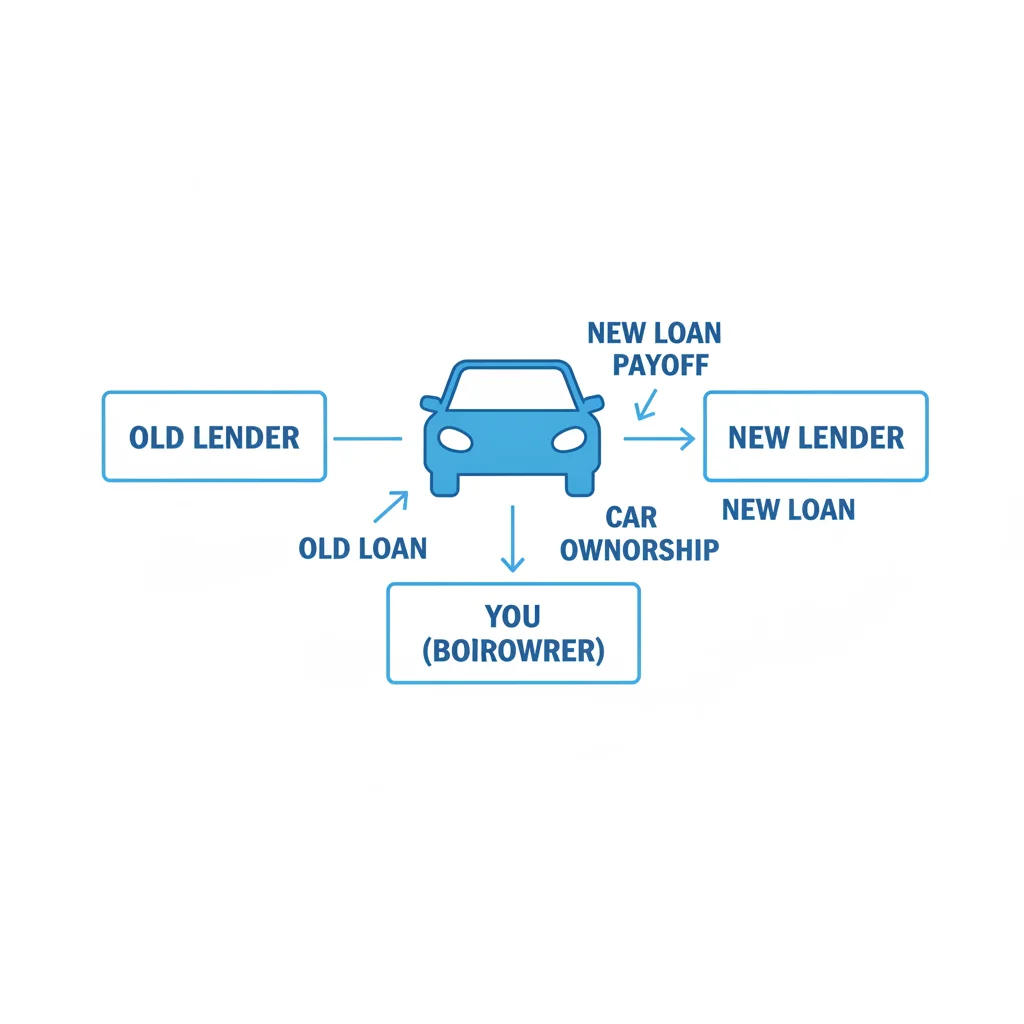
For a comparison of how refinancing differs from the original financing process, see our guide to the auto loan preapproval process — the mechanics overlap more than most borrowers realize.
When Refinancing Makes Financial Sense
Timing is everything with refinancing. The two factors that matter most are market interest rates and your personal credit profile. When either of those has improved since you took out your original loan, refinancing deserves a serious look.
Market Rate Drops
If the Federal Reserve has cut benchmark rates since you financed your car, lenders may now be offering rates meaningfully below what you locked in. Even a 1.5 to 2 percentage point reduction on a $25,000 loan can save $1,500 or more in total interest over a 48-month term. Check current average auto loan rates against the rate on your existing loan — the gap tells you whether the market has moved in your favor.
Your Credit Score Has Improved
This is the most common and most rewarding reason to refinance. If you financed through a dealership with a thin credit file or a score in the 580s, and you've since built it up to 660 or 700+, you may now qualify for lender tiers with dramatically lower rates. A jump from subprime to near-prime or prime lending territory routinely cuts APR by 3 to 8 percentage points.
43%
Borrowers who never shop for better auto loan rates
According to a Consumer Financial Protection Bureau study, nearly half of auto loan borrowers accept their first offer without comparing alternatives.
$1,000–$3,000
Typical savings from refinancing at a lower rate
Borrowers who refinance a $25,000 loan from a 10% APR to 6% APR over 48 months save approximately $2,100 in total interest.
40–60 pts
Credit score improvement that unlocks better rate tiers
Moving from the subprime to near-prime lending tier often requires only a modest score improvement but can reduce APR by 3–8 percentage points.
1–2 weeks
Typical time from application to loan closing
Most auto refinance lenders complete the full process — application, approval, title transfer initiation, and payoff — within 7–14 business days.
0.25%
Rate discount commonly offered for autopay enrollment
Many lenders reduce the APR by a quarter point when borrowers set up automatic payment, a small but real long-term saving.
You Got a Poor Rate at the Dealership
Dealer-arranged financing often carries a markup above the lender's actual rate — sometimes called a dealer reserve — that goes into the dealership's pocket. If you accepted dealer financing without shopping around, refinancing through a direct lender (bank, credit union, or online lender) may get you closer to the actual market rate.
Your Financial Situation Has Changed
A job change, a new income source, or a shift in monthly expenses can make a different loan structure more appropriate. Some borrowers need to reduce their monthly payment even if it means a longer term; others have increased income and want to accelerate payoff. Refinancing lets you restructure to fit your current life — not the financial snapshot from when you bought the car.
Don't wait for a 'perfect' moment to refinance — run the numbers whenever your credit score crosses a tier boundary (e.g., from 659 to 660) or when benchmark rates drop by more than a full percentage point.
Rate tiers work like tax brackets — crossing a threshold can unlock a meaningfully lower rate class, and the savings compound over the remaining loan term.
Call your current lender for the exact 10-day payoff figure, not just your current balance. Payoff amounts include interest accrued through the payoff date and can be $200–$500 higher than your statement balance.
Applying with the wrong balance figure can cause a mismatch with the new loan amount, creating delays at closing or an unexpected out-of-pocket difference.
When comparing lenders, ask specifically whether any extra principal payments are applied immediately to the principal balance or deferred to future scheduled payments.
Some lenders automatically apply overpayments to advance your next due date rather than reducing your principal — which eliminates the interest-saving benefit of paying ahead.
If a lender pre-qualifies you with a soft pull before a full application, use it — this lets you gauge the rate you'll likely receive without any credit impact.
Soft inquiries don't affect your FICO score, so pre-qualification is essentially free information that helps you decide whether a full application is worth pursuing.
Keep making your old loan payment on time throughout the refinancing process, even if you've already signed new loan documents.
Until the payoff clears — which can take 5–10 business days — your old account remains open. A missed payment during this gap will appear as a delinquency on your credit report.
To understand what lenders evaluate on the approval side, our article on what lenders look at before approving an auto refinance breaks down every factor in detail.
Step 1: Pull Your Credit Report and Know Your Score
Before you approach a single lender, you need an accurate picture of where you stand. This means pulling your full credit report — not just your score — from all three major bureaus: Equifax, Experian, and TransUnion. You're entitled to free reports at AnnualCreditReport.com.
Here's why the full report matters more than the number alone: lenders making refinance decisions look at the detail of your credit history, not just the summary score. They want to see your payment history on the current auto loan (30, 60, or 90-day late payments carry significant weight), your utilization on revolving accounts, any collections or derogatory marks, and the age of your accounts.
What to Look for Before You Apply
- Errors and inaccuracies: Wrong account balances, accounts that aren't yours, or late payments reported in error. Dispute these before you apply — even one incorrect derogatory mark can push you into a worse rate tier.
- Recent hard inquiries: Multiple recent inquiries from unrelated credit applications can signal risk to lenders. If you've been shopping for other credit recently, consider waiting 30–60 days.
- Current auto loan status: Make sure all your on-time payments are showing correctly. Your payment history on the existing loan is often the first thing a refinance lender checks.
FICO's Rate-Shopping Window Explained
FICO Score models 8 and above treat multiple auto loan inquiries within a 45-day window as a single inquiry. Older FICO versions use a 14-day window. Since you rarely know which version a lender is using, targeting a 14-day window for all your applications is the safest approach. VantageScore uses a 14-day window. Either way, concentrated shopping carries minimal credit risk.
Title Transfer Timing Varies by State
After closing, the update to your vehicle title to reflect the new lienholder can take anywhere from two weeks to several months depending on your state's DMV processing times. This does not affect your loan — you're legally bound to the new lender from the day you sign. Don't be alarmed if your title paperwork lags behind the loan closing by several weeks.
Once you know your score range, you can reference rate tiers: scores above 720 typically qualify for the best rates; 680–719 is considered prime; 640–679 is near-prime; below 640 is subprime. These thresholds vary by lender, but they give you a realistic benchmark for what to expect.
Step 2: Gather Your Loan and Vehicle Information
Lenders need two categories of information to evaluate a refinance application: details about you as a borrower, and details about the vehicle they'd be lending against. Having everything organized before you apply speeds up the process and signals that you're a prepared, low-risk borrower.
What You Need About Your Current Loan
- Your current lender's name and your account number
- Your current outstanding loan balance (the payoff amount — call your lender to get the exact 10-day payoff figure)
- Your current interest rate and monthly payment
- The number of months remaining on your loan
What You Need About Your Vehicle
- The Vehicle Identification Number (VIN) — found on the driver's side dashboard or your registration
- Year, make, model, and trim level
- Current mileage
- The vehicle's current market value (use Kelley Blue Book or J.D. Power as references)

Understanding Loan-to-Value (LTV) Ratio
Most lenders won't refinance a vehicle if you owe significantly more than it's worth. The loan-to-value ratio — your payoff balance divided by the vehicle's current market value — needs to stay within their guidelines, typically 100–125%. If your car has depreciated heavily or you rolled negative equity from a previous trade-in, your LTV may be too high to qualify. This is one of the most common reasons refinance applications are denied, and knowing your numbers in advance lets you address it proactively. For a broader look at how loan terms affect total cost, the Loan Terms Explained hub is a useful reference.
Watch Out for Rollover of Negative Equity
If your lender quotes you a loan amount higher than your current payoff balance, ask specifically why. In some cases, fees, GAP coverage, or even negative equity are being rolled into the new loan — a practice that increases what you owe and can push your LTV ratio above lender limits. Always verify that the 'amount financed' on your disclosure matches only what you actually owe on the original loan.
Calculate the Break-Even Point Before You Commit
If your refinance comes with fees — title transfer, origination, or state filing costs — make sure your monthly savings add up to more than those fees within the remaining loan term. If you'll pay $400 in fees and only save $30/month, it takes more than 13 months to break even. If you plan to sell or trade the car before then, the refinance costs you money rather than saving it.
Step 3: Shop Multiple Lenders and Compare Offers
This step is where most borrowers leave money on the table by going to just one or two lenders. Rate shopping is not just acceptable — it's essential. The difference between the best and worst offer you receive from qualified lenders can easily run to thousands of dollars over the life of the loan.
Where to Shop
- Your current bank or credit union: Start here if you have an existing relationship. Loyalty sometimes earns a rate discount, and they already have your financial history on file.
- Other credit unions: Credit unions are member-owned nonprofits and consistently offer some of the lowest auto loan rates available. Many have easy membership requirements.
- Online lenders and marketplaces: Platforms like LightStream, RefiJet, and OpenRoad Lending specialize in auto refinancing and can generate multiple offers quickly.
- Your current auto lender: Worth asking, though they have less incentive to offer you a better rate than a competitor does.
“The auto loan market is far more competitive than most consumers realize. Borrowers who shop at least three lenders consistently secure better rates — and the credit impact of doing so is minimal when applications are concentrated within the rate-shopping window.”
— Melinda Zabritski, Senior Director of Automotive Financial Solutions, Experian
The Rate Shopping Window
When you apply for a refinance, each lender pulls a hard inquiry on your credit report. Multiple hard inquiries from the same type of loan within a 14-day window (some scoring models extend this to 45 days) are typically treated as a single inquiry by FICO. This means you can shop aggressively without damaging your score — as long as you concentrate your applications in a short window.
What to Compare Across Offers
Don't compare monthly payments in isolation. A lower monthly payment with a longer term can cost significantly more in total interest. Use this comparison framework for every offer:
| Factor | What to Look At |
|---|---|
| APR | The true cost of borrowing — lower is better |
| Loan term | Total months; shorter saves interest, longer reduces payment |
| Monthly payment | Must be sustainable in your actual budget |
| Total interest paid | APR × term = the real cost; always calculate this |
| Prepayment penalty | Some lenders charge fees for early payoff — check carefully |
| Origination/processing fees | Some lenders add upfront costs that erode savings |
If you want to understand how loan preapproval fits into this shopping process, the Loan Preapproval hub covers the mechanics clearly.
Use Pre-Qualification Before You Formally Apply
Many online lenders and credit unions offer a soft-pull pre-qualification that gives you an estimated rate without affecting your credit score. Run pre-qualifications with three to five lenders before choosing where to submit a full application. This approach lets you compare likely offers with zero credit impact, then concentrate your hard inquiries on the most promising candidates.
Set Autopay — But Verify It Processes
Enrolling in autopay often earns a 0.25% rate discount and eliminates the risk of missed payments. However, set a monthly calendar reminder to check your account the day after each scheduled payment — autopay failures are more common than expected, especially after a loan transition when banking details have changed. Catching a failed payment within a few days keeps you well inside the grace period.
Pay Extra Toward Principal Each Month
If your refinance lowered your rate, apply some of your monthly savings directly to extra principal payments. Even $50 extra per month on a $20,000 balance at 6% APR can cut several months off your loan and save hundreds in interest. Confirm with your lender in writing that overpayments reduce principal immediately rather than advancing future due dates.
Step 4: Submit Your Application and Review the Terms
Once you've identified your best offer, it's time to submit a formal application. Most lenders allow you to do this online in 10–15 minutes. You'll provide personal identification, employment and income information, and the vehicle and current loan details you gathered in Step 2.
Documents Typically Required
- Government-issued photo ID (driver's license or passport)
- Proof of income: recent pay stubs, W-2s, or tax returns if self-employed
- Proof of residence: a utility bill or bank statement with your current address
- Proof of insurance: most lenders require full coverage on any vehicle they're financing
- Current loan account number and lender contact information
Reading the Loan Disclosure Carefully
Before you sign anything, you'll receive a loan disclosure document — often called a Truth in Lending disclosure. This is the most important document in the entire process, and most borrowers spend less than two minutes with it. Take at least 20 minutes.
Verify these specific items against what you were quoted:
- APR: Should match the rate you were offered exactly.
- Finance charge: Total dollar amount of interest over the life of the loan.
- Amount financed: Should equal your current payoff balance, not a higher number.
- Total of payments: Every dollar you'll pay back, including principal and interest.
- Payment due date and late fee policy: Know exactly when your first payment is due and what happens if you're late.
Never Sign a Disclosure With Unresolved Discrepancies
If the APR, amount financed, or total cost on your Truth in Lending disclosure doesn't exactly match what you were quoted, stop the process and request a written explanation. Discrepancies sometimes reflect errors — but they can also reflect added fees or changed terms. You have the legal right to a clear, accurate disclosure before signing. Any lender that pressures you to sign over unresolved number differences is a lender to walk away from.
Post-Bankruptcy Refinancing Requires Patience
Attempting to refinance too soon after a bankruptcy discharge — typically less than 12 months — will result in rejections that generate hard inquiries without any benefit. Each denial slightly erodes your score at a time when rebuilding is critical. Wait until you have documented on-time payment history and research lenders who explicitly work with post-bankruptcy borrowers before submitting any application.
If any number on the disclosure doesn't match what you were quoted verbally or in writing, stop and ask for a written explanation before proceeding. Lenders are required to honor their disclosed terms, and discrepancies — even small ones — sometimes indicate errors that compound significantly over time.
Step 5: Close the New Loan and Pay Off the Old One
Closing a refinance is less ceremonial than buying a car — there's no dealership visit, no handshakes over a desk. Most closings happen electronically or through overnight mail for documents requiring a wet signature. Here's the sequence:
The Closing Sequence
- Sign the new loan agreement: Either electronically or by signing and returning physical documents. Read everything before you sign — confirm the terms one final time against your disclosure.
- New lender pays off your old loan: Your new lender sends the payoff amount directly to your previous lender. You don't handle this money. The payoff typically takes 5–10 business days to process.
- Lienholder changes on the title: Your state's DMV updates the vehicle title to reflect the new lender as the lienholder. This can take several weeks depending on the state — don't be alarmed if the title update lags behind the loan closing.
- Confirm the old loan is closed: About two weeks after closing, contact your former lender and confirm the payoff was received and the account is closed. Get this confirmation in writing if possible.
- Set up payments with your new lender: Enroll in autopay — many lenders offer a 0.25% rate discount for it — and confirm your first payment due date.

The Gap Window: A Critical Detail
Between the day you sign your new loan and the day the old lender receives and processes the payoff, you may have a payment due on your old account. Make that payment. A missed payment during this window will show as delinquent on your credit report, even though you've already refinanced. Once the payoff posts and the account closes, any overpayment will be refunded to you.
Mistakes That Can Cost You the Deal
Refinancing is a fairly forgiving process when you're prepared, but a handful of common mistakes can derail an application or cost you a better rate.
Applying Too Early in Your Current Loan
Most lenders require at least 60–90 days of payment history on your existing loan before they'll consider a refinance. Some require six months or more. Additionally, if your vehicle is very new, it may have depreciated faster than you've paid down principal — creating an LTV problem. The sweet spot for most borrowers is 6–24 months into the original loan.
Only Looking at the Monthly Payment
Extending a 48-month loan to 72 months might drop your payment by $120/month, but you could end up paying $2,000–3,000 more in total interest. Always run the full-term calculation before deciding.
Skipping the Fine Print on Fees
Some states charge a title transfer fee for refinancing. Some lenders charge a processing or origination fee. Your original loan may have a prepayment penalty. Add up all fees and factor them into your break-even calculation — if it takes 30 months to recoup closing costs but you only have 28 months left on your loan, the refinance probably isn't worth it.
Watch Out for Rollover of Negative Equity
If your lender quotes you a loan amount higher than your current payoff balance, ask specifically why. In some cases, fees, GAP coverage, or even negative equity are being rolled into the new loan — a practice that increases what you owe and can push your LTV ratio above lender limits. Always verify that the 'amount financed' on your disclosure matches only what you actually owe on the original loan.
Calculate the Break-Even Point Before You Commit
If your refinance comes with fees — title transfer, origination, or state filing costs — make sure your monthly savings add up to more than those fees within the remaining loan term. If you'll pay $400 in fees and only save $30/month, it takes more than 13 months to break even. If you plan to sell or trade the car before then, the refinance costs you money rather than saving it.
Not Verifying Insurance Coverage
Your new lender will require you to list them as the lienholder on your insurance policy before the loan closes. If you forget to update your insurance and there's a gap or an incident during the transition, you may face coverage complications. Call your insurer as soon as you have your new lender's information.
Letting Multiple Applications Drag Out Over Months
If you spread your rate shopping across three months instead of concentrating it in a two-week window, each application generates a separate hard inquiry that independently impacts your score. Focus your shopping, decide quickly, and apply within the window.
Special Situations: Bad Credit, Bankruptcy, and Underwater Loans
Refinancing is not one-size-fits-all. Three situations come up often enough that they deserve direct treatment.
Refinancing With Poor Credit
If your credit score hasn't improved since your original loan — or has gotten worse — refinancing will likely result in a higher rate, not a lower one. In this case, refinancing usually makes sense only to extend the term and reduce a payment you genuinely can't afford, not to save money on interest. If you're in this position, our guide to auto loans for bad credit explains how lenders evaluate borrowers in the subprime tier and what realistic expectations look like.
Refinancing After Bankruptcy
Bankruptcy does not permanently close the door on auto loan refinancing, but timing and lender selection are critical. Most lenders want to see at least 12–24 months of clean payment history post-discharge before approving a refinance. Specialty lenders exist for this situation. Our detailed article on refinancing after bankruptcy covers realistic timelines and what rates to expect at each stage of post-bankruptcy credit rebuilding.
Never Sign a Disclosure With Unresolved Discrepancies
If the APR, amount financed, or total cost on your Truth in Lending disclosure doesn't exactly match what you were quoted, stop the process and request a written explanation. Discrepancies sometimes reflect errors — but they can also reflect added fees or changed terms. You have the legal right to a clear, accurate disclosure before signing. Any lender that pressures you to sign over unresolved number differences is a lender to walk away from.
Post-Bankruptcy Refinancing Requires Patience
Attempting to refinance too soon after a bankruptcy discharge — typically less than 12 months — will result in rejections that generate hard inquiries without any benefit. Each denial slightly erodes your score at a time when rebuilding is critical. Wait until you have documented on-time payment history and research lenders who explicitly work with post-bankruptcy borrowers before submitting any application.
Refinancing an Underwater Loan
Being underwater (also called negative equity) means you owe more than the car is worth. Most standard refinance lenders cap LTV at 100–125%, so if you're significantly upside down, you may be declined outright. Options in this scenario include:
- Making extra principal payments for 3–6 months to reduce the balance before applying
- Looking for specialty lenders who work with higher LTV ratios (at a higher rate)
- Rolling the negative equity into a new loan if a lender permits it — though this compounds the problem
The best long-term strategy for an underwater loan is almost always to make extra payments until you reach positive equity, then refinance from a position of strength.
AnnualCreditReport.com
The official free source for your Equifax, Experian, and TransUnion credit reports, authorized by federal law. Pull all three before you apply to catch errors and verify your payment history is showing correctly.
Kelley Blue Book (KBB) Vehicle Valuation
Enter your car's year, make, model, trim, mileage, and condition to get a current market value estimate. Use this to calculate your loan-to-value ratio before approaching lenders.
What Lenders Look at Before Approving an Auto Refinance
A detailed breakdown of every factor lenders weigh in a refinance decision — from LTV ratio to payment history — so you know exactly what to prepare before you apply.
Loan Terms Explained Hub
Clear explanations of loan length, APR, monthly payments, and total cost — the foundational concepts you need to compare refinance offers accurately.
Auto Loan Refinance Calculator
Input your current rate, new rate, remaining balance, and term to calculate exact monthly savings and total interest difference. Run this for every offer you receive before deciding.
Refinancing After Bankruptcy: Timelines and Realistic Rates
If you have a bankruptcy in your history, this guide explains how long to wait, which lenders to approach, and what rates are realistic at each stage of credit recovery.
After Closing: What to Do Next
Closing the refinance is not the finish line — it's the starting point for a smarter repayment strategy. Here's what to do in the first 30–60 days after your new loan is active.
Confirm Everything Is Clean
Verify your old loan shows as paid and closed on your credit report within 30–60 days of payoff. If it lingers as open or shows a balance, file a dispute with the credit bureaus and provide documentation of the payoff.
Make Payments on Time — Every Time
Your payment history is the single largest factor in your credit score. Now that you have a new loan, a streak of on-time payments builds positive history. Set up autopay, but also set a calendar reminder to check your account the day after the payment date to confirm it processed correctly. Autopay failures due to account number changes or bank issues are more common than people expect.
Consider Paying More Than the Minimum
If your refinance lowered your rate and kept the term the same, you're already saving money. But you can save even more by paying extra toward principal each month. Even $50–100 extra per month can shave months off your loan and reduce total interest significantly. Confirm with your new lender that extra payments apply to principal — not to future payments — and that there's no prepayment penalty.
Use Pre-Qualification Before You Formally Apply
Many online lenders and credit unions offer a soft-pull pre-qualification that gives you an estimated rate without affecting your credit score. Run pre-qualifications with three to five lenders before choosing where to submit a full application. This approach lets you compare likely offers with zero credit impact, then concentrate your hard inquiries on the most promising candidates.
Set Autopay — But Verify It Processes
Enrolling in autopay often earns a 0.25% rate discount and eliminates the risk of missed payments. However, set a monthly calendar reminder to check your account the day after each scheduled payment — autopay failures are more common than expected, especially after a loan transition when banking details have changed. Catching a failed payment within a few days keeps you well inside the grace period.
Pay Extra Toward Principal Each Month
If your refinance lowered your rate, apply some of your monthly savings directly to extra principal payments. Even $50 extra per month on a $20,000 balance at 6% APR can cut several months off your loan and save hundreds in interest. Confirm with your lender in writing that overpayments reduce principal immediately rather than advancing future due dates.
Revisit the Decision in 12–18 Months
If you refinanced from a subprime rate and your credit is still improving, you may qualify for an even better rate 12–18 months from now. Keep building your credit profile, and don't hesitate to run the numbers again when the market or your score shifts meaningfully. Refinancing once doesn't preclude refinancing again — as long as the math supports it each time.
Refinancing your auto loan is one of the few financial levers that can put real money back in your pocket without requiring a major life change. A few hours of preparation, disciplined rate shopping, and careful review of the terms is all it takes to move from a loan that's costing you more than necessary to one that fits your current financial reality.

All claims are backed by peer-reviewed research. Sources on request.