
Key Takeaways
Always ask a lender which FICO model they use to pull your credit. If they use FICO Auto Score 8 or 9, pull that version from myFICO.com before you apply — the number you see on free monitoring apps may differ by 30–50 points.
Auto-specific FICO models weight installment loan history differently than generic models, meaning your effective score for auto lending can be notably higher or lower than what you see on typical dashboards.
When a dealer shows you a monthly payment first, stop the conversation. Always negotiate the vehicle price and then discuss financing — bundling them lets the F&I office obscure rate markups inside monthly payment math.
F&I managers are trained to anchor buyers to monthly payments rather than total cost. Separating the two negotiations forces transparency on both the vehicle price and the interest rate independently.
Before accepting a 72- or 84-month loan, ask the lender for a payoff schedule at the 36-month mark. If you're still deeply underwater at that point, the term is too long for the vehicle's depreciation curve.
Being underwater on a loan creates a debt trap: if you need to sell or the car is totaled, you owe more than you receive, often forcing you to roll negative equity into your next loan at a higher cost.
Why Auto Loan Rates Aren't One-Size-Fits-All
Walk into a dealership and ask what the interest rate is on a new car loan, and you'll get a frustratingly vague answer: "It depends." That's not a dodge — it's the truth. Auto loan rates are personalized pricing, built by stacking half a dozen variables on top of each other, and the spread between the best and worst outcomes is enormous.
In 2024, borrowers with superprime credit were securing new-car loans near 5–6% APR. Borrowers in the deep subprime tier were paying 15–21% on used cars. On a $30,000 loan over 60 months, that difference translates to roughly $8,000 more in interest over the life of the loan. That's not a rounding error — it's a used car's worth of money.
This guide breaks down every variable that feeds into your rate, explains how each one is weighted, and shows you what happens when they interact. If you want a foundation on how auto loans are structured before diving into rate factors, start with everything you need to know before signing an auto loan. If you're already familiar with the mechanics, keep reading.

Credit Score: The Biggest Single Variable
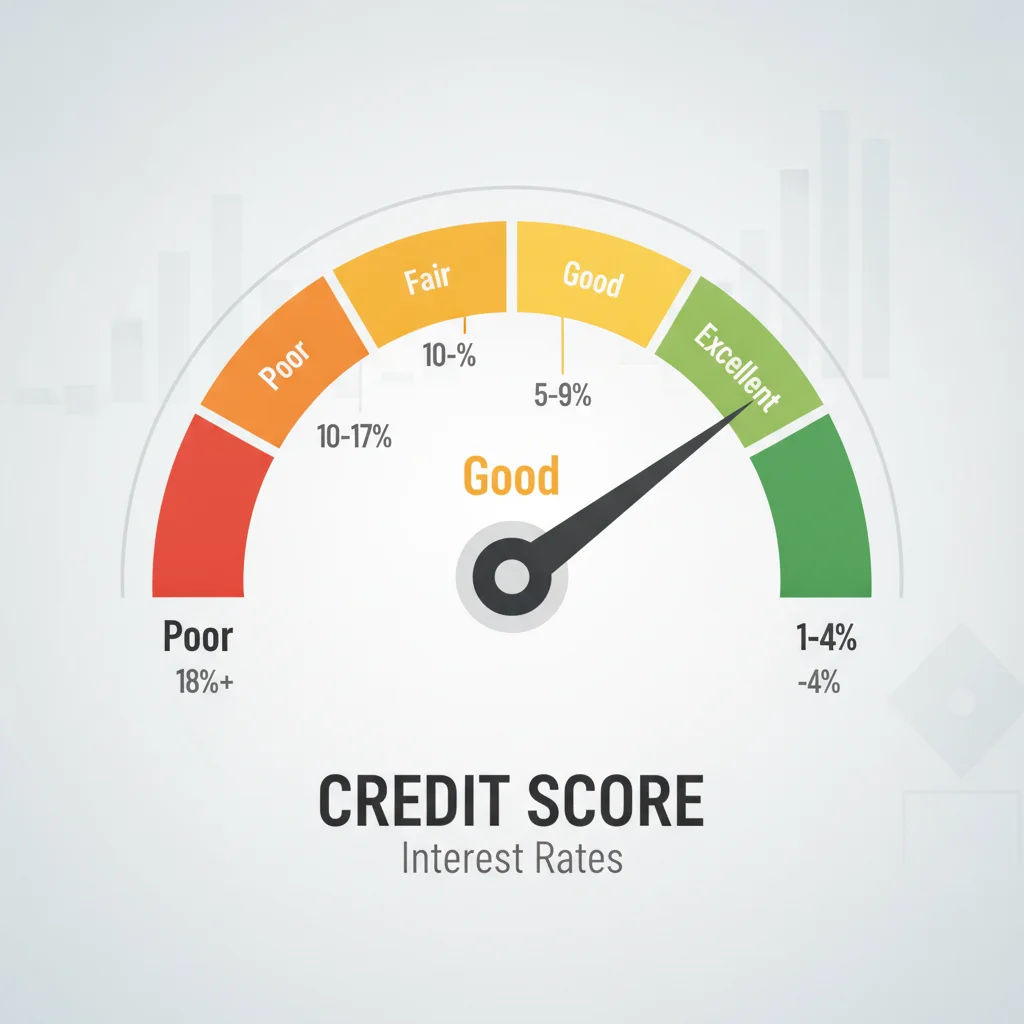
No other factor moves your rate as far or as fast as your credit score. Lenders use it as a shorthand for risk — the lower the score, the higher the probability of default, so the higher the rate they charge to compensate. The tiers are roughly standardized across the industry, though exact cutoffs vary by lender.
| Credit Tier | Score Range | Typical New Car APR | Typical Used Car APR |
|---|---|---|---|
| Deep Subprime | 300–500 | 14–21% | 18–26% |
| Subprime | 501–600 | 10–14% | 13–18% |
| Near-Prime | 601–660 | 7–10% | 10–14% |
| Prime | 661–780 | 5–7% | 7–10% |
| Superprime | 781–850 | 4–6% | 5–8% |
For a detailed breakdown of what each tier actually costs month to month, see auto loan rates by credit score tier.
One thing most buyers don't realize: lenders pull your auto-specific FICO score (FICO Auto Score 8 or 9), not the generic FICO score you see on Credit Karma. These scoring models weight your history with installment loans — especially previous car loans — more heavily than the standard model. A buyer with a 680 generic score might have a 710 auto score if they've managed car payments well in the past, or a 650 auto score if they've had a repo.
Always ask a lender which FICO model they use to pull your credit. If they use FICO Auto Score 8 or 9, pull that version from myFICO.com before you apply — the number you see on free monitoring apps may differ by 30–50 points.
Auto-specific FICO models weight installment loan history differently than generic models, meaning your effective score for auto lending can be notably higher or lower than what you see on typical dashboards.
When a dealer shows you a monthly payment first, stop the conversation. Always negotiate the vehicle price and then discuss financing — bundling them lets the F&I office obscure rate markups inside monthly payment math.
F&I managers are trained to anchor buyers to monthly payments rather than total cost. Separating the two negotiations forces transparency on both the vehicle price and the interest rate independently.
Before accepting a 72- or 84-month loan, ask the lender for a payoff schedule at the 36-month mark. If you're still deeply underwater at that point, the term is too long for the vehicle's depreciation curve.
Being underwater on a loan creates a debt trap: if you need to sell or the car is totaled, you owe more than you receive, often forcing you to roll negative equity into your next loan at a higher cost.
Beyond the tier itself, lenders also look at what's behind the score: payment history depth, recency of any derogatory marks, credit utilization, and how long your accounts have been open. Two borrowers with identical 690 scores can receive meaningfully different rates if one has a foreclosure from three years ago and the other doesn't.
Your Auto-Specific FICO Score Can Differ Significantly
The credit score lenders use for auto loans is often different from the score you see on free monitoring apps. FICO Auto Score models weight your history with installment loans — especially previous auto loans — more heavily. A buyer with a generic 680 FICO might have a 710 or a 650 auto score depending on their loan history. Before you apply, pull your FICO Auto Score from myFICO.com to know exactly where you stand.
Rolling Negative Equity Into a New Loan Is a Trap
If you owe more on your current vehicle than it's worth and you roll that difference into a new loan, you're starting your next loan already underwater — and paying interest on debt that has nothing to do with the vehicle you're buying. This is one of the most common ways buyers end up in a cycle of perpetually unaffordable car payments. Lenders will allow it, but that doesn't make it a sound financial move.
Loan Term: How Length Multiplies Your Cost
Loan term is the second most impactful variable — and the one buyers most often misunderstand. Extending your loan from 48 months to 72 months doesn't just change your monthly payment. It changes the total amount of interest the lender collects, and it changes your rate itself.
Most lenders price longer terms at higher APRs. A 48-month loan might come in at 6.5% from the same lender who quotes you 7.2% on a 72-month loan. Why? Because longer loans carry more risk — over six years, more things can go wrong (job loss, major expenses, vehicle depreciation). They're also more likely to result in the borrower being underwater on the loan.
$7,100+
Extra interest from 36-month vs. 84-month term
Based on a $35,000 loan comparing typical APRs at 36 and 84 months from major lenders in 2024.
15–25%
Average new car depreciation in year one
Industry-wide average based on Carfax and Edmunds depreciation data; varies significantly by make and model.
1.5 pts
Typical dealer financing markup over buy rate
Based on Consumer Financial Protection Bureau (CFPB) analysis of dealer reserve practices in retail auto lending.
$13,000+
Interest gap between optimized and unoptimized deals
Illustrated on same $28,000 used vehicle comparing prime credit union borrower vs. subprime dealer-financed borrower.
0.5–1.5%
Rate advantage credit unions offer over banks
According to National Credit Union Administration (NCUA) data comparing average auto loan rates across lender types.
Here's a concrete example on a $35,000 new car loan:
| Term | APR | Monthly Payment | Total Interest Paid |
|---|---|---|---|
| 36 months | 6.0% | $1,065 | $3,340 |
| 48 months | 6.5% | $829 | $4,792 |
| 60 months | 6.9% | $690 | $6,400 |
| 72 months | 7.4% | $601 | $8,272 |
| 84 months | 8.0% | $541 | $10,444 |
The monthly payment difference between 36 and 84 months is $524. But the interest difference is over $7,100. Buyers who focus only on the monthly number systematically overpay. See the loan terms hub for more on how to evaluate the true cost of different term lengths.
84-Month Loans: Low Payment, High Risk
Seven-year auto loans have become common, but they carry serious hidden costs. Rates on 84-month loans are typically 1–2 percentage points higher than on 48-month loans from the same lender. You'll also spend several years significantly underwater on the vehicle — meaning if it's totaled or you need to sell, you'll owe more than the car is worth. Only consider an 84-month term if you're absolutely certain you'll keep the vehicle for its full life.
Down Payment and Loan-to-Value Ratio
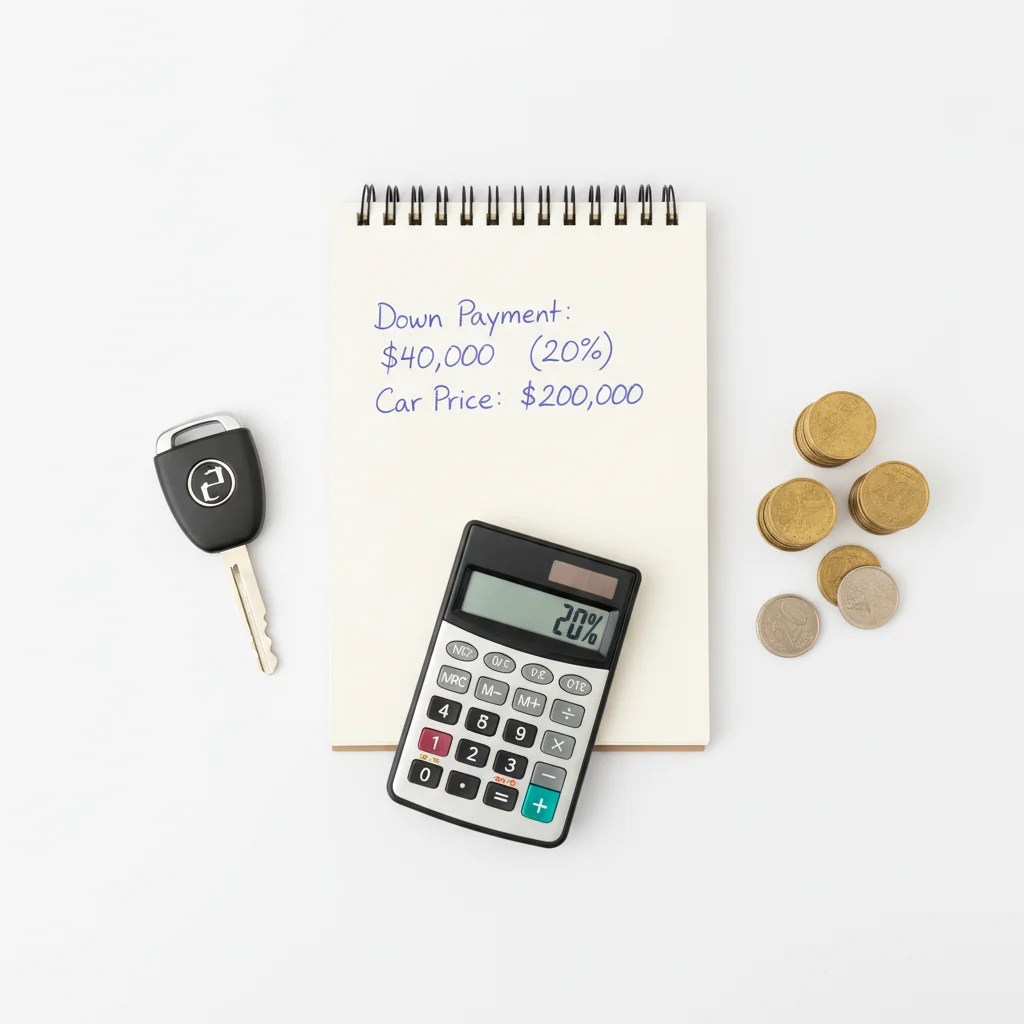
Your down payment directly determines your loan-to-value (LTV) ratio — the percentage of the car's value that you're borrowing. A $40,000 car with a $4,000 down payment gives you a 90% LTV. The same car with $8,000 down drops LTV to 80%. Lenders care about this number because it determines how much they'd recover if you defaulted and they had to repossess and sell the vehicle.
Vehicles depreciate fast — roughly 15–25% in the first year. If you put nothing down on a $35,000 car and drive off the lot, you may immediately owe more than the car is worth. That's negative equity, and it's a risk lenders price into your rate.
In practical terms:
- LTV under 80%: Typically qualifies for the lender's best published rates
- LTV 80–100%: Standard rates, no penalty but no advantage
- LTV over 100%: Lenders charge a premium or decline outright — this occurs when buyers roll negative equity from a trade-in into a new loan
A 10–20% down payment is the practical target for most buyers. It keeps LTV in a favorable range, reduces the monthly payment, and shortens the time until you build positive equity. The down payments hub covers the mechanics and tradeoffs in detail.
Use Your Down Payment to Cross a Rate Tier
If you're close to an LTV threshold — say, 82% instead of 80% — making a slightly larger down payment to cross that line can unlock a materially better rate from some lenders. Ask your lender directly: 'Is there an LTV threshold where my rate improves?' A $500 additional down payment that saves 0.5% on a 60-month loan can return $400+ in interest savings.
Always Compare the Rebate vs. Low-Rate Offer
When a manufacturer offers 0.9% APR OR a $2,500 cash rebate, run both scenarios with your own financing. On a $35,000 vehicle over 48 months, 0.9% vs. a 6.5% rate after a $2,500 rebate often comes out close. The math shifts based on loan amount and term — never assume the promotional rate is the better deal without calculating it.
Get a Credit Union Preapproval Before Visiting Any Dealer
Joining a credit union takes about 20 minutes and usually requires a $5–$25 deposit to open a savings account. The rate advantage — often 0.5–1.5 percentage points lower than bank or dealer financing — can easily save $1,500 or more on a typical loan. Do this before you even pick your vehicle.
New vs. Used: The Vehicle Age Penalty
If you compare rates on a new 2025 Honda Accord versus a used 2021 Honda Accord, the used car loan will almost always carry a higher rate — even if everything else about the borrower is identical. This isn't arbitrary. Lenders see used vehicles as harder to value and faster to depreciate, which increases collateral risk.
The age penalty varies by lender, but typical spreads look like this:
- New vehicles: Base rate tier
- Certified Pre-Owned (CPO): 0.5–1.0 percentage points higher than new
- Used (1–3 years old): 1.0–2.0 points higher than comparable new loan
- Used (4–7 years old): 1.5–3.0 points higher
- Used (8+ years old): Many lenders add 2–4+ points or set maximum loan amounts
Some lenders won't finance vehicles over 10 years old or with more than 100,000–125,000 miles at all, regardless of credit score. When they do, expect rates in the double digits even for borrowers with 700+ scores.
CPO Loans: Better Than Used, Not as Good as New
Certified Pre-Owned vehicles often qualify for lower rates than standard used cars because they come with manufacturer inspections and extended warranties, which reduce lender risk. Some manufacturers offer CPO-specific financing promotions through their captive finance arms. If you're buying a 1–3 year old vehicle, CPO status is worth seeking out specifically for the financing benefit, not just the warranty.
Manufacturer-subsidized financing complicates this picture. When you see a 0.9% or 1.9% APR deal on a new car, that rate is being bought down by the automaker's financing arm to move inventory. Those deals are only available on new vehicles, only to borrowers with prime or superprime credit, and usually require you to forgo a cash rebate. The underlying market rate from a bank or credit union on the same car might be 6–7%. Run the math on both options — sometimes taking the rebate and financing independently at a higher rate is actually cheaper overall.
Lender Type: Banks, Credit Unions, and Dealers
Where you get your loan matters as much as your qualifications. Three major channels exist, and they operate very differently.
Banks
Traditional banks — your national chains and regional banks — typically offer competitive rates to existing customers. They have strict underwriting standards, move quickly, and offer online preapproval. Rates tend to be average to slightly above credit union rates but well below dealer-arranged financing for most borrowers.
Credit Unions
Credit unions are member-owned nonprofits, which means their profit motive is structurally different. They consistently offer rates 0.5–1.5 percentage points below comparable bank rates for the same credit profile. If you have a 660+ credit score and aren't a credit union member, opening an account before car shopping is one of the most straightforward ways to save money on your loan.
“The best thing a car buyer can do is walk into the dealership already knowing their rate. A preapproval doesn't just save you money — it changes the entire power dynamic of the negotiation.”
— Melinda Zabritski, Senior Director of Automotive Financial Solutions, Experian
Dealer-Arranged Financing
When you finance through a dealership's F&I (finance and insurance) office, the dealer is not actually the lender. They submit your application to multiple lenders, receive competing buy rates, and then mark up the rate before presenting it to you. That markup — sometimes called a "dealer reserve" — is how F&I offices generate profit. On a $30,000 loan over 60 months, a 1.5 percentage point markup costs you roughly $1,200 in extra interest.
This doesn't mean dealer financing is always bad. Dealers can sometimes beat banks on promotional rates (manufacturer-subsidized deals) or when competing lenders offer better terms than you'd find yourself. But you need a preapproval in hand before you walk in so you have a benchmark to compare against. The factors that shape your APR before you step into a dealership covers exactly what lenders evaluate behind the scenes.
Always ask a lender which FICO model they use to pull your credit. If they use FICO Auto Score 8 or 9, pull that version from myFICO.com before you apply — the number you see on free monitoring apps may differ by 30–50 points.
Auto-specific FICO models weight installment loan history differently than generic models, meaning your effective score for auto lending can be notably higher or lower than what you see on typical dashboards.
When a dealer shows you a monthly payment first, stop the conversation. Always negotiate the vehicle price and then discuss financing — bundling them lets the F&I office obscure rate markups inside monthly payment math.
F&I managers are trained to anchor buyers to monthly payments rather than total cost. Separating the two negotiations forces transparency on both the vehicle price and the interest rate independently.
Before accepting a 72- or 84-month loan, ask the lender for a payoff schedule at the 36-month mark. If you're still deeply underwater at that point, the term is too long for the vehicle's depreciation curve.
Being underwater on a loan creates a debt trap: if you need to sell or the car is totaled, you owe more than you receive, often forcing you to roll negative equity into your next loan at a higher cost.
Income, DTI, and Employment Stability
Your credit score tells lenders how you've managed debt in the past. Your income and debt-to-income (DTI) ratio tells them whether you can realistically manage this debt going forward.
DTI is calculated as your total monthly debt payments divided by your gross monthly income. Most lenders want to see a DTI below 45–50% after the new car payment is included. Some, particularly credit unions, prefer under 40%.
If your gross monthly income is $5,000 and you currently pay $800 in rent, $300 in student loans, and $150 in credit card minimums, you're already at $1,250 / $5,000 = 25% DTI. Adding a $600 car payment brings you to 37%, which is within most lenders' comfort zone. Add a $900 payment on an expensive truck and you're at 49%, which triggers scrutiny.

Employment type also matters:
- W-2 employees: Easiest to verify, lenders are comfortable after 2+ years at the same employer
- Self-employed: Requires 2 years of tax returns; lenders use net income after deductions, which often reads lower than self-reported income
- Gig workers: Increasingly accepted but may require additional documentation and carry a slight rate premium
- Recent job changers: Same-field moves are generally fine; changing industries recently can prompt questions
Income verification requirements have tightened since the loose lending environment of 2020–2022. Expect lenders to ask for pay stubs, bank statements, or tax returns — particularly for loans over $30,000 or DTIs above 40%.
How All These Variables Interact
Here's where it gets real. None of these factors operate in isolation. A strong credit score doesn't rescue you from a terrible LTV. A large down payment doesn't fully offset a subprime credit tier. Understanding how they compound — or counteract — each other is what separates a buyer who gets a good deal from one who overpays by $5,000.
Consider two buyers both purchasing a 4-year-old used SUV for $28,000:
| Variable | Buyer A | Buyer B |
|---|---|---|
| Credit Score | 720 | 620 |
| Down Payment | $5,600 (20%) | $0 (0%) |
| Loan Term | 48 months | 72 months |
| Lender | Credit union | Dealer-arranged |
| APR | 7.2% | 16.8% |
| Monthly Payment | $538 | $617 |
| Total Interest Paid | $3,424 | $16,424 |
On the same vehicle, Buyer B pays over $13,000 more in interest — and has a higher monthly payment despite a longer term. Each individual decision Buyer B made was suboptimal: no down payment, long term, no rate shopping, financing in-house at the dealership. None of those decisions was catastrophic alone. Together, they created a $13,000 gap.
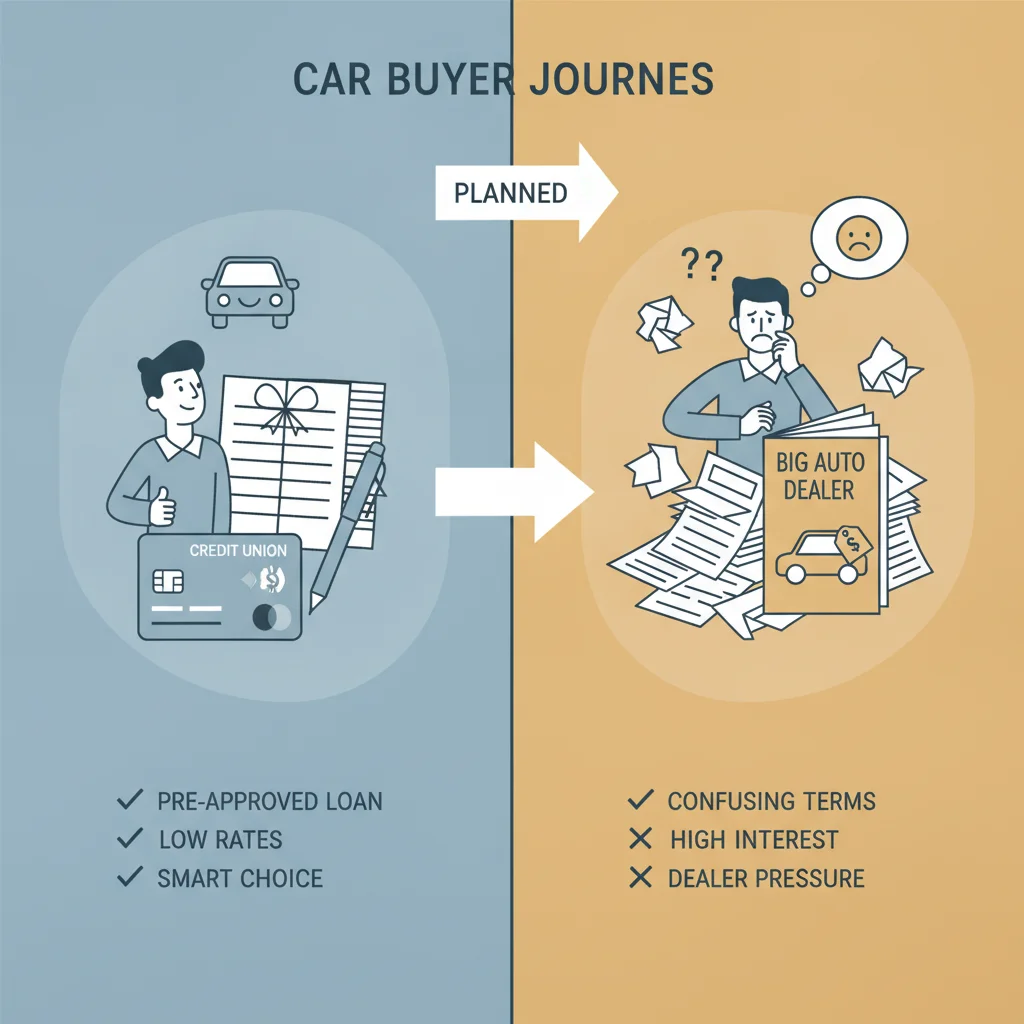
The reverse is also true. Even a borrower with a 640 credit score can materially improve their rate outcome by: putting 15% down (reduces LTV risk), choosing a 48-month term instead of 72 (signals commitment and reduces lender risk), and getting a credit union preapproval (removes dealer markup from the equation). The score doesn't change. The deal does.
Your Auto-Specific FICO Score Can Differ Significantly
The credit score lenders use for auto loans is often different from the score you see on free monitoring apps. FICO Auto Score models weight your history with installment loans — especially previous auto loans — more heavily. A buyer with a generic 680 FICO might have a 710 or a 650 auto score depending on their loan history. Before you apply, pull your FICO Auto Score from myFICO.com to know exactly where you stand.
Rolling Negative Equity Into a New Loan Is a Trap
If you owe more on your current vehicle than it's worth and you roll that difference into a new loan, you're starting your next loan already underwater — and paying interest on debt that has nothing to do with the vehicle you're buying. This is one of the most common ways buyers end up in a cycle of perpetually unaffordable car payments. Lenders will allow it, but that doesn't make it a sound financial move.
What You Can Actually Change Before You Apply
Certain factors are fixed at the moment you walk in: the vehicle's age, the base market rate environment, the lender's published rate tiers. But several variables are within your control — and each one you optimize translates directly into dollars.
1. Raise Your Credit Score Before Applying
Even moving from a 659 to a 661 — crossing a tier boundary — can cut your rate by a full percentage point. Focus on what moves scores fastest: paying down revolving balances below 30% utilization, disputing errors on your credit report, and avoiding new credit applications in the 60–90 days before your car loan. See which credit score factors move the needle most before a car loan for a prioritized action list.
2. Shop Multiple Lenders in a Compressed Window
Apply to your bank, at least one credit union, and one online lender within a 14-day window. FICO treats all auto loan inquiries within this window as a single inquiry, so rate shopping costs you nothing on your score. Get at least three competing offers before you set foot on a lot.
3. Right-Size Your Down Payment
If cash is tight, prioritize getting to 10% down — enough to keep LTV below 90% on most vehicles and avoid the worst-case pricing. If you can reach 20%, you'll often access the lender's best rate tier and build equity fast enough to avoid being underwater.
4. Choose the Shortest Term You Can Afford
Not the shortest possible — the shortest you can manage without financial stress. If 48 months is tight but doable, it beats 60 months on rate and total cost. Don't stretch to 36 months and then miss a payment. Missed payments compound the problem from both a credit score and a late fee perspective.
5. Bring Your Preapproval to the Dealer
A preapproval letter changes the conversation. You're no longer asking the F&I manager to give you a rate — you're asking them to beat the one you already have. Sometimes they can, especially on promotional manufacturer deals. Often they can't, and you use your preapproval. Either way, you win.
Use Your Down Payment to Cross a Rate Tier
If you're close to an LTV threshold — say, 82% instead of 80% — making a slightly larger down payment to cross that line can unlock a materially better rate from some lenders. Ask your lender directly: 'Is there an LTV threshold where my rate improves?' A $500 additional down payment that saves 0.5% on a 60-month loan can return $400+ in interest savings.
Always Compare the Rebate vs. Low-Rate Offer
When a manufacturer offers 0.9% APR OR a $2,500 cash rebate, run both scenarios with your own financing. On a $35,000 vehicle over 48 months, 0.9% vs. a 6.5% rate after a $2,500 rebate often comes out close. The math shifts based on loan amount and term — never assume the promotional rate is the better deal without calculating it.
Get a Credit Union Preapproval Before Visiting Any Dealer
Joining a credit union takes about 20 minutes and usually requires a $5–$25 deposit to open a savings account. The rate advantage — often 0.5–1.5 percentage points lower than bank or dealer financing — can easily save $1,500 or more on a typical loan. Do this before you even pick your vehicle.
myFICO Auto Score Report
Pull your FICO Auto Score 8 and 9 — the scores most lenders actually use for auto loans — directly from myFICO.com before applying. This is not the same score as free monitoring apps.
NCUA Credit Union Locator
The National Credit Union Administration's online tool helps you find federally insured credit unions you're eligible to join, including low-membership-barrier options open to most U.S. residents.
Auto Loan Rates by Credit Score: A Range-by-Range Breakdown
See exactly how interest rates shift across every credit tier — from deep subprime to superprime — and what each range typically costs per month on a standard loan amount.
Credit Score Factors That Move the Needle Most Before a Car Loan
Not all credit improvements are equal. This guide identifies the specific actions with the fastest and largest impact on your score in the weeks before you apply.
Auto Loan Amortization Calculator
Enter any loan amount, rate, and term to see your monthly payment, total interest paid, and a full amortization schedule showing when you'll build positive equity.
Down Payments: Why Size Matters and How It Shapes Your Loan
A practical breakdown of how down payment size interacts with LTV, monthly payment, and total loan cost — including the optimal target for different buyer situations.
The variables that shape your auto loan rate are the same ones that shape your overall financial profile. Getting one right — whether it's credit score, down payment, or lender choice — helps, but optimizing the combination is what produces the outcomes that actually make a difference. Use this reference every time you're comparing financing options, and revisit it if your situation changes before you sign.
All claims are backed by peer-reviewed research. Sources on request.