Key Takeaways
Why Long Loan Terms Are Worth Escaping
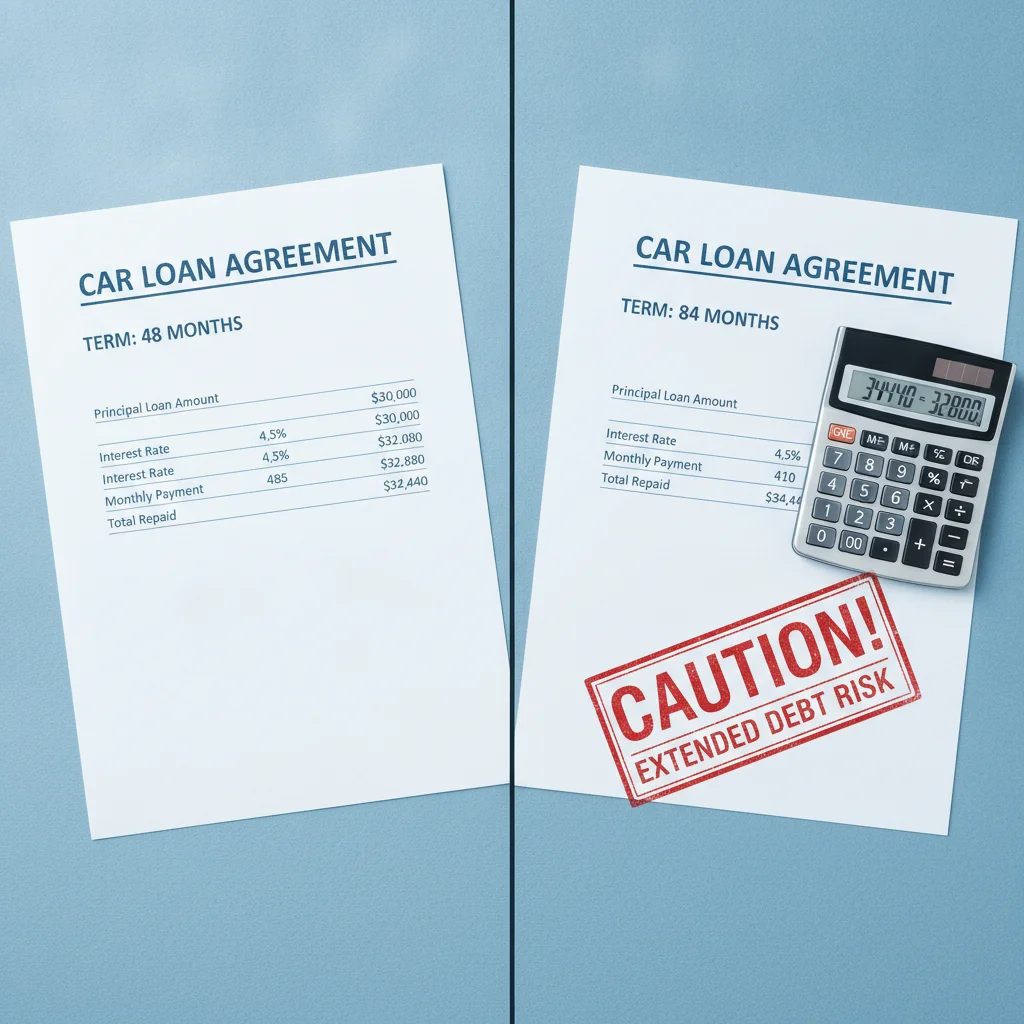
When you signed for that 72- or 84-month auto loan, the low monthly payment probably looked like the smart move. But as you get further into the loan, the math starts to sting. Long loan terms mean lenders collect interest over a much longer runway — and in the early months, nearly all of your payment goes toward interest rather than the actual car balance.
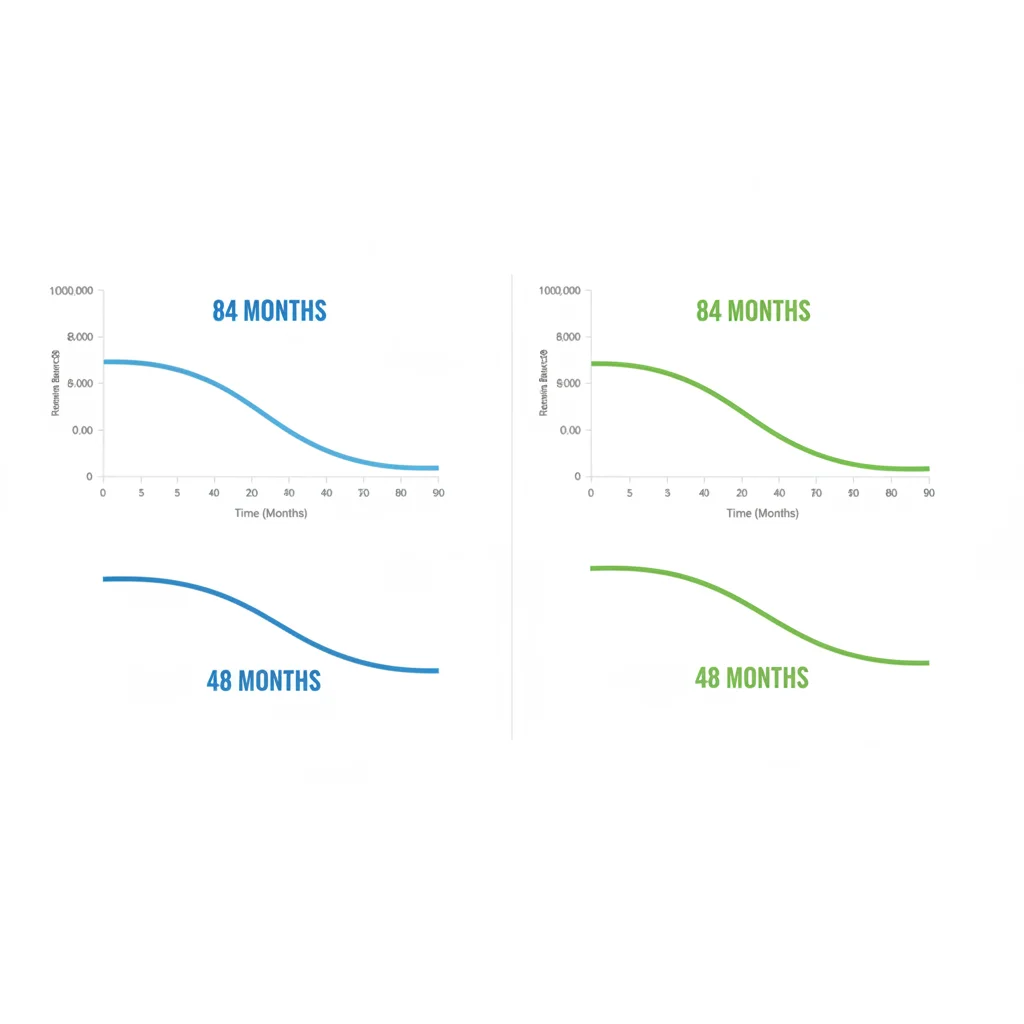
The result: you could be 18 months into a 72-month loan and still owe close to what you borrowed. That's not a bug — it's how amortization works. Each loan length carries a different total interest cost, and the gap between a 48-month and a 72-month loan can easily reach $3,000–$6,000 or more depending on your rate and balance.
There's also the depreciation problem. Cars lose value fastest in their first three years. If your loan amortizes slowly while the car depreciates quickly, you end up upside down — owing more than the vehicle is worth. That's a dangerous spot if you need to sell, trade in, or if the car gets totaled.
The good news: you don't have to go through a full refinance to fix this. Refinancing makes sense in some situations, but it requires a credit check, new loan paperwork, and sometimes fees. The strategies below let you shorten your effective payoff timeline using your current loan — no new application required.
Confirm Principal Application Before Sending Extra Money
Sending extra money to your lender without confirming application rules is one of the most common and costly mistakes borrowers make. Some servicers treat overpayments as pre-paid future installments, which doesn't reduce your balance any faster. Always get explicit written confirmation — or a clear option in your account portal — that your extra payment will reduce your principal immediately. If your lender won't accommodate this, that itself is a signal to consider refinancing to a better servicer.
What You Need Before You Start
Before you send a single extra dollar to your lender, you need to understand two things: how your lender handles extra payments, and where you stand on your current payoff timeline.
What you will need
Call your lender's customer service line or log into your online account and ask specifically: "If I send extra money, will it be applied to the principal balance or to future payments?" This is not a minor detail. Some lenders — especially those servicing older loans — will treat extra money as a pre-payment of your next scheduled installment, which doesn't reduce your principal any faster. You need explicit confirmation that excess funds reduce principal immediately.
Also pull your full amortization schedule. This is the month-by-month breakdown of how each payment splits between principal and interest. If your lender doesn't provide one automatically, you can build one using any loan amortization calculator — you just need your original loan amount, interest rate, and term. This schedule becomes your roadmap: it shows exactly how much interest you're on track to pay and how early payoff changes that figure.
Loan amortization calculator
Shows the month-by-month split between principal and interest for your loan, and lets you model how extra payments change your payoff date.
Lender online account portal
Used to verify your current principal balance, confirm payment application settings, and check that extra payments post correctly.
Spreadsheet software (Excel or Google Sheets)
Lets you build a custom amortization model and track your progress month by month against your original schedule.
Vehicle valuation tool (Kelley Blue Book or Edmunds)
Helps you compare your outstanding loan balance against your car's current market value to monitor your equity position.
Strategies to Shorten Your Loan Term Without Refinancing
The following steps work independently or in combination. You don't have to do all of them — even one applied consistently will move you toward a shorter effective term and lower total interest paid. The risks of staying in a long-term loan compound over time, so starting sooner matters more than doing everything at once.
Contact your lender and confirm principal-only payment rules
Before any strategy works, you need to know the rules. Call your lender or visit your account portal and ask explicitly how extra payments are handled. Request written or electronic confirmation that any amount above your minimum monthly payment will be applied directly to your principal balance — not to future scheduled payments.
Some lenders require you to include a note with each payment (e.g., "Apply excess to principal"), while others have a dedicated online toggle or checkbox. Know your lender's specific process so your extra dollars go exactly where you intend.
Add a fixed extra amount to every monthly payment
The simplest and most sustainable strategy is to add a set dollar amount to each monthly payment. Even a modest addition makes a meaningful difference over time because it directly reduces the principal balance — which means every future payment has less interest accruing against it.
To figure out a realistic target, look at your amortization schedule and find the principal portion of your current payment. Adding an amount equal to one additional month's principal payment per month effectively moves you two months ahead each cycle. For a $25,000 loan at 7% over 72 months, adding $100/month to every payment can cut roughly 10–12 months off your term and save $700–$1,000 in interest.
Set this up as an automatic payment if possible — human behavior research consistently shows that automatic contributions stick better than manual ones.
Switch to biweekly payments
Instead of making one full payment per month, split your monthly payment in half and pay that amount every two weeks. Because there are 52 weeks in a year, you'll make 26 half-payments — the equivalent of 13 full monthly payments instead of 12. That 13th payment goes entirely to principal.
On a 72-month loan, biweekly payments alone typically cut 5–8 months off the effective payoff date without you consciously budgeting extra money. It works because you're paying slightly more per year while also reducing the average daily balance that interest accrues against.
Check that your lender accepts biweekly payments and posts them immediately — not held until your due date. Some lenders hold partial payments until they equal a full installment, which defeats the purpose.
Apply windfalls directly to principal
Tax refunds, work bonuses, side-income payments, or any unexpected cash are powerful payoff accelerators when directed to your loan principal. A single $1,500 lump-sum payment on a mid-term balance can eliminate multiple months of scheduled payments and save hundreds in interest — far more impact than the same amount spread out over a year.
When making a lump-sum payment, specify explicitly — in writing or through your lender's portal — that the full amount should be applied to principal. Follow up by checking your account statement within 2–3 business days to confirm the balance dropped as expected.
Make one full extra payment per year
If biweekly payments or fixed monthly additions feel like too much to manage, the simplest annual strategy is to make one full extra payment per year — a 13th payment that goes entirely to principal. Many borrowers do this in February or March using their tax refund, or in December using a year-end bonus.
On a 72-month loan, one extra full payment per year typically trims 6–10 months off your remaining term, depending on your rate and where you are in the loan. The earlier in the loan you start this habit, the greater the interest savings, since more of your balance is still outstanding.
To execute this cleanly, make your regular payment as normal, then send a separate payment — clearly labeled for principal — within the same month.
Recalculate your amortization schedule after each change
Every time you make a lump-sum payment or consistently add to your monthly installment, your projected payoff date changes. Don't wait until the loan is nearly paid to see where you stand — recalculate quarterly using a free amortization calculator.
Input your current outstanding balance (not the original loan amount), your current interest rate, and your updated monthly payment (including any extra you're now adding). The resulting schedule shows your new projected payoff date and total interest remaining. Comparing this to your original schedule makes the financial impact of your actions concrete and motivating.
After you've applied one or more of these strategies for a few months, revisit your amortization schedule. A good loan calculator will let you enter a revised balance and see how many months you've effectively knocked off your timeline. That number is your real motivation to keep going.
Combine Strategies for Maximum Impact
You don't have to pick just one approach. A borrower who switches to biweekly payments, adds $75/month to each installment, and applies one annual tax refund to principal can realistically cut a 72-month loan down to an effective 52–55 month payoff — saving thousands in interest without ever refinancing. Start with whichever strategy fits your current budget and layer in others as your financial flexibility grows.
Early Payments Save More Than Late Ones
Because auto loans front-load interest, extra payments made in the first half of your loan term save significantly more than the same payments made later. A $500 extra payment in month 6 of a 72-month loan reduces a higher outstanding balance, which means interest accrues on a smaller number for a longer remaining period. Don't wait until you feel financially comfortable — start small now.
How to Track Your Progress and Stay on Course
Shortening a loan term through extra payments is a slow burn — it's not as dramatic as refinancing, where you sign new paperwork and get a clear new end date. That's why tracking matters. Without a clear picture of your progress, it's easy to stop adding extra payments when life gets busy.

Set a reminder every three months to log into your lender account and check your current payoff balance. Then run that balance through a fresh amortization calculation at your current interest rate. Compare the resulting payoff date to your original loan end date. The gap between those two dates is what you've already saved.
If you've been consistent and your balance has dropped faster than your original schedule projected, you're ahead of plan. If the numbers haven't moved much, it's worth checking whether your extra payments were correctly applied to principal — contact your lender directly if anything looks off.
Watch for Misapplied Payments
Even when you've confirmed your lender's process, mistakes happen. After every extra payment, check your account statement within a few business days and verify that your principal balance dropped by the amount you intended. If your balance didn't move as expected, contact your lender's customer service immediately and request a payment reallocation in writing. Don't let a misapplied payment sit uncorrected — every month it goes unfixed costs you interest.
Also watch your equity position. As you pay down faster, your loan balance should stay below — ideally well below — the current market value of your car. You can get a quick value estimate from sources like Kelley Blue Book or Edmunds. Once you've crossed into positive equity territory (you owe less than the car is worth), you've escaped one of the biggest financial risks of long auto loans: being trapped in a car you can't afford to sell or trade.
For borrowers who took a long term specifically because of credit constraints, the math is especially important. Long terms and bad credit are a high-cost combination — every month you carry a high-rate balance, you pay more in interest than a borrower with better credit would. Shortening your effective term is one of the highest-leverage moves you can make.
When to Reconsider Refinancing Instead
Everything in this guide works within your existing loan. But there are situations where skipping refinancing is the wrong call and you'd be better served going through that process instead.
If your credit score has improved significantly since you took out the loan — say, 60 or more points — you may qualify for a meaningfully lower interest rate. In that case, refinancing to a shorter term accomplishes two things at once: it locks in a better rate AND resets your payoff clock to a shorter timeline. The monthly payment will be higher, but total interest paid can drop substantially.
Refinancing also makes sense if your current lender makes extra principal payments difficult — whether through restrictive policies, prepayment penalties, or poor online tools. Life is too short to fight your lender every month over where your money goes.
How do you know which path fits your situation? Ask yourself three questions:
- Has my credit improved enough to get a materially better rate? If yes, refinancing earns its cost.
- Does my current lender apply extra payments correctly? If no, refinancing to a more borrower-friendly servicer may be worth it.
- Am I comfortable with a higher monthly payment for a shorter term? Refinancing typically raises your payment; the strategies in this guide let you control how much extra you send each month.
If all three answers point toward staying put, the strategies above are your best path. If even one answer tilts toward refinancing, it's worth getting a few quotes to compare. Many borrowers regret waiting too long to act on a costly loan — whether through extra payments or refinancing, the sooner you shorten your effective term, the less interest you'll hand to your lender.
For a broader view of how term length shapes your entire loan experience, the Loan Terms Explained hub breaks down everything from monthly payment math to total cost comparisons across term lengths.

All claims are backed by peer-reviewed research. Sources on request.