
Key Takeaways
Why Loan Term Myths Are So Financially Damaging
Auto loan terms are one of the most misunderstood corners of car financing. Borrowers routinely walk into dealerships focused on one number — the monthly payment — and walk out with a loan structure that will cost them thousands of dollars more than necessary. That's not an accident. Monthly payments are easy to understand, easy to compare, and easy to manipulate.
The problem is that a loan term isn't just a payment schedule. It's a set of financial consequences that play out over years: the rate at which you build equity, the total interest you surrender to the lender, how exposed you are if your car is totaled, and how much flexibility you have if your financial situation changes. Every one of those outcomes is shaped by the term you agree to on signing day.
The myths below are the most common beliefs about loan terms that cost real borrowers real money. Some sound like common sense. Most feel intuitive. All of them are wrong in ways that matter.
Myth
A lower monthly payment always means a better deal.
Fact
A lower payment produced by a longer term means you're paying more in total interest — often thousands more — over the life of the loan.
The monthly payment is the most visible number in an auto loan, so it gets treated as the primary measure of a good deal. But a payment is just an arithmetic output — it goes down when you extend the repayment period, regardless of what that extension costs you in interest.
A $35,000 loan at 7% APR over 48 months produces a payment of about $838. Stretch that to 72 months and the payment drops to about $598 — a savings of $240 per month that sounds compelling. But over the full loan life, the 72-month borrower pays roughly $6,000 more in interest than the 48-month borrower. The "savings" per month are an illusion funded by a larger total transfer of wealth to the lender.
The only payment comparison that matters is total cost: principal plus all interest paid. Always ask for that figure before agreeing to any term.
Myth
Longer loan terms are always available, so they must be financially reasonable options.
Fact
Lenders offer 84-month terms because they generate more interest income, not because they're in the borrower's best financial interest.
The availability of a loan product doesn't signal its financial wisdom. Lenders profit from longer loan terms — every additional month of interest is revenue for them. The expansion of 72- and 84-month auto loans over the past decade was driven by lender strategy and consumer demand for lower monthly payments, not by evidence that these terms serve borrowers well.
An 84-month loan on a vehicle that depreciates rapidly means the borrower is almost certainly underwater for most of the loan's life. They're also making payments on a car that may be approaching the end of its reliable service life in years six and seven, often while absorbing escalating maintenance costs simultaneously.
The case against always choosing the longest available term is built on a simple truth: the longest term is designed to maximize what you pay, not minimize it.
Myth
As long as you can afford the monthly payment, the loan term doesn't really matter.
Fact
Affordability of a payment and financial soundness of a loan are two entirely different evaluations.
"Can I make this payment each month?" is a cash-flow question. "Is this a good loan?" is a total-cost question. Conflating the two is one of the most expensive mistakes auto loan borrowers make.
A borrower earning $60,000 per year can likely afford a $500 monthly car payment. That same payment on a 72-month loan versus a 48-month loan on the same vehicle represents a difference in total interest that could fund several months of payments. The money doesn't vanish — it transfers to the lender as profit.
Affordability is the floor of the decision, not the ceiling. Once you establish that you can make a payment, the next question is: what's the shortest term at which I can make this payment comfortably? That's the term that minimizes your total cost. For borrowers with credit challenges, this analysis becomes even more critical — see what subprime borrowers can actually negotiate before accepting any terms as fixed.
Myth
Paying off a loan early on a long-term loan gives you all the savings of a shorter term.
Fact
Early payoff helps, but front-loaded interest means you lose more to the lender in the early months of a long-term loan regardless.
Many borrowers choose a long loan term as a safety net — lower required payment, but they plan to pay more when possible to offset the interest cost. This logic has partial merit, but it misses how amortization works.
Auto loans are structured so that interest is front-loaded. In the early months of a long-term loan, the majority of each payment goes to interest rather than principal. By choosing a longer term, you've already agreed to a payment structure that directs more of your early dollars to the lender's profit margin. Even if you pay the loan off in month 36 of a 72-month term, you will have paid more interest during those 36 months than you would have under a 36- or 48-month amortization schedule from the start.
Early payoff is still worthwhile — but it's not a perfect substitute for choosing the right term from the beginning. For more on how payoff strategies interact with loan structure, see our breakdown of auto loan payoff myths.
Myth
The loan term that fits your budget today will still fit two or three years from now.
Fact
Life changes. A term that locks you in for 72 or 84 months exposes you to far more financial risk than a shorter commitment.
A six- or seven-year loan term is a long-horizon commitment. Over that span, jobs change, families grow, health situations shift, and financial priorities evolve. A borrower who signs an 84-month loan in a period of financial stability may face unemployment, medical expenses, or other major costs before that loan is retired.
Longer terms create two compounding risks. First, you're more likely to still owe money on the car when a financial hardship hits. Second, you're more likely to be underwater — owing more than the car is worth — when that hardship forces a sale or trade. Short of certain lender practices that slow payoff progress, the most reliable protection against financial disruption is owning equity in your vehicle as quickly as possible. That means shorter terms, not longer ones.
Myth
If the dealer offers a very low interest rate, a longer term is fine because the rate is what drives total cost.
Fact
A low rate does not neutralize the cost of additional months of interest — both variables must be evaluated together.
Promotional financing offers — 0%, 1.9%, 2.9% — are genuinely valuable, but they don't make term length irrelevant. Even at 2.9% APR, a borrower who stretches a $40,000 loan from 48 months to 84 months will pay several thousand dollars more in total interest and will spend far more months in negative equity.
Additionally, promotional rates are often exclusive to specific terms. A manufacturer might offer 2.9% on 60-month financing but not on 72-month financing. If a dealer presents you with a longer term on a promotional rate, verify that the advertised rate actually applies to that term — it may not. Always read the fine print on promotional financing, and always calculate total cost under each available term at the actual rate that applies to that term.
Understanding how interest rates and APR work together to determine your true financing cost is essential before evaluating any promotional offer.
How Loan Term Interacts With Interest Rate and Total Cost
One reason loan term myths are so persistent is that borrowers tend to evaluate rate and term separately — as if they're independent levers. They're not. The relationship between your APR, your term length, and your total loan cost is compounding: even a modest rate increase, applied over a much longer term, produces a dramatically higher total interest burden.
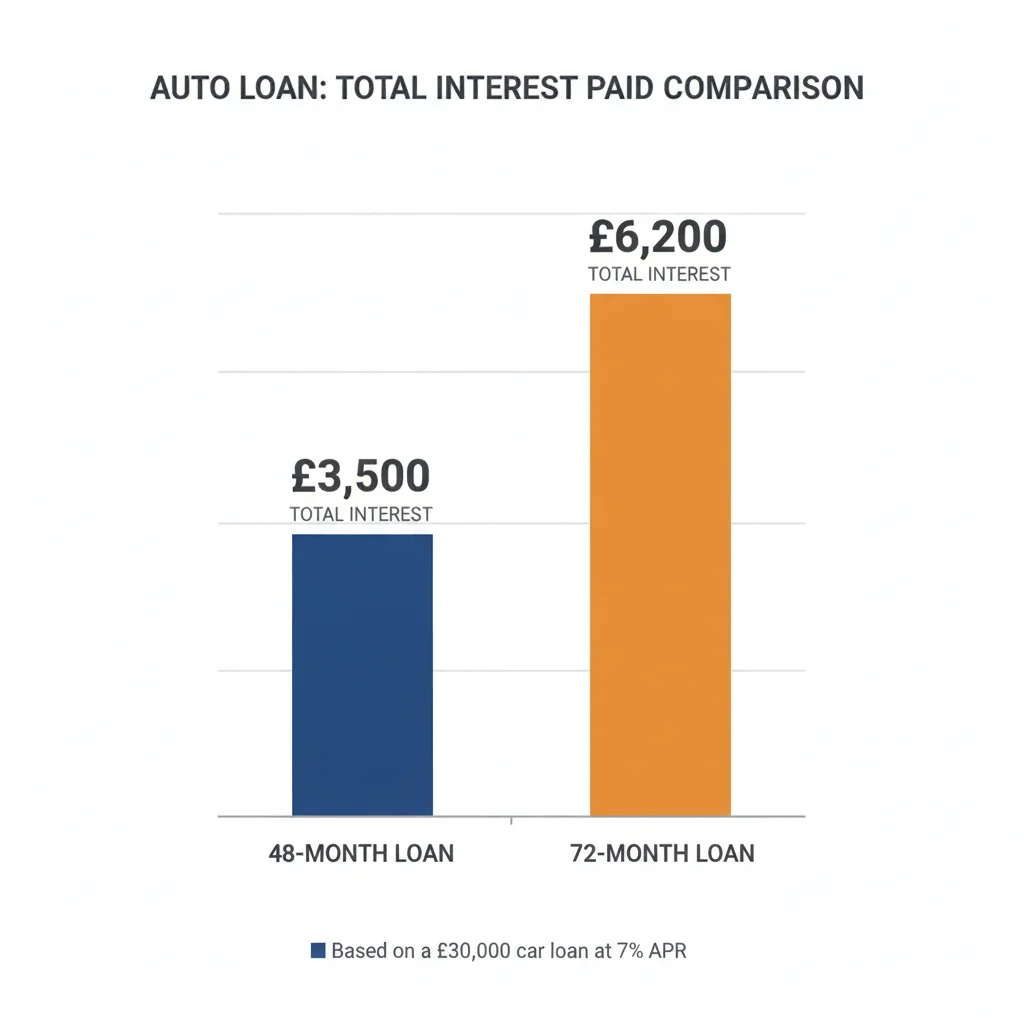
Consider two borrowers financing $32,000 at 7% APR. Borrower A chooses a 48-month term. Borrower B chooses a 72-month term. Borrower A pays roughly $3,600 in total interest. Borrower B pays roughly $5,500. That's nearly $1,900 in additional interest for the privilege of a lower monthly payment — and that difference assumes the same rate. In practice, longer-term loans often carry slightly higher rates, which widens the gap further.
$1,900+
Extra interest on 72-month vs. 48-month loan
Based on a $32,000 loan at 7% APR — the difference in total interest between a 48-month and 72-month term, assuming the same rate for both.
38%
New car loans with terms over 60 months
According to Experian's State of the Automotive Finance Market report, more than a third of new vehicle loans now carry terms exceeding 60 months.
~50%
Average vehicle value lost in first 3 years
Industry depreciation data consistently shows most new vehicles lose approximately half their value within three years of purchase.
Month 30+
When equity turns positive on a 72-month loan
For a typical new vehicle financed over 72 months with no down payment, the equity crossover point — when loan balance drops below market value — often occurs around month 30 or later.
This is why comparing total loan cost — not just monthly payment — is the only financially sound way to evaluate a financing offer. Your lender is required to disclose the total of payments and the total finance charge in your loan contract. Use those numbers. They tell the real story that the monthly payment figure deliberately obscures.
For a deeper look at how APR myths layer on top of term myths to create compounding confusion, see our breakdown of common APR misconceptions.
The Equity Problem: Why Term Length Determines Your Financial Cushion
Beyond interest cost, loan term determines how quickly you build ownership stake in your vehicle. Cars depreciate — most lose 15% to 25% of their value in the first year alone, and roughly 50% within three years. A longer loan term means slower principal paydown, which means your loan balance drops more slowly than the car's market value. The result is negative equity, also called being "underwater" or "upside down" on your loan.
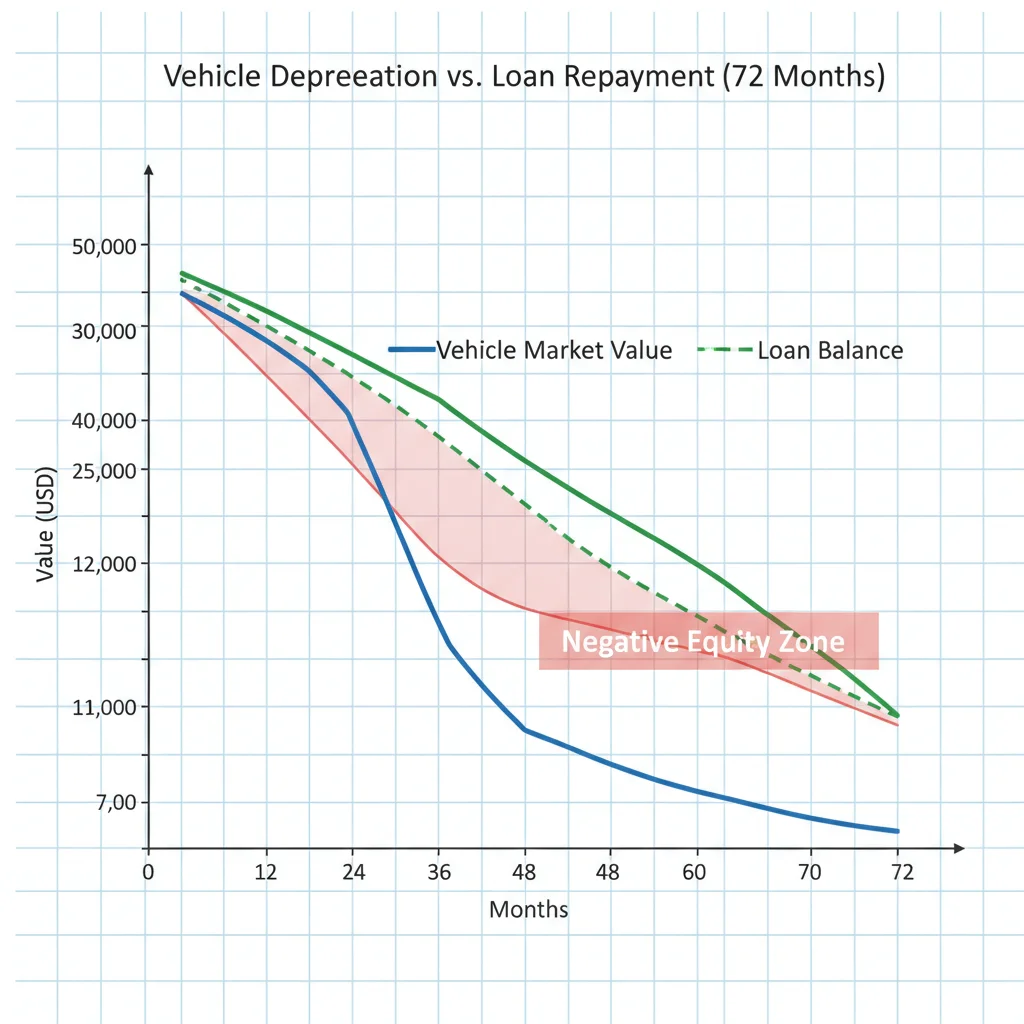
Negative equity isn't just an accounting abstraction. It becomes a real problem when:
- Your car is totaled and your insurance payout is less than your remaining loan balance
- You need to sell the car before the loan ends and must cover the difference out of pocket
- You want to trade in the vehicle and the dealer rolls negative equity into your next loan, compounding the problem
Shorter loan terms build equity faster because more of each early payment goes to principal rather than interest. With a 48-month loan on a $30,000 car, you're likely to have positive equity within the first 12 to 18 months. With a 72-month loan, that crossover point may not arrive until month 30 or later.
Rolling Negative Equity Into a New Loan
One of the costliest consequences of a long-term loan is being upside down when you want to trade in or sell. Dealers routinely offer to "handle" that shortfall by rolling negative equity into your next loan — which means you immediately owe more than your new car is worth from day one. This cycle can compound over multiple trade-ins, leaving borrowers permanently behind. Never agree to roll negative equity without calculating exactly what it adds to your new loan's total cost.
Used Cars and Long Loan Terms Are a Risky Combination
Financing a used vehicle with a 72- or 84-month term means the loan may outlast the car's reliable service life. In the final years of that loan, you could be making full monthly payments on a vehicle requiring significant repairs — while still not owning it free and clear. As a general guideline, your loan term should not extend beyond the number of years you realistically expect the vehicle to remain in reliable, low-repair service.
The loan-term decisions borrowers tend to regret most almost always involve stretching into a term so long that negative equity persists for years — and then facing a life event that forces a sale or trade before the loan is paid down.
What to Do Before You Agree to Any Loan Term
Armed with accurate information, borrowers can approach loan term decisions with a straightforward framework instead of instinct or dealership pressure.
- Calculate total interest, not just monthly payment. Use an online auto loan calculator to compare total cost across 48-, 60-, and 72-month terms at your quoted rate. The difference is almost always larger than borrowers expect.
- Match the term to the car's expected useful life. Financing a three-year-old used car with a 72-month loan means making payments on a nine-year-old car in the final years of the loan — often while also paying for increasingly expensive repairs.
- Use down payment to shorten the term you need. A larger down payment reduces the loan amount, which makes a shorter term more affordable. Our guide to down payments explains how to size your contribution to optimize the loan structure.
- Ask specifically about the rate differential between terms. Many lenders charge a slightly higher rate for longer terms. If your 72-month offer carries a higher rate than the 60-month offer, the payment difference narrows and the cost advantage of the shorter term grows.
- Consider refinancing if you're already in a long-term loan. If you're currently in a 72- or 84-month loan and your credit has improved, refinancing to a shorter term can reduce both your rate and your total interest burden. See what misconceptions cause borrowers to wait too long to refinance.
Always Compare Total Loan Cost, Not Just Monthly Payment
Before signing any auto loan, ask for — or calculate — the total of all payments over the full term. Subtract the amount financed to see exactly how much interest you're paying. This single number is more informative than the monthly payment, the stated rate, or any dealer framing of the deal. Federal law (the Truth in Lending Act) requires lenders to disclose this figure in your loan contract — use it.
The goal is never to find the lowest monthly payment. The goal is to find the shortest term your budget can genuinely support — and then hold firm on that number when the finance manager presents alternatives.

All claims are backed by peer-reviewed research. Sources on request.