Key Takeaways
Option A
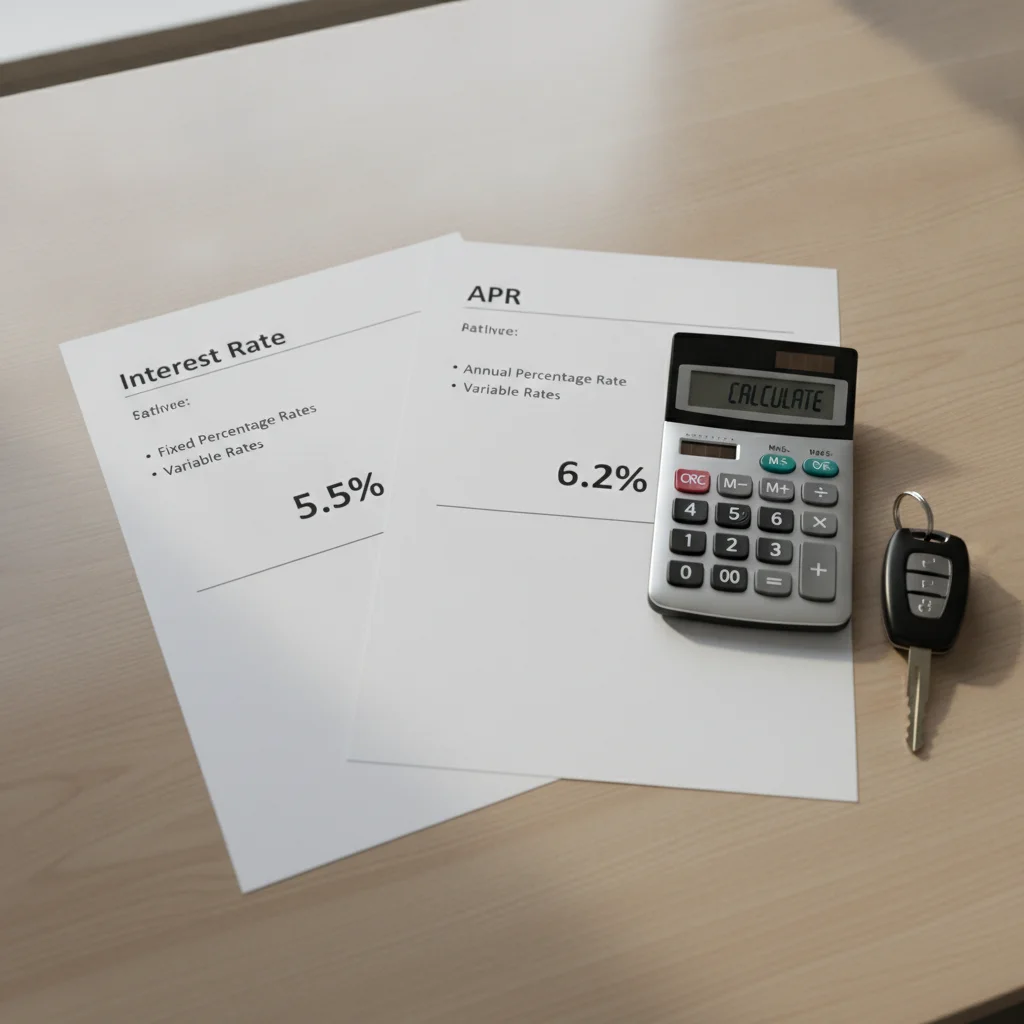
Interest Rate
The base cost of borrowing, before fees.
Best for: Understanding how much of each payment goes toward the lender's profit on the principal balance.
Option B
APR (Annual Percentage Rate)
The all-in cost of borrowing, fees included.
Best for: Comparing loan offers apples-to-apples, because it captures the true annual cost of the loan.
If you want to understand how your monthly payment is calculated
Interest Rate
Monthly payment math is based on the nominal interest rate applied to the principal. Knowing the rate helps you understand the mechanics of amortization.
If you're comparing two or more loan offers from different lenders
APR (Annual Percentage Rate)
APR standardizes the cost of borrowing by folding in fees, giving you a true apples-to-apples comparison that the interest rate alone cannot provide.
If you're evaluating a dealer-arranged loan versus a bank or credit union offer
APR (Annual Percentage Rate)
Dealers may mark up the base interest rate and bundle fees differently. APR exposes those added costs in a single number, making the true price of each offer visible.
If you want to minimize total money paid over the life of the loan
APR (Annual Percentage Rate)
Choosing the loan with the lowest APR — not just the lowest rate — ensures you minimize total financing costs, including origination and processing fees.
Why Two Numbers Appear on Every Car Loan Offer
When you receive a loan quote — whether from a bank, credit union, or dealership finance office — you'll typically see two percentages listed: an interest rate and an APR. They're usually close in value, which makes many buyers assume they're the same thing. They are not.
The interest rate is the annual percentage the lender charges on the money you borrow. It feeds directly into the formula that calculates your monthly payment. But it only tells part of the story — it leaves out origination fees, document processing fees, and other lender charges that you'll also pay as part of the financing arrangement.
APR — Annual Percentage Rate — takes the interest rate and layers in those additional costs, expressing the combined expense as an annualized percentage of the loan amount. The result is a single number that more accurately reflects what borrowing actually costs you each year.
For a deeper breakdown of everything APR captures, see our full explainer on what APR actually means on an auto loan. This article focuses specifically on how the two numbers relate — and when each one matters most.

The Mechanics: How Each Number Is Calculated
Understanding the math behind each figure helps clarify why they diverge — and how much they can diverge.
How the interest rate works
Your interest rate — sometimes called the nominal rate — is applied to your loan principal each month. Lenders use a simple amortization formula:
- Each month, the lender multiplies your outstanding balance by the monthly interest rate (annual rate ÷ 12).
- That amount becomes the interest portion of your payment.
- The remainder of your payment reduces the principal.
- As principal falls, the interest portion of each payment shrinks — and more of your payment goes toward the balance.
This is why the early months of a car loan are interest-heavy. On a $30,000 loan at 7% interest, your first payment of approximately $594 might include nearly $175 in interest and only $419 toward principal.
How APR is calculated
APR folds in lender fees by treating them as an additional cost spread across the loan term. Here's the logic: if you borrow $30,000 but pay $500 in origination fees up front, you're effectively receiving $29,500 of usable value while still repaying based on $30,000. That difference is the equivalent of a slightly higher interest rate — and APR captures exactly that.
Regulators require lenders to disclose APR under the federal Truth in Lending Act (TILA), specifically so consumers have a standardized way to compare loan costs across lenders who bundle fees differently.
| Criterion | Interest Rate | APR (Annual Percentage Rate) |
|---|---|---|
| What it measures | Annual cost of borrowing principal only | Annual cost including fees and charges |
| Includes lender fees | No | Yes |
| Used to calculate monthly payment | Yes | No |
| Best for comparing loan offers | No — incomplete picture | Yes — standardized cost view |
| Required TILA disclosure | Yes | Yes |
| Affected by dealer markup | Yes | Yes |
| Typically higher or lower | Lower | Higher (or equal with no fees) |
| Reflects total borrowing cost | Partially | More completely |
0.3%–1.5%
Typical APR vs. interest rate spread on auto loans
Consumer finance analysts note that the gap widens significantly when dealer-arranged loans include bundled products or high origination fees.
$868
Extra cost of a 1% higher APR on a $30,000/60-month loan
Calculated over a 60-month term on a $30,000 loan, a 1 percentage point APR difference translates to roughly $868 in additional total finance charges.
72 months
Most common new car loan term in the U.S.
According to Experian's State of the Automotive Finance Market report, 72-month loans account for the largest share of new vehicle financing, amplifying the impact of APR differences.
What the Gap Between Interest Rate and APR Tells You
Here's a rule of thumb worth memorizing: the wider the gap between your interest rate and your APR, the more you're paying in fees.
On a straightforward auto loan with minimal lender fees, the APR might be only 0.1% to 0.3% higher than the interest rate. But on a loan with a hefty origination fee — or one where the dealer has bundled add-ons like GAP insurance or an extended warranty into the financing — the spread can widen considerably.
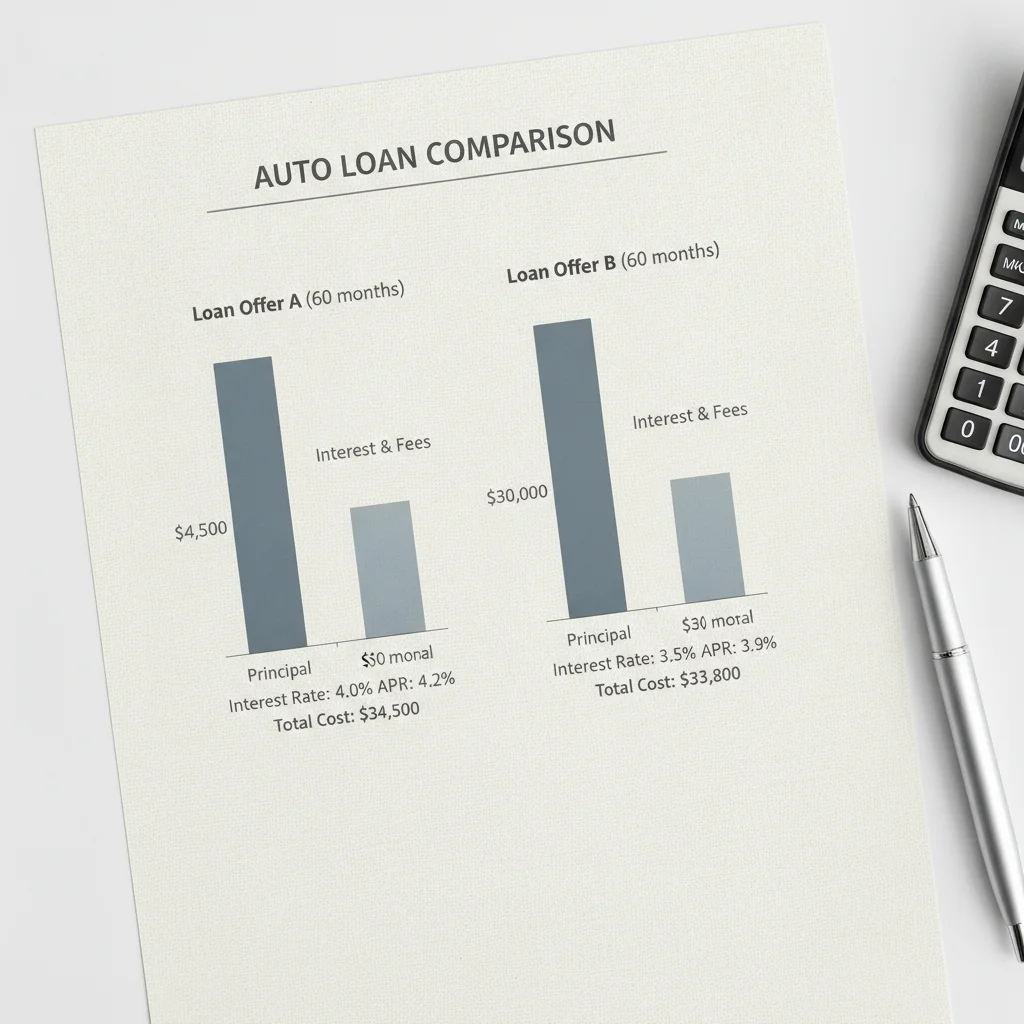
Consider two competing offers:
- Offer A: 6.5% interest rate / 6.8% APR
- Offer B: 6.2% interest rate / 7.1% APR
Offer B has a lower nominal interest rate, which means a lower monthly payment. But its APR is almost a full percentage point higher than Offer A's. That gap signals significant fees — fees you're still paying, even if they don't show up in the monthly payment line.
Over a 60-month term, Offer B could cost hundreds more in total. This is exactly why comparing APRs — not just rates — is the correct method for shopping auto loans. To understand which specific fees lenders are allowed to include in APR calculations, see our guide on the fees hidden inside your APR.
APR Has Limits Too — Know What It Doesn't Include
APR is a more complete measure than the interest rate alone, but it doesn't capture everything. Sales tax, title and registration fees, dealer documentation fees, and optional add-ons purchased at the dealership typically fall outside APR. This means two loans can show identical APRs while carrying very different out-of-pocket costs at signing. Always request an itemized list of all fees — both those included in APR and those that aren't — before you sign.
How Loan Term Length Interacts With Both Numbers
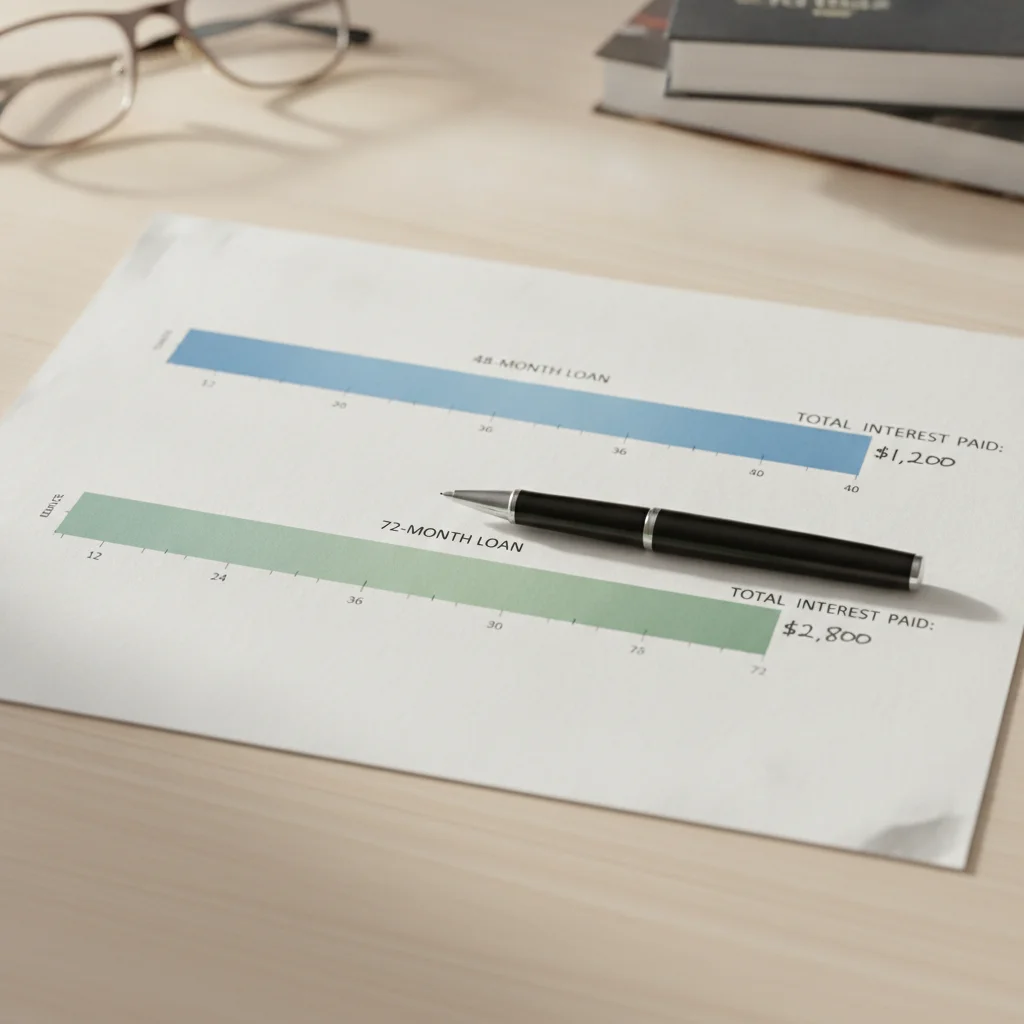
Loan term — the number of months you have to repay the loan — adds another layer of complexity. Here's the critical point most buyers miss: a lower APR on a longer loan can still cost you more in total interest than a higher APR on a shorter term.
This happens because interest accrues over time. A 7% APR loan paid over 72 months generates far more total interest than a 7.5% APR loan paid over 48 months, even though the first loan has the lower rate.
To see this trade-off quantified across real scenarios, our article on loan term length and APR walks through exactly what different combinations cost you at the end of the loan.
The practical takeaway: when you're comparing offers, hold the term constant first. Compare a 60-month loan against another 60-month loan using APR. Only then consider whether adjusting the term changes the picture — and always look at total interest paid, not just monthly payment.
When Your Credit Score Shapes Both Numbers
Neither your interest rate nor your APR is set in stone before a lender checks your credit. Your credit score is the single largest factor in determining the base rate a lender will offer you. From there, a dealer can add what's called a markup — an increase above the lender's buy rate that becomes dealer profit.
This means the APR you see on a dealer contract may be higher than the rate your credit score actually qualifies you for. The Credit Score Impact hub covers how scores translate to rates across credit tiers, giving you a benchmark before you walk into a finance office.
And if you want to reverse-engineer a dealer quote — separating the portion driven by your credit from the dealer's markup — see our article on understanding the APR you were quoted. It gives you a framework for knowing whether the number on the contract reflects your creditworthiness or a dealer's margin strategy.
The bottom line: before you can negotiate APR effectively, you need to know what your credit score actually qualifies you for. Getting pre-approved through a bank or credit union gives you that benchmark — and a competing offer to bring to the table.
How to Use Both Numbers When Evaluating a Loan Offer
Here's a step-by-step approach that puts both figures to work:
- Use the interest rate to verify your monthly payment calculation. Plug the rate, loan amount, and term into any amortization calculator. If the lender's quoted payment doesn't match, ask for an itemized breakdown.
- Use the APR to compare this offer against any other offer you're evaluating. Even if one lender quotes a lower interest rate, a higher APR on the same term means you're paying more overall in financing costs.
- Check the gap. If the APR is more than 0.5 percentage points above the interest rate on a standard auto loan (no bundled products), ask what fees account for the difference. Lenders are required to disclose this.
- Compare APR on equal terms. Make sure you're comparing the same loan term across all offers. A 60-month APR and a 72-month APR aren't directly comparable in terms of total cost.
- Look at total interest paid. Most loan documents include a total finance charge figure — the dollar amount you'll pay in interest and fees over the full term. This number often communicates the stakes more clearly than any percentage.
For buyers approaching their first auto loan, our complete guide to auto loan interest and APR ties all these concepts together with a first-time buyer lens. And for a deeper comparison of what the gap between these two numbers signals in practice, see Interest Rate vs. APR: Why the Gap Between Them Matters.


All claims are backed by peer-reviewed research. Sources on request.