
Key Takeaways
Annual Percentage Rate (APR)
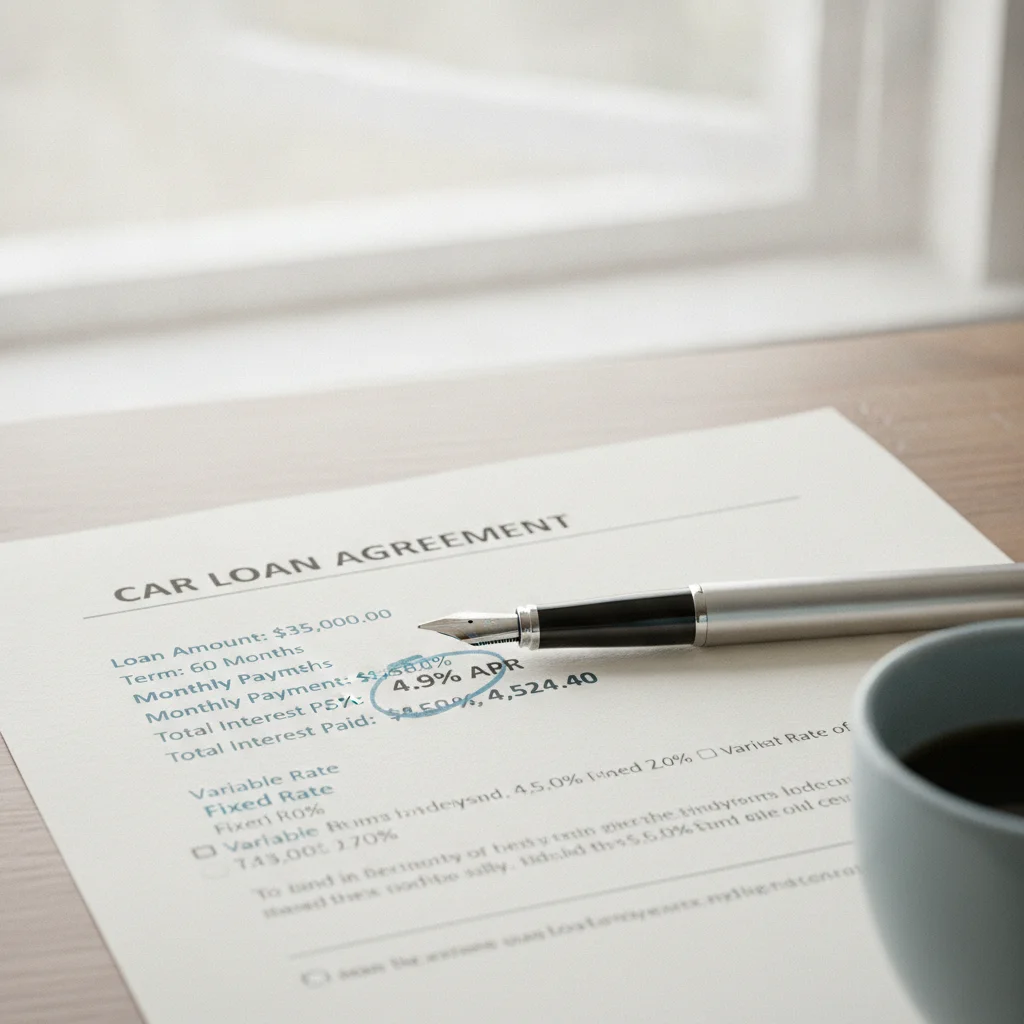
APR stands for Annual Percentage Rate. On an auto loan, it represents the total yearly cost of borrowing money, expressed as a percentage. Unlike the base interest rate, APR folds in certain fees and charges, giving you a more complete picture of what the loan actually costs you over time.
APR is calculated using a standardized federal formula under the Truth in Lending Act (TILA), which requires lenders to disclose it before you sign. This makes it a legally defined, comparable metric across lenders — though not all fees are required to be included.
Why APR Is the Number That Actually Matters
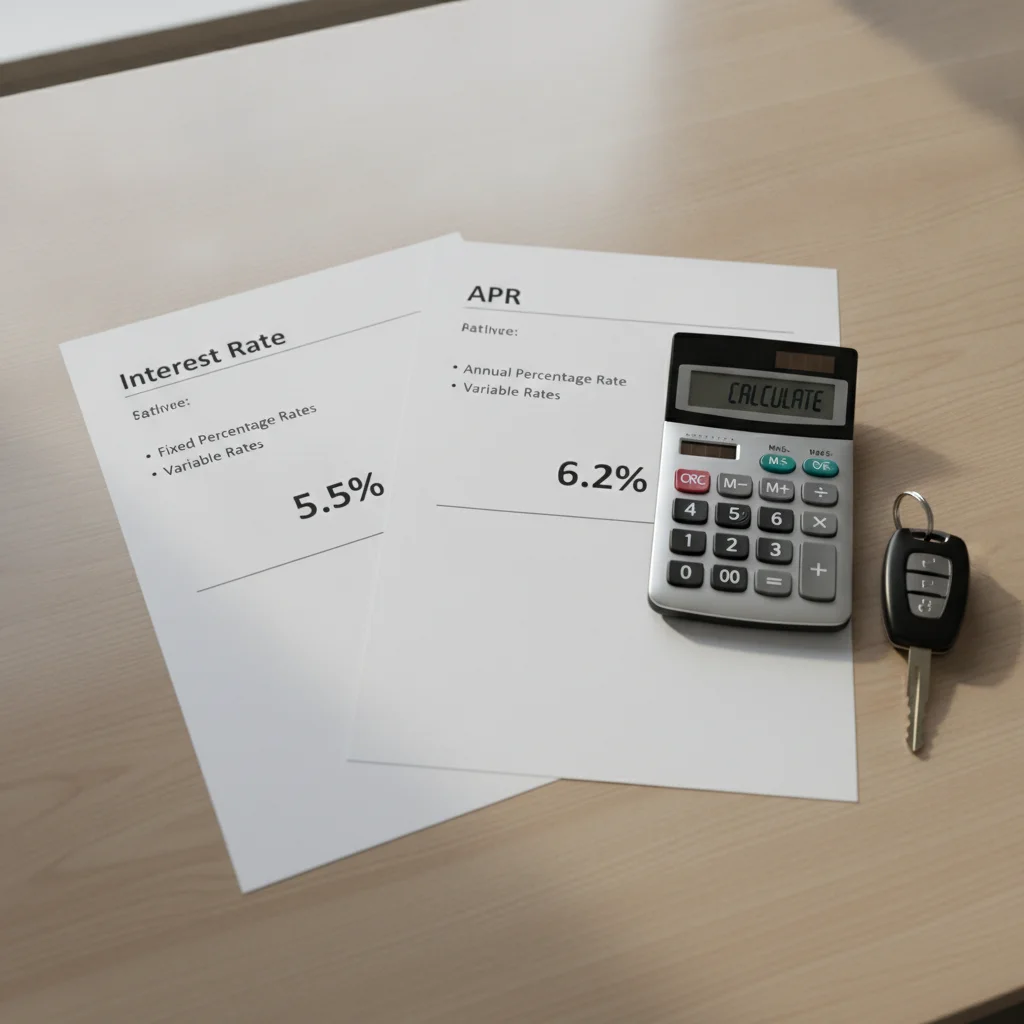
When a dealer quotes you an interest rate, they're giving you one piece of a bigger puzzle. The interest rate tells you the cost of the principal — the base amount you're borrowing. APR tells you the cost of the entire loan, because it wraps in fees and other charges alongside that base rate.
Here's why this distinction matters in practice: imagine two lenders both offer you a $30,000 auto loan at 6.9% interest. Lender A charges a $500 loan origination fee. Lender B charges no fee. Both loans have the same interest rate, but Lender A's APR will be higher because that fee gets folded in. If you only compared the interest rate, you'd miss the real cost difference.
The federal government recognized this problem and passed the Truth in Lending Act (TILA), which requires lenders to disclose APR before you sign. It's the one number designed to let you compare apples to apples across different lenders, loan structures, and fee arrangements. Use it that way.
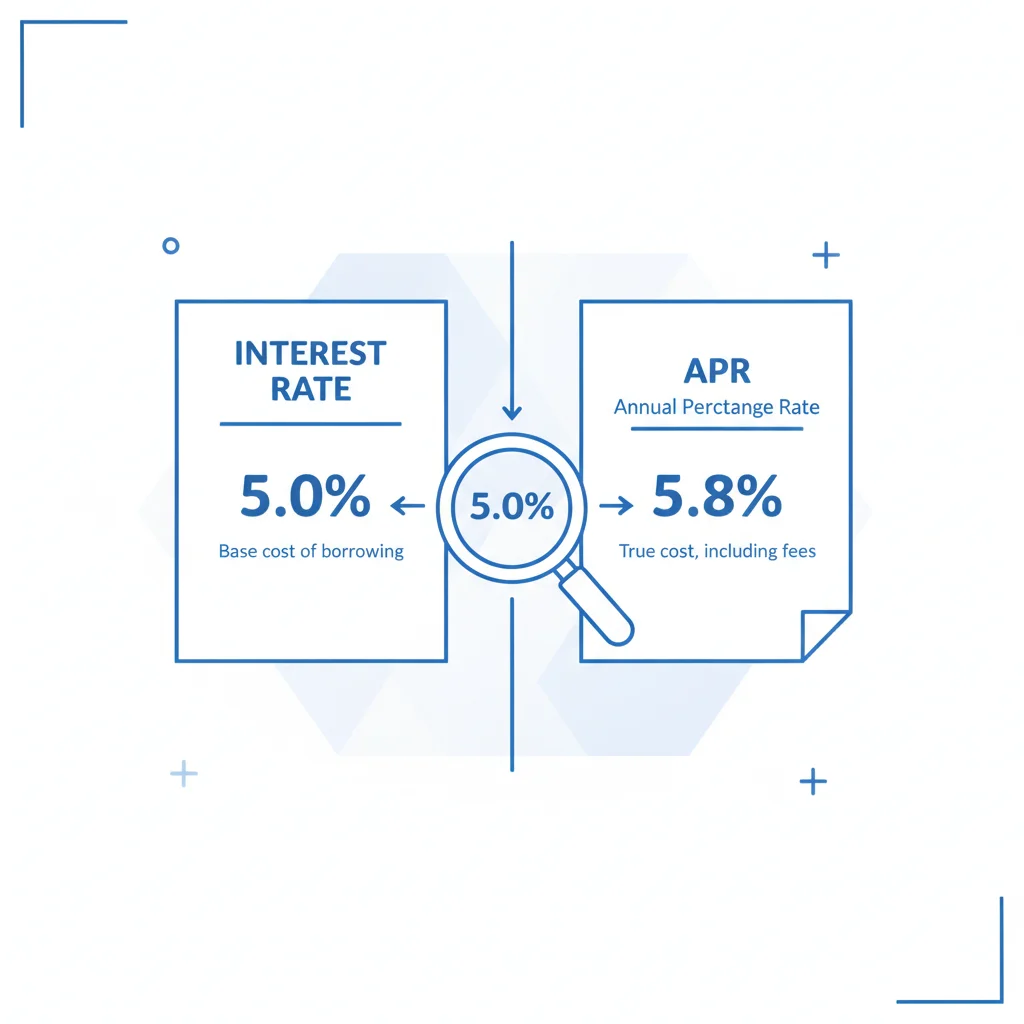
For a deeper look at how these two figures relate to each other, see our comparison of APR vs. interest rate on a car loan.
How APR Is Calculated
APR isn't just the interest rate rounded up. It's a specific mathematical calculation that converts the total cost of the loan — interest plus required fees — into an annualized percentage of the loan amount. The formula accounts for the timing and size of each payment across the full loan term.
In simplified terms:
- The lender starts with your loan principal (say, $28,000).
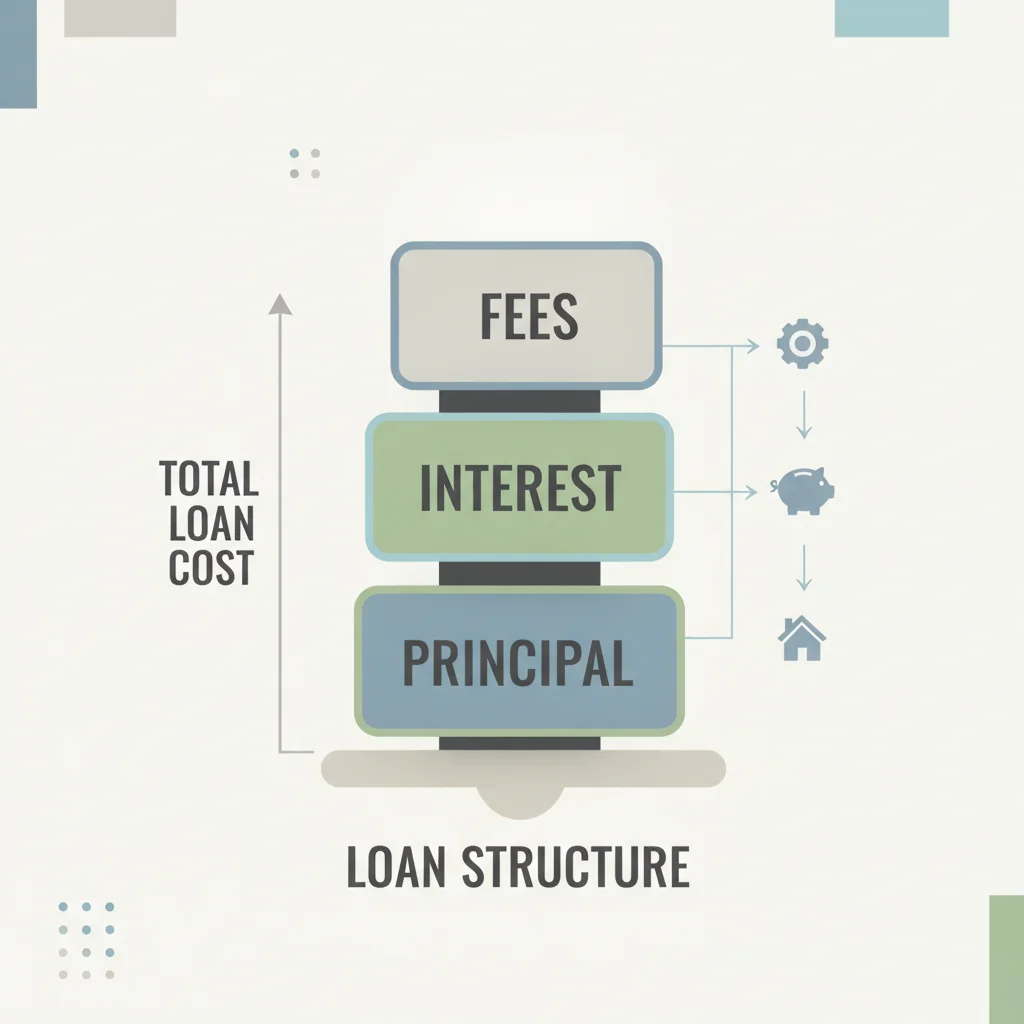
- They add up all the finance charges required to get the loan — interest over the full term plus any mandatory fees.
- They express that total cost as an annual rate relative to the amount borrowed.
Because APR is annualized, a short-term loan and a long-term loan at the same stated interest rate will produce the same APR — assuming identical fees. Where term length changes things is in the total dollars you pay, not the APR itself. A 72-month loan at 7% APR means more total interest than a 48-month loan at 7% APR, simply because the clock runs longer.
6.73%
Average APR on a new car loan (Q1 2024)
According to Experian's State of the Automotive Finance Market report, Q1 2024.
11.91%
Average APR on a used car loan (Q1 2024)
Experian's Q1 2024 data shows used car APRs running nearly double those for new vehicles.
$10,000+
Extra interest paid over loan life by poor vs. excellent credit borrowers
Based on illustrative modeling of a $32,000, 60-month loan across credit tiers using typical lender APR ranges.
2%–2.5%
Typical dealer rate markup above buy rate
Industry estimates suggest dealers commonly add 1–2.5 percentage points above the lender's approved buy rate.
Understanding how amortization interacts with your loan term is equally important. Our auto loan terms decoder walks through every figure on a standard contract.
“APR is the most important number in consumer lending. It's the one metric designed to cut through the noise and let you compare what you're actually paying — not just the rate a salesperson quoted you.”
— Richard Cordray, Former Director, Consumer Financial Protection Bureau
What Goes Into APR — and What Doesn't
This is where a lot of buyers get burned. APR sounds like a complete picture, but it's only as complete as what federal law requires lenders to include. Here's the rough breakdown:
Fees typically included in APR
- Loan origination fees charged by the lender
- Prepaid finance charges
- Mandatory credit insurance (if required by the lender as a condition of the loan)
Fees typically NOT included in APR
- Dealer documentation (doc) fees
- Title and registration fees
- Optional add-ons like extended warranties, GAP insurance, or paint protection
- Sales tax
APR Is Standardized — But Not Comprehensive
Federal law standardizes how APR is calculated and disclosed, but it doesn't require every cost to be included. Fees like dealer doc fees, sales tax, title fees, and optional add-ons typically fall outside the APR calculation. This means even a fully TILA-compliant APR disclosure can understate the loan's true cost if you're also financing add-ons or paying high dealership fees.
Rate Shopping Won't Tank Your Credit Score
Many buyers avoid getting multiple loan quotes because they worry about credit inquiries lowering their score. In practice, credit bureaus recognize rate shopping behavior: multiple auto loan inquiries within a 14–45 day window are typically counted as a single inquiry under FICO and VantageScore models. Shop freely within that window without fear of meaningful score damage.
The practical implication: two loans with identical APRs can have meaningfully different total costs once you factor in doc fees and add-ons. A dealer quoting 6.9% APR might also be loading $1,800 in optional products into your loan. Those products don't raise the APR — but they raise your balance and your monthly payment.
For the full breakdown of which fees land inside and outside your APR, read The Fees Hidden Inside Your APR — and the Ones That Aren't.
How Your Credit Score Drives Your APR
Lenders use your credit score as a proxy for risk. A higher score signals that you're likely to repay on time, so lenders compete for your business with lower rates. A lower score means they're taking on more risk and price accordingly.
The difference between credit tiers isn't small. Consider this real-world range on a $32,000, 60-month loan:
| Credit Score Range | Typical APR (New Car) | Monthly Payment | Total Interest Paid |
|---|---|---|---|
| 750–850 (Excellent) | 5.5% | $613 | $4,780 |
| 700–749 (Good) | 7.5% | $640 | $6,400 |
| 650–699 (Fair) | 11.0% | $695 | $9,700 |
| 580–649 (Poor) | 16.5% | $781 | $14,860 |
That's a $10,080 difference in total interest between excellent and poor credit on the same vehicle. If your score is borderline, it's often worth waiting a few months to improve it before applying.
Check Your Credit Before You Apply
Pull your free credit report at AnnualCreditReport.com before applying for any auto loan. Errors on credit reports are more common than most people think, and a single incorrect collection account can push your APR into a higher tier. Disputing errors before you apply can save real money.
Calculate Total Interest, Not Just Monthly Payment
Before accepting any loan offer, multiply your monthly payment by the number of payments and subtract the loan amount. The result is the total interest you'll pay. This number is far more revealing than any monthly payment figure alone. Most lender websites and Google's loan calculator will do this math for you in seconds.
For a full look at how lenders evaluate your creditworthiness and what you can do about it, see our hub on how credit scores impact auto loan rates.
The Dealer Rate Markup: A Hidden APR Inflator
Here's something most buyers don't know: when you finance through a dealership, the dealer isn't the actual lender. They submit your application to banks and captive finance companies, who respond with a buy rate — the minimum rate the lender will accept. The dealer is then allowed to mark up that rate and pocket the difference as profit. This is called the dealer reserve.
Example: A lender approves you at 6.5% APR. The dealer tells you the rate is 8.5% APR. On a $30,000, 60-month loan, that 2% markup costs you roughly $1,550 in extra interest over the loan term — and the dealer earns a portion of it as a flat fee or percentage from the lender.
The only way to defend against this is to walk in with a competing offer. Get pre-approved from your bank, credit union, or an online lender before you visit the lot. That number becomes your floor. If the dealer can beat it with a legitimately lower APR (sometimes manufacturers offer subsidized rates through captive lenders), great. If not, use your pre-approval.

The Loan Terms Explained hub covers the full structure of how auto loans are built, from principal to payoff.
APR vs. Monthly Payment: Don't Optimize for the Wrong Number
Dealers are trained to move the conversation toward monthly payment as quickly as possible. It's easier to hide the true cost of a loan inside a lower monthly figure by stretching the term. A buyer who says "I need to stay under $450 a month" has just handed the finance office a target — not a constraint.
Here's the math that gets buyers: a $35,000 loan at 7% APR over 48 months runs $837/month with $5,176 total interest. Stretch it to 72 months and the payment drops to $597/month — but total interest climbs to $7,984. You pay $2,808 more in interest just to get a lower monthly number. And over 72 months, you're underwater on the car's value for longer, which creates real problems if you need to sell or trade before payoff.
APR is a fixed rate. The total cost is a function of APR multiplied by time. Always run both numbers — monthly payment and total interest paid — before signing.
Check Your Credit Before You Apply
Pull your free credit report at AnnualCreditReport.com before applying for any auto loan. Errors on credit reports are more common than most people think, and a single incorrect collection account can push your APR into a higher tier. Disputing errors before you apply can save real money.
Calculate Total Interest, Not Just Monthly Payment
Before accepting any loan offer, multiply your monthly payment by the number of payments and subtract the loan amount. The result is the total interest you'll pay. This number is far more revealing than any monthly payment figure alone. Most lender websites and Google's loan calculator will do this math for you in seconds.
How to Use APR to Actually Compare Lenders
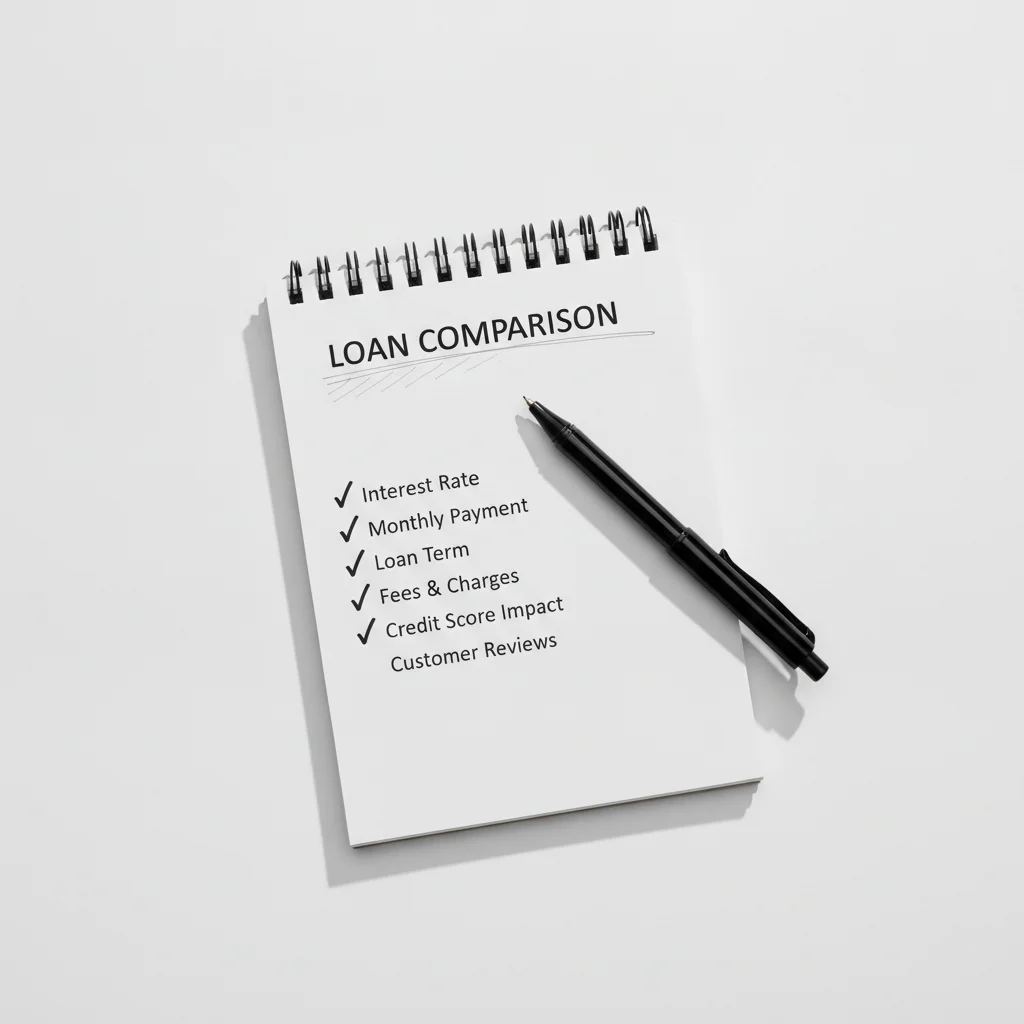
Now that you understand what APR includes and what it doesn't, here's how to put it to work when shopping:
- Get at least three quotes. Your own bank, a local credit union, and one online lender (like LightStream, PenFed, or a major bank's direct auto lending arm). These give you a real market range without relying on the dealer's word.
- Compare APRs on identical loan structures. A 48-month loan and a 60-month loan are not directly comparable by APR alone. Standardize the term when you compare, or calculate total interest paid for each option.
- Ask what fees are excluded from APR. Specifically ask about doc fees and any required products. These raise your effective cost without showing up in APR.
- Check whether the quoted APR is fixed or variable. Most auto loans are fixed, but verify. A variable-rate loan could look cheap today and cost more over time.
- Read your TILA disclosure. By law, lenders must provide a Truth in Lending disclosure before closing. It lists APR, total finance charge, amount financed, and total of payments. These four numbers together tell the full story.
APR Is Standardized — But Not Comprehensive
Federal law standardizes how APR is calculated and disclosed, but it doesn't require every cost to be included. Fees like dealer doc fees, sales tax, title fees, and optional add-ons typically fall outside the APR calculation. This means even a fully TILA-compliant APR disclosure can understate the loan's true cost if you're also financing add-ons or paying high dealership fees.
Rate Shopping Won't Tank Your Credit Score
Many buyers avoid getting multiple loan quotes because they worry about credit inquiries lowering their score. In practice, credit bureaus recognize rate shopping behavior: multiple auto loan inquiries within a 14–45 day window are typically counted as a single inquiry under FICO and VantageScore models. Shop freely within that window without fear of meaningful score damage.
See the full auto loan contract decoder to understand every line item on your loan agreement before you sign.
All claims are backed by peer-reviewed research. Sources on request.