
Key Takeaways
APR vs. Interest Rate
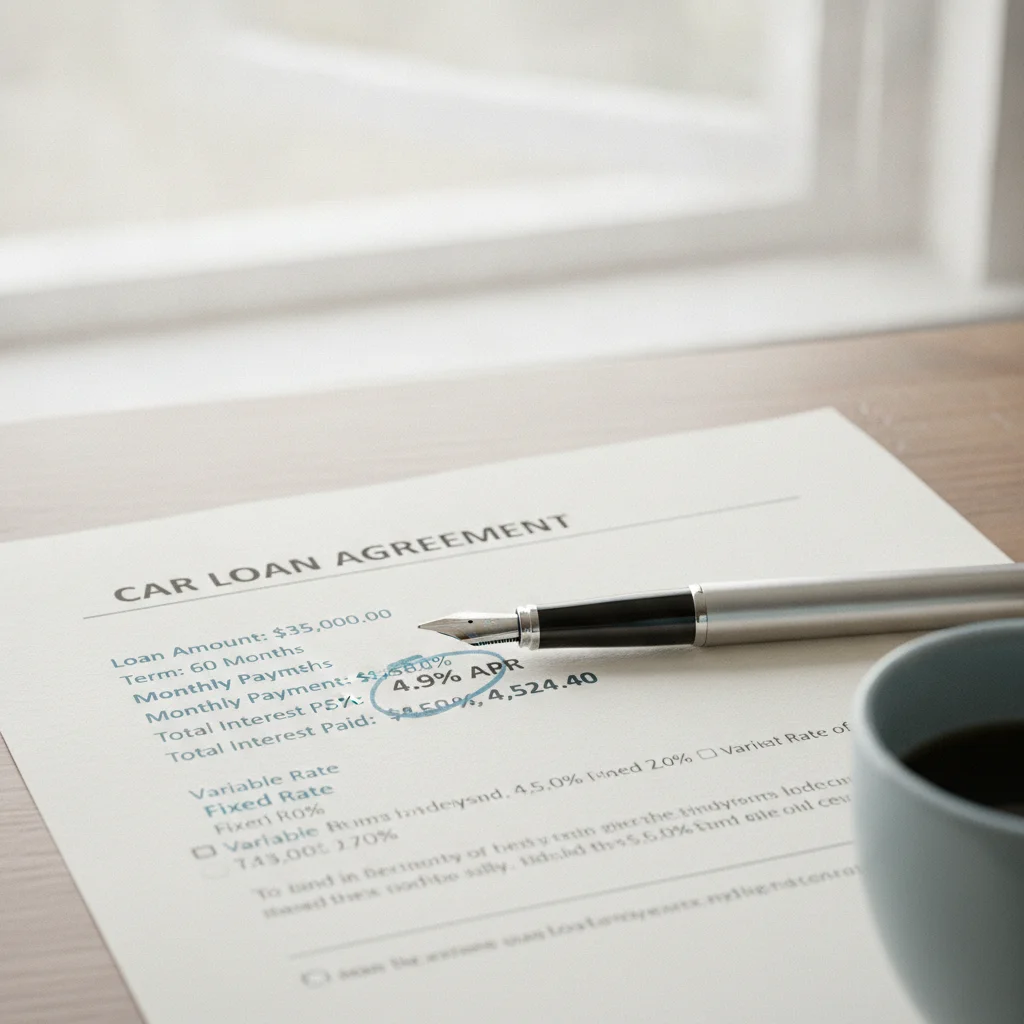
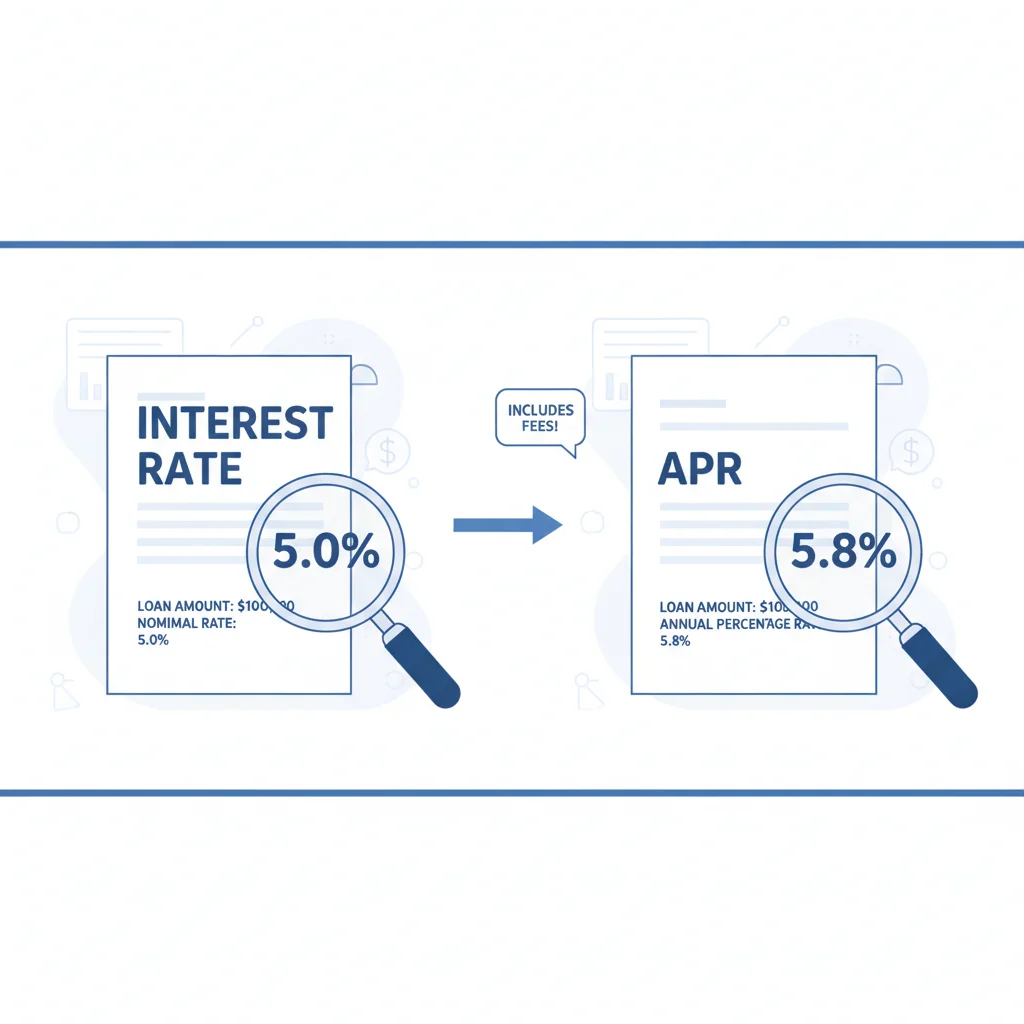
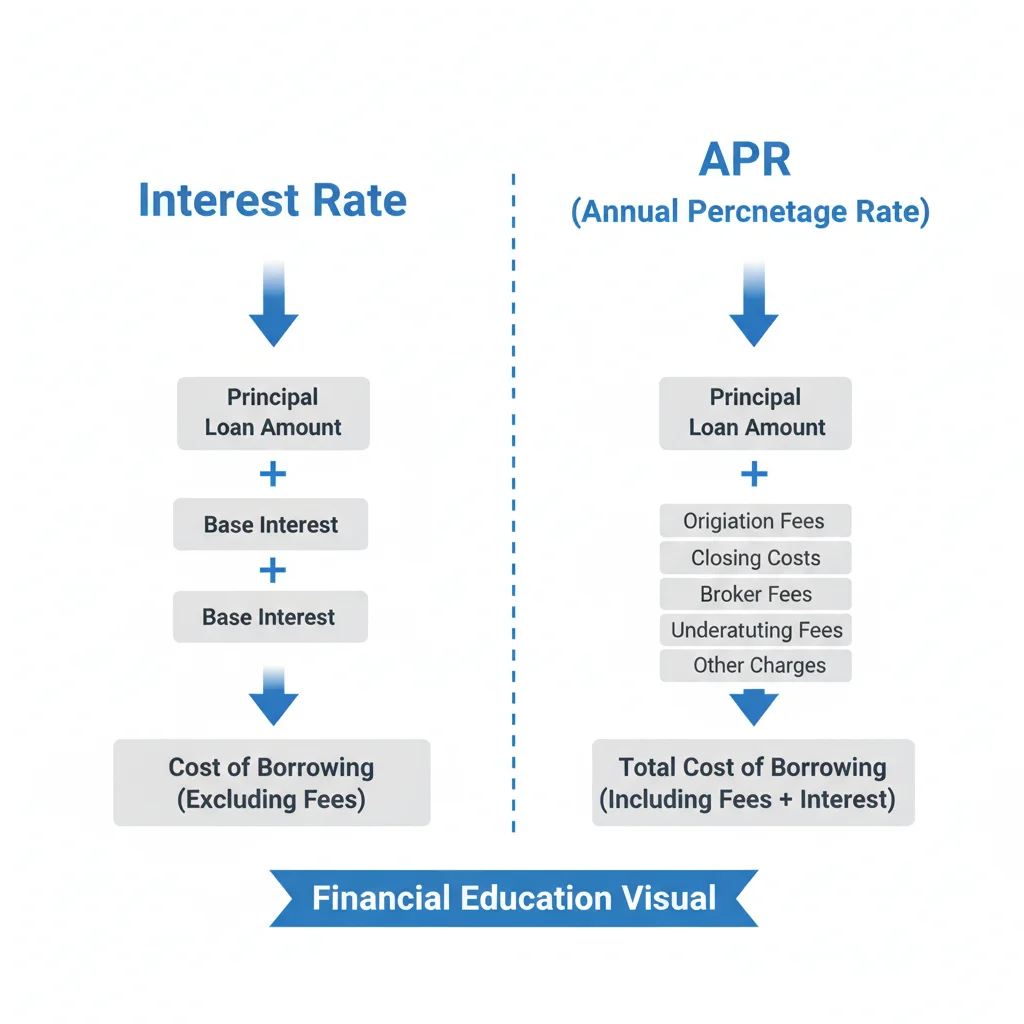
Your interest rate is simply the cost of borrowing the principal — expressed as a yearly percentage. APR (Annual Percentage Rate) goes further: it wraps the interest rate together with certain mandatory fees into a single number, giving you a more complete picture of what the loan actually costs per year. The gap between these two numbers is where hidden costs live.
Under the federal Truth in Lending Act (TILA), lenders are required to disclose APR, but the law specifies which fees must be included — and some significant costs fall outside that definition entirely.
Why the APR Number Is Incomplete by Design
Most buyers treat APR as a complete summary of their loan cost. It isn't — and the law doesn't require it to be. APR is a standardized measure defined by the federal Truth in Lending Act, and that definition deliberately includes some fees while excluding others.
The practical result: two loans can show the same APR but cost very different amounts over their lifetimes, depending on what got left out of the calculation. Understanding the boundary between "included" and "excluded" is the first step to evaluating any auto loan honestly.
For a broader overview of what APR actually captures, see what APR actually means on an auto loan. This article goes deeper into the specific fees on either side of that line — and the hidden markup that sits outside it entirely.
Fees That Must Be Included in APR
Under TILA, lenders are required to include certain charges in the APR calculation. These are costs that are required to obtain the loan and paid to the lender or their designated agents. The core categories include:
- Origination fees: A flat charge or percentage of the loan amount the lender collects for processing and underwriting the loan.
- Administrative or processing fees: Any mandatory fee charged by the lender as a condition of approval — regardless of what it's labeled.
- Prepaid interest: Interest that accrues between your loan closing date and the start of your first payment period. This is especially relevant on retail installment contracts signed mid-month.
- Points: Less common in auto lending than mortgage lending, but if a lender charges upfront points to reduce your rate, those must be included.
The math works like this: a $30,000 loan at 6% interest with a $400 origination fee doesn't have a true cost of 6%. The fee effectively raises your annual cost — and that's what APR is supposed to capture. On a 60-month loan, a $400 fee translates roughly to an extra 0.10–0.15 percentage points in APR depending on the loan amount and term.
“The APR disclosure tells you what the lender is charging. It doesn't tell you everything the dealer is charging. Those are two different conversations, and conflating them is exactly what costs buyers money.”
— Jordan Delray, Former dealership finance professional and auto loan writer
To understand how lenders calculate this in practice, the gap between interest rate and APR is covered in detail in a companion piece.
1–3%
Typical dealer markup above lender's buy rate
Consumer Financial Protection Bureau research indicates dealers commonly mark up interest rates by 1 to 3 percentage points above the lender-approved buy rate.
$1,850
Extra interest from a 2% rate markup on $35K loan
On a $35,000, 60-month loan, a 2 percentage point dealer markup (e.g., 5.9% to 7.9%) adds approximately $1,850 in total interest charges.
$700+
Maximum documentation fee in some U.S. states
Documentation fees are state-regulated and range from under $100 to over $700 depending on the state, with no federal cap.
72 months
Most common new car loan term as of recent years
Experian's State of the Automotive Finance Market reports that six-year loan terms have become the most common for new vehicle purchases, extending interest accumulation significantly.
$4,000+
Potential non-APR fees in a typical transaction
Between documentation fees, optional products, and dealer-installed accessories, buyers can face over $4,000 in costs that never factor into the disclosed APR.
Fees That Are NOT Included in APR
This is where buyers get burned. Several significant charges fall outside the APR calculation — either because they're technically optional, because they're government-imposed, or because the law simply doesn't require their inclusion.
Optional Financial Products
GAP insurance, credit life insurance, disability insurance, and extended warranties are all sold in the finance office as add-ons. Because they're framed as "voluntary," they don't have to be included in APR — even if a dealer strongly pressures you to take them. A $1,200 GAP product rolled into a 72-month loan doesn't move your APR by much, but it absolutely increases your total financing cost.
Documentation Fees
The "doc fee" is charged by the dealership — not the lender — for preparing the sales contract and paperwork. Amounts vary wildly by state: in some states, dealers charge $100; in others, it's legally capped at $700 or more. Because this fee is paid to the dealer rather than the lender, it typically does not factor into the APR on your loan contract. It does, however, get rolled into the amount you're financing, which means you're paying interest on it for the life of the loan.
Title, Registration, and Government Taxes
State taxes, DMV fees, and registration charges are excluded from APR by law. These are government-imposed costs that apply equally regardless of how you finance the car — so the logic is that they don't reflect the cost of the credit itself. Fair enough, but they still raise your total out-of-pocket cost substantially.
Dealer-Installed Accessories and Protection Packages
Paint sealant, fabric protection, nitrogen-filled tires, theft etching — these products are added to the vehicle price or financed separately. They won't show up in the APR disclosure, but if they're rolled into the loan amount, you're financing them at your full loan interest rate for years.
Ask This Before You Sit Down to Sign
Request a "payment quote sheet" or deal summary before entering the finance office. This document lists every charge, add-on, and fee proposed for your deal. If the finance manager is reluctant to produce one, that reluctance is itself useful information. A legitimate deal can always be itemized.
Bring Your Pre-Approval in Writing
Print or screenshot your external pre-approval with the rate, term, and loan amount clearly visible. Hand it to the finance manager before they present their options. This signals you've done the work and eliminates the information asymmetry that dealer markup depends on.
The core test: if a fee is charged by the dealer rather than the lender, and it's described as optional, it almost certainly doesn't move the APR needle. That's why the APR figure alone doesn't tell the full story.
The Dealer Rate Markup: The Hidden Cost Inside Your Rate
Here's the one that trips up even savvy buyers. When a dealer arranges financing through a third-party lender — a bank, credit union, or captive finance company — the lender sends the dealer a buy rate: the minimum rate the lender will accept for your credit profile. The dealer is then typically allowed to mark that rate up by 1% to 3% and keep the difference as compensation.
This markup never appears as a fee on your contract. It simply becomes part of your interest rate — and therefore part of your APR. There's no line item that says "dealer markup: $1,800." You'll see a 7.9% APR and have no idea the lender's actual approved rate was 5.9%.
On a $35,000 loan financed at 7.9% instead of 5.9% over 60 months, that 2% markup costs you approximately $1,850 in additional interest. It's completely legal and, under current federal rules, only requires disclosure in specific circumstances.
Dealer Markup Disclosure Rules
In the United States, dealers are generally not required to disclose the buy rate or the spread they earn on your loan. The marked-up rate simply becomes your contract rate. This is legal and common. The only reliable defense is knowing your approved rate from an outside lender before you negotiate financing at the dealership.
APR Is a Comparison Tool — Use It That Way
APR is most powerful when you're comparing two offers for the same loan amount and term from different lenders. In that context, a lower APR reliably means a lower cost loan. Where it breaks down is when fees outside the APR calculation vary significantly between deals — which is exactly what happens when dealer-sold products enter the picture.
The practical defense: get pre-approved directly from a bank, credit union, or online lender before walking into the dealership. That pre-approval gives you a benchmark rate tied to your actual credit profile — so you can tell immediately whether the dealer's financing offer beats it or costs more. Your credit score plays a central role in what buy rate lenders will offer, so knowing where you stand matters.
Reading Your Contract: Where These Numbers Actually Live
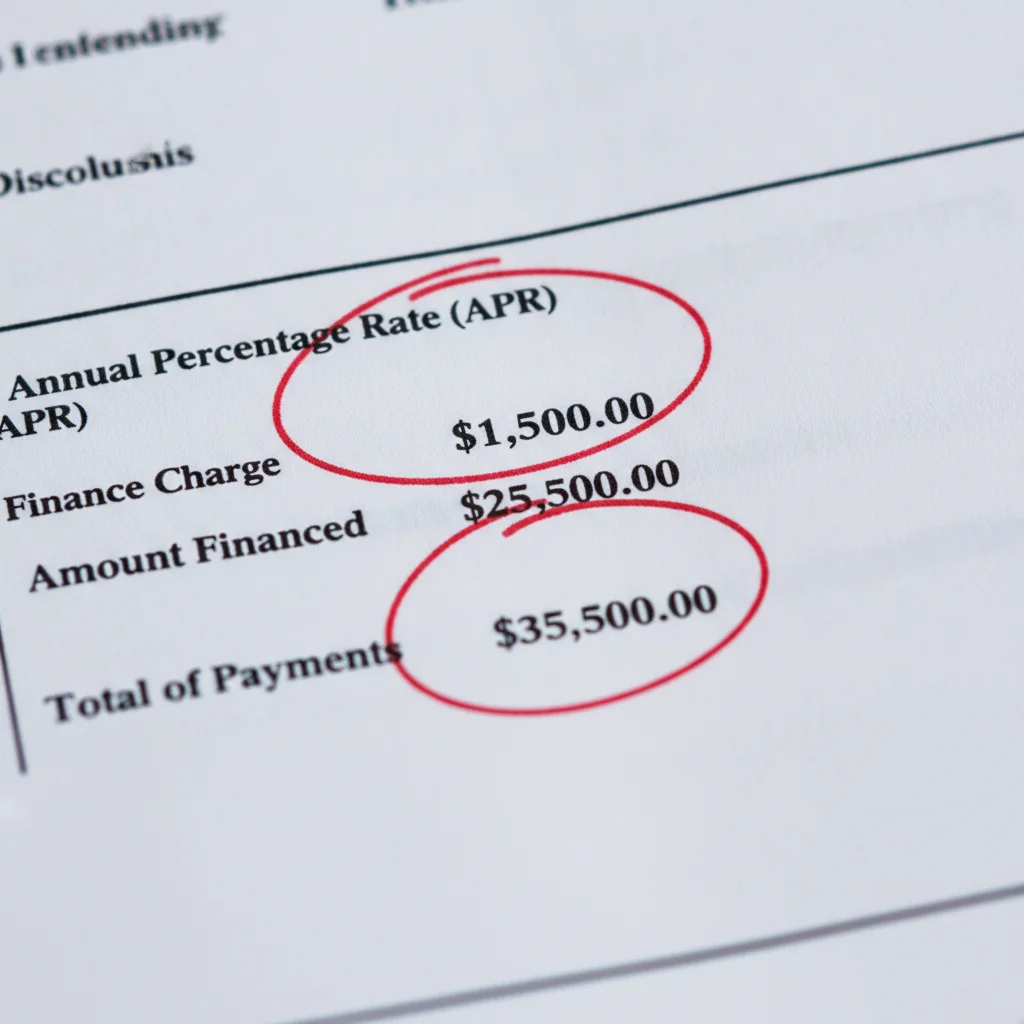
Federal law requires every auto loan to include a Truth in Lending disclosure — commonly called the TILA box or the federal box. It shows four key figures:
- Annual Percentage Rate (APR)
- Finance Charge: The total dollar cost of the credit over the full loan term
- Amount Financed: The net loan amount after prepaid finance charges are subtracted
- Total of Payments: What you'll pay in total if you make every payment as scheduled
The Finance Charge is often more illuminating than the APR alone. If your vehicle purchase price is $32,000 and your Amount Financed shows $33,800, that $1,800 gap represents fees that were rolled into the loan — even before interest starts compounding.
Compare the Amount Financed against what you know the vehicle and required charges should cost. A meaningful gap signals rolled-in products or fees worth investigating line by line.
For a step-by-step walkthrough of interpreting these fields on an actual contract, reading the APR box on your auto loan agreement covers the disclosure in detail.
How to Catch Hidden Costs Before You Sign
You don't need a finance degree. You need a short checklist and the willingness to slow down the process.
Step 1: Get Pre-Approved Externally First
Contact your bank or credit union and get a written pre-approval at a stated rate before visiting any dealership. This is your baseline. Any dealer financing offer needs to beat this number — not just on rate, but on total finance charges.
Step 2: Request a Full Fee Itemization
Before the finance office prints the contract, ask for a written list of every charge included in the deal. Specifically ask: "What is the amount financed, and what fees make up the difference between the vehicle price and that figure?" A reluctant answer to that question tells you something.
Step 3: Compare the Amount Financed to Your Expected Total
Add up the vehicle price, your state's taxes and registration, and any legitimate dealer fees. Then compare that total to the Amount Financed on your TILA disclosure. A gap means something got rolled in that wasn't discussed — or wasn't discussed clearly.
Step 4: Negotiate Products Separately
If you want GAP insurance or an extended warranty, price them separately — not as a monthly payment add-on in the finance office. GAP insurance from your auto insurer often costs a fraction of what the dealer charges, and extended warranties can sometimes be purchased directly from the manufacturer later.
Step 5: Focus on Total Cost, Not Monthly Payment
A dealer who keeps steering you to "what payment works for you?" is probably working the term length to make fees disappear into a palatable monthly number. The true cost of focusing on monthly payment instead of APR shows exactly how much that framing can cost over the life of a loan.
Ask This Before You Sit Down to Sign
Request a "payment quote sheet" or deal summary before entering the finance office. This document lists every charge, add-on, and fee proposed for your deal. If the finance manager is reluctant to produce one, that reluctance is itself useful information. A legitimate deal can always be itemized.
Bring Your Pre-Approval in Writing
Print or screenshot your external pre-approval with the rate, term, and loan amount clearly visible. Hand it to the finance manager before they present their options. This signals you've done the work and eliminates the information asymmetry that dealer markup depends on.
Finally, remember that loan terms — the length of your repayment schedule — interact directly with all of these costs. A longer term lowers your payment but extends the window over which every rolled-in fee and every basis point of markup compounds against you.
The Bottom Line: APR Is a Starting Point, Not the Whole Answer
APR is the most useful single number for comparing two loan offers from competing lenders. It's standardized, legally required, and better than looking at the interest rate alone. But it is not a complete measure of what a car purchase costs to finance.
The fees excluded by law — doc fees, GAP products, warranties, paint protection, government taxes — can easily add $1,500 to $4,000 to a typical transaction. The dealer markup can add another $1,000 to $2,500 in interest over the loan's life. None of that moves the APR in a way that makes the cost visible.
Your job as a buyer is to treat APR as the floor of your analysis, not the ceiling. Ask for itemization. Get pre-approved. Compare the Amount Financed to your expected total. And never let a monthly payment figure substitute for understanding what you're actually paying over time.
Dealer Markup Disclosure Rules
In the United States, dealers are generally not required to disclose the buy rate or the spread they earn on your loan. The marked-up rate simply becomes your contract rate. This is legal and common. The only reliable defense is knowing your approved rate from an outside lender before you negotiate financing at the dealership.
APR Is a Comparison Tool — Use It That Way
APR is most powerful when you're comparing two offers for the same loan amount and term from different lenders. In that context, a lower APR reliably means a lower cost loan. Where it breaks down is when fees outside the APR calculation vary significantly between deals — which is exactly what happens when dealer-sold products enter the picture.
If you're building a complete picture of what auto loan financing really involves, start with what APR actually means on an auto loan and work through each element systematically before you sit down in a finance office.
All claims are backed by peer-reviewed research. Sources on request.