Key Takeaways
Prepayment Penalty
A prepayment penalty is a fee some lenders charge when you pay off your auto loan before the scheduled end date. It exists because lenders earn money from the interest you pay over the life of a loan — paying early cuts into that expected income. Not every loan has one, but when they do appear, they can significantly reduce or eliminate the savings you'd otherwise gain from paying early.
Prepayment penalties may be calculated as a flat fee, a percentage of the remaining principal, or as a portion of the interest the lender would have collected — sometimes called a "precomputed interest" rebate shortfall.
Why Prepayment Penalties Exist in the First Place
When a lender offers you a car loan, they're not doing it as a favor — they're making an investment. Your loan agreement locks in a stream of monthly interest payments, and the lender has built their profit around receiving that full stream. If you pay off the loan in year two of a six-year term, the lender misses out on four years of interest income.
Prepayment penalties were designed to offset that lost income. They're essentially a lender's way of saying: "We priced this loan assuming you'd pay over the full term. If you exit early, you owe us a portion of what we expected to earn."
This logic made more sense decades ago when auto lending was less competitive. Today, many lenders — particularly credit unions and online lenders — have dropped prepayment penalties to attract borrowers. But they still appear frequently in dealership-arranged financing, subprime loans, and certain buy-here-pay-here arrangements.

Understanding why these penalties exist helps you recognize which loan products are most likely to include them. The higher the lender's expected profit margin from interest — and the riskier the borrower profile — the more likely a prepayment penalty appears in the contract. Loan terms like APR and loan length directly affect how much interest is built into your contract, which in turn affects how much a lender stands to lose if you pay early.
The Three Most Common Ways Prepayment Penalties Are Calculated
Not all prepayment penalties are structured the same way. Knowing the type in your contract helps you calculate the actual cost of paying early.
36%
Auto loans that may carry prepayment penalties
Industry estimates suggest a significant share of dealership-arranged and subprime auto loans still include prepayment penalty clauses, though the exact figure varies by lender type and borrower credit profile.
$200–$500
Typical prepayment penalty range on auto loans
Depending on the penalty structure (flat fee or percentage of balance), most auto loan prepayment fees fall within this range for mid-sized loan balances of $10,000–$25,000.
24 months
Common penalty window in loan contracts
Many prepayment penalty clauses apply only during the first 24 months of the loan term, after which borrowers can pay off early without additional fees.
Rule of 78s
Restricted in 18+ U.S. states
The Rule of 78s — a front-loaded interest method that penalizes early payoff — is prohibited or restricted in more than 18 states due to consumer protection concerns.
1. Flat Fee
The simplest form. Your contract specifies a fixed dollar amount — say, $200 or $350 — that you owe if you pay off before a certain date. This type is straightforward to calculate but can feel disproportionate on smaller loan balances.
2. Percentage of Remaining Balance
More common in larger loans, this penalty is calculated as a percentage — typically 1% to 2% — of the outstanding principal at the time of payoff. On a $15,000 remaining balance, a 2% penalty costs you $300. On a $25,000 balance, that same rate adds up to $500.
3. Precomputed Interest (Rule of 78s)
This is the most complex and often the most costly method. With precomputed interest loans, the total interest you owe over the life of the loan is calculated upfront and front-loaded into your early payments. If you pay off early, you don't automatically get credit for the interest you haven't "used" yet — or you get less credit than you'd expect.
The Rule of 78s is a specific precomputed method where interest is distributed across payments using a declining-sum formula. It's designed so that paying early returns less interest to the borrower than a simple interest calculation would. This method is restricted or banned in some states because of how it disadvantages borrowers.
Rule of 78s: Still Legal in Some States
Despite being widely criticized as unfair to borrowers, the Rule of 78s remains legal in a number of U.S. states for loans with terms of 61 months or less. The Federal Reserve has noted that this method can effectively double the cost of paying off early compared to simple interest loans. If your contract mentions "precomputed interest" or references the Rule of 78s, verify whether your state has any consumer protections that limit its use.
If your contract says "precomputed interest" or mentions the Rule of 78s, treat it as a significant red flag before deciding to pay off early. Our glossary of early payoff terms explains these concepts in plain language so you can compare loan structures side by side.
How to Find the Prepayment Penalty Clause in Your Contract
The penalty clause doesn't always sit in an obvious place. Here's how to locate it systematically.
- Check the TILA disclosure box. Federal law — specifically the Truth in Lending Act — requires lenders to disclose whether a prepayment penalty applies in the standardized disclosure form near the front of your loan agreement. Look for a line that reads "Prepayment" and indicates whether you "may" or "will not" be charged a penalty.
- Search for the word "prepayment" in the body of the contract. Use Ctrl+F if you're reviewing a digital document. The clause may be tucked into sections titled "Prepayment," "Early Payoff," "Your Right to Prepay," or "Default and Remedies."
- Read the payoff quote process section. Some contracts describe how a payoff quote is calculated, and this section often reveals whether an early termination fee or penalty applies.
- Ask the lender directly — in writing. Before signing any loan, email or message the lender and ask: "Does this loan include a prepayment penalty? If so, how is it calculated and when does it apply?" Keep their written response.

If you've already signed and you're trying to figure out your current loan's terms, the same steps apply. Pull out your original contract, check the TILA box, and search for "prepayment." You can also call your lender and request a payoff quote — ask them to confirm whether any early termination fee will be added to that amount.
Ask Before You Sign — Not After
Once you've signed a loan contract, the prepayment penalty is legally binding. Asking the lender about it before signing is the only moment you have real negotiating power. Make it a standard question on your checklist alongside interest rate, loan term, and monthly payment.
Request a Full Payoff Quote in Writing
When you're ready to pay off your loan early, always request a formal payoff quote in writing from your lender. This quote must include any applicable prepayment fee and has a defined expiration date — usually 10 to 30 days. Don't rely on a verbal estimate from a customer service representative, as it may not account for all fees.
Understanding what early payoff actually means under your specific loan type is equally important — lenders define "early" differently, and that definition affects whether the penalty even triggers.
When Prepayment Penalties Typically Apply
Even if your loan contract includes a prepayment penalty clause, it may not always trigger. Many penalties are time-limited — meaning they apply only during the first 12, 24, or 36 months of the loan. After that window passes, you're free to pay off the balance without a fee.
This is why reading the clause carefully matters. A contract might say: "A prepayment fee of 2% of the remaining balance applies if the loan is paid in full within the first 24 months of the loan term." In that case, making extra payments in month 25 or later carries no penalty.
Some lenders also structure partial prepayment restrictions — meaning you can make extra payments, but if you pay off the entire balance before the cutoff date, the penalty kicks in. In that scenario, an aggressive extra-payment strategy might still be viable even if a lump-sum payoff would cost you.
Common situations where prepayment penalties are most likely to trigger:
- Selling the vehicle and paying off the loan from sale proceeds
- Trading in the vehicle at a dealership before the loan matures
- Refinancing into a new loan (your original lender receives a payoff, which counts as early termination)
- Receiving a large windfall and paying off the balance in one lump sum
Refinancing is a particularly important case to flag. If your current loan has a prepayment penalty and you're considering refinancing to a lower rate, the penalty could eat into — or entirely eliminate — the savings you'd gain. How prepayment penalties can kill refinancing savings walks through the exact math so you can determine whether switching lenders still makes financial sense.
“Prepayment penalties are one of the least-discussed loan terms during the car buying process — and one of the most consequential when a borrower's financial situation changes. Reading that clause before you sign is not optional.”
— Jack Gillis, Executive Director, Consumer Federation of America
How to Avoid Prepayment Penalties When Getting a New Loan
The most effective way to deal with a prepayment penalty is to avoid agreeing to one in the first place. Here are the strategies that work.
Compare Multiple Lenders Before Signing
Interest rates get the most attention during loan shopping, but loan terms matter just as much. When you receive loan offers, ask each lender directly about prepayment penalties. Credit unions typically don't charge them. Major banks vary. Dealership-arranged financing — especially for buyers with lower credit scores — is where prepayment penalties appear most frequently.
Getting preapproved for a loan before visiting the dealership gives you leverage: you arrive with an offer already in hand, which means you're less dependent on whatever financing the dealer's F&I office presents.
Negotiate the Clause Out
If you're presented with a contract that includes a prepayment penalty, you can ask the lender or dealer to remove it. This works more often than borrowers expect, particularly if you have strong credit or competing offers. Get any agreed-upon change in writing — verbal promises from finance offices are not enforceable.
Read Every Section Before Signing
Dealership finance offices move quickly, and the pressure to sign can feel intense. Slow down. Ask for time to read the full contract. Any lender unwilling to give you time to review a document you're legally bound by is showing you a warning sign worth heeding.
Ask Before You Sign — Not After
Once you've signed a loan contract, the prepayment penalty is legally binding. Asking the lender about it before signing is the only moment you have real negotiating power. Make it a standard question on your checklist alongside interest rate, loan term, and monthly payment.
Request a Full Payoff Quote in Writing
When you're ready to pay off your loan early, always request a formal payoff quote in writing from your lender. This quote must include any applicable prepayment fee and has a defined expiration date — usually 10 to 30 days. Don't rely on a verbal estimate from a customer service representative, as it may not account for all fees.
Once you've confirmed your loan has no prepayment penalty — or once any penalty window has passed — you're positioned to use extra payments strategically. What happens to your interest when you pay off a car loan early explains exactly how those savings accumulate over time.
Doing the Math: Is Early Payoff Still Worth It With a Penalty?
Finding a prepayment penalty in your contract doesn't mean early payoff is off the table — it means you need to run the numbers before deciding.
Here's the basic framework:
- Get a current payoff quote from your lender. Ask them to include any applicable prepayment fee in the total. This gives you the actual cost to close the loan today.
- Calculate the interest you'd pay over the remaining loan term. Your lender can provide an amortization schedule, or you can use an online loan calculator. This is the amount you'd pay in interest if you continue making scheduled payments to the end.
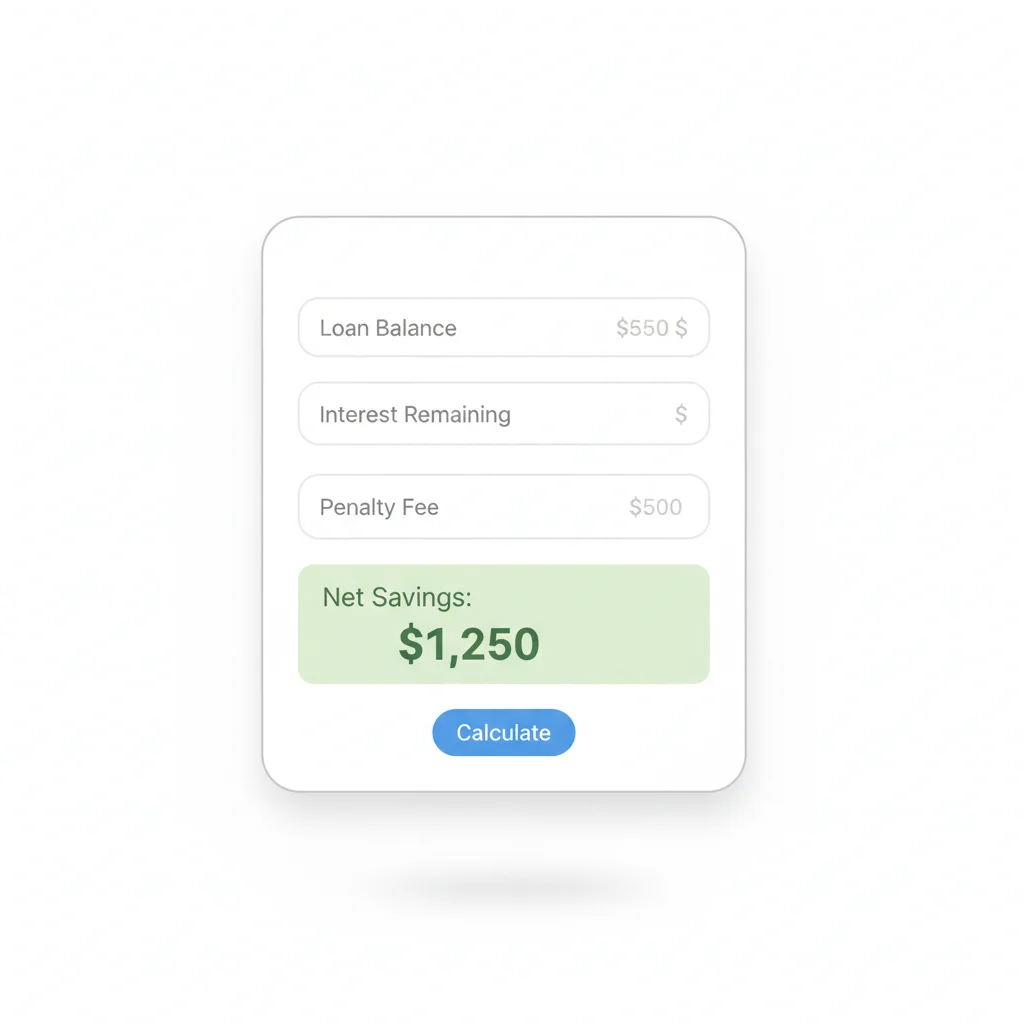
- Subtract the penalty from your interest savings. If the remaining interest you'd avoid exceeds the penalty, early payoff still puts money in your pocket. If they're roughly equal or the penalty is larger, your financial gain disappears.
Example: You have 30 months left on your loan. Your amortization schedule shows you'll pay $1,200 in remaining interest. Your prepayment penalty is $350. Paying off early still saves you $850 net — a worthwhile move. But if that penalty were $1,100, you'd only net $100 in savings, and the effort and cash flow impact might not be worth it.
Keep in mind that certain loan structures reduce early payoff benefits even without a formal penalty — front-loaded interest and precomputed loan types can produce similar outcomes.
If the numbers are close, there's one more factor to consider: what would you do with the money otherwise? If the cash earns meaningful returns in savings or investments, holding it rather than paying off a low-rate loan may be the smarter move even when there's no penalty at all.

All claims are backed by peer-reviewed research. Sources on request.